
Montana PSY Requirements: Hours, Exams & Step-by-Step Guide
Stop guessing if your categories match Montana requirements. License Trail checks your direct, indirect, and supervision hours against PSY requirements continuously and flags mismatches before you submit.
No credit card required · Free plan available
Quick Requirements Overview
- Governing authority: Montana Board of Psychologists; MCA 37-17 + ARM 24.189.6
- Baseline eligibility: 18+, good moral character, pay fees, meet education/supervision, pass exams
- Doctoral degree: APA-accredited clinical psych or accredited psych doctorate + APA retraining or non-APA program meeting ARM 24.189.640 minimum standards (incl. required core content & 40 semester/60 quarter psych coursework minimum)
- Predoctoral internship: ≥1,500 hours over 9–24 months; ≥25% face-to-face client contact; part of the doctoral program
- Supervised experience total: 2 calendar years / ≥3,200 hours; ≥1 year postdoc (≥1,600 hours) after all doctoral requirements
- Postdoc constraints: ≥1 hr/week supervision by psychologist licensed ≥3 years; ≥25% direct clinical service (≈≥400 hrs if 1,600); research/teaching ≤6 months (≤800 hrs); practicum-student supervision ≤400 hrs; no solo private practice/independent billing
- Exams: EPPP + Montana jurisprudence/jurisdictional training course (evaluated)
- Fees (not exhaustive): Psychologist application $175; MT postdoc supervision plan approval $25; postdoc supervisee license available and expires when supervision ends unless fully licensed
License Details
Procedures
Licensure as a psychologist (“PSY”) in Montana is governed by the Montana Board of Psychologists and by Title 37, Chapter 17 of the Montana Code Annotated, together with Administrative Rules of Montana (ARM) 24.189.6. What follows focuses on the standard route to initial licensure as a psychologist, not on licensure‑by‑experience for already‑licensed out‑of‑state psychologists.
1. Legal framework and license category
Montana issues a single psychologist license (no separate “clinical” license). The core qualifications are set out in 37‑17‑302, MCA, which requires:
- Payment of the prescribed fee and passing the prescribed examination.
- Being at least 18 years old and of good moral character.
- A qualifying doctoral degree in psychology (described below).
- Completion of a minimum of two years of supervised experience, with at least one year postdoctoral, and with the postdoctoral year including no more than six months of supervised research and/or teaching. (law.justia.com)
ARM 24.189.648 then specifies that this supervised experience must span two calendar years totaling at least 3,200 hours. (law.cornell.edu)
2. Doctoral education requirements
2.1. Degree type
Under 37‑17‑302(3), you must have one of the following: (law.justia.com)
- A doctoral degree in clinical psychology from an accredited institution with an APA‑approved graduate program; or
- A doctoral degree in psychology from an accredited institution not approved by APA, plus an APA‑approved formal graduate retraining program in clinical psychology; or
- A doctoral degree in psychology from an accredited institution and a course of study that meets “minimum standards” set in board rules (ARM 24.189.640). (law.cornell.edu)
2.2. Course‑of‑study minimum standards (when relying on option 3)
ARM 24.189.640 defines what a qualifying psychology program must look like if it is not APA‑approved. Key points include: (law.cornell.edu)
- It must be clearly identified as a psychology program (e.g., clinical, counseling, school, or I‑O), housed as a coherent organizational entity, with identifiable psychology faculty.
- The curriculum must include at least three academic years of full‑time graduate study, with appropriate supervised clinical experience of at least three terms/two semesters.
- The curriculum must provide instruction in ethics, research design and methodology, statistics, and psychometrics, and require demonstrated competence (≥3 graduate semester hours or ≥5 quarter hours) in:
- Biological bases of behavior
- Cognitive‑affective bases of behavior
- Social bases of behavior
- Individual differences
- At least 60 quarter hours / 40 semester hours of formal graduate psychology coursework, with at least 45 quarter / 30 semester hours taken while matriculated in the doctoral program (excluding practicum, dissertation, and transfer credits).
3. Required pre‑doctoral internship: minimum 1,500 hours
Montana explicitly defines the pre‑doctoral internship in ARM 24.189.644. For your internship to qualify toward licensure: (regulations.justia.com)
- It must be part of the doctoral program at the institution awarding your degree (“active engagement” in that program’s training).
- It must be at least 1,500 hours in length.
- It must be completed in no less than 9 months and no more than 24 months.
- You must spend at least 25% of internship hours in face‑to‑face contact with patients or clients.
- Internship on‑site time must be at least 30 and no more than 45 hours per week.
- Activities must be documented in a log signed by your academic advisor and must involve substantial faculty‑to‑student and student‑to‑student interaction.
This internship is the typical vehicle for earning the pre‑doctoral portion of your supervised experience (see Section 4).
4. Supervised experience: 2 years / 3,200 hours minimum
4.1. Statutory requirement: two supervised years, one postdoctoral
Montana statute requires that at the time of application you have completed a minimum of 2 years of supervised experience in the practice of psychology, with one of these years postdoctoral. That postdoctoral year may include no more than six months of supervised research, teaching, or both. (law.justia.com)
The Board recites this the same way on its official “Psychologist” license information page. (boards.bsd.dli.mt.gov)
4.2. Administrative rule: “two calendar years (3200 hours minimum)”
ARM 24.189.648 specifies the number and distribution of hours. Supervised experience must: (law.cornell.edu)
- Occur over two calendar years; and
- Total at least 3,200 hours.
The rule then divides those 3,200 hours as follows:
-
Predoctoral year (up to one year of the total)
- “One year may be predoctoral,” and must:
- Occur after the master’s degree; and
- Be obtained during an APA‑approved or substantially equivalent internship for the psychology doctoral degree. (law.cornell.edu)
- In practice, this means that up to approximately one year (about 1,600 hours) of qualifying internship experience can make up the pre‑doctoral portion of the required 3,200 supervised hours (you may of course accrue more, but 3,200 total is the minimum).
- “One year may be predoctoral,” and must:
-
Postdoctoral year (at least 1,600 hours)
- “One year (1600 hours minimum) must be postdoctoral,” occurring after completion of all doctoral degree requirements. (law.cornell.edu)
- Extending the postdoctoral supervised period beyond 12 consecutive months requires board approval.
So, at the minimum:
- Total supervised experience: 3,200 hours
- Postdoctoral supervised experience: at least 1,600 of those hours
- Predoctoral supervised experience (usually internship): the remaining hours necessary to reach at least 3,200 (commonly ≈1,600 hours, though the internship itself must be ≥1,500 hours).
5. Type and distribution of supervised hours
ARM 24.189.648 also specifies what kinds of activities must make up your supervised experience, especially postdoctorally.
5.1. Weekly supervision requirement
During the postdoctoral year, supervision must include: (law.cornell.edu)
- At least one hour per week of in‑person or approved telehealth supervision;
- Supervision by a psychologist who has:
- Been licensed for at least three years prior to supervising; and
- Prior supervisor training and/or experience at least equivalent to Montana’s requirements, in the skills/knowledge area in which you are working.
- At least one other licensed mental health professional in the setting, on‑site when the primary supervisor is not.
5.2. Direct clinical service requirement
The Board’s rule requires that, during your postdoctoral supervision: (law.cornell.edu)
- You must be providing direct clinical services at least 25% of the time.
In addition, the rule defines satisfactory postdoctoral experience to include at least: (regulations.justia.com)
- Administering and interpreting psychological tests and helping to solve professional or personal problems for no less than 25% of one year, stated explicitly as a minimum of 400 hours of such activities in the postdoctoral year (since the postdoctoral year is defined as at least 1,600 hours).
So in practical terms, within your minimum 1,600 postdoctoral hours, at least:
- 400 hours must involve substantive professional services (e.g., psychological assessment and intervention/problem‑solving with clients).
- Overall, at least 25% of postdoctoral time is direct clinical service (if you do exactly 1,600 hours, that again works out to ≥400 hours of direct clinical services).
5.3. Limits on research, teaching, and supervising practicum students
Montana allows some of your supervised postdoctoral experience to consist of research, teaching, or supervising others, but caps how much can be counted:
- Under the statute, no more than six months of the required supervised postdoctoral year may be supervised research, teaching, or a combination. (law.justia.com)
- ARM 24.189.648 makes this more concrete for one postdoctoral year (1,600 hours): (regulations.justia.com)
- Research/teaching:
- Designing original research projects, analyzing/reporting data, and/or teaching psychology courses may be counted for no more than 50% of one year, which the rule states as a maximum of 800 hours.
- Supervising graduate‑level practicum:
- Supervision of graduate practicum students may be counted for no more than 25% of one year, i.e., a maximum of 400 hours.
- Research/teaching:
Taken together, for the minimum 1,600 postdoctoral hours:
- At least 400 hours must be direct, test‑and‑treatment‑type professional services (as in 5.2).
- You may count:
- Up to 400 hours of supervising graduate practicum; and
- Up to 800 hours of research and/or teaching.
- But you cannot have more than six months (about 800 hours at full‑time) of research/teaching counted toward the required postdoctoral year.
5.4. Activities that do not count
The Board explicitly lists activities that are unacceptable as supervised experience if they are outside a board‑approved plan or exempted settings. These include: (regulations.justia.com)
- Routine, repetitious tasks such as:
- Merely administering and scoring structured tests
- Computing statistics
- Assisting course instructors in purely ancillary ways
- Receiving personal therapy
- Any experience gained before completion of all requirements for a psychology master’s degree (for supervised experience credit).
- Individual solo private practice does not qualify as acceptable professional experience; the supervisee must be an employee of the postdoctoral training setting and may not bill independently for services.
Credit for part‑time employment is prorated. (regulations.justia.com)
6. Licensure of postdoctoral supervisees (temporary/transition license)
Montana has a specific statutory mechanism for licensing individuals while they are in postdoctoral supervision:
- Under 37‑17‑320, MCA, the Board must license as a psychologist any person who: (archive.legmt.gov)
- Meets the basic qualifications of 37‑17‑302 (other than the postdoctoral experience and exam pieces specified in the statute); and
- Is engaged in a board‑approved postdoctoral supervision program as part of an approved plan.
- A person licensed under this section:
- Is not yet required to have completed one year of postdoctoral supervised experience or passed the exam referenced in 37‑17‑302(4).
- May only practice as described in the approved supervision plan.
- Holds a license that expires at the conclusion of the approved postdoctoral supervision program, unless all qualifications for full licensure are then met.
ARM 24.189.648(1) aligns with this, stating that postdoctoral supervisee licenses expire when the approved supervision ends unless the supervisee has obtained a full psychologist license. (law.cornell.edu)
7. Examination requirements
The Board’s examination rule (ARM 24.189.610) and license information page together show that you must: (law.cornell.edu)
- Pass the national written examination (the EPPP, as administered through the ASPPB program).
- Complete and pass a Montana jurisdictional training course with evaluative aspects (a computerized Montana‑specific law/ethics or “jurisprudence” exam).
The Board’s website describes the national exam as a standardized written exam and the Montana‑specific component as a jurisdictional course with evaluation. (ecpcta.org)
8. Application and fees
On the Board’s official “Psychologist and Psychologist by Experience” page, general license information includes: (boards.bsd.dli.mt.gov)
- Application fee for a psychologist license: $175.
- Postdoctoral supervision application fee: $25 (for Board approval of postdoctoral supervision obtained in Montana).
- Renewal and CE requirements (40 CE hours every two years, with ethics and suicide‑prevention components) and renewal fees are also outlined there, but they are post‑licensure obligations rather than initial licensure prerequisites.
The Board also emphasizes that postdoctoral supervision obtained in Montana must be approved by the Board, and postdoctoral supervisees must keep a supervision log (previously referenced via ARM 24.189.607; although that rule is now repealed, the Board still expects documentation of supervision). (boards.bsd.dli.mt.gov)
9. Alternative: Licensure by experience (for already‑licensed psychologists)
For completeness, Montana also provides “licensure by experience,” codified at 37‑17‑319, MCA. This path is for applicants already licensed or certified in another jurisdiction who: (law.justia.com)
- Hold a qualifying doctoral degree as in 37‑17‑302.
- Have practiced psychology under license/certification for at least 5 of the 7 years immediately preceding the Montana application.
- Are not subject to pending disciplinary or criminal charges related to unprofessional conduct or impairment and have not been administratively disciplined for such within the past 7 years.
This route bypasses the supervised‑experience‑as‑a‑trainee model but is only available to experienced practitioners.
10. Summary of hour‑based requirements (standard initial licensure)
Putting the Board’s statutory and rule language together, the minimum supervised experience profile for a first‑time Montana psychologist license looks like:
- Predoctoral internship
- At least 1,500 hours over 9–24 months.
- At least 25% of internship hours must be face‑to‑face contact with patients/clients. (regulations.justia.com)
- Total supervised experience
- Two calendar years, totaling at least 3,200 hours. (law.cornell.edu)
- Postdoctoral supervised experience (within the 3,200 hours)
- At least one full year, defined as 1,600 hours minimum, completed after all doctoral requirements. (law.cornell.edu)
- Direct clinical services at ≥25% of the time during postdoc (for a 1,600‑hour year, this is ≥400 hours). (law.cornell.edu)
- Within that postdoctoral year:
- ≥400 hours administering/interpreting psychological tests and helping to solve professional/personal problems.
- ≤400 hours supervising graduate‑level practicum.
- ≤800 hours in research and/or teaching. (regulations.justia.com)
These are the core quantitative and qualitative hour requirements as defined by the Montana Board of Psychologists and related Montana law, which you must satisfy—along with degree, character, and examination requirements—to obtain a full PSY psychologist license in Montana.
Track your PSY hours with confidence
License Trail checks your direct, indirect, and supervision hours against Montana PSY requirements continuously and flags mismatches before you submit.
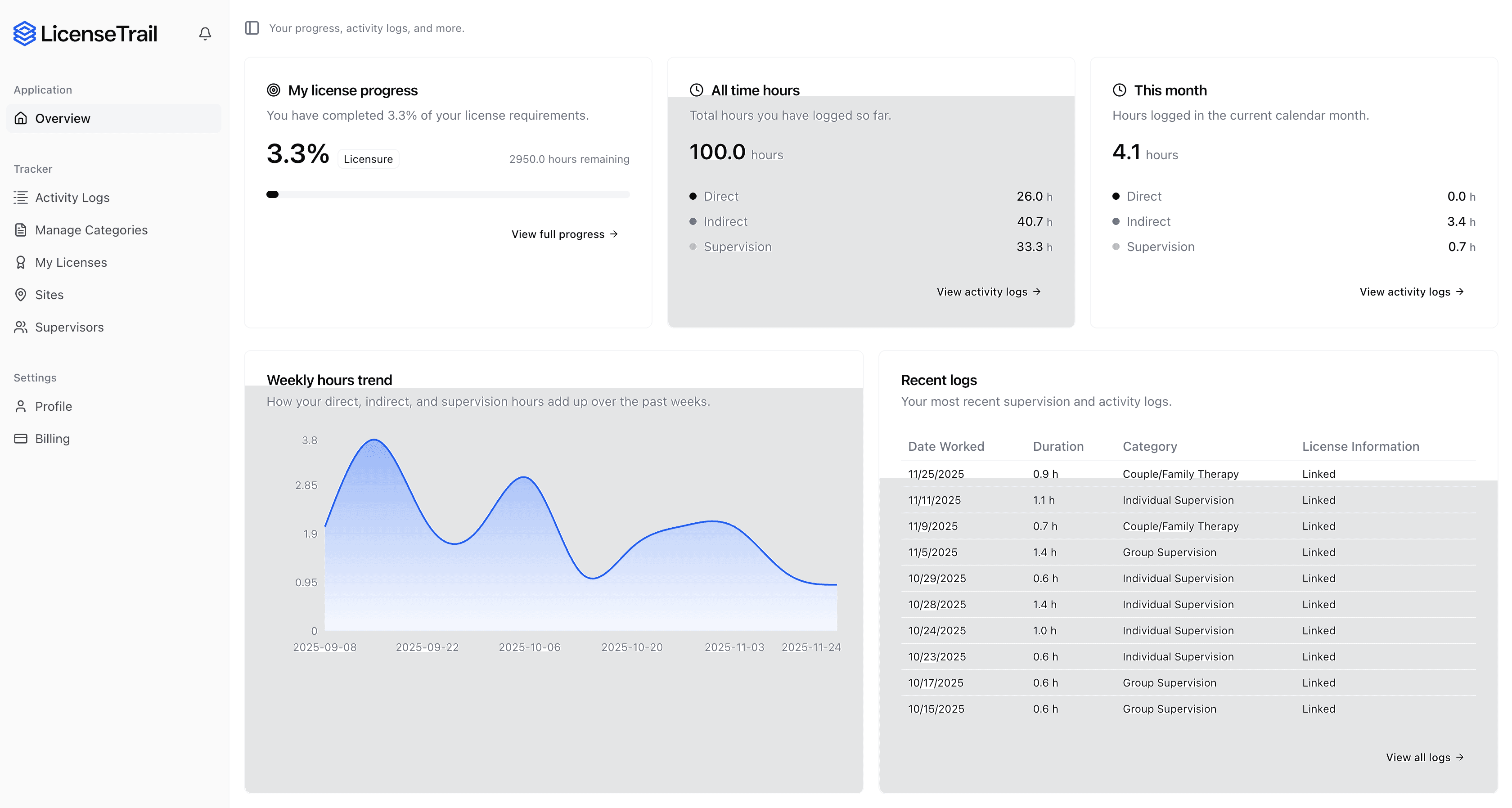 Start Tracking for Free
No credit card required · Free plan available
Is your spreadsheet hiding Montana PSY risks?
Stop guessing if your categories match Montana Board of Psychologists requirements. License Trail checks your direct, indirect, and supervision hours continuously and flags mismatches before you submit.
Import or log
Bring your spreadsheet or start fresh
Upload your existing tracking spreadsheet and we'll map every hour into the right Montana Board of Psychologists categories automatically.
Verify against Montana
Catch mismatches before the board does
License Trail checks your direct, indirect, and supervision hours against Montana PSY requirements continuously.
Export board-ready
One-click clean reports
Generate professional, board-ready reports for supervision meetings and Montana Board of Psychologists submissions in seconds.
No credit card required · Free plan available