
Nevada PSY Requirements: Hours, Exams & Step-by-Step Guide
Stop guessing if your categories match Nevada requirements. License Trail checks your direct, indirect, and supervision hours against PSY requirements continuously and flags mismatches before you submit.
No credit card required · Free plan available
Quick Requirements Overview
- Eligibility (NRS 641.170): Age 21+, good moral character, doctoral degree in psychology (APA-accredited or Board-approved equivalent), plus 2 years experience with ≥1 year postdoctoral
- Doctoral education: Typically ≥3 academic years full-time graduate study with ≥1 year in full-time residence; non-APA programs must prove substantial equivalency (NAC 641.061/062/0623)
- Supervised experience (standard pathway): 2,000 hours predoctoral internship (APA-accredited or equivalent) + 1,750 hours postdoctoral (min) = 3,750 hours total
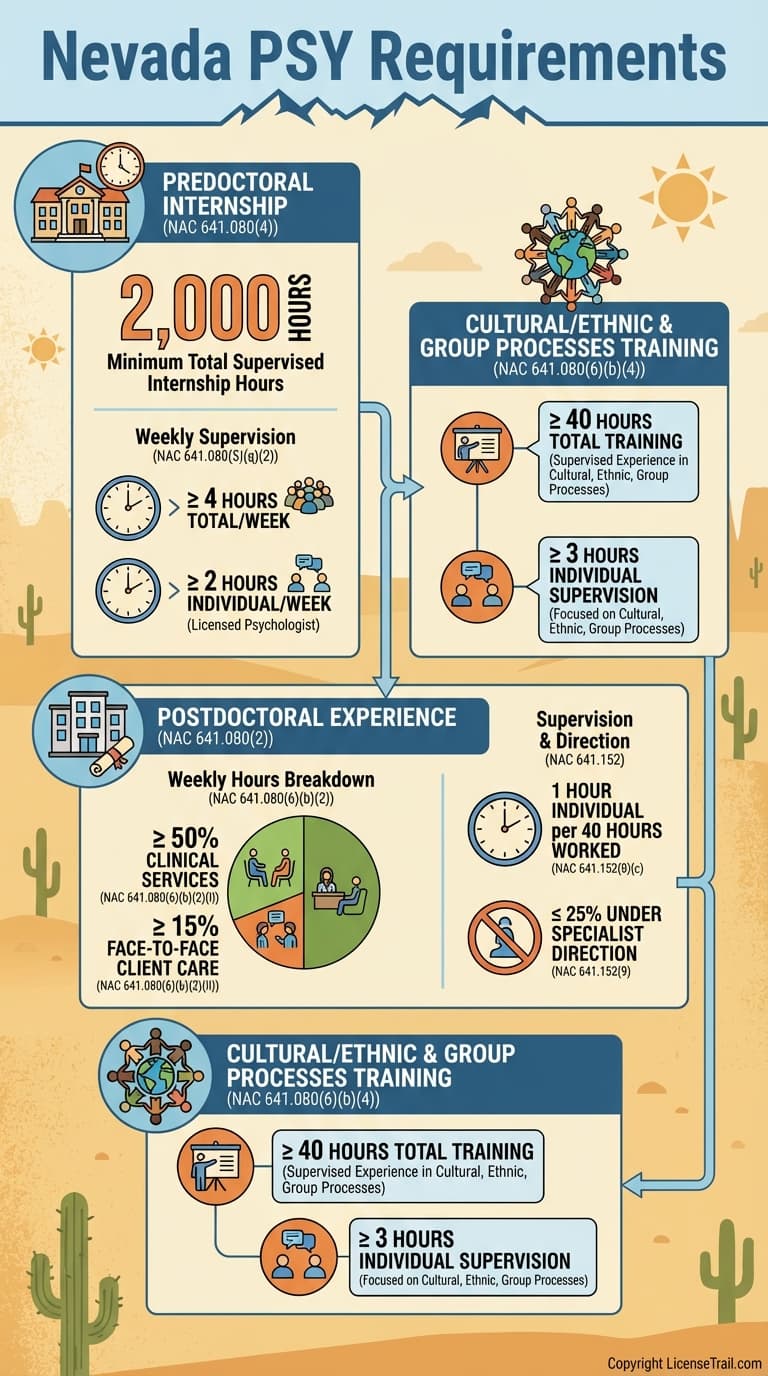
- Internship supervision (predoc): ≥4 hrs/week supervision, including ≥2 hrs/week face-to-face individual supervision by licensed doctoral-level psychologists
- Postdoc structure (NAC 641.080(6)): Complete 1,750+ hours in 10 months–3 years (unless exception); weekly ≥50% clinical services and ≥15% face-to-face client care
- Diversity training (postdoc): ≥40 hours in cultural/ethnic/group processes + ≥3 hours individual face-to-face supervision focused on that area
- Exams: EPPP Part 1 (all); EPPP Part 2 if required; passing score 500 (each). NV state law/ethics exam required; passing 75%
- Application & checks: Submit Applicant Screening Form + $150 fee, complete PLUS if directed; background check required for all applicants; NV requires state exam even for endorsement/expedited routes (e.g., CPQ/ABPP/NRHSPP/20+ yrs)
License Details
Procedures
Becoming a PSY‑licensed psychologist in Nevada means meeting specific requirements in statute (NRS 641) and regulation (NAC 641), as interpreted and applied by the Nevada State Board of Psychological Examiners. Below is a step‑by‑step outline focused on the exact types and amounts of hours the Board expects, along with the Board’s own terminology.
1. Basic statutory qualifications
Under NRS 641.170, every applicant for licensure as a psychologist must provide evidence that they:(nevada.public.law)
- Are at least 21 years of age.
- Are of good moral character (as determined by the Board).
- Have earned a doctorate in psychology from an accredited educational institution approved by the Board, or other doctorate‑level training deemed equivalent by the Board in both subject matter and extent of training.
- Have at least 2 years of experience satisfactory to the Board, one year of which must be postdoctoral experience in accordance with Board regulations (NAC 641.080).
The rest of the requirements—how many hours and what kinds of supervised experience—are spelled out in NAC 641.080 and Board guidance.
2. Doctoral education requirements
The Board’s FAQ and regulations describe the education standard this way:(psyexam.nv.gov)
- You must have a doctoral degree in psychology from a program that is APA‑accredited or deemed substantially equivalent.
- For non‑APA programs, the burden is on the applicant to prove equivalency under NAC 641.061 / 641.062 (for programs in the U.S.) or NAC 641.0623 (for programs outside the U.S.).
- The doctoral program must typically include at least 3 academic years of full‑time graduate study, including 1 year in full‑time residence, with a structure that supports mentoring, supervision, and evaluation of developing professional competence.
This doctorate is the foundation for both your pre‑doctoral internship and postdoctoral supervised experience.
3. Supervised experience: core structure and hour requirements
3.1 Overall framework
Nevada’s licensure regulations require “2 years of supervised and documented experience that is the equivalent of full‑time experience.”(regulations.justia.com)
For most new graduates, the Board breaks this down as:(psyexam.nv.gov)
- 2,000 hours of pre‑doctoral training (internship year), plus
- 1,750 hours of postdoctoral supervised experience,
for a total of 3,750 hours of supervised, full‑time experience.
The regulations themselves speak in terms of “years” and “full‑time” experience; the Board’s FAQ clarifies the pre‑doctoral year as 2,000 hours and the postdoctoral year as 1,750 hours.
3.2 Standard (new graduate) pathway
Under NAC 641.080(2), the required 2 years of supervised experience must meet two conditions:(regulations.justia.com)
- Year 1 (pre‑doctoral) – must satisfy subsection 4 (doctoral internship requirements).
- Year 2 (postdoctoral) – must be postdoctoral, consist of not less than 1,750 hours, and either:
- meet ASPPB guidelines, or
- meet the detailed requirements in subsection 6 of NAC 641.080.
3.2.1 The pre‑doctoral year (internship) – 2,000 hours
Board guidance states that one year of supervision and training is:(psyexam.nv.gov)
- “2,000 hours in pre‑doctoral training (NAC 641.080).”
Under NAC 641.080(4), this year must be completed in either:(regulations.justia.com)
- A doctoral internship program accredited by the American Psychological Association, or
- A doctoral internship that is equivalent to an APA‑accredited internship.
To be accepted as “equivalent,” the internship must substantially comply with APA’s Standards of Accreditation for Health Service Psychology and related implementing regulations. This includes demonstrating elements such as:(regulations.justia.com)
- A clear training mission in health service psychology.
- A structured sequence of training experiences that build competence in research; ethical and legal standards; individual and cultural diversity; assessment; intervention; supervision; and consultation/interprofessional skills.
- Primary use of experiential training, meaning interns deliver services directly to clients with robust observation and supervision by doctoral‑level licensed psychologists.
- Supervision requirements: each full‑time intern must receive at least 4 hours per week of supervision, including at least 2 hours per week of face‑to‑face individual supervision with one or more doctoral‑level licensed psychologists who have primary professional responsibility for the cases discussed.
While NAC 641.080 itself does not specify a numeric total for the internship year, the Board’s FAQ operationalizes this as 2,000 hours of pre‑doctoral training, and programs are expected to approximate a full‑time training year.
3.2.2 The postdoctoral year – minimum 1,750 hours
The second required year must be postdoctoral and must:(regulations.justia.com)
- Consist of not less than 1,750 hours of supervised experience, and
- Either meet ASPPB guidelines or satisfy the specific requirements of NAC 641.080(6) (described below).
The Board’s FAQ mirrors this:(psyexam.nv.gov)
- “1,750 hours in postdoctoral training.”
3.2.2.1 Time frame for postdoctoral hours
Under NAC 641.080(6)(b)(1), the required postdoctoral hours:(regulations.justia.com)
- Must be completed in no less than 10 months, and
- No more than 3 years, unless the Board approves an exception.
3.2.2.2 Required weekly composition of postdoctoral hours
For the postdoctoral year, NAC 641.080(6) defines in detail how your supervised experience hours must be spent:(regulations.justia.com)
-
Type of setting
- Hours are credited only for professional work in a setting that provides:
- Interaction with colleagues, and
- Work with a broad range of clients (e.g., private practice, public or private agencies, institutions, or organizations).
- Hours are credited only for professional work in a setting that provides:
-
Excluding graduate practicum
- Postdoctoral supervised experience must be separate from any practicum experience for which graduate credits were granted.
-
Weekly hours: clinical vs. other activities
- At least 50% of your hours per week must be spent providing clinical services, which the regulation defines to include:
- Psychological services rendered directly to individuals, couples, families, or groups,
- Psychological testing, and
- Individual or group supervision that is directly related to those services.
- At least 15% of your hours per week must be face‑to‑face client care.
- The remaining weekly hours must be spent in activities related to psychology, such as:
- Teaching psychology,
- Performing psychological research (beyond certain academic practicum),
- Administrative activities related to psychology, or other psychology‑related functions.
- At least 50% of your hours per week must be spent providing clinical services, which the regulation defines to include:
-
Cultural, ethnic, and group processes requirement
- At least 40 hours of the supervised postdoctoral experience must consist of training in cultural, ethnic, and group processes as social bases of behavior.
- At least 3 hours of individual face‑to‑face supervision must be specifically focused on that area.
- These hours can be met through: direct clinical work with diverse or underserved populations, reading, research, workshops or conferences on diversity, presentations, or publishing on related topics.
-
Who may count hours
- Unless you are registered as a psychological assistant or psychological intern, you may not count hours toward Nevada’s supervised experience requirement that were accrued while practicing under another kind of medical or behavioral health license.(regulations.justia.com)
3.3 Alternative hour structure for experienced out‑of‑state licensees (5+ years)
NAC 641.080(3) offers a different hour structure for applicants who:(regulations.justia.com)
- Have been licensed for at least 5 years as a psychologist in another U.S. state, territory, or the District of Columbia, and
- Have no disciplinary or other adverse action from that jurisdiction’s regulatory body.
For these applicants, the 2 years of required supervised experience must:
- Consist of two supervised years, each of not less than 1,500 hours.
- Include:
- One year that satisfies the doctoral internship requirements in NAC 641.080(4); and
- One postdoctoral year that satisfies the postdoctoral structure in NAC 641.080(6) (50% clinical, 15% face‑to‑face, 40 hours cultural training, etc.).
So for this pathway, the Board’s regulation specifies 1,500 hours per year (minimum) instead of 2,000 + 1,750, but retains the same qualitative standards for internship and postdoctoral training.
4. Registration categories while accruing hours in Nevada
If you are accruing postdoctoral hours in Nevada, you generally must register in one of the Board’s training categories.
4.1 Psychological assistant (for postdoc hours)
NAC 641.151 and the Board’s own definition page specify that a psychological assistant is a person who:(regulations.justia.com)
- Registers with the Board to obtain postdoctoral supervised experience required by NAC 641.080.
- Has already graduated with a doctoral degree from an APA‑accredited program or from a program that meets Nevada’s equivalency standards.
- Initially registers for 1 year, and ordinarily may not remain registered as a psychological assistant for more than 3 years (unless the Board approves an extension).
A psychological assistant must work under a Nevada‑licensed psychologist supervisor who meets specific supervision requirements.
4.2 Psychological intern and psychological trainee
The Board also offers registration as a psychological intern and psychological trainee for earlier training stages. These are also training‑level positions and require supervision by a Nevada‑licensed psychologist under NAC 641.1519. Registration does not guarantee licensure.(psyexam.nv.gov)
5. Examinations
5.1 National examination (EPPP)
By statute (NRS 641.180), each applicant must generally pass the national examination, which Nevada defines as the Examination for Professional Practice in Psychology (EPPP) administered by ASPPB.(nevada.public.law)
The Board’s FAQ adds the following specifics:(psyexam.nv.gov)
- EPPP Part 1 is required for all applicants.
- EPPP Part 2 is required for applicants who:
- Did not attend an APA‑accredited doctoral program, and
- Are not already licensed in another U.S. jurisdiction, or, if licensed elsewhere, were not licensed prior to November 1, 2020.
- The required passing score on both EPPP Part 1 and Part 2 is 500.
The Board may, in limited circumstances, waive the national examination for highly experienced psychologists (e.g., ABPP diplomates with 10+ years of practice), but such applicants still must meet Nevada’s other requirements, including the state exam.(nevada.public.law)
5.2 Nevada State Exam (jurisprudence/ethics)
Every applicant must also pass Nevada’s state examination:(regulations.justia.com)
- The exam covers federal and Nevada laws, ethical principles, and codes of professional conduct relevant to practicing psychology in Nevada (per NAC 641.112).
- The Board must provide a description of the exam content at least 30 days before the exam date.
- If you fail, you may review the exam and have limited opportunities to retake it; repeated failures can eventually require waiting 18 months and reapplying.
- The Board’s FAQ specifies that the passing score is 75%.
The state exam is mandatory for all licensure applicants, including endorsement and expedited applicants.
6. Application process and background check
The Board describes the application process on its Psychologist Licensure page:(psyexam.nv.gov)
-
Applicant Screening Form + Fee
- First step is to submit a Psychologist Applicant Screening Form (online or by mail) with the $150 non‑refundable application fee.
- The Board reviews the screening form and then provides instructions for next steps.
-
PLUS (ASPPB) application
- Depending on what you report on the screening form, you will often receive an email invitation to use ASPPB’s Psychological Licensure Universal System (PLUS) for your main application file.
-
State exam and background check
- The Board states explicitly that the Nevada State Exam and a background check are required for ALL licensure applicants, including:
- CPQ, ABPP, NRHSPP credential holders, and
- Applicants licensed 20+ years in other jurisdictions.(psyexam.nv.gov)
- The Board states explicitly that the Nevada State Exam and a background check are required for ALL licensure applicants, including:
-
Endorsement/expedited pathways
- Nevada does not have simple reciprocity, but offers licensure by endorsement or expedited processes for:
- Certificate of Professional Qualification in Psychology (CPQ) holders,
- ABPP diplomates,
- National Register of Health Service Psychologists (NRHSPP) credential holders, and
- Psychologists licensed in good standing for 20 or more years in other jurisdictions.(psyexam.nv.gov)
- These applicants still must:
- Demonstrate appropriate education and experience,
- Pass the Nevada State Exam, and
- Complete the background check.
- Nevada does not have simple reciprocity, but offers licensure by endorsement or expedited processes for:
7. How Nevada’s hours compare to the “1,500 direct / 1,500 supervised” style example
Nevada’s psychologist (PSY) license does not use a simple split like “1,500 hours direct experience and 1,500 hours supervised experience.”
Instead, the Board’s framework is:
- Total supervised experience
- 2,000 hours pre‑doctoral training (internship) + 1,750 hours postdoctoral training for the standard pathway.(psyexam.nv.gov)
- Qualitative distribution of hours (especially postdoctoral)
- At least 50% of weekly hours in direct clinical services (including direct psychological services, testing, and supervision related to those services).
- At least 15% of weekly hours in face‑to‑face client care.
- Remaining hours in other psychology‑related activities (teaching, research, administration, etc.).
- At least 40 hours of training in cultural/ethnic/group processes, with 3 hours of individual supervision specifically devoted to that topic.(regulations.justia.com)
For certain experienced applicants already licensed elsewhere for 5+ years, Nevada instead requires two supervised years of at least 1,500 hours each, one internship‑equivalent year and one postdoctoral year structured according to NAC 641.080.(regulations.justia.com)
8. Practical checklist for Nevada PSY licensure
Putting it all together, the core requirements to become a Licensed Psychologist (PSY) in Nevada are:
-
Doctoral degree in psychology
- APA‑accredited or deemed substantially equivalent; meets Nevada’s education rules (NAC 641.061/641.062/641.0623).(leg.state.nv.us)
-
Supervised experience
- Standard pathway (new graduate):
- 2,000 hours pre‑doctoral internship training (APA‑accredited or equivalent), and
- 1,750 hours postdoctoral supervised experience, meeting time frame and content requirements (≥50% clinical, ≥15% face‑to‑face, 40 hours cultural‑process training, etc.).(psyexam.nv.gov)
- Experienced out‑of‑state pathway (licensed ≥5 years):
- Two supervised years, each of ≥1,500 hours, one internship‑equivalent and one postdoctoral year that meets Nevada’s structured requirements.(regulations.justia.com)
- Standard pathway (new graduate):
-
Registration during training (if in Nevada)
- Register as a psychological assistant (and, earlier, intern or trainee as applicable) when accruing supervised hours in Nevada, under a Nevada‑licensed psychologist supervisor.(regulations.justia.com)
-
Examinations
- EPPP Part 1 (required for all) and EPPP Part 2 where applicable, each with a minimum score of 500.(psyexam.nv.gov)
- Nevada State Exam in laws/ethics, with a passing score of 75% and strict retake rules.(regulations.justia.com)
-
Application and background check
- Submit Applicant Screening Form and $150 non‑refundable fee, then complete the PLUS application if directed.(psyexam.nv.gov)
- Complete background check (required for all licensure applicants).(psyexam.nv.gov)
-
Endorsement / expedited options
- If you hold CPQ, ABPP, NRHSPP, or have 20+ years of licensed practice, you may use an expedited or endorsement route but must still meet Nevada’s education standards, pass the Nevada State Exam, and complete the background check.(psyexam.nv.gov)
Because Nevada periodically updates NAC 641 and NRS 641, it is wise to confirm details directly with the Nevada State Board of Psychological Examiners and the current NAC/NRS text before relying on specific numbers or procedures.
Track your PSY hours with confidence
License Trail checks your direct, indirect, and supervision hours against Nevada PSY requirements continuously and flags mismatches before you submit.
 Start Tracking for Free
No credit card required · Free plan available
Is your spreadsheet hiding Nevada PSY risks?
Stop guessing if your categories match Nevada Board of Psychological Examiners requirements. License Trail checks your direct, indirect, and supervision hours continuously and flags mismatches before you submit.
Import or log
Bring your spreadsheet or start fresh
Upload your existing tracking spreadsheet and we'll map every hour into the right Nevada Board of Psychological Examiners categories automatically.
Verify against Nevada
Catch mismatches before the board does
License Trail checks your direct, indirect, and supervision hours against Nevada PSY requirements continuously.
Export board-ready
One-click clean reports
Generate professional, board-ready reports for supervision meetings and Nevada Board of Psychological Examiners submissions in seconds.
No credit card required · Free plan available