
Nevada MFT Requirements: Hours, Exams & Step-by-Step Guide
Stop guessing if your categories match Nevada requirements. License Trail checks your direct, indirect, and supervision hours against MFT requirements continuously and flags mismatches before you submit.
No credit card required · Free plan available
Quick Requirements Overview
- Eligibility: Age 21+; good moral character; BA/BS from Board-approved accredited institution
- Education: Board-approved graduate degree (MFT/closely related mental-health field; COAMFTE/CACREP recognized) incl. required content areas; supervised practice coursework (≈ 40 weeks, individuals/couples/families)
- Postgrad experience: 2 years minimum in MFT
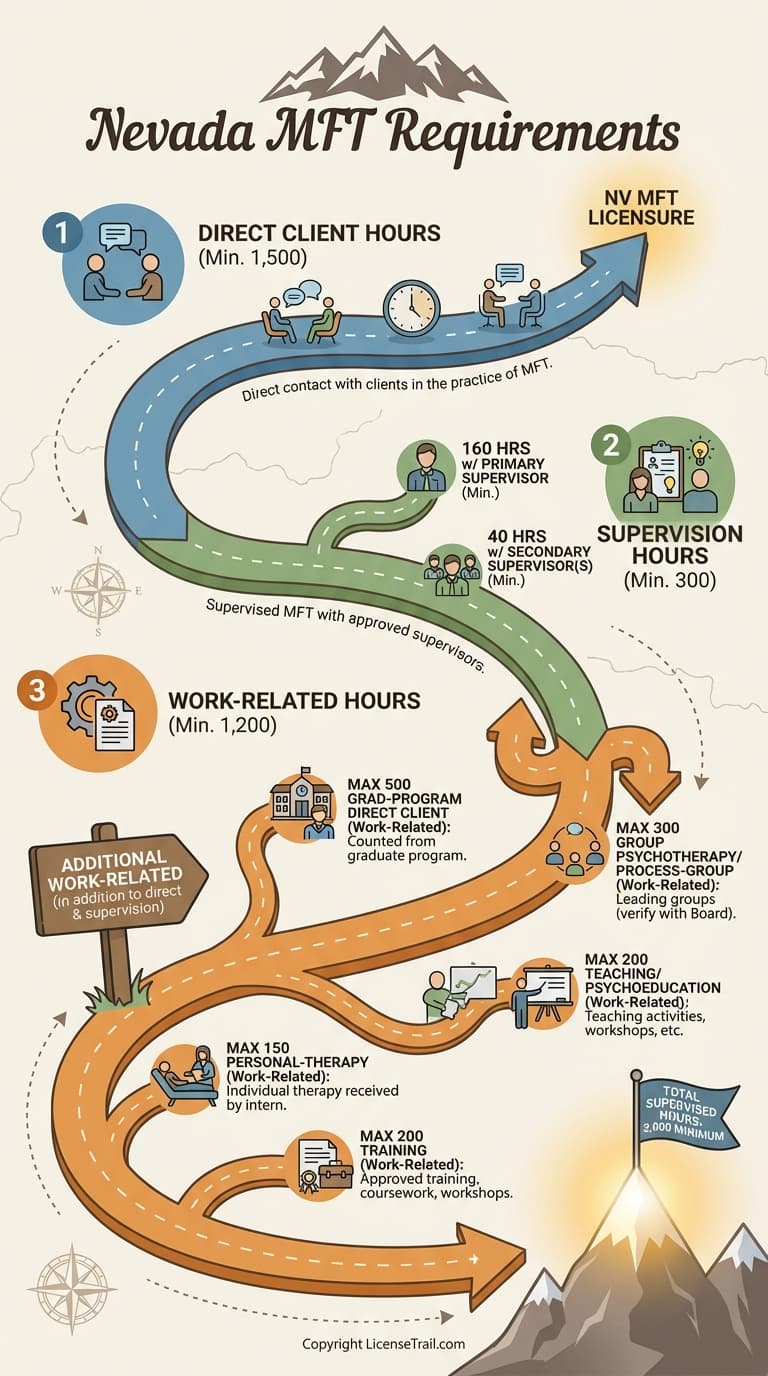
- Supervised hours (total 3,000): 1,500 direct client contact + 300 supervision (160 primary; 40 secondary) + 1,200 related practice work
- Intern path: Typically complete hours under MFT-Intern license; supervisors Board-approved; periodic written progress/hour reports
- Exam: Pass AMFTRB national MFT exam (interns eligible after intern licensure)
- Intern timing: Internship must be completed within Board time limits; typically one 3-year renewal possible
- Renewal (after licensure): 20 CE hours/period (incl. 3 ethics + 2 suicide prevention; ≤ 10 non-interactive distance)
License Details
Procedures
Licensure as a Marriage and Family Therapist (MFT) in Nevada is governed by the Nevada Board of Examiners for Marriage and Family Therapists and Clinical Professional Counselors under Nevada Revised Statutes (NRS) Chapter 641A and Nevada Administrative Code (NAC) Chapter 641A. What follows organizes the requirements into a practical, step‑by‑step path while preserving the Board’s own definitions of the required hours.
1. Basic eligibility for an MFT license
Under NRS 641A.220, to be licensed as a Marriage and Family Therapist in Nevada you must provide evidence that you: (nevada.public.law)
- Are at least 21 years of age.
- Are of good moral character.
- Have completed either:
- Residency training in psychiatry from an accredited institution approved by the Board, or
- A graduate degree in marriage and family therapy, psychology, or social work from an accredited institution approved by the Board, or
- Other education and training that the Board deems equivalent.
- Have:
- At least 2 years of postgraduate experience in marriage and family therapy, and
- At least 3,000 hours of supervised experience in marriage and family therapy, of which at least 1,500 hours must consist of direct contact with clients. (nevada.public.law)
- Hold an undergraduate degree from an accredited institution approved by the Board. (nevada.public.law)
These hours and experience are normally accumulated in Nevada under an MFT‑Intern license (or via endorsement from another state).
2. Educational requirements in more detail
2.1 Graduate degree structure
The educational requirements are spelled out in NAC 641A.085 and related provisions. In summary: (regulations.justia.com)
-
Your qualifying graduate degree must:
- Be in marriage and family therapy, counseling, mental health counseling, psychology, social work, or a closely related mental‑health field the Board finds comparable.
- Come from a regionally accredited institution approved by the Board.
- Include coursework in specified content areas (e.g., human development, ethics, assessment, research, social and cultural foundations, couples counseling, family systems, crisis/trauma, grief/loss, and abuse of alcohol or controlled substances).
- Include supervised practice courses that:
- Provide clinical experience working with individuals, couples and families.
- Are equivalent to three semester courses or four quarter courses providing a minimum of 40 weeks of supervised practice. (leg.state.nv.us)
-
The Board only counts graduate‑level courses for these requirements, and a single course can’t be double‑counted for multiple required areas of study. (regulations.justia.com)
The Board also explicitly recognizes degrees from programs accredited by COAMFTE (Commission on Accreditation for Marriage and Family Therapy Education) or CACREP as meeting the educational requirement for intern licensure, subject to the content‑area requirements. (regulations.justia.com)
3. The Nevada MFT‑Intern license and supervised experience
In practice, most applicants become a Marriage and Family Therapist‑Intern first, and then complete their supervised hours under this intern license.
3.1 Overall supervised‑experience requirement
NRS 641A.220 requires, for full MFT licensure: (nevada.public.law)
- At least 2 years of postgraduate experience in marriage and family therapy, and
- At least 3,000 hours of supervised experience in marriage and family therapy, of which at least 1,500 hours must consist of direct contact with clients.
NAC 641A.146 then breaks down what an intern must complete in order to meet these NRS requirements. Under NAC 641A.146(5), to obtain the required supervised experience an intern must complete: (law.cornell.edu)
-
Direct client contact hours – 1,500 hours
The regulation states that an intern must complete “at least 1,500 hours of direct contact with clients in the practice of marriage and family therapy” (or clinical professional counseling, if applicable). (law.cornell.edu)
- These are your face‑to‑face (or live telehealth) clinical hours where you are providing marriage and family therapy services directly to clients (individuals, couples, or families).
-
Supervision hours – 300 hours
NAC 641A.146(5)(b) requires: (law.cornell.edu)
- At least 300 hours of marriage and family therapy that is supervised by your approved primary and/or secondary supervisors, including:
- At least 160 hours supervised by your primary approved supervisor, and
- At least 40 hours supervised by your secondary supervisor or supervisors.
These are supervision sessions (individual, triadic, or group) where your clinical work is reviewed and guided by an approved supervisor.
- At least 300 hours of marriage and family therapy that is supervised by your approved primary and/or secondary supervisors, including:
-
Additional related‑work hours – 1,200 hours
NAC 641A.146(5)(c) further requires: (law.cornell.edu)
- At least 1,200 hours of work related to the practice of marriage and family therapy, in addition to the hours listed above.
These related‑work hours may include, among other things (within the caps set by the regulation): (leg.state.nv.us)
- Up to 500 hours of direct client contact performed in conjunction with a graduate program of study.
- Up to 300 hours of leading group therapy or counseling sessions.
- Up to 200 hours of teaching activities (e.g., leading parent or family education sessions, workshops, or similar teaching activities) approved by your primary supervisor.
The NAC provision provides more categories (e.g., case notes, case conferences, training) under this “work related to the practice” umbrella; the central point for licensure is that these must be practice‑related activities supporting or complementing your clinical work, and they are counted separately from the 1,500 direct hours and 300 supervision hours.
3.2 How these pieces fit together
Putting the statutory and regulatory language side by side:
- NRS 641A.220 sets the headline requirement of 3,000 hours of supervised experience, including at least 1,500 hours of direct contact with clients. (nevada.public.law)
- NAC 641A.146 specifies, for an intern, that to meet this requirement the supervised experience must include: (law.cornell.edu)
- 1,500 hours of direct client contact, plus
- 300 hours of supervision, plus
- 1,200 hours of other work related to the practice of marriage and family therapy, for a total of 3,000 hours.
In other words, Nevada’s Board effectively defines the supervised experience for MFTs as:
- 1,500 hours of direct contact with clients
- 300 hours of supervised practice (supervision sessions)
- 1,200 hours of related professional work
- Total: 3,000 hours of supervised experience in marriage and family therapy
All of this must be completed post‑degree during your MFT‑Intern period (unless some graduate‑program hours are approved within the limits for credit). (law.cornell.edu)
4. Time limits and structure of the internship
NAC 641A.146 also governs timing and completion of the internship: (leg.state.nv.us)
- The internship must be completed within a specified time frame set by the Board; if needed, an intern may request an extension, but there are limits on how long an intern license can be renewed.
- The Board will typically allow one 3‑year renewal of an intern license; if you fail to complete your internship within that extended period you must reapply under current law and explain the reasons for non‑completion.
- Your supervisors must submit written reports to the Board documenting your progress and hours.
The Board may grant credit for certain experiences obtained before you applied as an intern (for example, some military‑related practice) within limits defined in NAC 641A.146. (law.cornell.edu)
5. Examination requirements
Beyond hours and education, you must also pass the Board‑approved exam.
5.1 National MFT examination
Under NRS 641A.230 and Board policy: (marriage.nv.gov)
- Each qualified MFT applicant must pass a written examination on marriage and family therapy.
- The Board satisfies this requirement by accepting a passing score on the national MFT exam sponsored by the Association of Marital and Family Therapy Regulatory Boards (AMFTRB).
- According to the Board’s own licensing page, state‑licensed MFT‑Interns are eligible to sit for the national MFT exam after obtaining their internship and must successfully pass this exam before they may be licensed as a Marriage and Family Therapist. (marriage.nv.gov)
The exam is administered on a computerized basis on a regular schedule (monthly), and interns submit an Exam Request Form to have their names authorized to sit for the exam. (marriage.nv.gov)
6. Application process (high‑level overview)
While forms and fees change periodically, the structural steps are consistent and spelled out on the Board’s “Marriage & Family Therapists (MFT)” and “Licensing Procedure” pages. (marriage.nv.gov)
6.1 Typical pathway
- Complete a qualifying graduate degree that meets NAC 641A.085 education and supervised‑practice requirements. (regulations.justia.com)
- Apply for an MFT‑Intern license with:
- Application form and fees.
- Official transcripts.
- Proof of U.S. citizenship or lawful authorization to work.
- Proposed primary and (if applicable) secondary supervisors, who must be Board‑approved MFT or CPC supervisors.
- Complete the required supervised experience as an intern:
- 1,500 hours of direct client contact in marriage and family therapy.
- 300 hours of documented supervision (160 with primary supervisor, 40 with secondary).
- 1,200 hours of work related to the practice of marriage and family therapy (within NAC limits). (law.cornell.edu)
- Accumulate at least 2 years of post‑graduate experience in marriage and family therapy while completing the 3,000 hours. (nevada.public.law)
- Pass the national MFT exam accepted by the Board. (marriage.nv.gov)
- Apply for full MFT licensure, submitting:
- Verification of completed hours and supervision (Board forms from supervisors).
- Proof of exam passage.
- Any additional forms such as background check or jurisprudence requirements, as specified in current Board procedures.
7. Continuing education after licensure (briefly)
Once licensed as an MFT, Nevada requires continuing education to maintain licensure. NAC 641A.131 currently requires: (mycasat.org)
- At least 20 hours of continuing education each licensing period, including:
- At least 3 hours in ethics specific to marriage and family therapy or clinical professional counseling.
- At least 2 hours in evidence‑based suicide prevention and awareness.
- No more than 10 hours may be from non‑interactive distance education.
(Additional CE requirements apply if you are an approved supervisor.)
8. Summary of Nevada’s key MFT hour requirements (using Board language)
Using the statutory and regulatory wording together, Nevada’s Board defines the supervised‑experience requirement for MFT licensure as:
- “At least 3,000 hours of supervised experience in marriage and family therapy, of which at least 1,500 hours must consist of direct contact with clients.” (nevada.public.law)
and, for an intern to obtain those hours, NAC 641A.146(5) requires:
- “At least 1,500 hours of direct contact with clients in the practice of marriage and family therapy”;
- “At least 300 hours of marriage and family therapy … that is supervised by the primary approved supervisor or secondary approved supervisor,” including at least 160 hours with the primary supervisor and at least 40 hours with secondary supervisor(s);
- “At least 1,200 hours of work related to the practice of marriage and family therapy,” which may include limited amounts of additional direct client contact, group therapy, teaching, and other practice‑related activities. (law.cornell.edu)
Together, these provisions establish the Nevada standard: 3,000 total supervised hours, composed of 1,500 direct client contact hours, 300 supervision hours, and 1,200 related‑work hours, completed over at least 2 years of postgraduate experience in marriage and family therapy, plus a passing score on the national MFT exam.
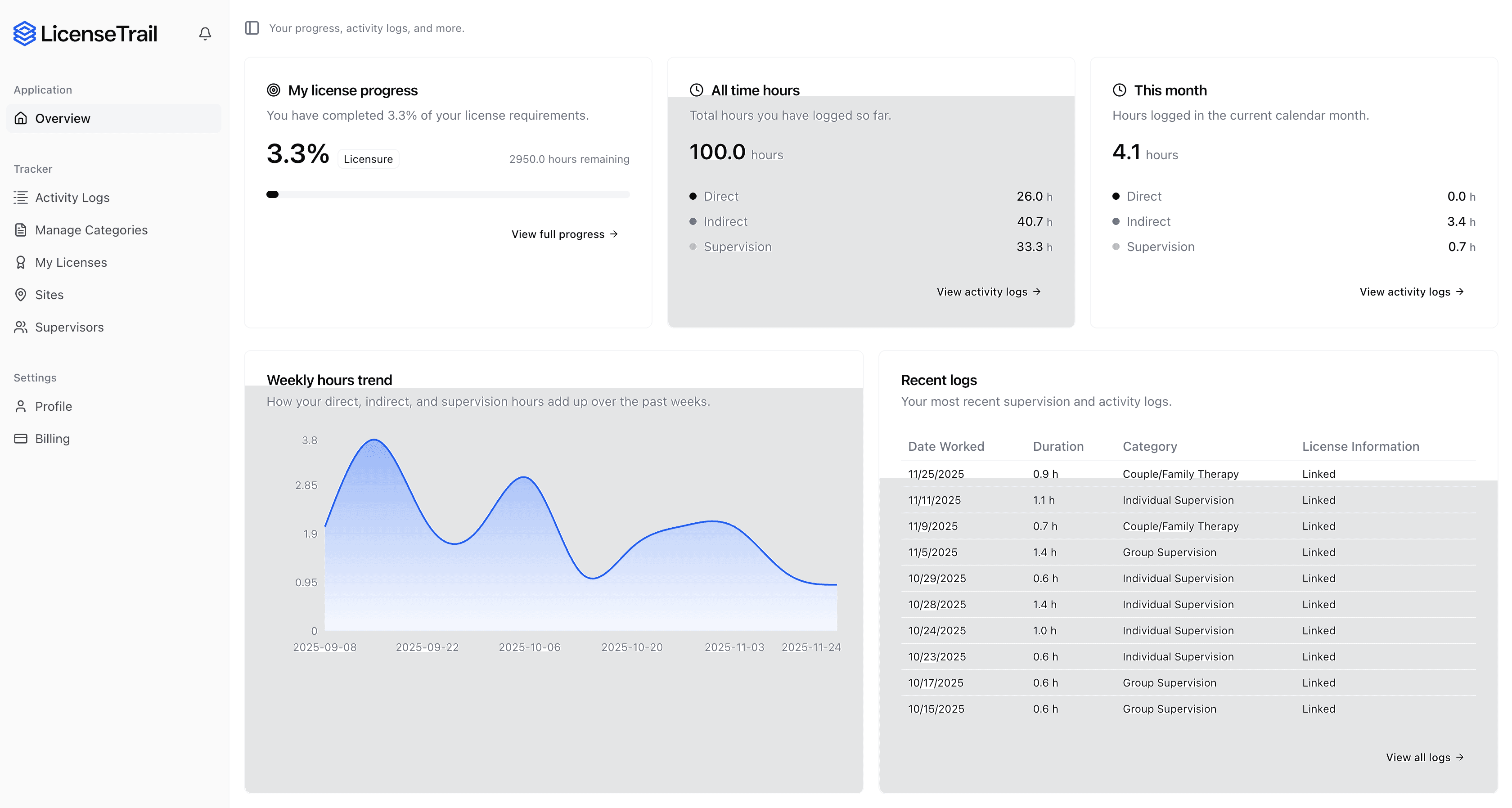
Track your MFT hours with confidence
License Trail checks your direct, indirect, and supervision hours against Nevada MFT requirements continuously and flags mismatches before you submit.
 Start Tracking for Free
No credit card required · Free plan available
Related Licenses
Is your spreadsheet hiding Nevada MFT risks?
Stop guessing if your categories match Nevada Board of Examiners for Marriage and Family Therapists and Clinical Professional Counselors requirements. License Trail checks your direct, indirect, and supervision hours continuously and flags mismatches before you submit.
Import or log
Bring your spreadsheet or start fresh
Upload your existing tracking spreadsheet and we'll map every hour into the right Nevada Board of Examiners for Marriage and Family Therapists and Clinical Professional Counselors categories automatically.
Verify against Nevada
Catch mismatches before the board does
License Trail checks your direct, indirect, and supervision hours against Nevada MFT requirements continuously.
Export board-ready
One-click clean reports
Generate professional, board-ready reports for supervision meetings and Nevada Board of Examiners for Marriage and Family Therapists and Clinical Professional Counselors submissions in seconds.
No credit card required · Free plan available