
New-york LCSW Requirements: Hours, Exams & Step-by-Step Guide
Stop guessing if your categories match New-york requirements. License Trail checks your direct, indirect, and supervision hours against LCSW requirements continuously and flags mismatches before you submit.
No credit card required · Free plan available
Quick Requirements Overview
- Age 21+ and good moral character (NYSED/Office of the Professions)
- Education: MSW (or equivalent) with 60 graduate semester hours; ≤50% advanced standing from BSW; 900-hour field practicum; 12 semester hours clinical coursework (dx/assessment, treatment, work w/ populations)
- Training: NYSED-approved child abuse identification & reporting course
- Experience: 36–72 months post‑MSW supervised clinical social work; typically while NY LMSW or limited permit
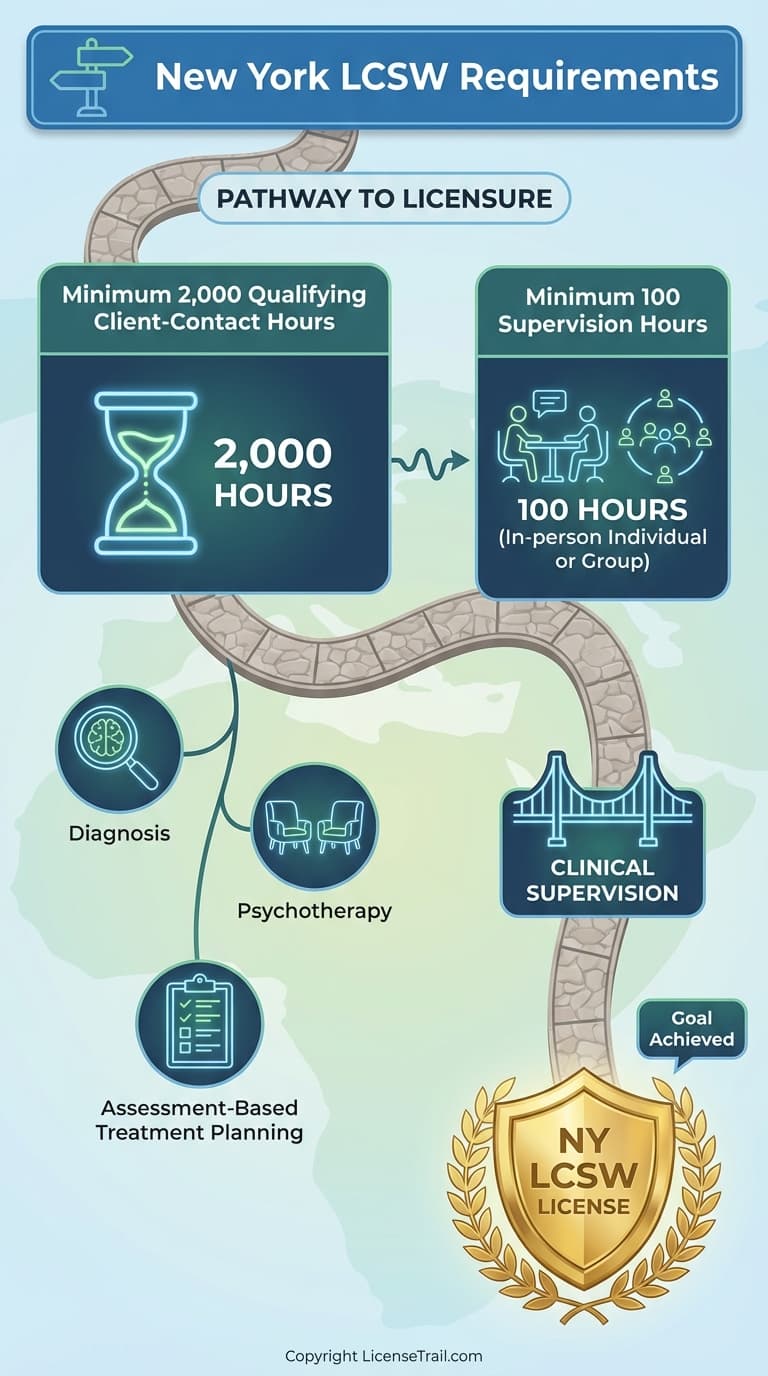
- Client hours: 2,000 supervised client contact hours in diagnosis, psychotherapy, and assessment-based treatment planning (non-clinical case management/advocacy/discharge planning alone won’t count)
- Supervision: 100+ hours in-person individual/group clinical supervision; supervisor must be NY LCSW (or equivalent), qualified psychologist, or psychiatrist; no familial relationship; Form 4Q if out-of-state
- Setting/docs: experience must be in a legally authorized psychotherapy/clinical setting; supervisors verify via Form 4B (Form 6 plan optional)
- Exam/app: pass ASWB Clinical; submit NYSED Form 1 + fee; school sends Form 2; ASWB sends scores directly to NYSED
License Details
Procedures
Licensure as a Licensed Clinical Social Worker (LCSW) in New York State is regulated by the New York State Education Department (NYSED), Office of the Professions, State Board for Social Work. The Board’s requirements are very specific about education, the type of experience you must obtain, the number of hours, and the nature of supervision.
Below is a structured guide that tracks the actual wording and structure of NYSED’s rules and guidance.
1. Overview of the LCSW license in New York
To practice licensed clinical social work and use the title “Licensed Clinical Social Worker” or “LCSW” in New York, you must hold an LCSW license issued by NYSED.(op.nysed.gov)
At a high level, you must:
- Be at least 21 years old and of good moral character.
- Hold a qualifying Master of Social Work (MSW) degree with required clinical coursework.
- Complete at least three years of post‑MSW supervised experience in clinical social work (described in detail below).
- Pass the ASWB Clinical examination.
- Complete NY-approved training in the identification and reporting of child abuse. (op.nysed.gov)
Most applicants complete their required experience while licensed in New York as a Licensed Master Social Worker (LMSW) or under an NYSED limited permit.(op.nysed.gov)
2. Educational requirements
2.1 Degree and credit requirements
You must complete a graduate social work program that meets NYSED’s standards for LCSW:
- A master’s degree in social work (M.S.W.) or equivalent.
- At least 60 semester hours (or equivalent) of graduate study; no more than half may be advanced standing credit from a BSW.
- A field practicum of at least 900 clock hours in social work, integrated with the curriculum.
- At least 12 semester hours of clinical coursework designed to prepare you for LCSW practice, including content in:
- Diagnosis and assessment in clinical social work practice
- Clinical social work treatment
- Clinical practice with general and special populations (op.nysed.gov)
Programs registered by NYSED as “licensure-qualifying for LCSW” automatically meet these criteria; other programs must be evaluated individually.
2.2 Child abuse identification and reporting course
All applicants must complete a NYSED‑approved course in identification and reporting of child abuse before licensure.(op.nysed.gov)
3. Licensure sequence: LMSW then LCSW
Because the LCSW requires supervised post‑MSW experience in clinical functions, most applicants first:
- Apply for and obtain LMSW licensure (or a limited permit) in New York.(op.nysed.gov)
- Work in an acceptable setting where clinical social work is authorized.
- Accrue supervised experience that meets the LCSW requirements described below.
Experience obtained in New York must be completed while you are licensed as an LMSW or working under a limited permit, unless NYSED makes an exception in limited circumstances.(op.nysed.gov)
4. Experience requirements: type of work and number of hours
New York is very specific about both the type of experience and the hours required.
4.1 Required type of experience
The law and regulations state that you must complete supervised post‑degree experience in:
“diagnosis, psychotherapy and assessment-based treatment planning”
Only these activities count toward LCSW experience.(op.nysed.gov)
NYSED is equally clear about what does not count toward the LCSW experience requirement. The Board notes that activities such as:
- Case management
- School social work (when focused on non-clinical roles)
- Discharge planning
- Counseling that is not diagnosis/psychotherapy
- Client advocacy
are considered direct social work services but do not satisfy the LCSW experience requirement by themselves, because they are not the specific combination of diagnosis, psychotherapy, and assessment-based treatment planning required by law.(op.nysed.gov)
4.2 Minimum duration and time window
The Education Law and regulations require:
- At least 36 months (three years) of supervised post‑MSW experience in the required activities.(op.nysed.gov)
- The experience may be part‑time, but:
- It must be equivalent to at least three years of full‑time work.
- It must be completed in no less than 36 months and no more than 72 months (six years) of continuous supervised practice.(op.nysed.gov)
Even if you accumulate the required client contact hours in less than 36 months, you cannot shorten the three‑year minimum experience period; the statute and regulations require three years of full‑time (or part‑time equivalent) experience.
4.3 Required client contact hours
Within that 36–72 month time frame, you must complete at least 2,000 client contact hours in the specified activities.(op.nysed.gov)
Key points about these 2,000 hours:
- They must be client contact hours—time spent directly providing clinical social work services to clients (individuals, families, or groups) that consist of:
- Diagnostic assessment
- Psychotherapy
- Assessment-based treatment planning
- They must be supervised by a qualified supervisor in an acceptable setting (see sections 5 and 6).(op.nysed.gov)
- All 2,000 hours must be obtained after you complete the MSW program that qualifies you for clinical licensure.(op.nysed.gov)
New York summarizes this standard as “36 months and 2,000 client contact hours of supervised experience in post‑LMSW diagnosis, psychotherapy and assessment‑based treatment planning.”(op.nysed.gov)
There is no separate second pool of “supervised hours” on top of this 2,000; instead, all 2,000 client contact hours must be supervised, and there is an additional minimum supervision session requirement of 100 hours (see below).
5. Supervision requirements
5.1 Who can supervise?
Your experience must be supervised by a qualified supervisor, defined by NYSED as someone who is licensed and registered as one of the following:(op.nysed.gov)
- A Licensed Clinical Social Worker (LCSW) in New York, or an equivalent license in another jurisdiction as determined by NYSED; or
- A psychologist who:
- Was licensed where the supervision occurred, and
- Is found by NYSED to be qualified in psychotherapy (based on education and training); or
- A physician who:
- At the time of supervision, was a diplomate in psychiatry of the American Board of Psychiatry and Neurology, or
- Had equivalent training and experience as determined by NYSED.
If the supervisor is not licensed in New York, they must submit an “Approval of Qualifications to Supervise Psychotherapy” (Form 4Q) so NYSED can confirm that they are qualified to supervise in diagnosis, psychotherapy, and assessment-based treatment planning.(op.nysed.gov)
A supervisor may not have a familial relationship with the applicant, to avoid dual‑relationship and unprofessional conduct issues.(op.nysed.gov)
5.2 Required supervision hours and content
Within your 36–72 months of experience, you must participate in:
- At least 100 hours of in-person individual or group clinical supervision, distributed over the period of supervised experience.(op.nysed.gov)
During supervision:
- You must review and discuss your clients and their diagnoses and treatment with your supervisor.
- The supervisor must provide oversight and guidance in diagnosis and treatment.
- The supervisor must regularly review and evaluate your professional work and maintain records of your client contact hours and supervision hours.(op.nysed.gov)
Your supervisor is legally and professionally responsible for the diagnosis and treatment of each client seen under supervision and must have access to all relevant information and records.(op.nysed.gov)
5.3 Supervision structure and documentation
- Supervision may be individual or group, as long as it meets the content requirements and totals at least 100 hours.(op.nysed.gov)
- Third‑party supervision (for example, a supervisor not employed by your agency) is allowed, but must be clearly documented in a written agreement between the employer, supervisor, and LMSW, including access to client records.(op.nysed.gov)
- Supervisors document your experience and ultimately verify it to NYSED on Form 4B (Verification of Supervised Experience).(op.nysed.gov)
6. Acceptable practice settings
To count toward LCSW licensure, experience completed in New York must be in a setting that is legally authorized to provide psychotherapy and clinical social work services.(op.nysed.gov)
NYSED lists examples of acceptable settings, including:(op.nysed.gov)
- A professional corporation, PLLC, PLLP, or similar entity authorized to provide services that include psychotherapy or services within the scope of LCSW practice.
- A sole proprietorship owned by a licensee providing professional services within the LCSW scope.
- Programs or services approved by:
- Office of Mental Health (OMH)
- Office for People With Developmental Disabilities (OPWDD)
- Office of Addiction Services and Supports (OASAS)
- Office of Children and Family Services (OCFS)
- Department of Corrections and Community Supervision (DOCCS)
- Department of Health (DOH)
- State Office for the Aging
- Local social services or mental hygiene districts
- Federal facilities such as the Veterans’ Administration that are authorized to provide health services including psychotherapy.
- Public K‑12 schools authorized by NYSED to provide school social work services, including clinical social work.
- Entities explicitly exempt or otherwise authorized under New York law or the laws of another jurisdiction to provide services including psychotherapy.
General business corporations or not‑for‑profit corporations may not employ licensed professionals to provide restricted professional services unless their corporate structure is specifically authorized under New York law.(op.nysed.gov)
It is the applicant’s responsibility to confirm that both the setting and the supervisor meet NYSED requirements before accepting a position that you intend to use for LCSW hours.(op.nysed.gov)
7. Step‑by‑step application process for LCSW
Once education, experience, and supervision requirements are met (or are in progress), the typical process is:
7.1 File your application and fee
- Submit Form 1 (Application for Licensure) and the required fee to NYSED.(op.nysed.gov)
7.2 Have your education verified
- Ask your graduate program to send verification of your MSW directly to NYSED on Form 2.(op.nysed.gov)
7.3 Plan and verify supervised experience
- (Optional but recommended) Submit a Plan for Supervised Experience (Form 6) before you begin accruing hours, to confirm that your setting and supervision will be acceptable.(op.nysed.gov)
- Each supervisor must document your client contact hours and supervision hours and submit Form 4B to NYSED verifying:
- Total months/years of experience
- Total client contact hours
- That the work was in diagnosis, psychotherapy, and assessment-based treatment planning
- That supervision met NYSED requirements(op.nysed.gov)
7.4 Examination
- After NYSED approves your education and experience, they notify both you and the Association of Social Work Boards (ASWB) that you are eligible for the ASWB Clinical examination.
- You register directly with ASWB, pay the exam fee, and take the Clinical exam.(op.nysed.gov)
NYSED must receive the official score directly from ASWB; they will not accept scores sent by you or another jurisdiction.(op.nysed.gov)
7.5 Final licensure
- When all requirements are met (education, 2,000 supervised client contact hours over at least 36 months, 100 hours of supervision, child abuse course, and ASWB Clinical exam), NYSED issues the LCSW license and initial registration.
8. Quick numerical summary of New York LCSW experience requirements
Using the Board’s terminology and structure:
-
Experience period
- Minimum: 36 months
- Maximum: 72 months (six years)
- Must be post‑MSW and supervised.(op.nysed.gov)
-
Type of experience required
- Supervised clinical social work in:
- Diagnosis
- Psychotherapy
- Assessment‑based treatment planning (op.nysed.gov)
- Supervised clinical social work in:
-
Client contact hours
- At least 2,000 client contact hours of supervised clinical social work in the three functions above, completed within the 36–72 month window.(op.nysed.gov)
-
Supervision hours
- At least 100 hours of in‑person individual or group clinical supervision, provided by a qualified supervisor and distributed over the supervised experience.(op.nysed.gov)
-
Setting and supervisor
- Experience must be obtained in a setting legally authorized to provide psychotherapy/clinical social work.
- Supervisor must be an LCSW, qualified psychologist, or psychiatrist (or equivalent), licensed and registered, and not in a familial relationship with you.(op.nysed.gov)
These are the core, state‑defined quantitative and qualitative requirements to become licensed as an LCSW in New York State.
Track your LCSW hours with confidence
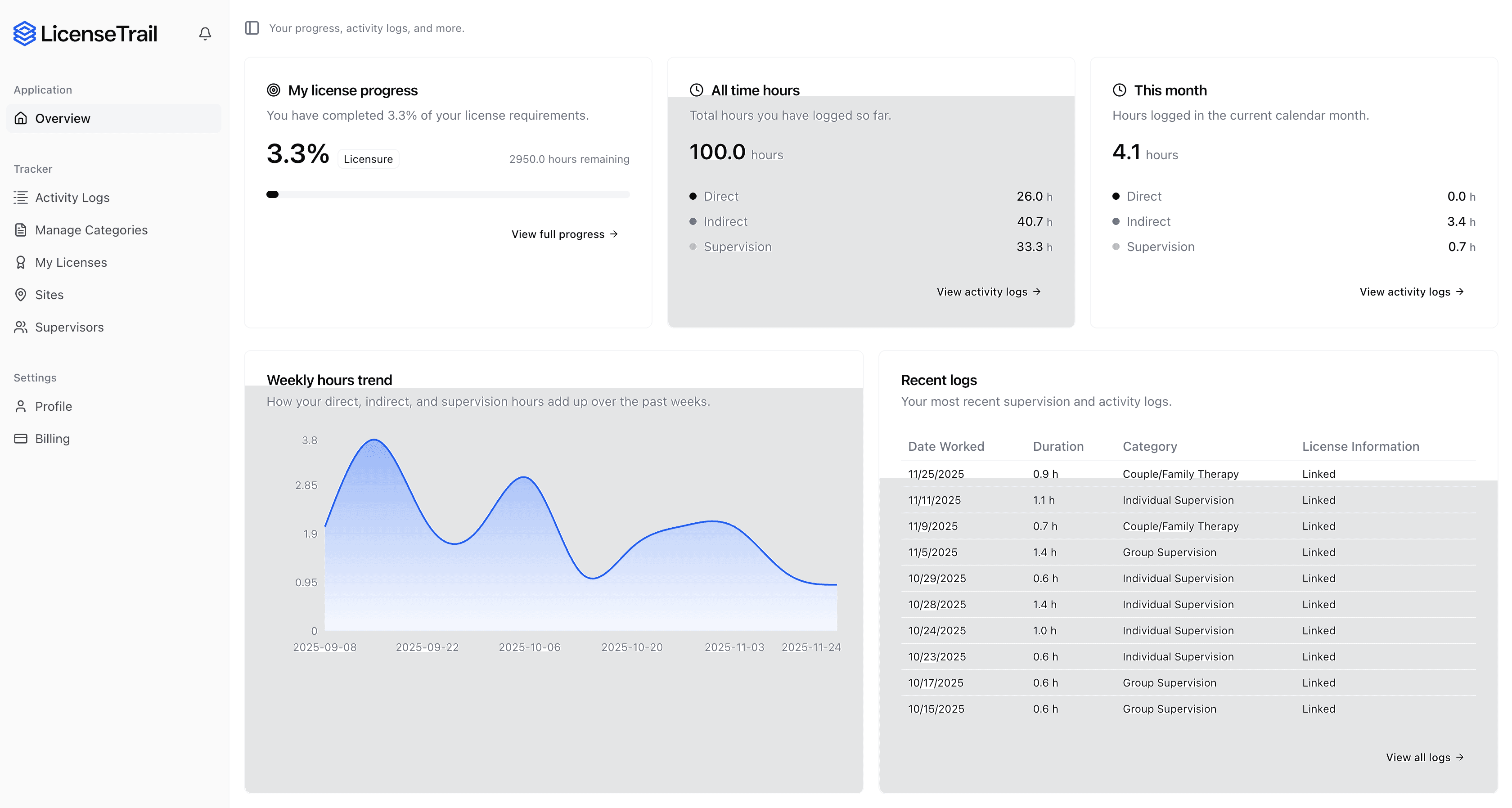
License Trail checks your direct, indirect, and supervision hours against New-york LCSW requirements continuously and flags mismatches before you submit.
 Start Tracking for Free
No credit card required · Free plan available
Is your spreadsheet hiding New-york LCSW risks?
Stop guessing if your categories match New York State Board for Social Work requirements. License Trail checks your direct, indirect, and supervision hours continuously and flags mismatches before you submit.
Import or log
Bring your spreadsheet or start fresh
Upload your existing tracking spreadsheet and we'll map every hour into the right New York State Board for Social Work categories automatically.
Verify against New-york
Catch mismatches before the board does
License Trail checks your direct, indirect, and supervision hours against New-york LCSW requirements continuously.
Export board-ready
One-click clean reports
Generate professional, board-ready reports for supervision meetings and New York State Board for Social Work submissions in seconds.
No credit card required · Free plan available