
New-york Psychologist Requirements: Hours, Exams & Step-by-Step Guide
Stop guessing if your categories match New-york requirements. License Trail checks your direct, indirect, and supervision hours against Psychologist requirements continuously and flags mismatches before you submit.
No credit card required · Free plan available
Quick Requirements Overview
- Eligibility: Age 21+, good moral character, required fees; NYSED-approved child-abuse identification/reporting training
- Education: Doctoral degree in psychology from NYSED licensure-qualifying program, APA-accredited health service psychology program, or NYSED “substantial equivalent” (≥3 years study; ≥30 semester hours at degree-granting institution)
- Doctoral applied training: Includes 1 year supervised practicum/internship/field experience/applied research (practicum must be internship-equivalent)
- Supervised experience (total): 3,500 clock hours = 2 years at 1,750 hours/year (full- or part-time equivalent)
- Predoc vs postdoc: Up to 1,750 hours may be predoctoral internship; remaining 1,750 hours must be postdoctoral (modern applicants)
- Work structure: Full-time 35–45 hrs/week; part-time 16–34 hrs/week (≥2 days/week); <16 hrs/week doesn’t count; experience must be continuous
- Supervision minimums: Full-time 2 hrs/week (≥1 hr individual face-to-face; +1 hr additional); part-time 2 hrs/2 weeks (≥1 hr face-to-face); secure video allowed
- Exam: Pass EPPP Part 1 with converted score ≥75 (NY does not require Part 2); apply/degree verified (and typically 1,750 hrs approved) to be authorized to test
License Details

Procedures
Becoming a licensed psychologist in New York State is governed by the New York State Education Department (NYSED), Office of the Professions, under Article 153 of the Education Law and Part 72 of the Commissioner’s Regulations. The State Board for Psychology administers these requirements.
What follows is a structured description of those requirements, with a focus on the exact types and amounts of supervised experience you must complete.
1. Baseline eligibility
To be licensed as a psychologist in New York State, you must: (op.nysed.gov)
- Be of good moral character.
- Be at least 21 years of age.
- Meet education, examination, and experience requirements set out in statute and regulation.
- Pay the required fees (currently $294 for licensure; $70 for a limited permit, if needed). (op.nysed.gov)
- Complete state‑approved training in the identification and reporting of child abuse. (op.nysed.gov)
2. Education: qualifying doctoral degree in psychology
New York requires a doctoral degree in psychology that meets very specific standards. (op.nysed.gov)
2.1 Type of doctoral program
Your doctorate must be one of the following: (op.nysed.gov)
- A psychology doctoral program registered by NYSED as “licensure‑qualifying”, or
- A doctoral program in health service psychology accredited by the American Psychological Association (APA), or
- A doctoral program that NYSED determines is the “substantial equivalent” of a New York licensure‑qualifying program.
Key features the Department requires from a substantially equivalent program include: (op.nysed.gov)
- At least three years of full‑time study (or part‑time equivalent),
- At least 30 semester hours of coursework at the doctoral degree‑granting institution, and
- Design and conduct by the degree‑granting institution to prepare graduates for independent professional practice in psychology.
2.2 Required coursework and applied training within the doctoral program
NYSED specifies that the doctoral program must include graduate‑level coursework in at least these domains: (op.nysed.gov)
- Research
- Ethical and legal standards
- Individual and cultural diversity
- Professional values, attitudes, and behaviors
- Communication and interpersonal skills
- Assessment and diagnosis
- Intervention
- Supervision
- Consultation and interprofessional/interdisciplinary skills
In addition, the program must include one year of supervised practicum, internship, field experience, or applied research appropriate to the state’s definition of the practice of psychology. The regulations clarify that, to count for this purpose, a practicum must be equivalent to an internship. (op.nysed.gov)
This doctoral‑level applied year is separate from, but related to, the licensure experience requirement discussed next.
3. Experience: required supervised hours and how New York defines them
3.1 Total number of hours
New York does not divide the experience requirement into “X hours of direct client contact” and “Y hours of supervision” the way some other states do. Instead, the regulations require:
- Two years of full‑time supervised experience, defined as 1,750 clock hours per year,
- For a total of 3,500 clock hours of supervised experience in psychology (full‑time or part‑time equivalent). (op.nysed.gov)
The Board’s regulation in Part 72.2 states that two years of full‑time supervised experience “shall… consist of 3,500 clock hours.” (op.nysed.gov)
3.2 How many hours can be predoctoral vs. postdoctoral?
New York specifies how much of those 3,500 hours may come from your doctoral internship and how much must be post‑degree:
- Maximum of 1,750 clock hours (one “year” of full‑time supervised experience) may be counted from your doctoral internship required for the degree.
- The remaining 1,750 clock hours must be completed after you have received the qualifying doctoral degree (i.e., as postdoctoral supervised experience). (op.nysed.gov)
Form 4 instructions further clarify that: (op.nysed.gov)
- A “year” is defined as 1,750 hours.
- Applicants who completed the doctoral requirement on or after October 1, 1992 are required to have one year of post‑doctoral experience—in practice, that means one 1,750‑hour postdoctoral year for modern applicants.
3.3 Nature of the experience
The supervised experience must be: (op.nysed.gov)
- A planned, programmed sequence of supervised employment or engagement in appropriate psychology activities,
- Performed in accordance with the statutory definition of the practice of psychology (Education Law §7601‑a), and
- “Satisfactory in quality, breadth, scope, and nature”, integrating psychological knowledge with application.
Examples of acceptable experience types (for up to one year of the total) include: (op.nysed.gov)
- A university‑approved doctoral‑level practicum, internship, field experience, or applied research (so long as the research is not part of your dissertation or thesis), or
- Teaching psychology as a university or college faculty member, if that teaching experience meets all of the supervision and setting requirements.
Work that is solely or primarily repetitive, routine, or “pre‑professional” may be rejected, because it may not have the breadth and depth required for licensure‑qualifying experience. (op.nysed.gov)
3.4 Authorized settings
If the experience is completed in New York State, it must occur in an “authorized setting” as defined by the Commissioner’s Regulations. Examples of such settings include: (op.nysed.gov)
- Professional corporations, professional limited liability companies, or partnerships authorized to provide psychology services;
- A sole proprietorship owned by a licensee providing psychology services;
- Programs or services operated, regulated, funded, or approved by state agencies such as the Office of Mental Health, Office of Children and Family Services, Department of Corrections and Community Supervision, Department of Health, etc.;
- Entities holding a state‑issued waiver to provide services within the scope of psychology;
- Federally authorized programs or facilities providing psychology services;
- Entities otherwise authorized under New York law (or the law of that jurisdiction) to provide services within the scope of practice of psychology.
The setting must: (op.nysed.gov)
- Actually provide psychological services as defined in Education Law §7601‑a,
- Provide qualified supervision by a licensed psychologist responsible for the design, coordination, and quality of your experience,
- Give you a title that clearly indicates your trainee status (e.g., psychological intern or psychological trainee, or psychologist only if you hold a limited permit), and
- Accept responsibility for the services you provide.
3.5 Full‑time vs. part‑time hours
New York defines these terms precisely: (op.nysed.gov)
-
Full‑time experience:
- At least 35 hours per week and not more than 45 hours per week.
- For experience gained on or after January 1, 1998, up to 45 hours per week may be counted (earlier experience was capped at 35).
-
Part‑time experience:
- At least 16 hours per week, but not more than 34 hours per week,
- Distributed over a minimum of two days per week.
Experience below 16 hours per week does not count toward licensure. (op.nysed.gov)
All acceptable experience must be continuous: for clinical employment, this means a continuous period; for academic settings, at least one semester, with teaching experience of at least six credit hours per semester to count. (op.nysed.gov)
3.6 Supervision requirements: hours and format
New York’s rules treat all of the 3,500 hours as supervised professional experience; they do not carve out a separate numerical requirement for “direct” vs. “indirect” hours. Instead, they specify the intensity and nature of supervision during that experience.
For experience to be acceptable: (op.nysed.gov)
-
Supervision must be provided by a psychologist licensed in the jurisdiction where the experience occurs.
- In New York, the supervisor must be licensed and currently registered under Article 153, or have qualifications the Department finds acceptable.
- The supervisor must be the owner of, employed by, or a consultant to the entity where the experience occurs, with access to files, personnel, and clients necessary for proper supervision.
-
For full‑time experience (35–45 hours/week):
- Supervision must occur weekly, and
- Must include at least one hour per week of individual, face‑to‑face supervision focusing on services you rendered, plus
- One additional hour per week that may be face‑to‑face supervision, group supervision, seminars/workshops, or apprenticeship‑type activities.
-
For part‑time experience (16–34 hours/week):
- You must have two hours of supervision within every two‑week period,
- One hour must be face‑to‑face supervision, and
- One hour may be face‑to‑face supervision, group supervision, seminars/workshops, or apprenticeship activities.
“Face‑to‑face” supervision may use secure video‑conferencing or similar technology acceptable to NYSED, provided confidentiality is protected. (op.nysed.gov)
In summary, New York requires 3,500 total supervised hours, with specified minimum supervision time each week or every two weeks, but it does not prescribe a numeric split such as “1,500 hours direct client contact and 1,500 hours other activities.” All hours must be professional psychology activities within the legal scope of practice, carried out under qualified supervision, in an authorized setting.
4. Examination requirements
New York requires passing the Examination for Professional Practice in Psychology (EPPP) – Part 1 (Knowledge). (op.nysed.gov)
Key points:
- You must achieve a converted score of at least 75, as determined by the State Board for Psychology. (op.nysed.gov)
- As of now, New York does not require EPPP Part 2 (Skills) for licensure. (op.nysed.gov)
- To be eligible to sit for the EPPP, you must first: (op.nysed.gov)
- Apply for licensure with NYSED (Form 1),
- Pay the initial licensure and first‑registration fees, and
- Have your doctoral degree in psychology conferred and verified by NYSED.
Once the Department determines you are eligible, it notifies the Association of State and Provincial Psychology Boards (ASPPB), which then authorizes you to register and schedule the exam through Pearson VUE. New York currently limits candidates to four EPPP attempts per year. (op.nysed.gov)
NYSED explicitly encourages candidates to take the EPPP prior to completing their postdoctoral experience, as long as the pre‑doctoral 1,750 hours (documented on Form 4) have been approved. (op.nysed.gov)
5. Application process and typical sequence
NYSED uses standardized forms for different parts of the application. For a first‑time applicant, the main forms and steps are: (op.nysed.gov)
5.1 Early steps (toward examination eligibility)
-
Application for Licensure – Form 1
- Submit Form 1 and the licensure fee to NYSED.
-
Certification of Professional Education – Form 2
- Your doctoral program submits Form 2 directly to NYSED to verify your degree.
-
Verification of Supervised Experience – Form 4 (Predoctoral)
- Your internship or other qualifying doctoral‑level supervised experience (up to 1,750 hours) is documented on Form 4 by your supervisor and sent directly to NYSED.
- For examination eligibility, NYSED must have an approved Form 4 showing at least 1,750 hours of acceptable supervised experience, typically from your predoctoral internship. (op.nysed.gov)
-
EPPP (Part 1 – Knowledge)
- After NYSED approves education and the initial 1,750 hours, you are authorized to register for and take the EPPP.
5.2 Completing postdoctoral hours and final licensure
-
Postdoctoral supervised experience (remaining 1,750 hours)
- You complete the additional 1,750 hours of supervised experience after the degree is conferred, usually under a limited permit if you are practicing psychology in New York. (op.nysed.gov)
-
Limited Permit – Form 5A (if needed)
- If you need to work in psychology while accruing postdoctoral hours in New York, you apply for a limited permit. Requirements include:
- Completion of all doctoral degree requirements,
- Meeting all other licensure requirements except examination and/or full experience, and
- Supervision by a New York‑licensed, currently registered psychologist. (op.nysed.gov)
- A limited permit is valid for up to 12 months and may be extended twice (for a maximum of three years) for good cause.
- If you need to work in psychology while accruing postdoctoral hours in New York, you apply for a limited permit. Requirements include:
-
Verification of Supervised Experience – Form 4 (Postdoctoral)
- Your postdoctoral supervisor completes another Form 4 documenting the remaining hours and sends it directly to NYSED. (op.nysed.gov)
-
Final review and issuance of license
- After NYSED has:
- Verified your education,
- Verified 3,500 total clock hours of acceptable supervised experience, with the required postdoctoral year,
- Received passing EPPP scores, and
- Confirmed moral character and child‑abuse training,
- The Department issues your license as a psychologist and initial registration.
- After NYSED has:
6. Licensure by endorsement (for already‑licensed psychologists elsewhere)
For psychologists licensed in another U.S. jurisdiction or country, New York provides licensure by endorsement if certain conditions are met. In brief, you must show: (op.nysed.gov)
- At least five years of licensed practice in the last ten years,
- A qualifying doctoral degree in psychology that met the other jurisdiction’s requirements at the time,
- Supervised experience and an examination acceptable to NYSED (typically the EPPP), and
- Good moral character and the required child‑abuse reporting training.
Applicants who cannot document five years of acceptable licensed practice must apply as initial licensure candidates and meet the full New York education, experience, and exam requirements. (op.nysed.gov)
7. How New York’s “verbiage” translates into hours
Putting the Board’s language into a numerical summary:
-
Total supervised experience required:
- “Two years of full‑time supervised experience (defined as 1,750 clock hours per year)” → 3,500 supervised clock hours total. (op.nysed.gov)
-
Predoctoral vs. postdoctoral:
- Up to 1,750 hours can come from the doctoral internship or equivalent supervised doctoral experience.
- At least 1,750 hours must be completed post‑doctorally.
-
Weekly structure:
- Full‑time: 35–45 hours/week, with 2 hours of required supervision per week (1 hour individual face‑to‑face; 1 hour additional supervision or related activities).
- Part‑time: 16–34 hours/week, with 2 hours of supervision every two weeks (1 hour must be face‑to‑face).
-
Direct vs. indirect hours:
- New York does not specify distinct numeric requirements such as “X hours of direct client contact” vs. “Y hours of supervision” or “supporting tasks.”
- All 3,500 hours must be supervised professional psychology activities in an authorized setting and within the legal scope of practice, under the supervision regimen described above.
All of these requirements are drawn from the New York State Education Department’s official “License Requirements for Psychology” page, the Commissioner’s Regulations (Part 72.2), the Form 4 instructions for documenting supervised experience, and NYSED’s “How to Apply” guidance, as in effect as of late 2025. (op.nysed.gov)
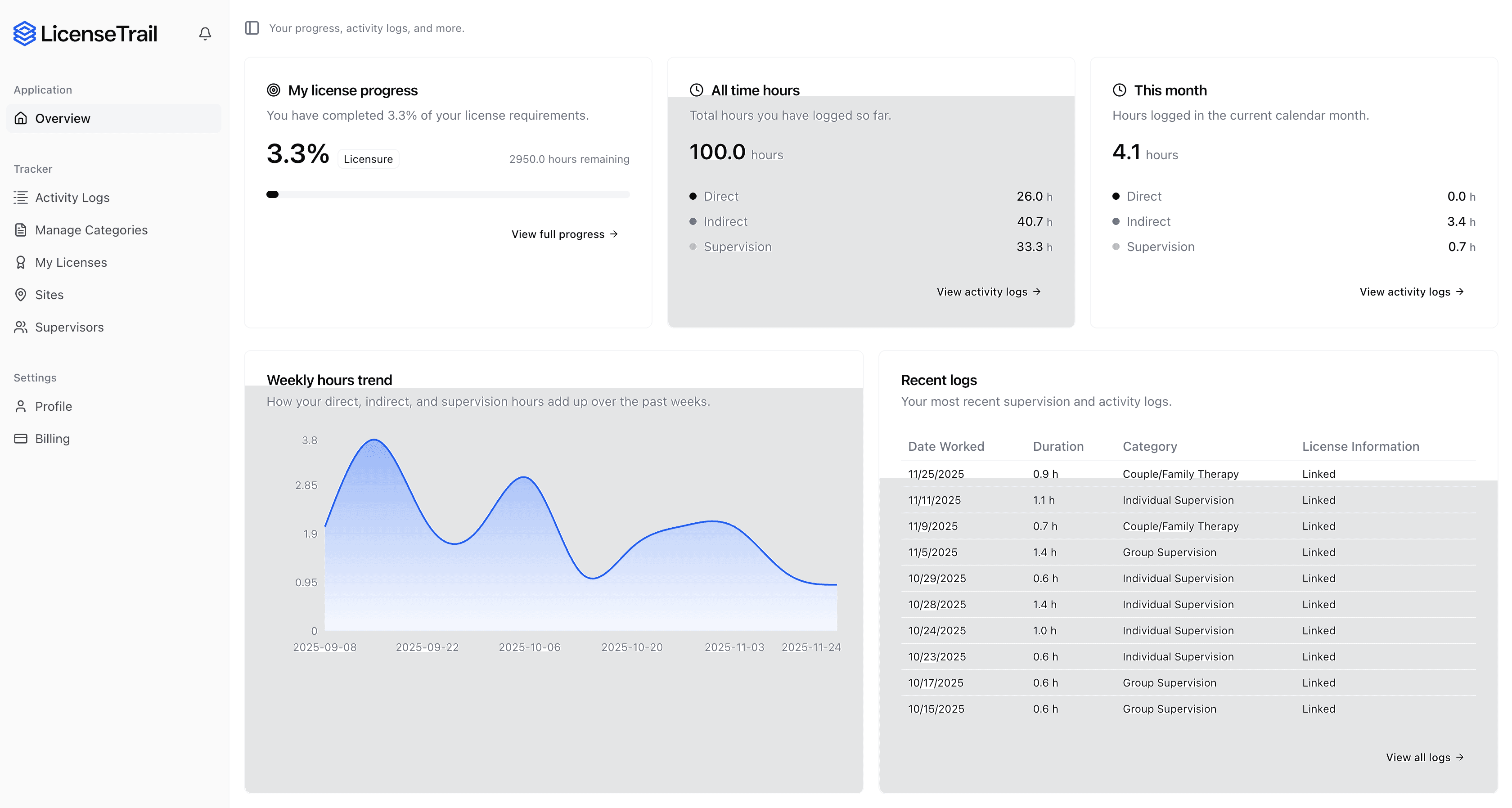
Track your Psychologist hours with confidence
License Trail checks your direct, indirect, and supervision hours against New-york Psychologist requirements continuously and flags mismatches before you submit.
 Start Tracking for Free
No credit card required · Free plan available
Is your spreadsheet hiding New-york Psychologist risks?
Stop guessing if your categories match New York State Board for Psychology requirements. License Trail checks your direct, indirect, and supervision hours continuously and flags mismatches before you submit.
Import or log
Bring your spreadsheet or start fresh
Upload your existing tracking spreadsheet and we'll map every hour into the right New York State Board for Psychology categories automatically.
Verify against New-york
Catch mismatches before the board does
License Trail checks your direct, indirect, and supervision hours against New-york Psychologist requirements continuously.
Export board-ready
One-click clean reports
Generate professional, board-ready reports for supervision meetings and New York State Board for Psychology submissions in seconds.
No credit card required · Free plan available