
North-carolina LCMHC Requirements: Hours, Exams & Step-by-Step Guide
Stop guessing if your categories match North-carolina requirements. License Trail checks your direct, indirect, and supervision hours against LCMHC requirements continuously and flags mismatches before you submit.
No credit card required · Free plan available
Quick Requirements Overview
- Education: Master’s in counseling/related field, 60 semester hrs/90 quarter hrs, from CACREP-accredited institution
- Pathway: Must first hold LCMHCA (restricted/associate), then upgrade to LCMHC (independent) after post-grad hours
- Supervised practice: 3,000 post-master’s hours (no practicum/internship credit), max 40 hrs/week, under Board-approved supervision/contracts
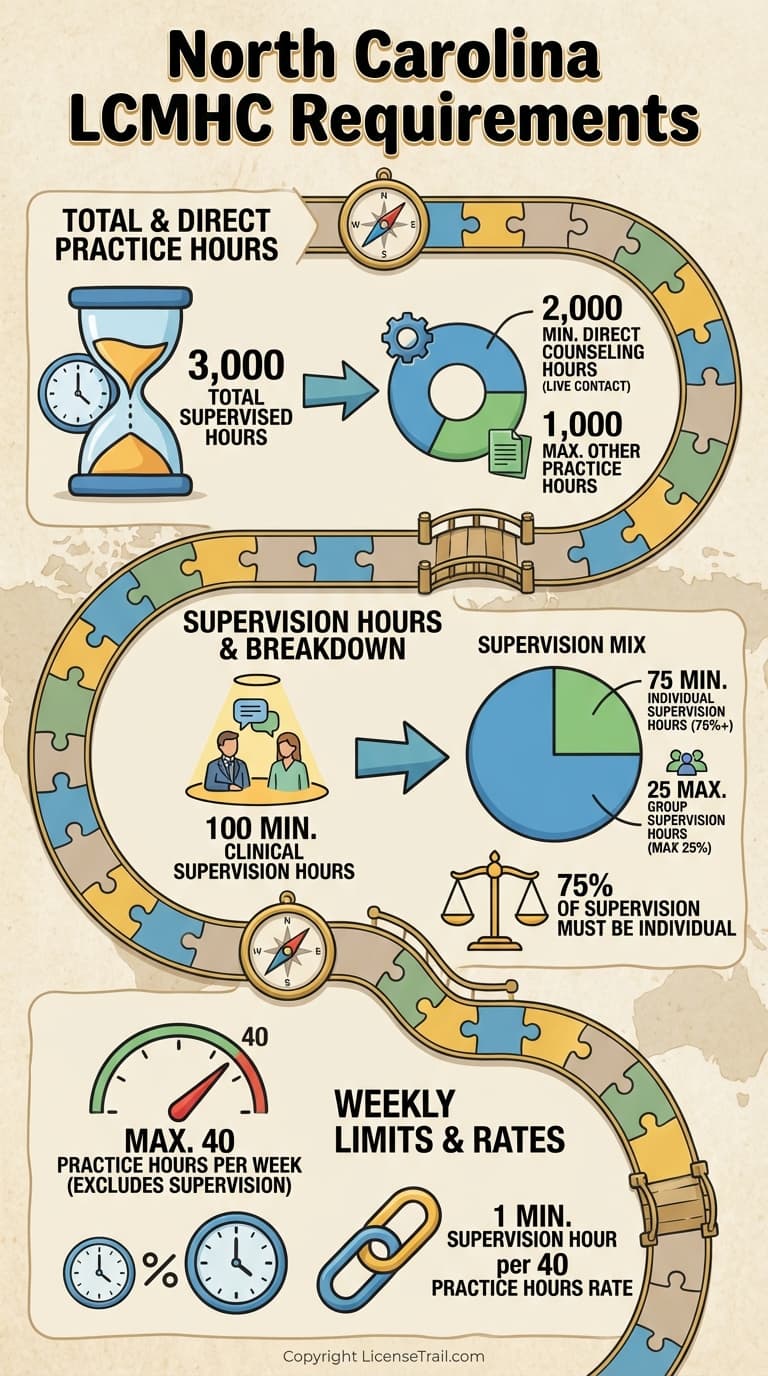
- Direct/Indirect split: ≥2,000 direct counseling hours (live client contact); ≤1,000 indirect (paperwork/calls/etc.)
- Supervision hours (separate): ≥100 clinical supervision hours, with ≥75 individual; supervision hours do not count toward the 3,000
- Supervision ratio/format: At least 1 hr individual or 2 hrs group per 40 hrs practice; group max 12; must include observed clinical work (not self-report only)
- Exams: Pass NCE or NCMHCE or CRC + NC Jurisprudence exam (within 6 months of application; “no-fail” completion certificate)
- Admin/compliance: Supervision contract(s) filed before practice (each setting/supervisor), ongoing reports/logs/final reports; PDS to clients; background check + refs (≥1 LCMHC); continue supervision until LCMHC issued
License Details
Procedures
North Carolina regulates Licensed Clinical Mental Health Counselors (LCMHCs) through the North Carolina Board of Licensed Clinical Mental Health Counselors (NCBLCMHC). The state uses a three‑tier system: Licensed Clinical Mental Health Counselor Associate (LCMHCA), Licensed Clinical Mental Health Counselor (LCMHC), and Licensed Clinical Mental Health Counselor Supervisor (LCMHCS). You must move through the Associate level to reach full, independent LCMHC licensure, and the Board sets very specific requirements for hours and supervision. (ncblcmhc.org)
Below is a step‑by‑step guide, focusing especially on the hour requirements and the Board’s own terminology.
1. Licensure tiers and overall pathway
For a new graduate trained in counseling, the standard in‑state pathway is:
- Complete an approved master’s degree in counseling or a related field.
- Obtain the LCMHCA (restricted/associate) license.
- Under the LCMHCA license, complete 3,000 hours of “supervised professional practice” with required supervision and direct‑service minimums.
- Apply to upgrade from LCMHCA to LCMHC (independent, non‑restricted) license.
The Board describes the LCMHC as an “independent, unrestricted license” held by counselors who have “completed at least 3,000 [hours] of supervised professional practice, with at 100 hours of supervision.” (ncblcmhc.org)
2. Educational requirements
For applicants after July 1, 2022, the Board requires: (ncblcmhc.org)
- Degree level and length
- A master’s degree with a minimum of 60 semester hours or 90 quarter hours in counseling or a related field.
- Institution / program
- The degree must be from an institution of higher education “accredited by the Council for Accreditation of Counseling and Related Educational Programs” (CACREP) (Board’s wording).
- Exam requirement tied to education
- Applicants must also “have passed an examination in accordance with rules adopted by the Board.”
In addition, the Board expects graduate coursework across standard counseling content areas (e.g., helping relationships, human growth and development, social and cultural foundations, group counseling, career counseling, assessment, research, and a supervised practicum and internship). (ncblcmhc.org)
These educational requirements are met before you begin accruing post‑master’s supervised hours toward LCMHC.
3. Initial licensure: becoming a LCMHCA
After meeting education and exam prerequisites, you first apply for the Licensed Clinical Mental Health Counselor Associate (LCMHCA). This is a restricted license that allows you to practice counseling only under Board‑approved supervision. (ncblcmhc.org)
Key points for the LCMHCA stage:
- The Board states that an LCMHCA is “a person engaged in the supervised practice of counseling” under the LCMHC Act. (ncblcmhc.org)
- You must have an approved supervision contract on file before providing counseling services.
- You may have multiple supervisors, but you need a separate supervision contract for each supervisor and each work setting. (ncblcmhc.org)
Once your LCMHCA license and supervision contract(s) are in place, you can begin accruing the hours that count toward full LCMHC licensure.
4. The core requirement: 3,000 hours of supervised professional practice
4.1 Total hours and basic rules
The central experiential requirement for becoming an LCMHC is:
- “3,000 hours supervised professional practice” after the qualifying master’s degree. (ncblcmhc.org)
The Board’s terminology and rules:
- Term used: “Supervised professional practice” – the Board defines this as “counseling experience under the supervision of a qualified clinical supervisor” (its own phrase). (ncblcmhc.org)
- Post‑master’s only: No hours from master’s‑level practicum or internship can be counted toward the 3,000 hours. (ncblcmhc.org)
- Weekly cap: You may count no more than 40 hours per week of supervised professional practice. (ncblcmhc.org)
In short: all 3,000 hours must be post‑graduate, under an active LCMHCA license, with a Board‑approved qualified clinical supervisor, and within the 40‑hours‑per‑week cap.
4.2 Breakdown of the 3,000 hours: direct vs indirect
Within the 3,000 hours, the Board distinguishes between direct counseling experience and indirect counseling experience, and sets a hard minimum for direct hours:
- Minimum direct counseling hours
- At least 2,000 hours must be direct counseling. (ncblcmhc.org)
- Remaining hours
- Up to 1,000 hours may be indirect (assuming you do exactly 2,000 direct hours; more direct is allowed as long as you reach 3,000 total).
The Board uses these definitions: (ncblcmhc.org)
- “Direct counseling experience – live contact with individuals, groups, or families through counseling” as defined in state statute.
- This includes face‑to‑face (or live synchronous telehealth) counseling involving evaluation, diagnosis, treatment planning, and other psychotherapeutic work.
- “Indirect counseling experience – counseling‑related work such as phone calls and paper work.”
So in the format you requested, the North Carolina requirements can be summarized numerically as:
- 3,000 hours of supervised professional practice, which must include:
- At least 2,000 hours of direct counseling experience (live client contact).
- Up to 1,000 hours of indirect counseling experience (case notes, treatment planning, calls, coordination, etc.).
Again, none of the 3,000 hours can come from your graduate practicum or internship, and they must be completed after your qualifying master’s degree. (ncblcmhc.org)
5. Clinical supervision requirements (separate from the 3,000 hours)
In addition to the 3,000 practice hours, the Board imposes a separate supervision requirement. These supervision hours do not count toward the 3,000.
5.1 Total supervision hours and required format
During your supervised professional practice as a LCMHCA, you must complete: (ncblcmhc.org)
- At least 100 hours of clinical supervision, and
- At least 75 of those hours must be individual supervision.
The Board sets a minimum supervision ratio:
- At least 1 hour of individual supervision OR 2 hours of group supervision for every 40 hours of supervised professional counseling practice. (ncblcmhc.org)
The Board also clarifies that individual and group clinical supervision hours do not count toward the 3,000 hours of supervised professional practice. (ncblcmhc.org)
5.2 Definitions of supervision types
Individual supervision (Rule .0210): (ncblcmhc.org)
- “Face‑to‑face supervision with one or two supervisees and a qualified clinical supervisor.”
- Must be live, interactive, and visual; video is allowed if it is synchronous with real‑time verbal and visual interaction.
- Minimum 1 hour per 40 hours of supervised professional practice when using individual supervision.
Group supervision (Rule .0211): (ncblcmhc.org)
- Face‑to‑face supervision with a group of supervisees (not more than 12) and a qualified supervisor.
- Provided in blocks of at least two hours of clinical supervision per group session.
Supervision must be based on actual observation of clinical work, using one or more of: direct/live observation, co‑therapy, audio or video recordings, or live supervision. Written materials and self‑reports may supplement but cannot be the sole basis of supervision sessions. (ncblcmhc.org)
5.3 Who counts as a “qualified clinical supervisor”
The Board’s term is “qualified clinical supervisor”. This includes: (ncblcmhc.org)
-
Licensed Clinical Mental Health Counselor Supervisor (LCMHCS) – an LCMHC who has:
- An independent license not under supervision;
- Graduate training or substantial continuing education in clinical supervision (3 semester credits or 45 CE hours);
- A defined amount of licensed professional counseling experience;
- And Board approval as a supervisor.
-
LCMHCs meeting supervisory criteria:
- Active, unrestricted LCMHC license;
- Supervision‑specific graduate coursework or 45 CE hours;
- At least 5 years of post‑graduate counseling experience, including 2 years post‑licensure.
-
Other equivalently and actively licensed mental health professionals, such as LMFTs, LCSWs, licensed psychologists, psychiatrists, and certain advanced practice psychiatric nurses, provided they:
- Hold at least a master’s degree;
- Have an independent, unrestricted license in good standing;
- Have supervision‑specific coursework or CE;
- Have at least 5 years post‑graduate experience with 2 years post‑licensure; and
- Complete continuing education specific to supervision.
Your supervision contract and Final Supervision Reports must identify these supervisors and be approved by the Board.
6. Documentation of supervised practice
The Board requires a structured paper trail for your supervised experience: (ncblcmhc.org)
- Supervision Contract – filed for each supervisor and each work setting, approved before counseling begins.
- Supervision Log – maintained by the supervisor and supervisee together, documenting:
- Date;
- Start and stop times;
- Supervision modality (live observation, co‑therapy, audio/video review, etc.);
- Notes on recommendations or interventions.
- Quarterly Supervision Reports – supervisors report each quarter that supervision has occurred.
- Final Supervision Report(s) – upon termination or completion of supervision, each supervisor submits a final report summarizing total hours (direct/indirect), supervision provided, and an assessment of competence.
The Board explicitly states that supervision must continue until the LCMHCA receives the LCMHC license; you cannot simply stop supervision once your hours are met but before the license is issued. (ncblcmhc.org)
7. Exams, Professional Disclosure, and application to LCMHC
When you are ready to convert from LCMHCA to LCMHC, the Board requires that you have: (ncblcmhc.org)
-
Examinations
- One nationally recognized exam:
- National Counselor Exam (NCE), or
- National Clinical Mental Health Counseling Exam (NCMHCE), or
- Certified Rehabilitation Counselor Exam (CRC).
- NC LCMHC Jurisprudence Exam:
- “No fail” exam;
- Must be completed within 6 months of the application submission date;
- Certificate of completion must accompany the application.
- One nationally recognized exam:
-
Professional Disclosure Statement (PDS)
- Must be provided to clients prior to rendering counseling services.
- A signed copy must be kept in the client record.
- Must include all required items listed in Board Rule .0204.
-
Application package via the online portal
- LCMHCA‑to‑LCMHC application sections:
- General Information
- Credentials
- Legal & Ethics History
- Education
- References (three references; at least one must be an LCMHC)
- Supervised Professional Practice
- Graduate courses/experience as applicable
- Required documents:
- Application validation (notarized);
- Criminal background check;
- Jurisprudence exam certificate;
- LCMHC‑level Professional Disclosure Statement;
- Final Supervision Report(s) from each supervisor;
- Licensure verification (if any out‑of‑state licensure applies).
- Application fee: $238 (includes a $38 criminal background check fee).
- LCMHCA‑to‑LCMHC application sections:
You must hold an active LCMHCA license at the time the application is reviewed, and you must continue under supervision until the Board issues the LCMHC license. (ncblcmhc.org)
8. Summary of hour and supervision requirements (new‑grad, in‑state pathway)
For clarity, the Board’s requirements to move from LCMHCA to full LCMHC licensure in North Carolina are:
-
3,000 hours of “supervised professional practice”, all post‑master’s, under an active LCMHCA and a Board‑approved qualified clinical supervisor.
- At least 2,000 hours of “direct counseling experience” (live client contact with individuals, groups, or families).
- Up to 1,000 hours of “indirect counseling experience” (counseling‑related tasks such as phone calls and paperwork).
- No more than 40 hours per week can be counted.
- No hours from Master’s‑level practicum or internship can be counted.
-
At least 100 hours of clinical supervision, separate from and not counted toward the 3,000 hours:
- At least 75 hours must be individual supervision.
- Minimum ratio of 1 hour individual or 2 hours group supervision for every 40 hours of supervised practice.
- Supervision must be based on direct observation methods (live, co‑therapy, recordings, etc.), not solely on self‑report.
These hour and supervision requirements, combined with the education, exams, Professional Disclosure Statement, references, background check, and a complete application, are what the North Carolina Board requires for a counselor to become a Licensed Clinical Mental Health Counselor (LCMHC). (ncblcmhc.org)
Track your LCMHC hours with confidence
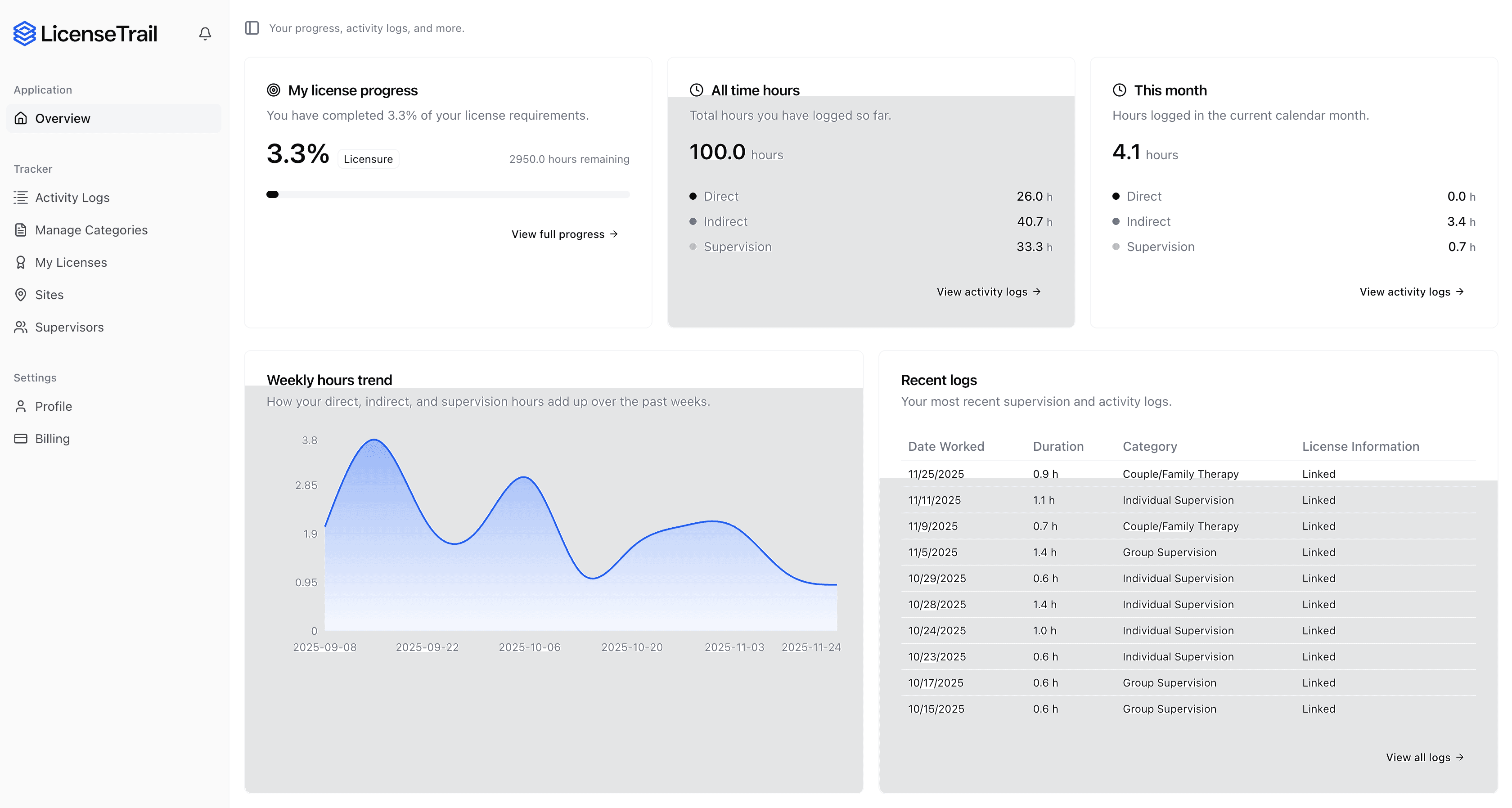
License Trail checks your direct, indirect, and supervision hours against North-carolina LCMHC requirements continuously and flags mismatches before you submit.
 Start Tracking for Free
No credit card required · Free plan available
Is your spreadsheet hiding North-carolina LCMHC risks?
Stop guessing if your categories match North Carolina Board of Licensed Clinical Mental Health Counselors requirements. License Trail checks your direct, indirect, and supervision hours continuously and flags mismatches before you submit.
Import or log
Bring your spreadsheet or start fresh
Upload your existing tracking spreadsheet and we'll map every hour into the right North Carolina Board of Licensed Clinical Mental Health Counselors categories automatically.
Verify against North-carolina
Catch mismatches before the board does
License Trail checks your direct, indirect, and supervision hours against North-carolina LCMHC requirements continuously.
Export board-ready
One-click clean reports
Generate professional, board-ready reports for supervision meetings and North Carolina Board of Licensed Clinical Mental Health Counselors submissions in seconds.
No credit card required · Free plan available