
North-carolina LCSW Requirements: Hours, Exams & Step-by-Step Guide
Stop guessing if your categories match North-carolina requirements. License Trail checks your direct, indirect, and supervision hours against LCSW requirements continuously and flags mismatches before you submit.
No credit card required · Free plan available
Quick Requirements Overview
- Education: MSW/DSW/PhD in Social Work from a CSWE-accredited/approved (or candidacy) program (foreign grads need CSWE equivalency).
- Associate stage required: Must hold LCSWA while earning post‑MSW clinical hours; practice only under appropriate supervision (with access to emergency clinical consultation).
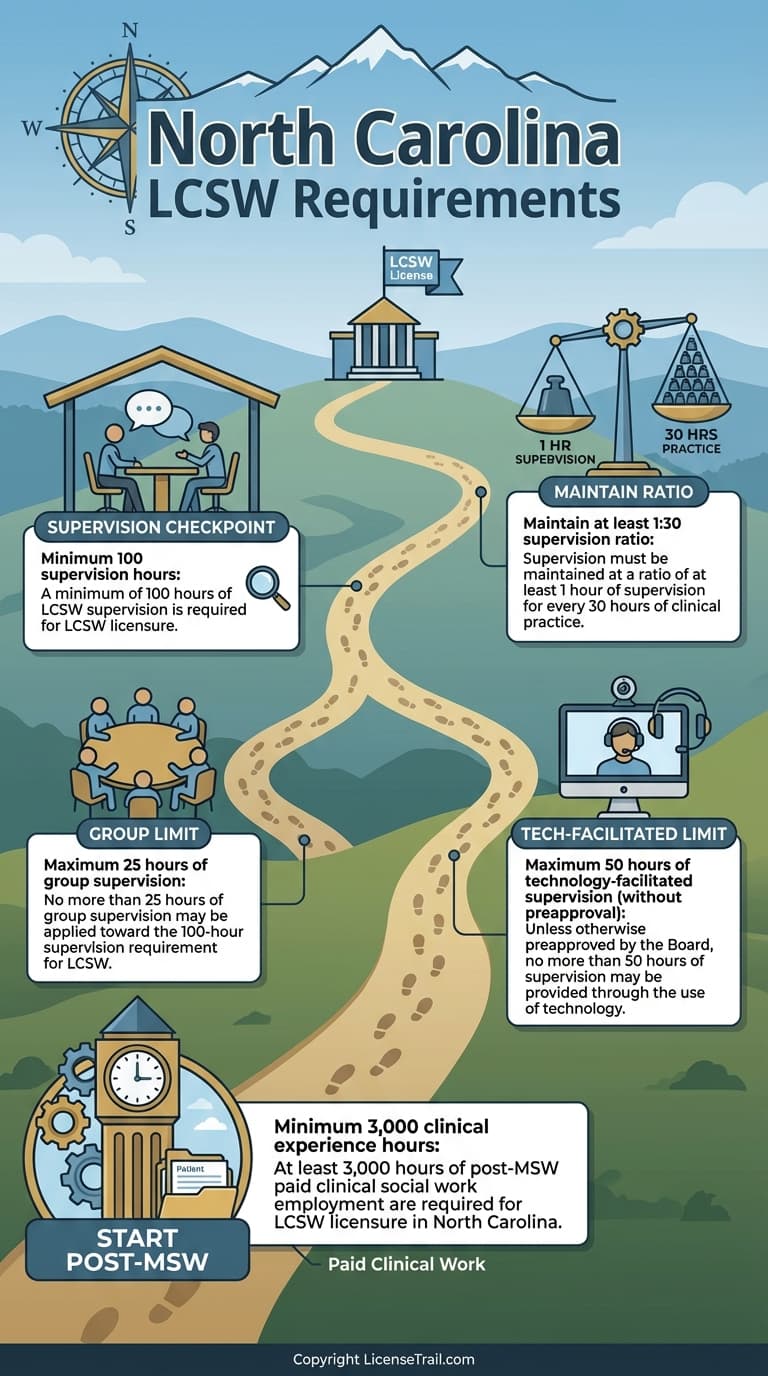
- Clinical experience: 3,000 clock hours of post‑MSW, paid clinical social work practice (no direct/indirect split); no practicum/internship hours.
- Timeframe: 3,000 hours completed in ≥ 2 years (24 months) and ≤ 6 consecutive years.
- Supervision total/ratio: 100 hours minimum of clinical supervision, at 1 hour per 30 practice hours, at least every 2 weeks.
- Supervision format limits: Max 25 hours group; max 50 hours via synchronous technology (unless Board pre-approves more).
- Supervisor qualifications: NC LCSW (good standing) + MSW with ≥ 2 years post‑LCSW clinical practice (discipline history may require Board permission).
- Exam & upgrade: After documenting hours/supervision, pass ASWB Clinical exam, then apply to convert to LCSW (Short Form) (CE + fee required).
License Details
Procedures
Becoming a Licensed Clinical Social Worker (LCSW) in North Carolina is a two‑stage process overseen by the North Carolina Social Work Certification and Licensure Board (NCSWCLB). You first practice as a Licensed Clinical Social Worker Associate (LCSWA) while you accumulate supervised clinical experience and supervision hours, then you upgrade to full LCSW.
Below is a step‑by‑step guide focused on the exact types and amounts of hours North Carolina requires and how the Board itself describes them.
1. Understand what “clinical social work” and “experience” mean in North Carolina
North Carolina law and rules define the experience requirement for LCSW in terms of post‑MSW, paid, clinical social work practice under supervision, not as separate “direct” vs “indirect” hour categories.
Core experience definition
Under 21 NCAC 63 .0211(a)(1), the Board states that:
- Two years of post‑MSW clinical social work experience means
“3,000 clock hours of work or employment for a fee or salary while engaged in the practice of clinical social work.” (ncswboard.gov) - These 3,000 hours must:
- Be post‑MSW (hours before the MSW do not count).
- Be paid employment (“for a fee or salary”), not volunteer hours. (ncswboard.gov)
- Be clinical social work practice as defined in the statute (e.g., assessment, diagnosis, treatment/psychotherapy, prevention of mental and emotional disorders, etc.). (ncswboard.gov)
- Be accumulated in no less than two (2) years and no more than six (6) consecutive years. (ncswboard.gov)
- Do not include practicum or internship experience that was part of an educational program. (ncswboard.gov)
On the Board’s licensure page, this is summarized as a:
“Minimum of 3,000 hours of post MSW paid clinical employment (appropriately supervised clinical practice) accumulated in no less than two (2) years, nor more than six (6) years.” (ncswboard.gov)
Important: North Carolina does not divide the 3,000 hours into, for example, “1,500 direct” and “1,500 indirect.” Instead:
- All 3,000 hours must be post‑MSW, paid, clinical practice, and
- They must be accumulated under appropriate supervision while you hold the LCSWA.
2. Step One: Meet the education requirement
To be eligible for LCSWA and ultimately LCSW, you must have: (ncswboard.gov)
- A Master of Social Work (MSW), Doctor of Social Work (DSW), or PhD in social work.
- The degree must be from a program approved, accredited, or in candidacy for accreditation by the Council on Social Work Education (CSWE).
Applicants educated outside the U.S. must get a CSWE equivalency determination. (ncswboard.gov)
3. Step Two: Obtain the LCSW Associate (LCSWA) license
If you want to practice clinical social work in North Carolina but have not yet met the experience requirements for LCSW, you must first be licensed at the LCSWA level. (ncswboard.gov)
Key points about the LCSWA:
- It is the required status while you accumulate LCSW‑qualifying experience.
- No experience is required to receive the LCSWA itself, but all LCSW‑qualifying hours must be post‑MSW paid clinical employment. (ncswboard.gov)
- The LCSWA is issued for two years and may be renewed; however, all 3,000 hours must be completed within six years (two renewal cycles). (ncswboard.gov)
- LCSWAs must practice only under appropriate supervision and must have immediate access to emergency clinical consultation before beginning practice. (ncswboard.gov)
- LCSWAs must submit supervision and practice documentation to the Board every six months. (ncswboard.gov)
4. Step Three: Accumulate the 3,000 hours of clinical practice
Total practice hours required
For full LCSW licensure, North Carolina requires: (ncswboard.gov)
- 3,000 hours of post‑MSW paid clinical employment (clinical social work practice),
- Completed over at least 24 months (2 years) and no more than 6 consecutive years.
Again, this is one pool of hours: 3,000 supervised clinical practice hours, not a split between direct vs indirect.
What counts as qualifying clinical practice?
The Board’s rules and statute require that all experience counted toward the 3,000 hours be “clinical social work” as defined in state law. In practice, qualifying work typically includes:
- Psychosocial assessment and diagnosis.
- Treatment of mental and emotional disorders (e.g., individual, family, and group psychotherapy).
- Clinical interventions related to behavioral and emotional problems.
- Case documentation and clinical case management that is directly tied to assessment/treatment of mental and emotional disorders.
Administrative, purely case‑management, or macro‑practice roles that do not meet the clinical definition may not count; the Board ultimately decides whether your duties meet the definition of clinical social work. (ncswboard.gov)
5. Step Four: Meet the clinical supervision requirements
In North Carolina, supervision hours are separate from, and in addition to, the 3,000 practice hours. The Board is very specific about the nature, amount, and structure of supervision.
Who qualifies as a supervisor (“appropriate supervision”)?
Under the rules: (ncswboard.gov)
- Your supervisor must:
- Hold a MSW and be a Licensed Clinical Social Worker (LCSW) in good standing with the Board.
- Have at least two years of post‑LCSW clinical practice experience.
- A supervisor with a prior disciplinary history may not supervise without written permission from the Board.
- The supervisor must be able to review and discuss your clinical cases, documentation, and give evaluative feedback and direction.
Amount and ratio of supervision required
The Board requires: (ncswboard.gov)
- Minimum of 100 hours of clinical supervision total.
- Supervision must be ongoing and regular, conducted at least once every two weeks.
- You must receive supervision at a ratio of at least 1 hour of supervision for every 30 hours of clinical practice.
- Practically, if you accrue 3,000 practice hours at the 1:30 ratio, you will have at least 100 supervision hours.
- Group versus individual supervision:
- A maximum of 25 hours of the required 100 may be group supervision.
- The remaining supervision hours must be individual (one‑on‑one) supervision.
- Technology‑based supervision: Current Board rules allow no more than 50 hours of supervision to be provided via synchronous technology (e.g., secure video), unless the Board pre‑approves more on a case‑by‑case basis. (ncswboard.gov)
Nature of supervision sessions
The rules specify that: (ncswboard.gov)
- Supervision must be face‑to‑face (in person or synchronous video when allowed).
- During supervision, the LCSW supervisor:
- Reviews and discusses your clinical cases.
- Reviews your documentation.
- Provides evaluative comments and direction about your clinical work.
6. Step Five: Pass the ASWB Clinical Examination
To be granted the LCSW, you must pass the Association of Social Work Boards (ASWB) Clinical level examination. (ncswboard.gov)
Key sequencing in North Carolina:
- You are initially licensed as LCSWA without taking the exam.
- After you have documented two full years of supervised clinical practice (at least 24 months) with no fewer than 3,000 clinical practice hours and at least 100 hours of appropriate clinical supervision, the Board grants exam eligibility for the ASWB Clinical exam. (ncswboard.gov)
- You must pass the exam before the Board will issue the LCSW license.
7. Step Six: Apply for LCSW (Short Form) after all requirements are met
Once you have met all LCSW requirements, you apply to convert your LCSWA to full LCSW via the Board’s Short Form LCSW application. The Board’s guidance explains that you may submit this once you have: (ncswboard.gov)
- Completed two full years (24 months) of supervised clinical practice.
- Documented at least 3,000 hours of supervised clinical practice.
- Documented at least 100 hours of appropriate clinical supervision, with no more than 25 hours of group supervision.
- Passed the ASWB Clinical exam.
- Completed required continuing education and enclosed the application fee.
The Board notes that review of a completed Short Form application may take a minimum of 21 days. (ncswboard.gov)
8. Ongoing licensure and renewal (after you’re an LCSW)
For context once you are licensed: (ncswboard.gov)
- The LCSW credential is issued for a period not to exceed 2 years.
- Renewal requires:
- Payment of the biennial renewal fee (the Board lists current fees).
- Documentation of 40 clock hours of continuing education every 2 years, including 4 hours in ethics.
9. Hour requirements summarized
To clarify the structure of hours (since you mentioned examples like “1,500 direct and 1,500 supervised”):
North Carolina LCSW Requirements (Post‑MSW, NCSWCLB)
| Category | Required Amount | How the Board Describes It |
|---|---|---|
| Clinical practice hours | 3,000 hours | “3,000 hours of post MSW paid clinical employment (appropriately supervised clinical practice)… accumulated in no less than two (2) years, nor more than six (6) years.” (ncswboard.gov) |
| Time frame for experience | ≥ 2 years, ≤ 6 years | Must be accumulated over at least 24 months and no more than six consecutive years. (ncswboard.gov) |
| Supervision hours (total) | 100 hours minimum | “A minimum of 100 hours of supervision… at least one (1) hour of supervision for every thirty (30) hours of clinical practice.” (ncswboard.gov) |
| Supervision ratio | 1:30 | At least 1 hour of supervision for every 30 hours of clinical practice. (ncswboard.gov) |
| Group supervision limit | Max 25 hours | No more than 25 of the 100 required supervision hours may be group. (ncswboard.gov) |
| Technology‑based supervision limit | Max 50 hours (without special approval) | No more than 50 supervision hours may be via synchronous technology unless the Board pre‑approves more. (ncswboard.gov) |
| License type while accruing hours | LCSWA | Must practice as a Licensed Clinical Social Worker Associate under appropriate supervision. (ncswboard.gov) |
So, instead of something like “1,500 hours of direct experience and 1,500 hours of supervised experience,” North Carolina requires:
- 3,000 hours of post‑MSW, paid, supervised clinical social work practice, plus
- At least 100 hours of clinical supervision at a 1:30 supervision‑to‑practice ratio,
- All completed over at least 2 years and no more than 6 years, while licensed as an LCSWA under an approved LCSW supervisor.
Track your LCSW hours with confidence
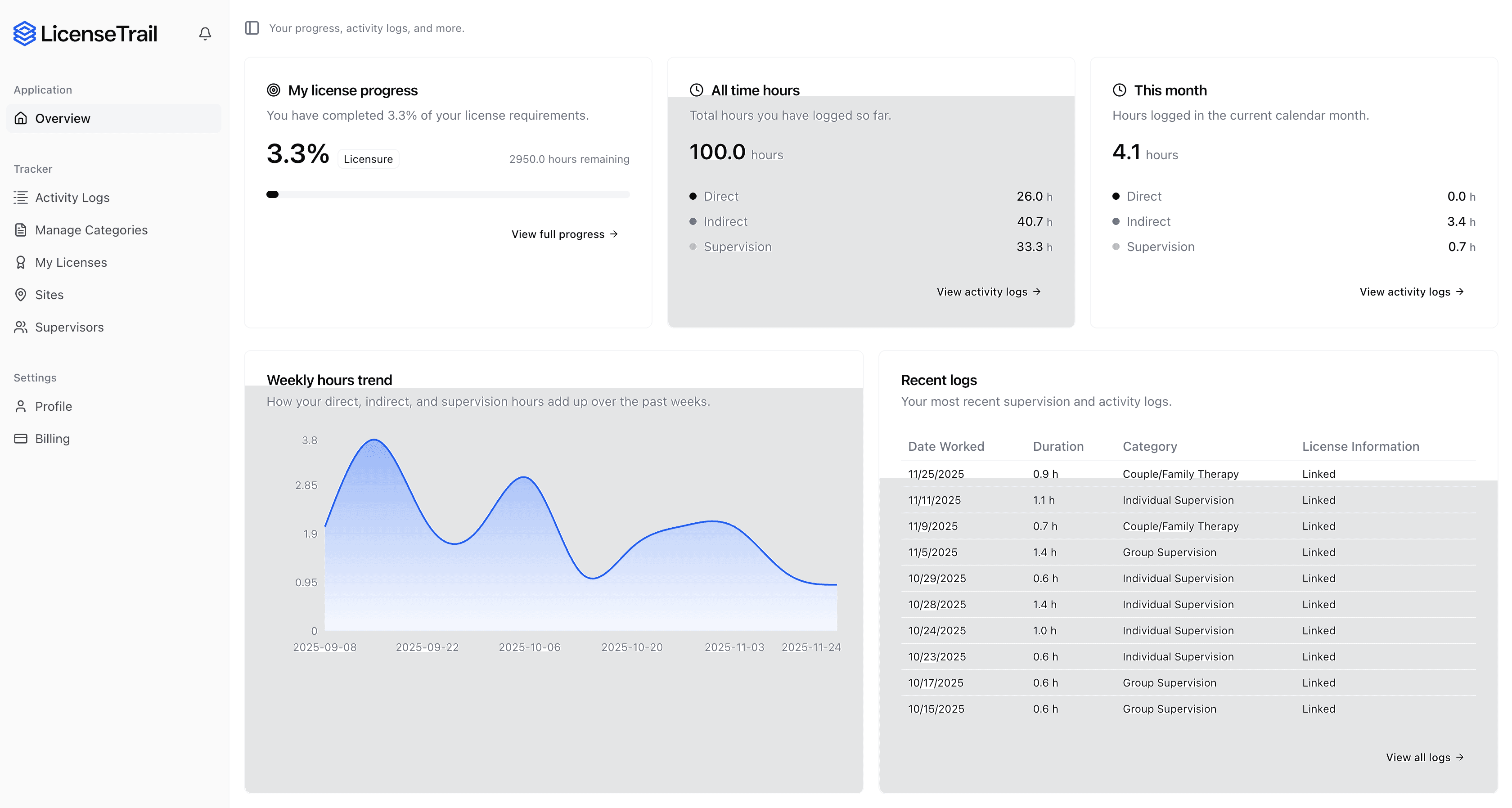
License Trail checks your direct, indirect, and supervision hours against North-carolina LCSW requirements continuously and flags mismatches before you submit.
 Start Tracking for Free
No credit card required · Free plan available
Is your spreadsheet hiding North-carolina LCSW risks?
Stop guessing if your categories match North Carolina Social Work Certification and Licensure Board requirements. License Trail checks your direct, indirect, and supervision hours continuously and flags mismatches before you submit.
Import or log
Bring your spreadsheet or start fresh
Upload your existing tracking spreadsheet and we'll map every hour into the right North Carolina Social Work Certification and Licensure Board categories automatically.
Verify against North-carolina
Catch mismatches before the board does
License Trail checks your direct, indirect, and supervision hours against North-carolina LCSW requirements continuously.
Export board-ready
One-click clean reports
Generate professional, board-ready reports for supervision meetings and North Carolina Social Work Certification and Licensure Board submissions in seconds.
No credit card required · Free plan available