
North-carolina LMFT Requirements: Hours, Exams & Step-by-Step Guide
Stop guessing if your categories match North-carolina requirements. License Trail checks your direct, indirect, and supervision hours against LMFT requirements continuously and flags mismatches before you submit.
No credit card required · Free plan available
Quick Requirements Overview
- Qualifying grad degree: Master’s (or higher) in MFT or related mental health field with ≥45 semester hours from a regionally accredited school; COAMFTE accepted, otherwise coursework/syllabi review; official transcript sent directly to Board.
- Exam: Must pass the AMFTRB National MFT Exam (only exam accepted), including for out-of-state licensees.
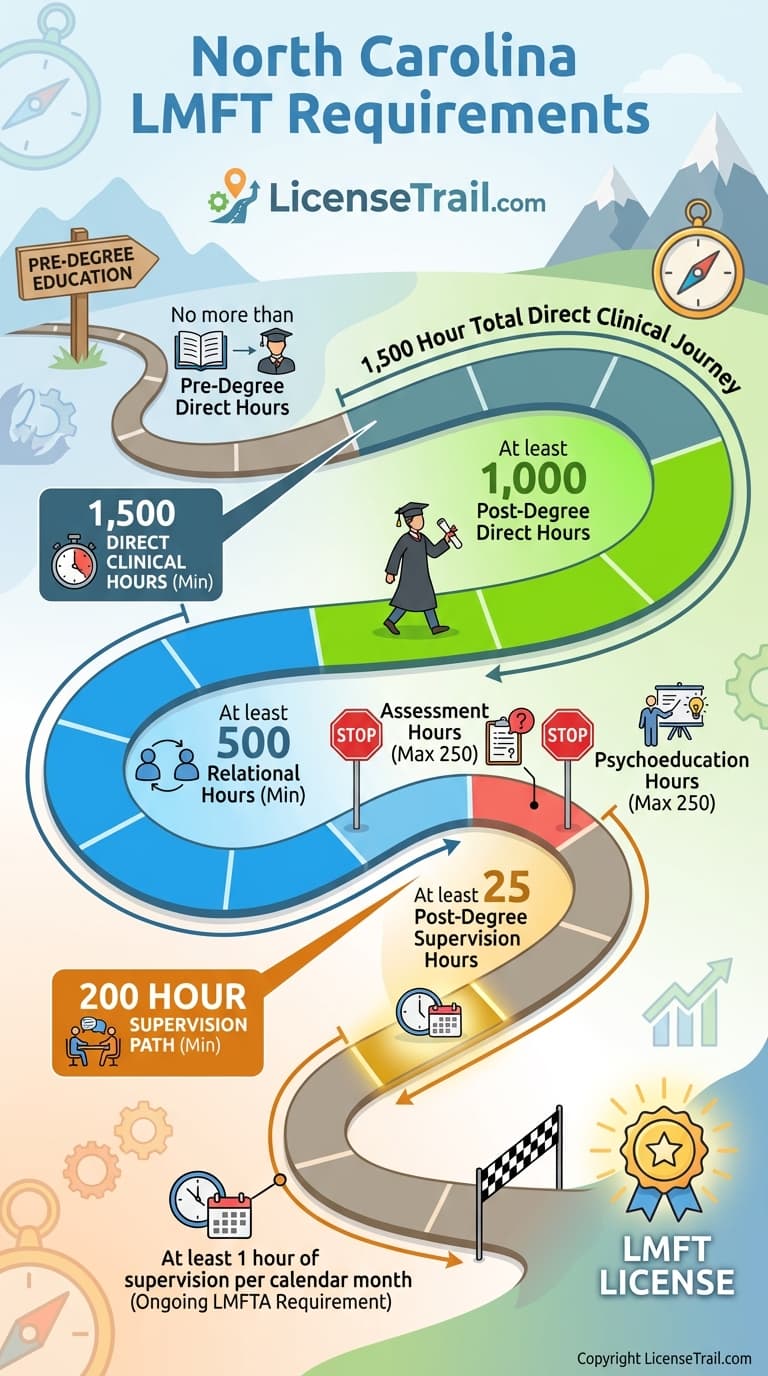
- Clinical hours for LMFT: 1,500 documented face-to-face MFT clinical hours; ≤500 may be earned in-degree; ≥1,000 must be post-degree.
- Relational requirement: ≥500 of the 1,500 clinical hours must be relational (couple/family/system) hours.
- Supervision: 200 hours of supervision with an AAMFT Approved Supervisor or Board-accepted Supervisor Candidate; ≥25 supervision hours must be post-degree.
- Supervisor rule: Hours count only if under AAMFT Approved Supervisor/accepted Candidate; if not, must complete 1,500 clinical + 200 supervision post-degree (no exceptions).
- Typical pathway/time limit: Usually obtain LMFTA first; must practice under approved supervision and complete hours within 3 years (possible 1-year extension).
- Background check: For applications started on/after Oct 1, 2025, fingerprint-based background check required ($38; results can take 1–4 weeks).
License Details
Procedures
The North Carolina Marriage and Family Therapy Licensure Board (NCMFTLB) licenses at two main levels:
- Licensed Marriage and Family Therapist Associate (LMFTA)
- Licensed Marriage and Family Therapist (LMFT) – the unrestricted license you asked about
To become an LMFT, you must meet specific education, exam, clinical hour, and supervision requirements under the NCMFTLB’s rules.
1. Educational foundation
North Carolina requires a qualifying graduate degree before you can be licensed.
- The Board approves licensure based on “whether a master’s degree in MFT or a related mental health degree with a minimum of 45 semester hours” from a regionally accredited university has been conferred. (ncbmft.org)
- Degrees from COAMFTE-accredited MFT programs are accepted; “all other applicants are considered related degree applicants” and must submit syllabi for required coursework. (ncbmft.org)
In practice, you will need:
- A master’s (or higher) in Marriage and Family Therapy, or
- A closely related mental health degree that meets NC’s MFT coursework requirements.
Your transcript must be sent directly from the institution to the Board (usually electronically). (ncbmft.org)
2. National MFT Examination
North Carolina recognizes only the AMFTRB National MFT Examination.
- “The only exam accepted and recognized for NC MFT Licensure purposes is the AMFTRB National MFT Exam.” (ncbmft.org)
- Passing the National MFT Exam is required of all applicants for MFT licensure in NC, including those already licensed in other states. (ncbmft.org)
You typically:
- Apply through the MFT Exam Application in the NC applicant portal once you’re in the last semester of your program or after graduation. (ncbmft.org)
- Receive an approval code from the Board to register with the exam service.
- Take and pass the National MFT Exam.
- Keep your official score report to upload later with your license application. (ncbmft.org)
3. LMFTA: Supervised practice prior to LMFT
Most new graduates first obtain the Licensed Marriage and Family Therapist Associate (LMFTA) credential.
The Board describes LMFTA as:
- “For those who have not gained the required hours to apply for Licensed Marriage Family Therapist (LMFT). LMFTAs must practice under an AAMFT Supervisor.” (ncbmft.org)
Key points about the LMFTA stage:
- You must have a supervision agreement with an AAMFT Approved Supervisor (or approved Supervisor Candidate) on file with the Board; this is built into the LMFTA application. (ncbmft.org)
- LMFTAs “have up to three years (a maximum of a one-year extension may be granted) from the date of initial licensing to acquire the clinical and approved supervision hours required for conversion to an LMFT.” (ncbmft.org)
- The FAQ clarifies: “The LMFTA is a provisional license. The licensee will have up to three years in which to acquire the remaining clinical and supervised hours required for unrestricted licensure (LMFT).” (ncbmft.org)
LMFTAs must also complete 20 hours of continuing education per year (including 3 hours of ethics); up to 12 hours can come from supervision. (ncbmft.org)
4. Clinical and supervision hours required for LMFT
The Board’s requirements for upgrading to LMFT are framed in two connected ways: a concise licensure standard, and a more detailed FAQ.
4.1. Core LMFT requirement (from the License Application page)
For the LMFT license, the Board states you must have:
- “At least 1500 hours of documented clinical experience (face-to-face therapy) in the practice of marriage and family therapy, not more than 500 hours of which were obtained while the applicant was a student in his/her qualifying degree program, at least 1000 of which were obtained after the degree was granted. At least 500 of the required 1500 hours must be relational hours. A minimum of 200 supervision hours with an AAMFT certified supervisor.” (ncbmft.org)
In other words:
-
1500 total clinical hours
- Must be documented clinical experience and specifically “face-to-face therapy” in MFT practice. (ncbmft.org)
- Up to 500 of these 1500 hours may be accrued during your qualifying degree program (if properly supervised – see below).
- At least 1000 clinical hours must be after your degree is granted (post-degree or as an LMFTA). (ncbmft.org)
-
Relational hour requirement
- “At least 500 of the required 1500 hours must be relational hours.” (ncbmft.org)
- “Relational hours” means sessions where you are working with couples, families, or other relational systems (not just individual clients).
-
Supervision requirement (200 hours total)
- The Board’s FAQ summarizes: “A total of 1500 clinical hours with 200 approved supervision hours (AAMFT Approved Supervisor or accepted AAMFT Supervisor Candidate) is the minimum requirement.” (ncbmft.org)
- Supervision must be with an AAMFT Approved Supervisor or a Supervisor Candidate accepted by the Board; “there are no exceptions to this rule.” (ncbmft.org)
4.2. How pre-degree and post-degree hours can be used
The FAQ clarifies which hours may count:
- “Up to 500 clinical hours and any amount of approved supervision earned while in your qualifying degree program may be counted toward the licensure requirement as long as they were under an AAMFT Approved Supervisor or an AAMFT Supervisor Candidate.” (ncbmft.org)
- “The remaining **1000 hours must be acquired, under approved supervision … or post licensure (LMFTA).” (ncbmft.org)
So, for most candidates:
- You can bring in 0–500 clinical hours and some supervision from your practicum/internship, if and only if those activities were supervised by a Board-recognized AAMFT Approved Supervisor or Candidate.
- The balance (at least 1000 hours) must be completed after graduation, usually as an LMFTA under approved supervision.
4.3. Minimum post-degree supervision
Even if you had substantial supervision in your graduate program, the Board imposes a minimum post-degree requirement:
- “A minimum of 25 supervision hours must be acquired post degree, regardless of the number of hours earned prior to completion of your degree.” (ncbmft.org)
Example: if you completed 200 supervision hours during your master’s, you still must complete at least 25 additional supervision hours after graduation under a Board-accepted AAMFT supervisor.
4.4. If your graduate supervision was not AAMFT-approved
If your practicum/internship supervisor was not an AAMFT Approved Supervisor or approved Supervisor Candidate:
- The Board explains that while such experience “may count toward the education requirement” if listed on your transcript, “the hours will not count toward the licensure requirement.” (ncbmft.org)
- In that situation, “You will need to earn 1500 clinical and 200 supervision hours post-degree under the supervision of an AAMFT Approved Supervisor or AAMFT Supervisory Candidate … or post licensure (LMFTA) as an LMFTA before applying for LMFT. There are NO EXCEPTIONS to this requirement.” (ncbmft.org)
5. Ongoing supervision expectations while you accrue hours
While you are working toward LMFT:
- All clinical hours you want to count must be “under the direction of an AAMFT Approved Supervisor or accepted Supervisory Candidate.” (ncbmft.org)
- For LMFTAs, the Board states you must “remain under the minimum supervision requirements until you are notified that LMFT has been approved which is at least one hour per month.” (ncbmft.org)
In practice, you set up a regular supervision schedule with your AAMFT supervisor, report hours quarterly through the Board’s reporting system, and maintain at least monthly supervision until your LMFT is formally granted.
6. Background check and application mechanics
As of October 1, 2025, North Carolina added a criminal background check requirement for new license applications:
- “Effective October 1, 2025 all new license applications started October 1, 2025 and after will require a background check.” (ncbmft.org)
- The process (handled in the online portal) includes:
- Paying a $38 fee.
- Downloading the Applicant Fingerprinting Guide and completing the Release of Information and Applicant Information forms.
- Being fingerprinted at a local law enforcement agency (often via LiveScan).
- Uploading the signed Release of Information form to your application. (ncbmft.org)
- The Board notes it can take 1–4 weeks for the SBI to send results, and “you will not be able to move forward with your application for licensure until the report is received.” (ncbmft.org)
The LMFT application itself is fully online:
- You apply for LMFT either through:
- LMFTA to LMFT Application (if already an NC LMFTA with required hours), or
- LMFT Application (if you meet all requirements without going through LMFTA, e.g., some reciprocity/experience cases). (ncbmft.org)
- Completed applications are typically reviewed around the 5th and 20th of each month. (ncbmft.org)
7. Step-by-step summary: Path to LMFT in North Carolina
Putting the Board’s requirements together, a typical new clinician’s path looks like this:
-
Complete a qualifying graduate degree
- Master’s in MFT or related mental health field meeting NC coursework rules (≥45 semester hours). (ncbmft.org)
-
Take and pass the National MFT Exam
- Apply through NC’s Exam Application, get an approval code, then register with the exam service.
- Pass the AMFTRB National MFT Exam and retain your score report. (ncbmft.org)
-
Obtain LMFTA and begin supervised practice
- File LMFTA application with supervision agreement (AAMFT Approved Supervisor/Supervisor Candidate).
- Work as an LMFTA while accruing:
- 1500 clinical hours of face-to-face MFT therapy (including 500 relational hours).
- 200 hours of approved supervision with a Board-recognized AAMFT supervisor. (ncbmft.org)
- Ensure at least 1000 clinical hours and 25 supervision hours are post-degree, and that any hours you wish to count (including pre-degree) were under an AAMFT Approved Supervisor or Candidate. (ncbmft.org)
-
Maintain supervision and CE while LMFTA
- Continue at least monthly supervision until LMFT is approved.
- Complete 20 hours of CE annually (3 ethics; up to 12 may be supervision). (ncbmft.org)
-
When hours are complete, submit LMFT application
- Choose “LMFTA to LMFT Application” in the portal (if applicable).
- Upload clinical and supervision documentation, exam score, transcripts, and any required endorsements.
- Complete the background check (if your LMFT application was started on or after October 1, 2025). (ncbmft.org)
-
Receive LMFT license
- After Board approval, you can print your license from the online portal and practice as an independent LMFT in North Carolina. (ncbmft.org)
8. Reciprocity/endorsement note
If you are already licensed as an LMFT in another state:
- North Carolina allows LMFT licensure by reciprocity if you have been licensed as an LMFT in another jurisdiction for at least two years, are in good standing, and have passed the required exam. However, “there is no automatic reciprocity agreement with any state,” and you must still apply and meet documentation requirements. (ncbmft.org)
In summary, North Carolina’s LMFT license hinges on a qualifying graduate degree, passage of the National MFT Exam, and—crucially—1500 documented face-to-face clinical hours (including 500 relational) plus 200 hours of AAMFT-approved supervision, with strict rules about how many of those hours must be post-degree and under recognized supervisors.
Track your LMFT hours with confidence
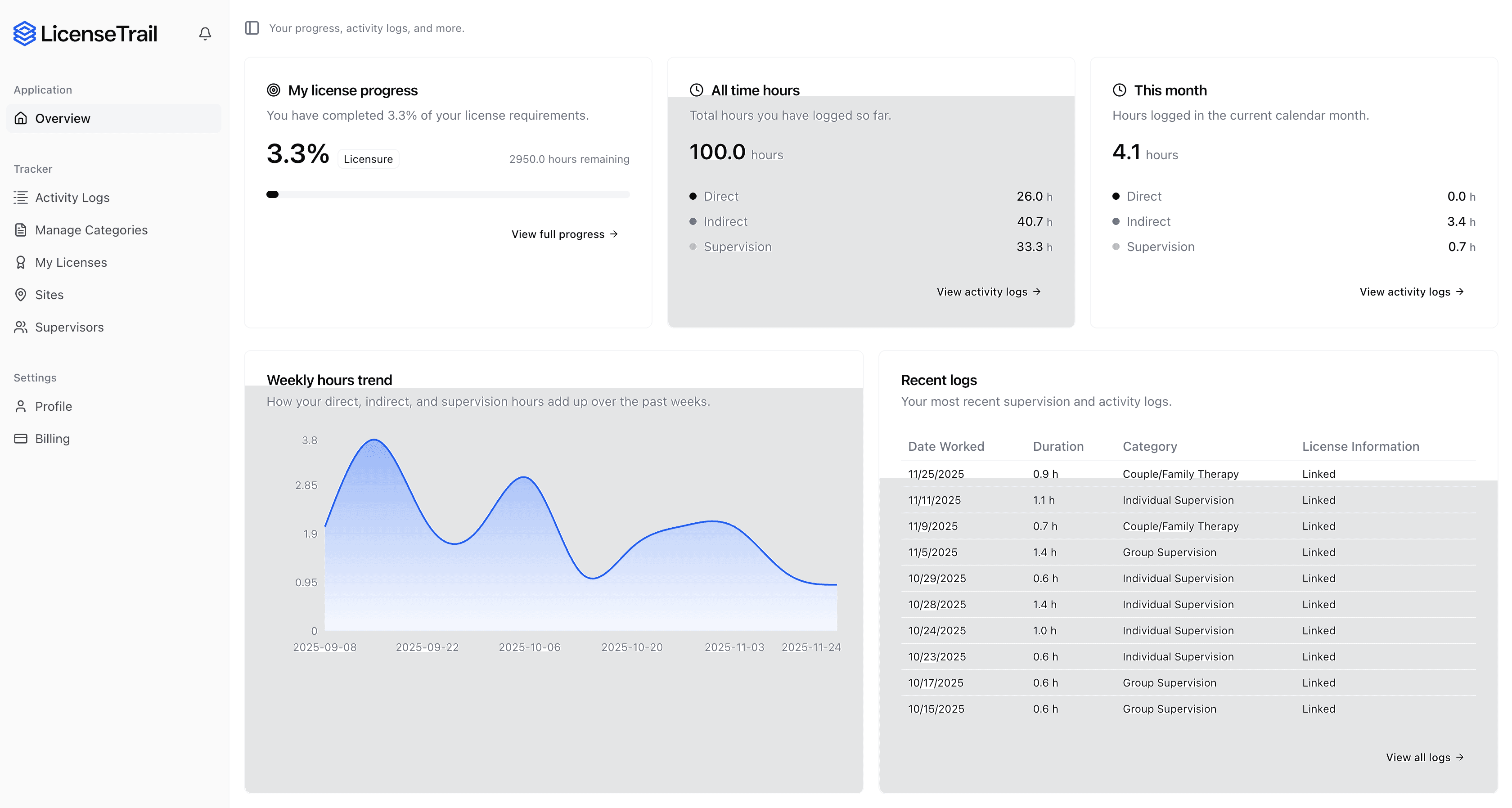
License Trail checks your direct, indirect, and supervision hours against North-carolina LMFT requirements continuously and flags mismatches before you submit.
 Start Tracking for Free
No credit card required · Free plan available
Is your spreadsheet hiding North-carolina LMFT risks?
Stop guessing if your categories match North Carolina Marriage and Family Therapy Licensure Board requirements. License Trail checks your direct, indirect, and supervision hours continuously and flags mismatches before you submit.
Import or log
Bring your spreadsheet or start fresh
Upload your existing tracking spreadsheet and we'll map every hour into the right North Carolina Marriage and Family Therapy Licensure Board categories automatically.
Verify against North-carolina
Catch mismatches before the board does
License Trail checks your direct, indirect, and supervision hours against North-carolina LMFT requirements continuously.
Export board-ready
One-click clean reports
Generate professional, board-ready reports for supervision meetings and North Carolina Marriage and Family Therapy Licensure Board submissions in seconds.
No credit card required · Free plan available