
North-dakota LMFT Requirements: Hours, Exams & Step-by-Step Guide
Stop guessing if your categories match North-dakota requirements. License Trail checks your direct, indirect, and supervision hours against LMFT requirements continuously and flags mismatches before you submit.
No credit card required · Free plan available
Quick Requirements Overview
- Master’s/doctoral in MFT or related field; Board-equivalent requires 54 semester hours in specified content areas
- Pre-licensure practicum: 9 semester hours or 500 hours/12 months client contact (≤250 hours individual; remainder couples/families); supervised by LMFT or AAMFT-approved supervisor
- Exams: pass AMFTRB national MFT exam + ND jurisprudence/state law exam
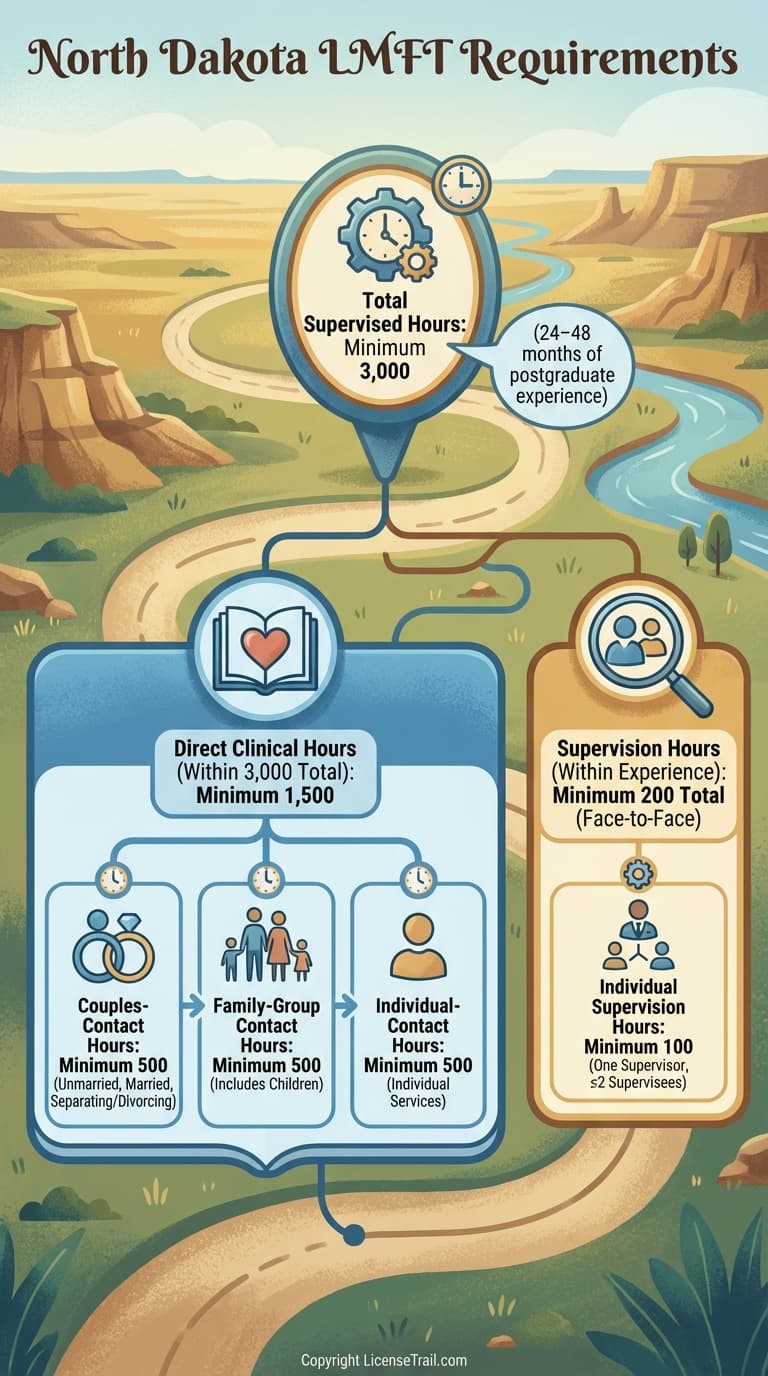
- Postgrad experience (LAMFT → LMFT): 3,000 hours supervised clinical services over 24–48 months
- Direct client contact within 3,000: 1,500 hours, including 500 couples + 500 family groups (incl. children) + 500 individual; must include assessment/diagnosis/treatment of mental illness
- Supervision: 200 hours face-to-face (can be live A/V); ≥100 hours individual; ≥1 hour every 2 weeks (≈100 hrs/yr FT; 50 hrs/yr PT)
- Supervision rules: ≥50% supervision with Board-approved LMFT supervisor; max 2 supervisors at a time unless preapproved
- Credit: up to 500 hours prior qualifying supervised clinical work may count toward the 3,000 (with Board approval)
License Details
Procedures
Licensure as a Licensed Marriage and Family Therapist (LMFT) in North Dakota is governed by the North Dakota Marriage and Family Therapy Licensure Board under Title 111 of the North Dakota Administrative Code and Chapter 43‑53 of the Century Code. The Board’s rules clearly spell out the education, examination, and—most importantly—the exact configuration of practicum and post‑graduate supervised hours you must complete.
Licensing structure in North Dakota
North Dakota recognizes two levels of marriage and family therapy licensure:
- Licensed Associate Marriage and Family Therapist (LAMFT) – for those who have completed the education and national exam but are still accruing supervised post‑graduate hours.
- Licensed Marriage and Family Therapist (LMFT) – full independent license, granted after all education, exams, and supervised experience requirements are met. (aamft.org)
The supervised experience requirements that lead to LMFT status apply to the post‑graduate associate period (the LAMFT stage), even though the Administrative Code describes them generally as “supervised, postgraduate experience.” (regulations.justia.com)
1. Educational base and practicum hours
To qualify educationally, you must hold a master’s or doctoral degree in marriage and family therapy or a closely related field from a regionally accredited institution, and that degree must be judged equivalent by the Board.
The Board defines an “equivalent” degree as one that includes at least 54 semester hours across specified content areas, including:
- Human development (9 semester hours)
- Systemic/relational assessment and mental health diagnosis and treatment (3)
- Marital and family studies (6)
- Marital and family therapy (12)
- Research (3)
- Professional studies (3)
- Diversity and psychopharmacology (9) (regulations.justia.com)
Required clinical practicum (pre‑licensure)
Within those 54 hours, the Board requires either:
- Nine semester hours in a clinical practicum in marriage and family therapy, or
- At least 500 hours or 12 months of clinical client contact with individuals, couples, and families for assessment and intervention. (regulations.justia.com)
Key Board language about those practicum hours:
- Of the 500 clinical hours, no more than 250 may be with individuals; the rest must involve couples and families. (regulations.justia.com)
- This practicum must be supervised onsite or at the academic institution by a licensed marriage and family therapist or an AAMFT‑approved supervisor. (regulations.justia.com)
These practicum hours are pre‑licensure and are separate from (though in some cases partially creditable toward) the post‑graduate supervised experience described below.
2. Examination requirements
For LMFT licensure, you must ultimately pass two parts of the examination referenced in the Century Code:
- The national examination in marital and family therapy (AMFTRB exam), normally completed at or before the associate level.
- A state examination (jurisprudence exam) on North Dakota laws and rules governing the practice of marriage and family therapy. (regulations.justia.com)
The Board’s licensing process (as summarized on its site) requires that applicants for associate licensure be approved by the Board before sitting for the national exam and that applicants for full LMFT licensure complete both the national and state examinations. (ndmftlb.org)
3. Post‑graduate supervised experience: exact hours and configuration
The heart of LMFT licensure in North Dakota is the post‑graduate supervised experience defined in N.D. Admin. Code § 111‑02‑02‑03 (Experience requirements), current through July 2025. (regulations.justia.com)
Total supervised experience
The Board states that the required two years (full time, or up to 48 months part‑time) of supervised post‑graduate experience in marriage and family therapy must consist of:
- At least 3,000 hours of supervised postgraduate clinical services completed over a minimum of 24 months (full time) and no more than 48 months (part time). (regulations.justia.com)
In other words, the Board’s minimum configuration is:
- 3,000 total supervised hours over 2–4 years.
Direct clinical client contact hours
Within those 3,000 hours, the Board requires:
- At least 1,500 hours of direct clinical client contact,
- These hours must include assessment, diagnosis, and treatment of mental illness within the scope of marriage and family therapy. (regulations.justia.com)
The Board further breaks down these 1,500 direct client hours:
You must demonstrate at least 500 hours of direct clinical client contact in each of three categories:
- Unmarried couples, married couples, and separating/divorcing couples
- Family groups, including children
- Individual services (regulations.justia.com)
So in Board terms, the direct‑service requirement is effectively:
- 1,500 hours of direct clinical client contact, structured as:
- 500 hours with couples (unmarried/married/separating/divorcing)
- 500 hours with family groups including children
- 500 hours of individual services
All of these must be legitimately clinical (assessment, diagnosis, and treatment), not just supportive or administrative contact. (regulations.justia.com)
Supervision hours and their structure
Supervision is regulated tightly and is explicitly counted within the supervised experience requirements.
The Board’s experience rule requires:
- At least 200 hours of face‑to‑face supervision between supervisor and supervisee,
- Of those 200 hours, at least 100 hours must be individual supervision. (regulations.justia.com)
Additional structure:
- Full‑time associates must obtain about 100 hours of supervision per year; part‑time associates must obtain 50 hours per year. (regulations.justia.com)
- The associate must receive a minimum of one hour of supervision every two weeks. (regulations.justia.com)
- Individual supervision is defined as a setting where one supervisor and no more than two supervisees are present.
- Group supervision is defined as a setting where one supervisor and between three and six supervisees are present. (regulations.justia.com)
Regarding the modality of supervision:
- The rule allows supervision via real‑time, two‑way audio and visual communication, and explicitly states that such hours count as in‑person supervision. (regulations.justia.com)
Who can provide supervision (qualified supervision)
The Century Code defines “qualified supervision” as supervision carried out according to Board standards by a Board‑recognized approved supervisor. At least half of all supervision hours must be with an approved supervisor who is an LMFT; remaining supervision may be provided by other professionals designated by the approved LMFT supervisor. (codes.findlaw.com)
The Board’s experience rule also specifies:
- An associate may not have more than two board‑approved supervisors at a time, unless the Board gives prior approval. (regulations.justia.com)
Other supervised clinical services (non‑direct hours)
Once the requirements above are met inside the 3,000 hours (1,500 direct client‑contact hours and 200 supervision hours), the remaining hours may consist of other supervised clinical services. The rule states that:
- All additional work used to complete the two‑year experience may be supervised “in a legal and ethical manner” by a licensed MFT credentialed for supervision or by another licensed mental health professional who meets the Board’s approved‑supervisor definition. (regulations.justia.com)
In practice, those remaining hours often include:
- Case documentation and record‑keeping
- Case consultation and case conferences
- Contact with collaterals (schools, physicians, social services)
- Treatment planning and related professional activities
(That list is drawn from standard practice and secondary summaries; the Board’s rule itself keeps the wording broad.) (stateregstoday.com)
Time frame and allowable credit from earlier experience
The experience rule makes the time frame and possible credit clear:
- The 3,000 supervised hours must be completed over at least 24 and no more than 48 months. (regulations.justia.com)
- An associate may receive credit for up to 500 clock‑hours toward the required 3,000 hours of supervised clinical services for qualifying prior supervised clinical work (for example, from a COAMFTE‑accredited graduate practicum), provided it meets Board standards. (regulations.justia.com)
4. Summary of hour requirements, in Board terms
Putting the North Dakota rules into a simple numeric summary:
-
Pre‑degree practicum (within the qualifying master’s/doctoral program)
- Minimum of 9 semester hours of clinical practicum, or
- At least 500 hours or 12 months of supervised clinical client contact,
- No more than 250 of those 500 hours with individuals (the rest must be couples/families),
- Supervised by an LMFT or AAMFT‑approved supervisor. (regulations.justia.com)
-
Post‑graduate supervised experience (toward LMFT)
- Total supervised clinical services:
- At least 3,000 hours of supervised postgraduate clinical services.
- Direct clinical client contact within that total:
- 1,500 hours of direct clinical client contact,
- Composed of 500 hours with couples, 500 with family groups including children, and 500 with individuals,
- These direct hours must involve assessment, diagnosis, and treatment of mental illness. (regulations.justia.com)
- Supervision within that total:
- At least 200 hours of face‑to‑face supervision,
- At least 100 hours must be individual supervision,
- Approximately 100 hours of supervision per year full‑time (or 50 per year part‑time),
- At least one hour of supervision every two weeks,
- Supervision may be in person or via real‑time two‑way audio‑visual technology and still counts as in‑person supervision. (regulations.justia.com)
- Credit from earlier supervised work:
- Up to 500 hours of qualifying supervised clinical services (typically from a COAMFTE‑accredited practicum) may be credited toward the 3,000‑hour requirement, subject to Board approval. (regulations.justia.com)
- Total supervised clinical services:
5. Final licensure as an LMFT
Once you have:
- Completed a Board‑qualifying master’s or doctoral degree (including practicum), (regulations.justia.com)
- Passed the national AMFTRB MFT examination, (regulations.justia.com)
- Held associate status while accruing:
- 3,000 supervised postgraduate clinical hours, including
- 1,500 hours of direct clinical client contact distributed 500/500/500 across couples, families with children, and individuals, and
- 200 hours of face‑to‑face supervision (100 of which are individual), (regulations.justia.com)
- Passed the North Dakota state (jurisprudence) exam, (regulations.justia.com)
you may apply to the North Dakota Marriage and Family Therapy Licensure Board for licensure as a Licensed Marriage and Family Therapist (LMFT), submitting Board forms verifying your supervised experience, education, and examinations as required. (ndmftlb.org)
This combination of education, examination, and very specifically structured supervised hours is what the North Dakota Board requires, in its own regulatory language, for full LMFT licensure.
Track your LMFT hours with confidence
License Trail checks your direct, indirect, and supervision hours against North-dakota LMFT requirements continuously and flags mismatches before you submit.
 Start Tracking for Free
No credit card required · Free plan available
Is your spreadsheet hiding North-dakota LMFT risks?
Stop guessing if your categories match North Dakota Marriage and Family Therapy Licensure Board requirements. License Trail checks your direct, indirect, and supervision hours continuously and flags mismatches before you submit.
Import or log
Bring your spreadsheet or start fresh
Upload your existing tracking spreadsheet and we'll map every hour into the right North Dakota Marriage and Family Therapy Licensure Board categories automatically.
Verify against North-dakota
Catch mismatches before the board does
License Trail checks your direct, indirect, and supervision hours against North-dakota LMFT requirements continuously.
Export board-ready
One-click clean reports
Generate professional, board-ready reports for supervision meetings and North Dakota Marriage and Family Therapy Licensure Board submissions in seconds.
No credit card required · Free plan available