
North-dakota LP Requirements: Hours, Exams & Step-by-Step Guide
Stop guessing if your categories match North-dakota requirements. License Trail checks your direct, indirect, and supervision hours against LP requirements continuously and flags mismatches before you submit.
No credit card required · Free plan available
Quick Requirements Overview
- Governing body/law: North Dakota State Board of Psychologist Examiners (NDSBPE); NDCC 43‑32 & NDAC 66
- Education: Doctorate in psychology from a board-approved accredited program (APA/CPA recognized)
- Total supervised professional experience: 3,000 hours (2 full years) in the practice of psychology
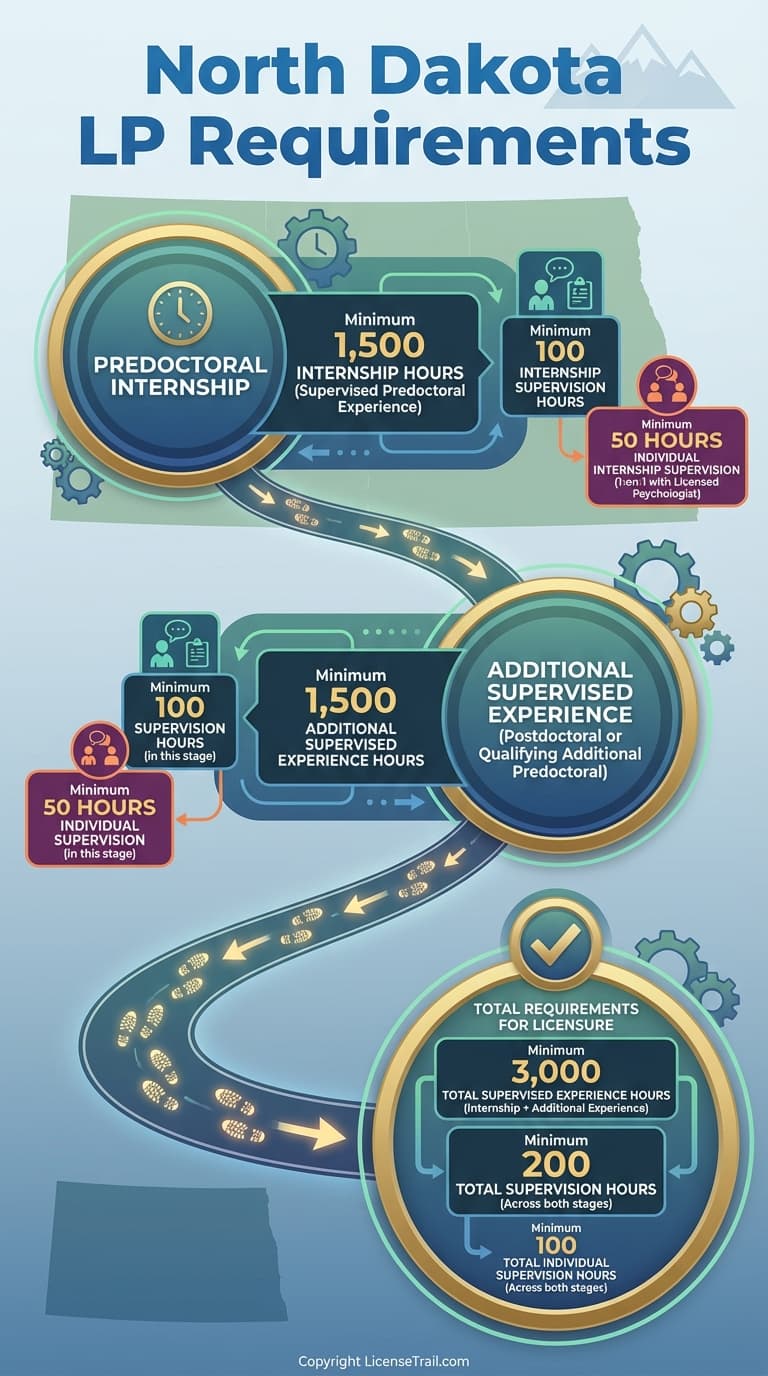
- Predoctoral internship: 1,500 hours; minimum 100 supervision hours (≥50 one-to-one); APA/CPA-accredited internship automatically accepted
- Second 1,500 hours (choose one): postdoctoral supervised experience or additional supervised predoctoral training experience (both in practice of psychology)
- Supervision for second 1,500 hours: minimum 100 supervision hours (≥50 one-to-one) by a psychologist licensed in good standing; postdoc supervision must be weekly (per statute)
- Exams: Pass EPPP and a state oral exam (ND law/rules + APA ethics)
- Application: Board application/fee + PLUS (ASPPB) application; supervision relationship/plan typically filed before accruing hours
License Details
Procedures
Licensure as a Licensed Psychologist (LP) in North Dakota is governed by the North Dakota State Board of Psychologist Examiners (NDSBPE), under North Dakota Century Code (NDCC) chapter 43‑32 and North Dakota Administrative Code (NDAC) title 66. The Board’s rules specify both the number and type of supervised hours required, and they use particular phrases such as “supervised professional experience,” “supervised predoctoral internship,” and “supervised postdoctoral experience.” (codes.findlaw.com)
Below is a concise, step‑by‑step guide focused on those requirements and the Board’s terminology.
1. Basic eligibility: degree and program
License type: “Psychologist” (this is the LP‑level health‑service license; the statute defines a “psychologist” as an individual licensed under chapter 43‑32 in the practice of psychology). (codes.findlaw.com)
Required degree
North Dakota law requires:
- A doctorate degree in psychology from a doctoral program in psychology accredited by an accrediting body approved by the board. (codes.findlaw.com)
By rule, the Board recognizes the American Psychological Association (APA) and Canadian Psychological Association (CPA) as approved accrediting bodies for psychology programs. (law.cornell.edu)
2. Overall supervised experience requirement
NDCC § 43‑32‑20(1)(d) states that an applicant for licensure as a psychologist must have:
- “At least two full years of supervised professional experience, one year of which must be an internship program, and one year of which may be postdoctoral. Both years of experience must comply with the board’s rules.” (codes.findlaw.com)
The Board’s supervision rule (NDAC 66‑02‑01‑11.1) operationalizes this as a total of 3,000 hours of supervised experience, divided as:
- 1,500 hours of supervised predoctoral internship in the practice of psychology; and
- 1,500 hours made up of either:
- supervised postdoctoral experience in the practice of psychology, or
- additional supervised predoctoral training experience in the practice of psychology (meeting strict criteria). (law.cornell.edu)
So in Board language, you are not accumulating generic “clinical” hours; you are accumulating supervised professional experience via a supervised predoctoral internship plus either supervised postdoctoral experience or additional supervised predoctoral training experience.
3. First 1,500 hours – supervised predoctoral internship
NDAC 66‑02‑01‑11.1(1) requires that all psychologist applicants complete:
- “One thousand five hundred hours of supervised predoctoral internship in the practice of psychology.” (law.cornell.edu)
Key Board requirements for this internship:
-
Supervision quantity
- At least 100 hours of supervision,
- At least 50 of those hours must be one‑to‑one (individual) supervision. (law.cornell.edu)
-
Internship approval
- An APA‑ or CPA‑accredited internship is automatically accepted as fulfilling this requirement. (law.cornell.edu)
- Any non‑accredited internship must be described in detail (setting, population, amount/nature of supervision, and demonstrated skills) on Board forms, and the supervisor(s) must corroborate the applicant’s claimed competencies. (law.cornell.edu)
The work itself must be “in the practice of psychology,” which the statute defines broadly to include assessment, psychological testing, psychotherapy, diagnosis and treatment of mental and emotional disorders, behavior modification, consultation, and related professional psychological services (including supervision of others doing such work). (codes.findlaw.com)
4. Second 1,500 hours – two main pathways
After the 1,500‑hour supervised predoctoral internship, the Board allows two main routes to complete the remaining 1,500 hours required for licensure. These are spelled out in NDAC 66‑02‑01‑11.1(1)(a)–(b). (law.cornell.edu)
Path A – 1,500 hours of supervised postdoctoral experience
Under NDAC 66‑02‑01‑11.1(1)(a), you may complete:
- “One thousand five hundred hours of supervised postdoctoral experience in the practice of psychology.” (law.cornell.edu)
Requirements:
-
Supervision quantity
- At least 100 hours of supervision,
- At least 50 hours must be one‑to‑one with a psychologist licensed in good standing. (law.cornell.edu)
-
Structure and documentation
- As with internship, any non‑accredited postdoctoral program must be described in detail on Board forms (settings, consumers served, supervision provided, and specific competencies), and supervisors must confirm the competencies claimed. (law.cornell.edu)
-
Additional statutory supervision standard
- NDCC § 43‑32‑20.1 requires that postdoctoral supervised employment include at least 100 hours of direct supervision, occurring weekly, with at least 50 hours provided by the primary supervisor (face‑to‑face or via distance communication). (codes.findlaw.com)
Path B – 1,500 hours of additional supervised predoctoral training experience
Alternatively, NDAC 66‑02‑01‑11.1(1)(b) allows:
- “One thousand five hundred hours of additional supervised predoctoral training experience in the practice of psychology.” (law.cornell.edu)
This route is more tightly structured. Key Board criteria include:
-
Supervision quantity
- Again, at least 100 hours of supervision,
- At least 50 hours must be one‑to‑one with a psychologist licensed in good standing. (law.cornell.edu)
-
Program link
- Training must be part of the doctoral program that meets NDCC 43‑32‑20(1)(b) requirements (Board‑approved, APA/CPA‑accredited psychology program). (law.cornell.edu)
-
Timing rules
- Must be completed within six years of the award of the terminal doctoral degree.
- Must be completed within ten years of first application for licensure.
- Must occur after an introductory practicum in applied professional psychology or psychotherapy of at least 600 hours. (law.cornell.edu)
-
Nature of the work
- Must be part of an individualized written plan for an “organized, sequential series of supervised experiences of increasing complexity.”
- Must occur outside the classroom and involve the trainee’s direct delivery of supervised psychological services in a practice, agency, institution, counseling center, graduate training clinic, or other approved setting.
- Must consist of activities defined as the practice of psychology in NDCC 43‑32‑01(6). (law.cornell.edu)
-
Minimum duration and weekly structure
- The training plan must cover at least 30 weeks.
- There must be a weekly onsite presence of at least 15 hours.
- Average weekly individual face‑to‑face supervision (which can include secure video) must be at least 1 hour per 15 onsite hours and at least 1 hour every week.
- At least 50% of this supervision must be provided by the primary supervisor, who:
- Is a licensed psychologist,
- Has been licensed for at least three years,
- Is licensed in the jurisdiction where the training occurs, and
- Is professionally responsible for the trainee’s clients. (law.cornell.edu)
-
Additional learning activities
- There must be on average at least one additional hour per week of structured learning (e.g., extra supervision, case conferences or grand rounds, didactic consultations, seminars, guided readings, or co‑therapy with a licensed psychologist or other qualified professional). (law.cornell.edu)
-
Program–supervisor coordination
- The rule requires regularly scheduled and documented interaction between the primary supervisor and the doctoral program’s director of training (or designee) about the trainee’s progress, with documentation available to the Board upon request. (law.cornell.edu)
5. What “counts” as experience: practice of psychology
For all three components — the 1,500‑hour supervised predoctoral internship, the 1,500‑hour supervised postdoctoral experience, or the 1,500‑hour additional predoctoral training — the Board ties the work to North Dakota’s statutory definition of “practice of psychology.”
Under NDCC § 43‑32‑01(6), this includes, in summary:
- Observation, description, evaluation, interpretation, or modification of human behavior using psychological principles;
- Psychological testing and assessment of characteristics such as intelligence, personality, abilities, interests, aptitudes, and neuropsychological functioning;
- Counseling, psychotherapy, behavior analysis and therapy, biofeedback, clinical hypnosis, and other therapeutic techniques based on psychological principles;
- Diagnosis and treatment of mental and emotional disorders, compulsive disorders, disorders of habit or conduct, and psychological aspects of physical illness/injury/disability;
- Psychoeducational evaluation, therapy, remediation, and consultation;
- Provision of psychological services to individuals, families, groups, organizations, institutions, and the public, whether or not payment is received;
- Supervising others who are themselves engaged in the practice of psychology. (codes.findlaw.com)
Experience hours must be anchored in this scope, not in unrelated academic or administrative work.
6. Examinations and application process (briefly)
While your question focuses on hours, the Board also requires specific exams and applications.
Examinations
Under NDCC § 43‑32‑20(1)(c), applicants must pass examinations, written or oral, as the Board determines necessary. (codes.findlaw.com) In practice, this means:
- Examination for Professional Practice in Psychology (EPPP) – the national written exam; common sources note a required scaled score of 500 for North Dakota. (learn.org)
- A state oral examination focused on North Dakota law and rules and APA ethics as they apply to practice in the state. (learn.org)
Application sequence
Recent descriptions of Board procedure show a two‑step application system:
-
Initial application / Application Initiation Form
- Submitted to the Board with an application fee of $450. (onlinepsychologyprograms.org)
- Includes a Notification of Supervision Relationship and an individualized supervision plan before you begin accruing supervised experience as a “psychology resident.” (psychologydegree411.com)
-
PLUS application (PSY|PRO)
- After initial Board review, you complete the Psychology Licensure Universal System (PLUS) application online, with an additional $200 fee paid to ASPPB. (onlinepsychologyprograms.org)
- This gathers primary‑source verification of education, supervised experience, and references.
Once education, supervised professional experience, and both exams are successfully completed, the Board may vote to issue a full psychologist license. (research.com)
7. Hour breakdown at a glance (LP – Psychologist)
For a standard Licensed Psychologist license (not industrial‑organizational):
- Doctoral degree in psychology from an APA‑ or CPA‑accredited program (or other Board‑approved equivalent). (codes.findlaw.com)
- Total supervised professional experience:
- 3,000 hours of Board‑defined supervised experience, consisting of:
- 1,500 hours of supervised predoctoral internship in the practice of psychology (≥100 supervision hours; ≥50 one‑to‑one).
- 1,500 hours of either:
- Supervised postdoctoral experience in the practice of psychology (≥100 supervision hours; ≥50 one‑to‑one); or
- Additional supervised predoctoral training experience in the practice of psychology that:
- Follows a 600‑hour introductory practicum,
- Is organized as a sequential, increasingly complex training plan,
- Occurs over ≥30 weeks with ≥15 onsite hours/week,
- Provides supervision at ≥1 hour per 15 onsite hours (and ≥1 hour/week),
- Includes ≥1 additional hour/week of structured learning activities, and
- Meets all Board conditions in NDAC 66‑02‑01‑11.1(1)(b)(1)–(15). (law.cornell.edu)
- 3,000 hours of Board‑defined supervised experience, consisting of:
The Board describes all of this collectively as “supervised professional experience” in the “practice of psychology.” (codes.findlaw.com)
For the most precise and current language, you should cross‑check NDCC §§ 43‑32‑01, 43‑32‑20, 43‑32‑20.1 and NDAC 66‑02‑01‑11.1, as updated through the latest supplements, along with any forms or guidance posted by the North Dakota State Board of Psychologist Examiners.
Track your LP hours with confidence
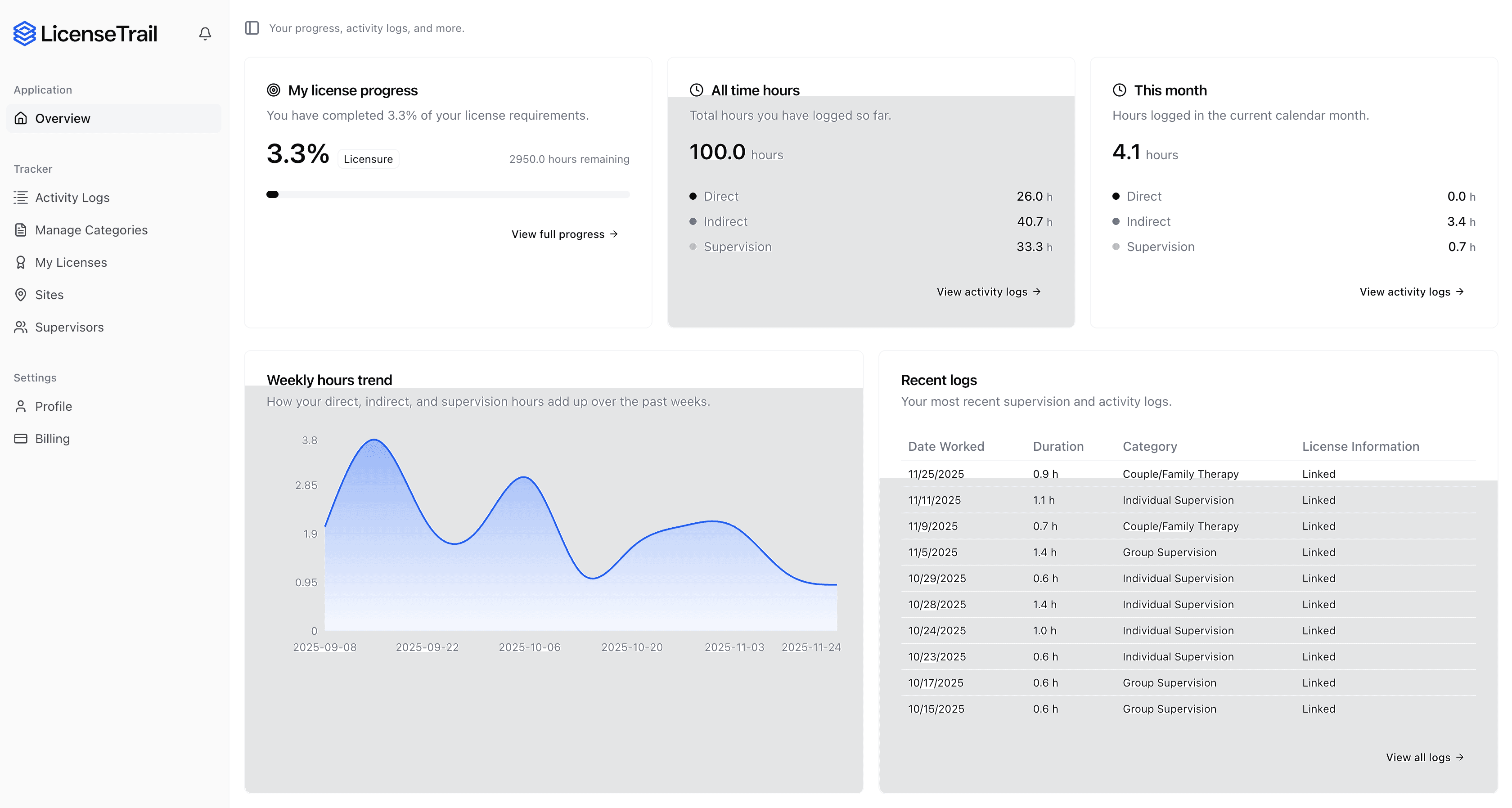
License Trail checks your direct, indirect, and supervision hours against North-dakota LP requirements continuously and flags mismatches before you submit.
 Start Tracking for Free
No credit card required · Free plan available
Related Licenses
Is your spreadsheet hiding North-dakota LP risks?
Stop guessing if your categories match North Dakota State Board of Psychologist Examiners requirements. License Trail checks your direct, indirect, and supervision hours continuously and flags mismatches before you submit.
Import or log
Bring your spreadsheet or start fresh
Upload your existing tracking spreadsheet and we'll map every hour into the right North Dakota State Board of Psychologist Examiners categories automatically.
Verify against North-dakota
Catch mismatches before the board does
License Trail checks your direct, indirect, and supervision hours against North-dakota LP requirements continuously.
Export board-ready
One-click clean reports
Generate professional, board-ready reports for supervision meetings and North Dakota State Board of Psychologist Examiners submissions in seconds.
No credit card required · Free plan available