
Oklahoma HSP Requirements: Hours, Exams & Step-by-Step Guide
Stop guessing if your categories match Oklahoma requirements. License Trail checks your direct, indirect, and supervision hours against HSP requirements continuously and flags mismatches before you submit.
No credit card required · Free plan available
Quick Requirements Overview
- HSP is required (in addition to OK psychologist license) to independently provide/offer “health services to the public.”
- Eligibility routes: (1) ABPP board certification, or (2) 2 years supervised health-service experience (typically 1 internship year + 1 postdoc year at a health-service site).
- Doctoral education: APA-accredited doctorate (or Board-approved equivalent/exception) required for licensure pathway.
- Exams for licensure: EPPP + OK Jurisprudence (≥ 70%).
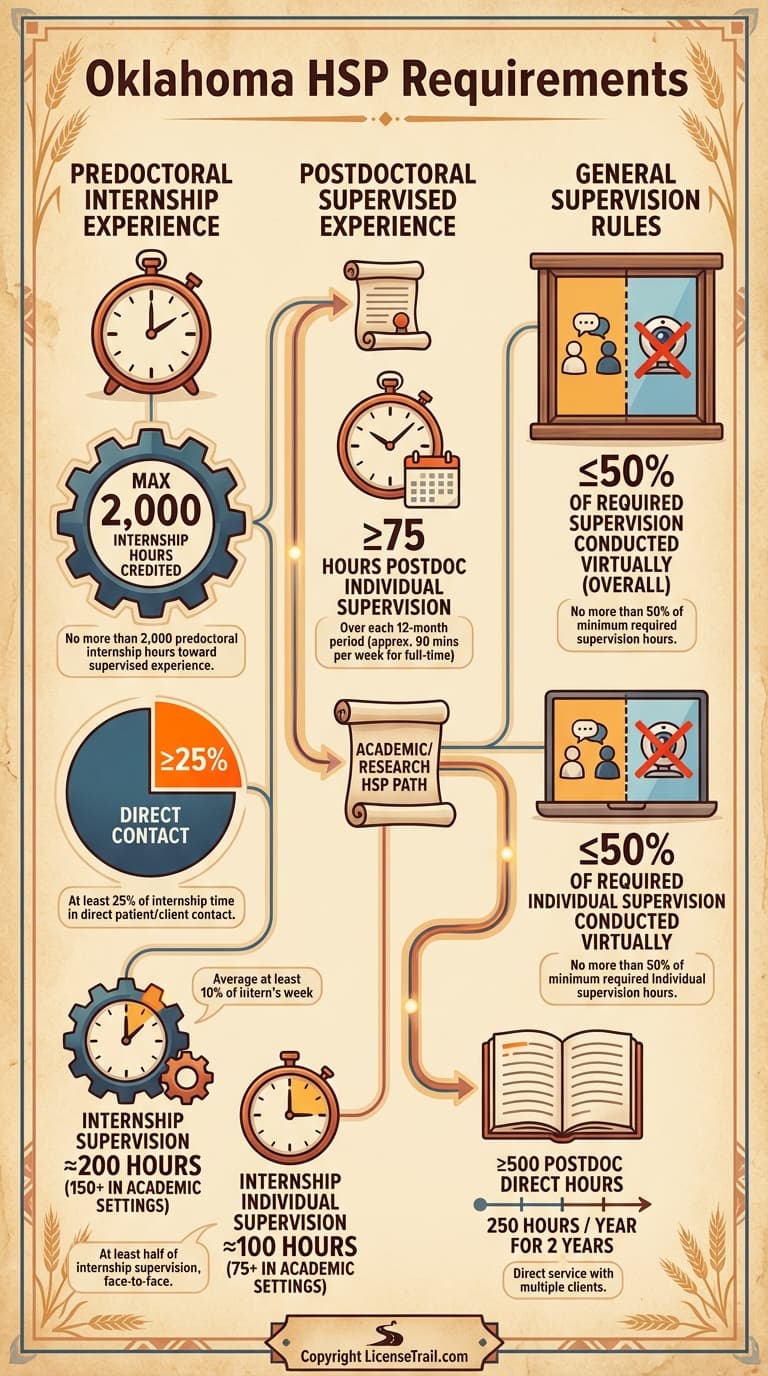
- Predoc internship (health-service): 2,000 hrs (or 1,500+ academic); ≥25% direct client contact; supervision ≥200 hrs (or 150+ academic) with ≥100 hrs individual F2F (or 75+ academic); ≥3 psychologist supervisors (≥2 academic); ≤50% virtual supervision.
- Postdoc supervised experience: 2,000 hrs (or 1,500+ academic) completed within ≤3 years; ≥75 hrs individual F2F supervision; ≤50% virtual supervision.
- Academic/clinical research postdoc seeking HSP: requires ≥2 postdoc years and ≥250 direct-service hrs/year for 2 years (≥500 total), plus required clinical activity mix.
License Details
Procedures
In Oklahoma, “Health Service Psychologist” (HSP) is a protected certification layered on top of a standard psychologist license. To practice independently and “provide health services to the public,” a licensed psychologist must hold HSP certification from the Oklahoma State Board of Examiners of Psychologists. (ok.elaws.us)
This article walks through the pathway and, in particular, the types and amounts of hours the Board requires.
1. How Oklahoma defines “health service” and “Health Service Psychologist”
Under the Psychologists Licensing Act:
- “Health service” is defined as the delivery of direct, preventive, assessment and therapeutic intervention services to individuals whose functioning is impaired or at risk of impairment. (ok.elaws.us)
- A “health service psychologist” is a licensed psychologist who provides health services to the public and shows two years of formal supervised experience conducting psychological intervention services as defined by Board rules. (ok.elaws.us)
Separately, state statute on certification states that any licensed psychologist who independently provides or offers to provide health services must be certified as an HSP, and that the Board must certify an applicant who has at least two years of full‑time supervised health service experience (or meets an ABPP-based alternative, discussed below). (law.justia.com)
2. Overview of the pathway
To become an HSP in Oklahoma through the “training + supervision” route, you must:
- Complete a qualifying doctoral program in psychology (usually APA‑accredited). (oklahoma.gov)
- Complete a predoctoral internship that meets Oklahoma’s health-service standards, including specified total hours, direct-service hours, and supervised hours. (law.cornell.edu)
- Complete supervised postdoctoral experience, with defined total hours and supervision, including special rules if you are in an academic or clinical research setting. (law.cornell.edu)
- Pass the licensing examinations (EPPP and Oklahoma Jurisprudence). (law.cornell.edu)
- Obtain HSP certification by either (a) ABPP board certification or (b) documenting two years of supervised health‑service experience (one internship year, one postdoc year at a health‑service site). (law.cornell.edu)
The hour requirements in steps 2 and 3 are what make up the “two years of supervised experience” and “two years of full‑time supervised health service experience” in statute and Board rules.
3. Educational requirements (briefly)
- You must complete a doctoral program in psychology accredited by APA, unless the program qualifies under one of the Board’s specific exceptions (new specialties, new programs in existing specialties, or certain foreign programs). (law.cornell.edu)
- The program must:
- Be clearly identified as a psychology program.
- Be a coherent, organized sequence of study with identifiable psychology faculty and students.
- Include specified core coursework (e.g., ethics, research methods, statistics, biological/cognitive/social bases of behavior, individual behavior). (law.cornell.edu)
These educational requirements are foundational but do not by themselves give you HSP status; that depends on internship, postdoc, and certification.
4. Predoctoral internship requirements and hours
For licensure as a health service psychologist, Oklahoma explicitly requires an internship that meets detailed standards in Board Rule OAC 575:10‑1‑2(i). (law.cornell.edu)
4.1 Total internship hours
The rule states:
- The internship must be:
- Full-time (40 hours/week) for one calendar or academic contract year, or
- Half‑time (20 hours/week) for two years
- This must total 2,000 hours, “except for an academic setting it is 1,500+ hours.” (law.cornell.edu)
So:
- Standard internship setting: at least 2,000 total internship hours.
- Academic setting internship: at least 1,500 total hours (the rule uses “1,500+ hours”).
The Board will not accept more than 2,000 hours of predoctoral internship towards the supervised‑experience requirement. (law.cornell.edu)
4.2 Direct service (“direct patient or client contact”)
The Board requires that the internship:
- Provide a “training experience in a range of assessment and treatment activities conducted directly with patients or clients.” (law.cornell.edu)
- Include at least 25% of the trainee’s time in direct patient or client contact. (law.cornell.edu)
Given a 2,000‑hour internship, 25% equates to a minimum of 500 hours of direct client contact (assessment and treatment).
In an academic setting with 1,500+ total hours, 25% implies at least 375+ hours of direct contact.
4.3 Supervision during internship
Supervision must be provided by licensed psychologists and meet all of the following: (law.cornell.edu)
-
Number of supervisors
- Experience with three or more licensed psychologist supervisors (or two or more in an academic setting).
-
Total supervision hours
- Supervision must average at least 10% of the intern’s week, which the rule specifies as 200 hours total (or 150+ hours in an academic setting).
-
Individual supervision
- At least half of the supervision (i.e., minimum 100 hours, or 75+ hours in an academic setting) must be regularly scheduled, formal, face‑to‑face, individual supervision focused on services the intern is delivering.
-
Format limits (hybrid supervision)
- For internships, no more than 50% of the required individual supervision hours and no more than 50% of additional supervision may be conducted virtually. (law.cornell.edu)
-
Program structure
- The internship must be an organized program with a written statement/brochure describing goals, content, and performance expectations. (law.cornell.edu)
This internship year can be used to partially fulfill the “two years of supervised experience” and the “two years of full‑time supervised health service experience” required for HSP status. (law.cornell.edu)
5. Postdoctoral supervised experience and hours
5.1 General supervised‑experience requirement
Oklahoma requires:
- Two years of supervised experience satisfactory to the Board, consistent with your major doctoral program of study. (law.cornell.edu)
At least one of those two years must be postdoctoral experience as a psychologist. (law.cornell.edu)
A predoctoral internship can supply up to one of the two years; the remaining year must be at the postdoctoral level.
5.2 Postdoctoral total hours
For the postdoctoral year, Board rules state: (law.cornell.edu)
- The postdoctoral experience must be:
- Full‑time (40 hours/week) for one calendar or academic contract year, or
- Half‑time (20 hours/week) for two years,
- For a total of 2,000 hours, “except for an academic setting it is 1,500+ hours” of appropriate experience, to be completed within a period not exceeding three years.
So:
- Standard postdoc: at least 2,000 supervised postdoctoral hours.
- Academic setting postdoc: at least 1,500 supervised hours.
5.3 Postdoctoral supervision
- Supervision must be provided by a licensed psychologist trained in your major doctoral area (or closely related) and currently delivering relevant psychological services. (law.cornell.edu)
- You must accrue 75 hours of regularly scheduled, formal, face‑to‑face individual supervision from your supervisor(s), reasonably distributed across the postdoc year. (law.cornell.edu)
- As with internship, no more than 50% of the minimum required individual supervision hours (and of the additional supervision) may be virtual. (law.cornell.edu)
5.4 Special rules for academic or clinical research postdocs seeking HSP
If you are completing your postdoctoral experience in an academic or clinical research setting and wish to qualify for HSP:
- The Board requires a minimum of two years of postdoctoral experience (not just one). (law.cornell.edu)
- You must spend 50% of your time in specific kinds of activities, including:
- Direct service with multiple client contacts per week (minimum of five clients), in an agency/university clinic or supervised private practice.
- For those in academic/research settings, the rule specifies a minimum of 250 hours of direct service per year, for at least two years (so at least 500 hours of direct service across the postdoctoral experience). (law.cornell.edu)
- Additional qualifying activities can include modeling clinical techniques, supervising clinical services (with faculty assuming direct responsibility), and conducting mental‑health related workshops or community programs. (law.cornell.edu)
The postdoctoral experience for those seeking HSP designation must also meet the requirements cross‑referenced in OAC 575:10‑1‑6(b)(5)(B), which is the HSP rule discussed next. (law.cornell.edu)
6. Licensure examinations
To actually become licensed as a psychologist, you must pass two exams: (law.cornell.edu)
- Objective exam (EPPP) – the Examination for Professional Practice in Psychology.
- Oklahoma Jurisprudence Examination – based on the Psychologists Licensing Act, Board Rules, Code of Ethics, and applicable Oklahoma mental health law.
You must achieve at least the passing score designated by the EPPP developer and at least 70% correct on the Jurisprudence exam. (law.cornell.edu)
Only after you are licensed as a psychologist can you be certified as an HSP.
7. HSP certification requirements (beyond basic licensure)
Once licensed, you obtain HSP certification under both the statute (§59‑1362.1) and the Board rule (OAC 575:10‑1‑6(b)(5)). These say essentially the same thing:
-
Statute: The Board shall certify as an HSP any licensed psychologist who:
- Has at least two years of full‑time supervised health‑service experience, OR
- Meets specified equivalent conditions (one year doctoral internship + one year postdoc at a health‑service site). (law.justia.com)
-
Board rule (directory listing rule): A psychologist licensed in Oklahoma qualifies for HSP certification if they: (law.cornell.edu)
- Are Board Certified by the American Board of Professional Psychology (ABPP), or
- Have two years of supervised experience in health services psychology,
- One year must be a doctoral internship consistent with their university doctoral program in an organized health‑services training program, and
- One year must be postdoctoral at a site where health services are provided.
In practice, this means:
-
Standard “training pathway” to HSP usually looks like:
- Internship: 2,000 hours (or 1,500+ academic) in an organized health-services training program, including at least 25% direct client contact and required supervision. (law.cornell.edu)
- Postdoc: 2,000 hours (or 1,500+ academic) at a site where health services are provided, with 75+ hours of individual supervision and, for research/academic settings, at least 250 direct‑service hours per year for two years. (law.cornell.edu)
- Together, these satisfy the “two years of full‑time supervised health‑service experience” required for HSP certification, as long as the settings and activities fit the statutory/Board definitions of health services. (law.justia.com)
-
ABPP shortcut:
- If you are board‑certified by ABPP in an appropriate specialty, you can qualify for HSP certification on that basis alone, without separately documenting every hour, provided you also meet Oklahoma licensure requirements. (law.cornell.edu)
The Board’s applicant page underscores that psychologists who have completed consistent training programs, internships/residencies, and postdoctoral supervision in clinical, counseling, or school psychology are generally eligible for HSP certification, assuming the above internship and postdoc criteria have been met. (oklahoma.gov)
8. Key hour requirements at a glance
For Oklahoma HSPs trained through the standard pathway (not solely via ABPP), the main hour‑based requirements break down as follows:
Predoctoral internship (health‑service): (law.cornell.edu)
- Total hours:
- 2,000 hours (standard settings), or
- 1,500+ hours (academic settings).
- Direct client contact:
- At least 25% of all internship hours in direct patient/client contact (assessment and treatment).
- Supervision:
- At least 200 hours of supervision (150+ in academic settings).
- At least 100 hours of individual, face‑to‑face supervision (75+ in academic settings).
- Experience with ≥3 licensed psychologist supervisors (≥2 in academic settings).
- No more than 50% of required supervision may be virtual.
Postdoctoral supervised experience: (law.cornell.edu)
- Total hours (one postdoc year):
- 2,000 hours (standard), or
- 1,500+ hours (academic).
- Supervision:
- At least 75 hours of regularly scheduled, formal, face‑to‑face individual supervision.
- Same 50% cap on virtual supervision.
- If postdoc is in academic/research setting and you want HSP:
- Minimum two years of postdoc.
- At least 50% of your time in approved clinical and related activities.
- Direct service: minimum 250 hours/year for at least two years (total ≥500 hours of direct client service).
Overall supervised experience for HSP certification: (law.cornell.edu)
- At least two years of supervised experience as a psychologist, consistent with your major program of study (internship + postdoc).
- At least two years of full‑time supervised health‑service experience, specifically:
- One full‑time year as a doctoral health‑services internship, and
- One full‑time year as a postdoctoral position at a site providing health services.
Together with licensure exams and Board approval, meeting these hour and content requirements leads to HSP certification by the Oklahoma State Board of Examiners of Psychologists.
Track your HSP hours with confidence
License Trail checks your direct, indirect, and supervision hours against Oklahoma HSP requirements continuously and flags mismatches before you submit.
 Start Tracking for Free
No credit card required · Free plan available
Related Licenses
Is your spreadsheet hiding Oklahoma HSP risks?
Stop guessing if your categories match Oklahoma State Board of Examiners of Psychologists requirements. License Trail checks your direct, indirect, and supervision hours continuously and flags mismatches before you submit.
Import or log
Bring your spreadsheet or start fresh
Upload your existing tracking spreadsheet and we'll map every hour into the right Oklahoma State Board of Examiners of Psychologists categories automatically.
Verify against Oklahoma
Catch mismatches before the board does
License Trail checks your direct, indirect, and supervision hours against Oklahoma HSP requirements continuously.
Export board-ready
One-click clean reports
Generate professional, board-ready reports for supervision meetings and Oklahoma State Board of Examiners of Psychologists submissions in seconds.
No credit card required · Free plan available