
Oregon CSWA Requirements: Hours, Exams & Step-by-Step Guide
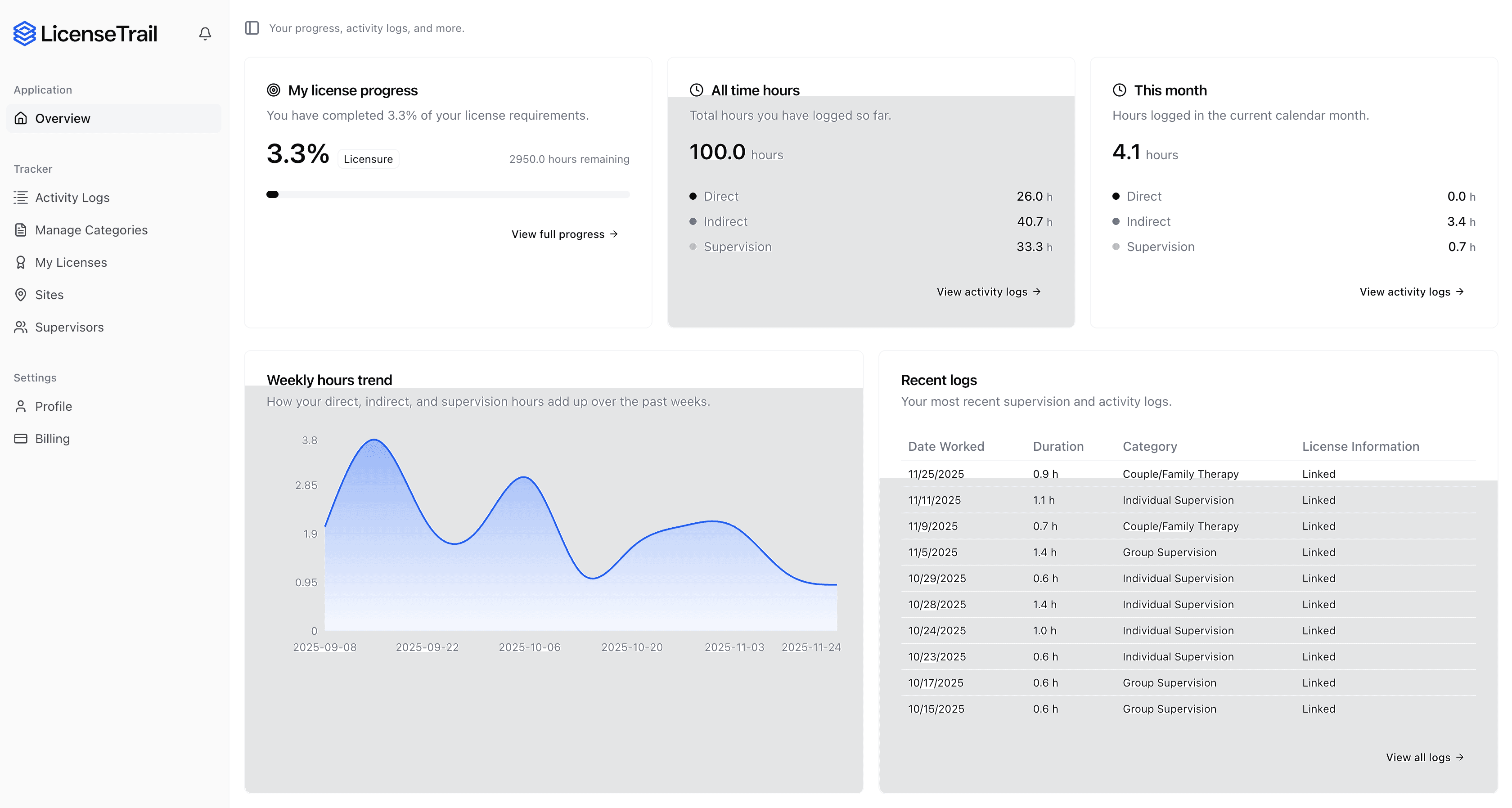
Stop guessing if your categories match Oregon requirements. License Trail checks your direct, indirect, and supervision hours against CSWA requirements continuously and flags mismatches before you submit.
No credit card required · Free plan available
Quick Requirements Overview
- Regulator: Oregon Board of Licensed Social Workers (BLSW); governed by ORS 675.510–675.600 & OAR 877 Div. 20
- Eligibility: MSW from CSWE/recognized accredited (or equivalent foreign eval) program + meet BLSW fitness standards + submit complete application
- Setting required: Must practice in a qualifying agency (DHS-licensed or otherwise legally authorized); private/independent practice hours do not count
- Plan required: Must have a BLSW-approved Plan of Practice & Supervision and approved supervisor; CSWA is not independent licensure
- Experience hours: 3,500 total clinical practice hours, including 2,000 direct client/contact hours
- Supervision hours/time: 100 supervision hours total (≥50 individual) over ≥24 months; meet ≥1 hour at least twice per month
- Completion window: Plan must be completed within 5 years; hours outside an approved plan (gaps/agency changes) don’t count
- Fees/renewal/CE: Application fee $260; annual renewal (birth month) fee about $66; no CE required for active CSWA renewal
License Details
Procedures
In Oregon, the Clinical Social Work Associate (CSWA) credential is the mandatory, supervised step toward becoming a Licensed Clinical Social Worker (LCSW). It is issued and regulated by the Oregon Board of Licensed Social Workers (BLSW) under ORS 675.510–675.600 and Division 20 of the Oregon Administrative Rules. (oregon.public.law)
Below is a structured, article‑style guide to (1) qualifying for CSWA certification and (2) the exact hour requirements and definitions you must meet while a CSWA to finish the program and move to the LCSW.
1. What the CSWA Is (and Is Not)
- The CSWA is described by the Board as “the first step to a clinical license” in Oregon and is required for most MSWs who want to practice clinical social work in the state. (oregon.gov)
- You may not practice clinical social work in Oregon unless you are either:
- a Licensed Clinical Social Worker (LCSW), or
- a Clinical Social Work Associate (CSWA) certified by the Board. (oregon.public.law)
- The Board emphasizes that a CSWA is not an independent license. Your legal authority to practice clinical social work comes from:
- a Board‑approved Plan of Practice and Supervision, and
- an approved supervisor. (oregon.gov)
Hours obtained in your own private or independent practice do not count toward licensure, and the Board explicitly states that you cannot count private‑practice hours toward the CSWA requirements. (oregon.gov)
2. Baseline Eligibility to Become a CSWA
To be certified as a Clinical Social Work Associate, Oregon Administrative Rule (OAR) 877‑020‑0009 and ORS 675.537 set out the requirements. In plain language, you must: (secure.sos.state.or.us)
-
Submit a complete application to the Board
- OAR 877‑020‑0009(1) requires a “complete and accurate application on a form provided by the board.” (secure.sos.state.or.us)
-
Hold an appropriate MSW degree
- You must have a master’s degree in social work from a college or university:
- accredited or in candidacy status by a credentialing body recognized by the Board (explicitly including the Council on Social Work Education (CSWE) and the Canadian Association for Social Work Education), or
- with a foreign degree deemed equivalent by CSWE’s International Social Work Degree Recognition and Evaluation Service. (secure.sos.state.or.us)
- You must have a master’s degree in social work from a college or university:
-
Meet the Board’s “fitness” requirements
- OAR 877‑020‑0009(3) requires you to meet the fitness standards in OAR 877‑020‑0008(2) (these cover issues such as criminal history, ethical conduct, and impairment). (secure.sos.state.or.us)
-
Have a qualifying employment setting (“agency”)
- Your Plan of Practice and Supervision must show you will work in an agency that:
- supports your progress toward licensure,
- screens the patients you and the agency serve, and
- is licensed by Oregon DHS or otherwise legally authorized to do business in Oregon. (secure.sos.state.or.us)
- The Board repeatedly states that a CSWA is expected to practice in an agency to qualify; private practice is not treated as an agency for these purposes. (oregon.gov)
- Your Plan of Practice and Supervision must show you will work in an agency that:
-
Pay the CSWA application fee
- The Board’s license description page lists the CSWA application fee as $260 (subject to change by rule). (oregon.gov)
Once these conditions are met and your application and Plan of Supervision are approved, the Board issues your CSWA certification. (oregon.public.law)
3. The Required Plan of Practice and Supervision
The most important part of becoming – and remaining – a CSWA is your Board‑approved Plan of Practice and Supervision. OAR 877‑020‑0009(4) and the Board’s supervision guidance spell out what that plan must include. (secure.sos.state.or.us)
3.1. Total Practice Hours
Your plan must require at least 3,500 practice hours of clinical social work.
- The rule states that the plan must “require a minimum of 3,500 practice hours.” (secure.sos.state.or.us)
- The Board’s supervision page refers to this as a minimum of 3,500 hours of supervised work experience. (oregon.gov)
In practice, this 3,500‑hour requirement is your total clinical practice time in your CSWA role (see definitions in section 4).
3.2. Direct Client / Direct Contact Hours
Out of the 3,500 total practice hours, at least 2,000 hours must be direct client work:
- The administrative rule requires that “at least 2,000 hours must involve direct contact with a client of the agency.” (secure.sos.state.or.us)
- The Board’s supervision guidance echoes this by requiring “2000 hours [that] are direct client hours.” (oregon.gov)
Using the Board’s own terminology, you must plan for:
- 3,500 practice hours total, of which
- 2,000 hours are “direct client” or “direct contact” hours (see section 4 for how “direct contact hours” are defined).
By implication, up to 1,500 hours (3,500 – 2,000) can be other clinical practice activities that are not direct client contact but still count toward total practice time (documentation, team meetings, case consultation, etc.), as long as they occur in your clinical role in the agency. This 1,500‑hour figure is an arithmetic consequence of the Board’s requirements, not a separate category in rule.
3.3. Supervision Requirements and Supervision Hours
The Board sets both frequency and total amount of supervision required:
-
Ongoing minimum frequency (by rule)
Your plan must:- ensure that all of your clinical social work is supervised, and
- require you to meet with your supervisor at least one hour, not fewer than two times per month.
This supervision cannot be satisfied by general trainings or purely administrative meetings and may be either individual or group (up to four other mental health professionals present). (secure.sos.state.or.us)
-
Cumulative supervision expectations (to complete the program)
To finish the CSWA program and qualify for the LCSW, the Board states that you must have: (oregon.gov)- 100 hours of supervision total,
- at least 50 hours of individual supervision, and
- supervision over a minimum of 24 months (two full years) of supervised practice.
The supervision page further quantifies this, saying CSWAs should receive on average one hour of face‑to‑face supervision twice per month for two cumulative years, which the Board explains totals at least 100 hours, with at least 50 hours individual. (oregon.gov)
3.4. Timeframe to Complete Hours
- The Board states that Associates must complete their approved Plan of Supervision within five years. (oregon.gov)
So, from the Board’s own guidance, the time‑and‑hours framework for a CSWA is:
- Up to 5 years to complete the plan, but
- At least 24 months of supervised practice,
- Within that period, 3,500 total practice hours, including 2,000 direct client hours, and
- At least 100 supervision hours, with 50 or more individual supervision hours.
4. How Oregon Defines Your Hour Types
The Board does more than give numbers; it defines key terms you’ll use in your hour logs.
4.1. “Direct contact” / “direct client” hours
On its CSWA information page, the Board explains “direct contact hours” (also called “direct client hours”) essentially as: (oregon.gov)
- time spent in direct dialogue with your client that results in clinical assessment, diagnosis, or treatment of a mental health condition or behavior;
- not time spent about the client with others (consulting with physicians, family members) or doing file management and similar tasks;
- in groups, you count the time spent in session, not multiplied by number of participants (one hour is one hour regardless of group size).
In other words, Oregon’s “direct client hours” = live clinical contact with the client, where you are actively providing assessment, diagnosis, or treatment, whether individually, in couples/family, or in groups.
4.2. “Total hours” / “practice hours”
The same CSWA page states that “Total hours is all hours you are physically at work in a clinical role.” (oregon.gov)
Taken together with OAR 877‑020‑0009(4)(b), which requires “a minimum of 3,500 practice hours,” this means:
- Total/practice hours include all time you are on duty in your clinical CSWA position at the agency—
- direct client hours, plus
- related indirect clinical activities (documentation, case conferences, treatment planning, etc.).
However, indirect hours do not substitute for the required 2,000 direct client hours.
4.3. Supervised work experience
The Board refers to the 3,500 hours as both “practice hours” in rule and “supervised work experience” in its supervision guidance. (secure.sos.state.or.us)
Every one of those hours must be:
- in your CSWA role,
- at the approved agency, and
- under the Board‑approved supervision plan.
Hours worked between plans (for example, after you leave an agency and before a new plan is approved) do not count and may place you out of compliance. (oregon.gov)
5. Practice Setting and Prohibited Hours
The Board is explicit about what kinds of hours do not qualify for your CSWA requirements:
- A CSWA is described as a “supervisory certification, and not a license to practice independently.”
- Your authority to practice clinical social work (and to count hours) comes from your approved agency plan and supervision.
- You may not count:
- hours in your own private practice,
- hours with clients who are part of a business you own outside the approved agency, or
- hours at an agency if a required plan change has not yet been approved. (oregon.gov)
If your agency position ends or you take a leave of three weeks or more, the CSWA must be placed on inactive status, and you cannot lawfully practice clinical social work until a new agency plan is approved. Hours in that gap are not counted. (oregon.gov)
6. Renewal and Continuing Education While a CSWA
Some requirements for maintaining the CSWA credential are comparatively light:
- Renewal: CSWAs renew annually during their birth month, via the online portal, with a renewal fee (listed as $66 at the time of the Board’s latest information). (oregon.gov)
- Continuing education: For active CSWAs, there are no continuing education requirements for renewal. The Board’s CE table lists “NONE” for CSWA‑Active. (oregon.gov)
Supervisors, by contrast, must meet their own CE and Oregon Rules & Laws exam requirements, but those apply to the supervisor’s license, not to you as a CSWA. (oregon.gov)
7. Numerical Summary of Hour Requirements (Board Language)
Putting the Board’s rules and guidance together, the core quantitative requirements associated with Oregon’s CSWA pathway are:
- 3,500 clinical practice hours (also described as “supervised work experience” or “clinical practice hours”)
- Of those, 2,000 must be direct client/direct contact hours
- At least 100 hours of supervision,
- with 50 or more hours in individual supervision,
- Supervision occurring at least one hour, at least twice per month, not fulfilled by general training or administrative meetings
- At least 24 months of supervised practice
- All hours worked under a Board‑approved Plan of Practice and Supervision,
- Plan must be completed within five years, and
- Hours in private or independent practice, or outside an approved agency plan, do not count. (secure.sos.state.or.us)
These figures reflect the Board’s own terminology—“practice hours,” “direct contact with a client,” “direct client hours,” “clinical practice hours,” and “supervision hours”—as used in Oregon statutes, administrative rules, and official guidance for CSWAs and their supervisors.
Track your CSWA hours with confidence
License Trail checks your direct, indirect, and supervision hours against Oregon CSWA requirements continuously and flags mismatches before you submit.
 Start Tracking for Free
No credit card required · Free plan available
Related Licenses
Is your spreadsheet hiding Oregon CSWA risks?
Stop guessing if your categories match Oregon Board of Licensed Social Workers requirements. License Trail checks your direct, indirect, and supervision hours continuously and flags mismatches before you submit.
Import or log
Bring your spreadsheet or start fresh
Upload your existing tracking spreadsheet and we'll map every hour into the right Oregon Board of Licensed Social Workers categories automatically.
Verify against Oregon
Catch mismatches before the board does
License Trail checks your direct, indirect, and supervision hours against Oregon CSWA requirements continuously.
Export board-ready
One-click clean reports
Generate professional, board-ready reports for supervision meetings and Oregon Board of Licensed Social Workers submissions in seconds.
No credit card required · Free plan available