
Oregon LMSW Requirements: Hours, Exams & Step-by-Step Guide
Stop guessing if your categories match Oregon requirements. License Trail checks your direct, indirect, and supervision hours against LMSW requirements continuously and flags mismatches before you submit.
No credit card required · Free plan available
Quick Requirements Overview
- Regulator: Oregon Board of Licensed Social Workers (BLSW)
- Education: MSW required
- Exam (national): ASWB Masters exam required (score transfer accepted)
- Exam (state): Oregon Rules & Laws (jurisprudence) exam required; open-book; 90% passing; retakes allowed
- Background check: Fingerprint-based criminal background check + character/fitness disclosures
- Verifications: Primary-source verification of all current/past professional licenses/certifications (incl. non–social work)
- Experience hours: No post-MSW supervised/direct hour requirement for LMSW (hours apply to CSWA/LCSW clinical track, not LMSW)
- Fees & renewal/CE: $200 application fee; first renewal CE exempt; thereafter 30 CE per cycle incl. 4 ethics + 4 cultural competency (no carryover)
License Details
Procedures
Oregon regulates social work practice through the Board of Licensed Social Workers (BLSW). To become a Licensed Master of Social Work (LMSW) in Oregon, you follow a defined process that is notably different from the clinical LCSW path—especially when it comes to supervised hours.
Below is a structured overview of the current requirements and how the Board itself describes them, based on its official website and rules as of November 23, 2025.
1. What the LMSW License Is in Oregon
The Board classifies LMSW as a non‑clinical license. On its “Board Members” page, it states that it regulates “two clinical licenses (CSWA and LCSW), and two non‑clinical license types (LMSW and RBSW)”. (oregon.gov)
On the license description page, the Board describes the practice of master’s social work (the scope of LMSW) as applying specialized knowledge and advanced practice skills in areas such as:
- Assessment
- Treatment planning, implementation, or evaluation
- Case management or referral
- Counseling
- Nonclinical supervision
- Consultation, education, research, advocacy, community organization
- Development, implementation or administration of policies, programs, or activities (oregon.gov)
LMSW does not authorize you to independently practice clinical social work (assessment, diagnosis, or treatment of mental, emotional, or behavioral disorders). Clinical work in Oregon requires the CSWA/LCSW track.
2. Core Eligibility Requirements for LMSW
2.1 Education
- You must hold a Master’s in Social Work (MSW).
The Board’s LMSW description states that the license “requires degree to be a Masters in Social Work.” (oregon.gov)
(While the Board does not spell out CSWE accreditation on this summary page, in practice Oregon expects an MSW from an appropriately accredited program; applicants with foreign or non‑standard degrees may be asked for additional documentation or evaluation.)
2.2 National Licensing Exam (ASWB Masters Exam)
Oregon requires the ASWB Masters-level exam for LMSW licensure:
- The Applications page specifies: “A masters level exam is required for licensure of an LMSW…” and that authorization to test can be issued after your application is approved if you haven’t already passed it. (oregon.gov)
- The Exams page, describing ASWB categories, defines the Masters level as an “MSW with no post‑degree experience”—this wording is directly from the Board’s own exam information. (oregon.gov)
If you already passed the ASWB Masters exam in another state, Oregon will accept verification sent either via your previous licensing board or via ASWB’s score transfer system. (oregon.gov)
2.3 Oregon Rules and Laws (Jurisprudence) Exam
The Oregon Rules and Laws Exam is required for every new applicant, regardless of license type:
- The Exams page states that this exam “is required of every new applicant” and describes it as an open‑book, self‑directed exam based on Oregon statutes and administrative rules. (oregon.gov)
- The Applications page adds that all applicants must pass this jurisprudence exam before the Board will issue any license or certificate. (oregon.gov)
You complete the exam online (answer sheet uploaded via the applicant portal) and must score at least 90%. You can retake it as often as needed until you pass. (oregon.gov)
2.4 Background Check and Character/Fitness
- The Board requires a fingerprint‑based criminal background check and responses to character and fitness questions as part of the application process (the background check is referenced in general application information and in BLSW’s online portal instructions). (oregon.gov)
Any “yes” responses or criminal history may lengthen the review but do not automatically disqualify you; the Board reviews them case‑by‑case.
2.5 Verification of Any Prior Licenses or Certifications
- For all license types, the Board requires verification of any and all professional licenses or certifications you hold or have ever held (including non‑social‑work credentials). These must be verified directly by the issuing board, using the Board’s verification forms. (oregon.gov)
If you hold or previously held a social work license in another state, that board must send verification directly to Oregon.
3. Experience and Supervised-Hours Requirements for LMSW
3.1 Are There Hour Requirements for LMSW?
Oregon does not require a set number of post‑MSW supervised hours or direct practice hours to obtain the LMSW.
This is a crucial distinction from the LCSW (clinical) license:
- The LMSW license description and the Applications and Exams pages list the MSW degree, the ASWB Masters exam, and the Oregon Rules and Laws exam. They do not list any minimum number of supervised or direct‑service hours for LMSW applicants. (oregon.gov)
- The Board’s ASWB exam explanation reinforces this by defining the Masters exam as appropriate for MSW‑level practice “with no post‑degree experience.” (oregon.gov)
So, unlike your example (e.g., “1,500 hours of direct experience and 1,500 hours of supervised experience”), Oregon’s LMSW has no formally prescribed hour counts. Any field practicum hours are embedded in your MSW program, not imposed separately by the Board for LMSW licensure.
3.2 Where the Hour Requirements Do Apply (LCSW Path)
The Board clearly ties hour requirements to the clinical licensure track:
- For LCSW, the Board specifies:
- 3,500 hours of post‑MSW experience under supervision,
- of which 2,000 hours must be direct client work,
- 100 hours of supervision, with at least 50 hours individual,
- completed over a minimum of 24 months of supervised experience. (oregon.gov)
These hours are usually earned under Clinical Social Work Associate (CSWA) status and are not required for, or counted toward, LMSW licensure itself. LMSW is a separate, non‑clinical credential.
If your long‑term goal is clinical practice (LCSW), you must follow the CSWA → LCSW pathway and meet those hour requirements, regardless of having an LMSW.
4. Step‑by‑Step Licensing Process for LMSW in Oregon
Step 1 – Confirm Degree and Gather Documentation
You should have:
- Official transcripts showing completion of an MSW.
- A current résumé or CV.
- Documentation for any previous licenses/certifications, including non‑social‑work professions, for verification. (oregon.gov)
Step 2 – Start the Online Application
- Go to the Board’s Applications page and create an account in the Applicant Portal (using a personal email you control, not a third‑party credentialling company). (oregon.gov)
- Select the LMSW application type and complete the online form, including:
- Personal information and education
- Work and practicum history
- Character and fitness disclosures
Step 3 – Arrange License Verifications (If Applicable)
- If you have ever been licensed or certified as a social worker or other professional (e.g., QMHPA, counseling license), request that each board send verification directly to Oregon BLSW using its verification forms or that board’s own method, as instructed. (oregon.gov)
Step 4 – Complete the Oregon Rules and Laws Exam
- Download or access the Oregon Rules and Laws (jurisprudence) exam, complete it as an open‑book test using Oregon statutes and administrative rules, and upload the answer sheet through the portal. (oregon.gov)
Step 5 – Take or Transfer the ASWB Masters Exam
- If you haven’t taken the ASWB Masters exam, the Board will issue authorization after your application is approved. Authorization lasts one year, with the possibility of an extension. (oregon.gov)
- If you’ve already passed the exam, arrange for ASWB or your previous board to send official score verification to Oregon. (oregon.gov)
Step 6 – Complete the Background Check and Pay Fees
- Follow the Board’s instructions for the fingerprint‑based background check.
- Pay the LMSW application fee, which the license description page currently lists as $200. (oregon.gov)
Application fees are non‑refundable and must be paid before the Board can approve your application. (oregon.gov)
Step 7 – Wait for Board Review and License Issuance
- The Board indicates it is processing complete applications within about 30 days, with longer timelines when additional documentation or review is needed. (oregon.gov)
- Once all components are complete (application, fees, background check, license verifications, jurisprudence and ASWB exams), the Board can issue your LMSW license number.
5. Renewal and Continuing Education Requirements for LMSW
5.1 Renewal Cycle and First Renewal Exception
- All regulated social workers must meet continuing education (CE) requirements under OAR 877, Division 25, except:
- CSWA certificate holders, and
- the first renewal for LCSW, RBSW, and LMSW. (oregon.gov)
So, your first LMSW renewal does not require you to report CE hours, but all subsequent renewals do.
5.2 CE Requirements for Active LMSW
For LMSW – Active status, the Board currently requires each renewal period: (oregon.gov)
- 30 total CE hours, including:
- 4 hours in Ethics, and
- 4 hours in Cultural Competency.
The Board does not allow CE carryover for LMSWs; any extra hours beyond the 30 in a period cannot be applied to the next renewal. (oregon.gov)
5.3 Inactive Status and Use of Title
The licenses description page clarifies that:
- An Inactive LMSW may still practice non‑clinical social work if the employer allows,
- but may not use the title “licensed social worker” or represent themselves as licensed in Oregon while inactive. (oregon.gov)
You may always use your academic degree title (“MSW”), regardless of licensure status. (oregon.gov)
6. Summary Checklist for Oregon LMSW Applicants
Before applying
- Earn an MSW from an appropriate program.
- Collect transcripts and résumé/CV.
- List any past or present licenses/certifications for verification.
Application and exams
- Create an account in the Oregon BLSW Applicant Portal and start an LMSW application. (oregon.gov)
- Complete the Oregon Rules and Laws Exam and upload your answer sheet. (oregon.gov)
- Arrange for ASWB Masters exam authorization (if you haven’t taken it) or have your exam scores sent to Oregon. (oregon.gov)
- Complete the fingerprint background check as directed.
- Pay the $200 LMSW application fee online. (oregon.gov)
After approval
- Receive your LMSW license number from the Board.
- Track your renewal date (based on your birth month).
- For renewals after your first, complete 30 CE hours per period, including 4 Ethics and 4 Cultural Competency, with no carryover allowed. (oregon.gov)
Key Point on Hours
To directly address the kind of statement you asked about:
- For LMSW in Oregon, the Board does not require:
- 1,500 hours of direct experience,
- 1,500 hours of supervised experience,
- or any other specific numeric post‑degree hour totals.
Those types of hour requirements exist only for the clinical LCSW track (3,500 supervised hours total, 2,000 direct client, 100 supervision hours over at least 24 months) and are fulfilled under CSWA/LCSW, not LMSW. (oregon.gov)
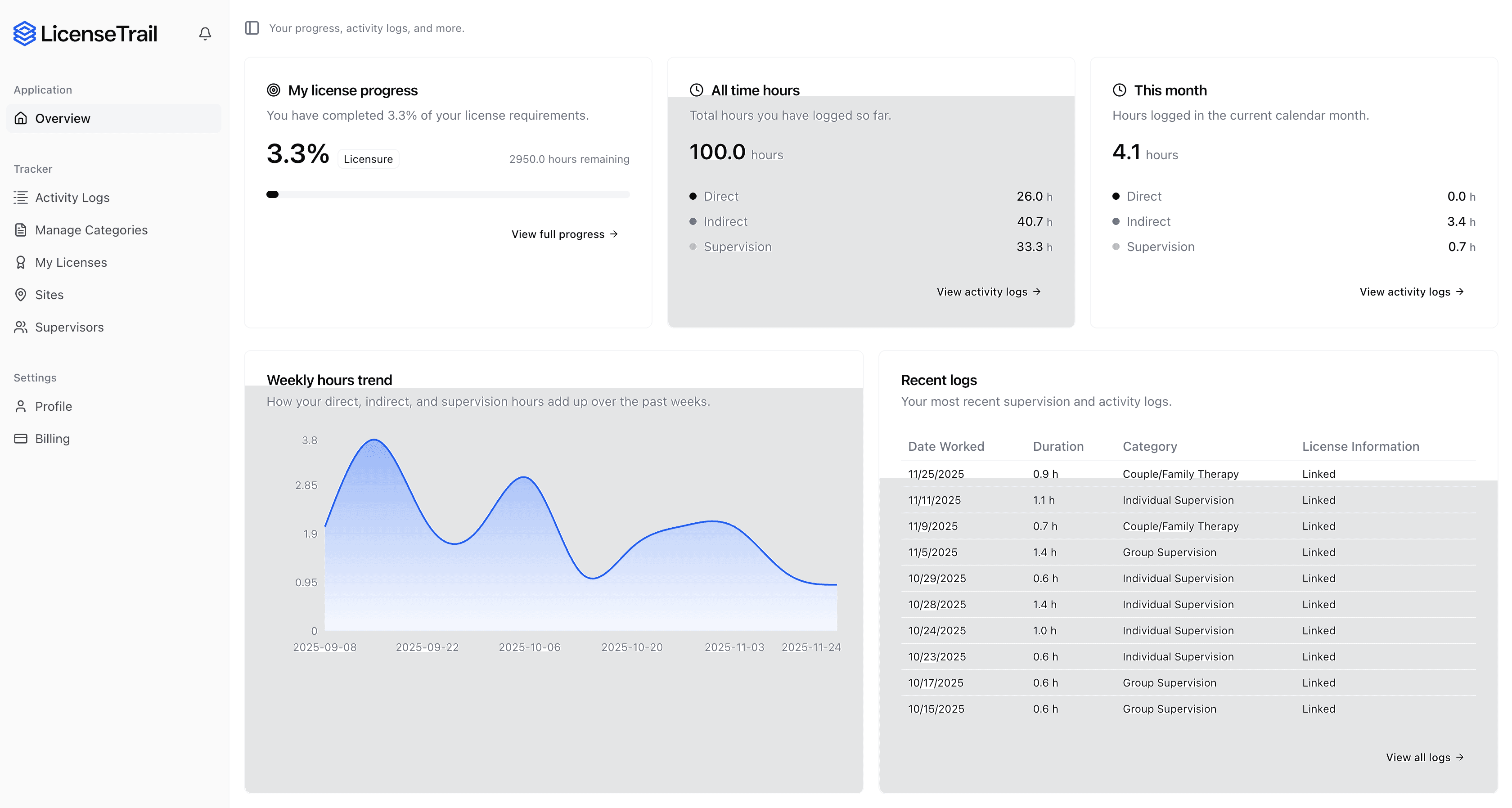
Track your LMSW hours with confidence
License Trail checks your direct, indirect, and supervision hours against Oregon LMSW requirements continuously and flags mismatches before you submit.
 Start Tracking for Free
No credit card required · Free plan available
Related Licenses
Is your spreadsheet hiding Oregon LMSW risks?
Stop guessing if your categories match Oregon Board of Licensed Social Workers requirements. License Trail checks your direct, indirect, and supervision hours continuously and flags mismatches before you submit.
Import or log
Bring your spreadsheet or start fresh
Upload your existing tracking spreadsheet and we'll map every hour into the right Oregon Board of Licensed Social Workers categories automatically.
Verify against Oregon
Catch mismatches before the board does
License Trail checks your direct, indirect, and supervision hours against Oregon LMSW requirements continuously.
Export board-ready
One-click clean reports
Generate professional, board-ready reports for supervision meetings and Oregon Board of Licensed Social Workers submissions in seconds.
No credit card required · Free plan available