
Oregon PSYA Requirements: Hours, Exams & Step-by-Step Guide
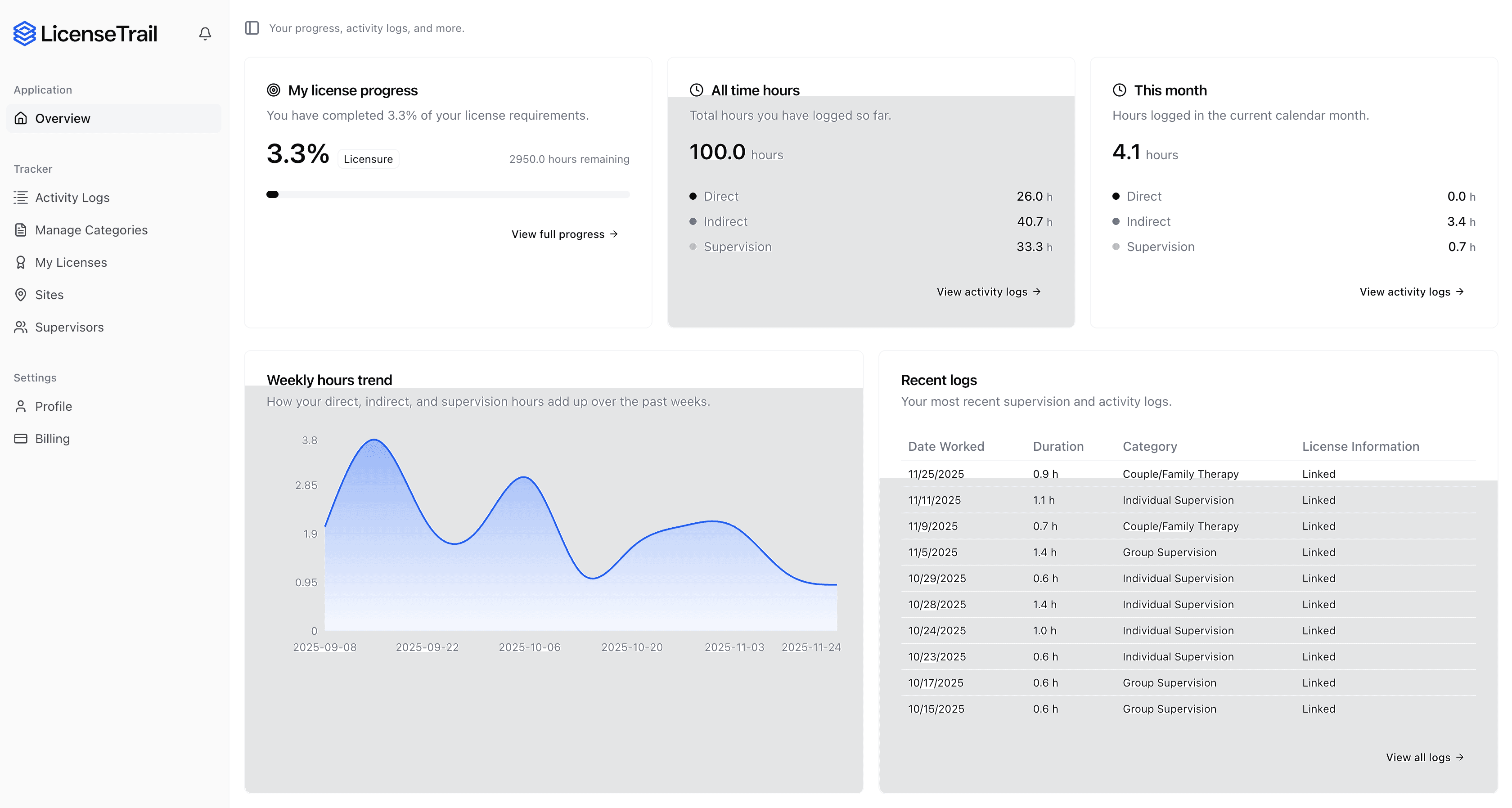
Stop guessing if your categories match Oregon requirements. License Trail checks your direct, indirect, and supervision hours against PSYA requirements continuously and flags mismatches before you submit.
No credit card required · Free plan available
Quick Requirements Overview
- Status (mid‑2025): Board repealed PSYA supervised‑experience rule (OAR 858‑010‑0037) effective 7/11/2025; Board site now lists only doctoral Psychologist for new applications—verify PSYA is still open to new applicants.
- Role/scope: Master’s‑level Psychologist Associate; practice is limited and requires supervision by a licensed psychologist.
- Education: Master’s in psychology from a regionally accredited institution; minimum 45 quarter / 30 semester graduate credits with 30 quarter / 20 semester graded.
- Coursework content: Coverage of ≥5 basic psychology areas + 1 graduate ethics course + 1 tests/measurement course; small deficiency (one course) may be remediated.
- Residency in program: 1 continuous year in residence (2 semesters/3 quarters); primarily distance/short intensives don’t meet this alone.
- Practicum (in degree): Organized practicum ≥2 semesters/3 quarters and ≥300 hours supervised psychological services.
- Internship (in degree, if applicable): Organized internship ≥1,500 hours completed within 24 months.
- Former post‑master’s pathway (repealed rule): 3 years full‑time supervised work (≈ 4,500 hours, since 1 year = 1,500 hours) under a Board‑approved supervision contract with weekly supervision (1 hr if 1–20 hrs/week; 2 hrs if >20, incl. ≥1 hr individual).
License Details
Procedures
Oregon’s Psychologist Associate license (license type PSYA) is a master’s‑level credential issued by the Oregon Board of Psychology. It authorizes a limited scope of psychological practice under supervision, with the possibility of later obtaining independent status.
As of mid‑2025, the Board has repealed the rule that specified supervised work experience for new Psychologist Associate applicants (OAR 858‑010‑0037). The Board’s “Apply for a License” page now lists only the doctoral‑level Psychologist license as available to new applicants. (oregon.gov)
Because of that, the requirements below describe the framework that has governed Psychologist Associate licensure, but you should verify with the Board whether they are still accepting new PSYA applications.
1. License type and role
The Board issues two psychology licenses:
- Psychologist – doctoral level.
- Psychologist Associate – master’s level. (oregon.gov)
A Psychologist Associate:
- Holds a master’s degree in psychology.
- Performs “certain functions within the practice of psychology under the periodic direct supervision of a psychologist,” such as psychological testing, assessments, and counseling. (apps.oregon.gov)
- May, after at least three years of supervised practice at a high level of proficiency, request authority to function without immediate supervision (independent status) under separate rules. (apps.oregon.gov)
The detailed minimum qualifications are set out in Oregon Administrative Rules (OAR) Chapter 858, Division 10.
2. Educational requirements (OAR 858‑010‑0015)
To qualify educationally as a Psychologist Associate, Oregon requires all of the following: (oregon.public.law)
2.1 Degree level and accreditation
- A master’s degree in psychology.
- The degree must be from a program offered by an institution that:
- Was regionally accredited at the graduate level on the date the degree was awarded (or provincially/territorially chartered in Canada).
2.2 Minimum graduate credits and content areas
Your master’s program must include:
- At least 45 quarter hours or 30 semester hours of graduate credit.
- At least 30 quarter hours or 20 semester hours must be graded (not pass/no‑pass).
- Courses must cover at least five of the “basic areas of psychology,” such as:
- Experimental, learning, physiological, perception, motivation, comparative, statistics, research design, developmental, individual differences, social, organizational, personality, abnormal (the rule lists these as examples). (oregon.public.law)
- One graduate‑level ethics course.
- One graduate‑level tests and measurement course.
A small coursework deficiency (up to one 3‑semester‑hour / 4.5‑quarter‑hour course) may be cured with additional graduate coursework at a regionally accredited institution. (oregon.public.law)
2.3 In‑residence requirement
Effective July 26, 2016, the master’s program must include a minimum of one continuous year in residence at the degree‑granting institution:
- “One continuous year” = two consecutive semesters or three consecutive quarters.
- “In‑residence” means physical, in‑person presence sufficient to support full participation and acculturation into the profession; short intensive weekends or primarily distance formats do not meet this by themselves. (oregon.public.law)
3. Practicum and internship requirements in the degree
Two different but related requirements apply during the degree program.
3.1 Practicum (OAR 858‑010‑0012)
The master’s program must include an organized practicum that is: (oregon.public.law)
- At least two semesters or three quarters, and
- At least 300 hours of supervised psychological services.
“Psychological services” are defined (for supervised‑experience purposes) as activities such as direct psychological services to individuals or groups, diagnosis and assessment, documentation related to services, client‑needs meetings and consultation, psychological testing, client‑related research, report writing, and formal training like workshops or conferences. Business/administrative tasks (marketing, billing, form creation, etc.) do not count. (oregon.public.law)
Practicum supervision must include structured discussion of cases, theory, law/ethics, standards of practice, coordination with other professionals, and evaluation of the supervisory process. (oregon.public.law)
3.2 Internship (OAR 858‑010‑0013)
The rules also recognize a formal internship: (oregon.public.law)
- Must be an organized internship as part of the qualifying degree program.
- Must include at least 1,500 hours of supervised experience, completed within 24 months.
- Must have a written description of goals and content, a clearly designated licensed psychologist responsible for integrity and quality, and be structured as a planned sequence of training experiences.
4. Supervised work experience to qualify for the PSYA license
Historically, supervised experience for Psychologist Associate licensure has been governed by two rules:
- OAR 858‑010‑0036 – Post‑Doctoral Supervised Work Experience (sets definitions, hours, and supervision standards).
- OAR 858‑010‑0037 – Supervised Work Experience — Psychologist Associate (applies 0036’s framework to master’s‑level associates with a few modifications). (oregon.public.law)
4.1 The now‑repealed Psychologist Associate supervised‑experience rule (OAR 858‑010‑0037)
OAR 858‑010‑0037 required that Psychologist Associate applicants: (oregon.public.law)
-
Complete a one‑year full‑time internship or other supervised learning practicum
- The internship/practicum had to meet the practicum or internship requirements of OAR 858‑010‑0012 or 858‑010‑0013 (see Sections 3.1 and 3.2).
-
Complete three years of full‑time post‑master’s supervised work experience,
- It had to be “in accordance with OAR 858‑010‑0036 (Post‑Doctoral Supervised Work Experience),” with two differences:
- The trainee is titled “psychologist associate resident.”
- The Resident Supervision Contract for a psychologist associate could run up to four years (whereas the standard psychologist residency contract is limited to two years, extendable for good cause). (oregon.public.law)
- It had to be “in accordance with OAR 858‑010‑0036 (Post‑Doctoral Supervised Work Experience),” with two differences:
This rule (858‑010‑0037) was formally repealed effective July 11, 2025. (oregon.gov)
4.2 How Oregon defines a “year” and what counts as hours (OAR 858‑010‑0036)
OAR 858‑010‑0036 defines one year of supervised work experience and the types of activities that qualify: (oregon.public.law)
- One year of supervised work experience = 1,500 hours of psychological services,
performed over no less than 12 months. - Psychological services (what you count toward the 1,500 hours) include:
- Direct psychological services to individuals or groups,
- Diagnosis and assessment,
- Completing documentation related to services,
- Client‑needs meetings and consultation,
- Psychological testing,
- Research related to client services,
- Report writing,
- Receiving formal training such as workshops and conferences.
- The rule explicitly excludes business‑development and administrative tasks (credentialing, marketing, purchasing, creating forms, billing, and other business‑management activities) from counting toward the required hours.
Because OAR 858‑010‑0037 required three years of full‑time supervised work “in accordance with” OAR 858‑010‑0036, the Board’s own definitions imply that a full three‑year psychologist associate residency is at least 4,500 hours of qualifying psychological services (1,500 hours × 3 years), completed over a minimum of three years.
Oregon does not break that down into “X hours of direct client contact and Y hours of supervised experience,” as some states do. Instead, it:
- Defines a global category of qualifying “psychological services”, and
- Sets separate rules for the frequency and nature of supervision during those hours.
4.3 Supervision structure and required supervision hours
Under OAR 858‑010‑0036(2), which also governs psychologist associate residents by cross‑reference, supervised work experience must occur under a Board‑approved Resident Supervision Contract and meet specific supervision‑frequency rules: (oregon.public.law)
- To practice psychology in Oregon while accruing supervised hours, a person must be:
- In a Board‑approved Resident Supervision Contract, or
- Practicing in an exempt setting under ORS 675.090 (with important limitations on counting those hours).
- Supervisor qualifications:
- For work done in Oregon, supervision must be by an Oregon‑licensed psychologist licensed at least two years in Oregon or another jurisdiction with comparable standards.
- Supervision frequency (per week):
- If the resident works 1–20 hours in a week: at least 1 hour of individual one‑on‑one supervision that week.
- If the resident works more than 20 hours in a week: at least 2 hours of supervision that week, of which:
- At least 1 hour must be individual supervision.
- Up to 1 hour may be group supervision, and group supervision must:
- Be a formal, ongoing group of at least three mental health professionals,
- Be facilitated by a licensed psychologist, and
- Be approved by the resident’s primary supervisor.
- Supervision can, on a non‑routine basis, be delayed up to 14 days or occur via electronic means when the primary supervisor is unavailable due to vacations, illness, travel, or weather, but:
- Any week that does not meet the supervision requirements cannot be counted toward the supervised‑experience total.
For psychologist associate residents, OAR 858‑010‑0037 adds that they must always use the title “psychologist associate resident,” and their supervision contract can last up to four years, with Board‑approved extensions if needed. (oregon.public.law)
5. Putting the hours together
Based on the rules above, the supervised experience pathway to a Psychologist Associate license has looked like this:
-
Graduate‑program practicum
- At least 300 hours of supervised psychological services over at least two semesters/three quarters. (oregon.public.law)
-
Graduate‑program internship (if used to meet the “one‑year supervised learning” requirement)
- At least 1,500 hours of supervised experience completed within 24 months. (oregon.public.law)
-
Post‑master’s supervised work as a psychologist associate resident
- Three years of full‑time supervised work experience “in accordance with OAR 858‑010‑0036.” (oregon.public.law)
- OAR 858‑010‑0036 defines one year as 1,500 hours of psychological services, so a full three‑year residency corresponds to at least 4,500 hours of qualifying psychological services under appropriate supervision (this total is an inference directly from the Board’s definition of a “year” multiplied by three).
Again, Oregon does not specify “1,500 hours of direct client contact and 1,500 hours of supervised experience” as separate numerical categories. Instead:
- You must accrue 1,500 hours of qualifying psychological services per year, and
- You must receive weekly individual (and sometimes group) supervision at the frequencies set in OAR 858‑010‑0036(2).
6. Other licensure components (exams, background check, etc.)
Although the Board’s public “Apply for a License” page is now framed solely around the Psychologist (doctoral) license, the general licensure framework (applied historically to both psychologists and psychologist associates) includes: (oregon.gov)
- Application through the Applicant Portal, with:
- A non‑refundable application/processing fee (the psychologist application currently lists a total of $370 including background check).
- Fingerprint‑based criminal background check.
- National written examination (the EPPP or equivalent, via OAR 858‑010‑0025).
- Oregon Jurisprudence Examination on Oregon psychology laws, rules, and ethics (OAR 858‑010‑0030).
- Verification of supervised experience and references, submitted on Board forms.
- Ongoing continuing education: all licensees (psychologists and psychologist associates) must complete 40 hours of CE every two years, including minimum hours in ethics and cultural competency. (oregon.gov)
7. Current status and practical implications
Key points about the current (late‑2025) landscape:
- The Board’s official “Apply for a License” page, as of summer 2025, lists only the Psychologist license under “Licenses Offered” and references only doctoral‑level education qualifications. (oregon.gov)
- The Board has explicitly repealed OAR 858‑010‑0037, the rule that described supervised work experience for Psychologist Associate licensure, effective July 11, 2025. (oregon.gov)
- The Credentialing page still recognizes “Psychologist Associate (master’s level)” as a license type the Board issues, and there are existing licensed Psychologist Associates and Psychologist Associate Residents listed in the Board’s license‑lookup system. (oregon.gov)
Taken together, this strongly suggests:
- Existing Psychologist Associates and Psychologist Associate Residents remain regulated under Chapter 858 (and related cross‑references in other Oregon rules).
- New applicants may not currently have a pathway to begin a fresh Psychologist Associate application, or that pathway is in transition, since the Board has removed explicit associate‑application instructions and repealed the dedicated supervised‑experience rule.
For anyone planning training routes now, it is essential to:
- Confirm directly with the Oregon Board of Psychology whether they are accepting new PSYA applications, and
- If not, consider doctoral‑level psychologist licensure or alternative master’s‑level behavioral health licensure (LPC, LMFT, LCSW, etc.) regulated by other Oregon boards.
Summary of hour requirements under the former PSYA framework
- Practicum (during master’s):
≥300 hours of supervised psychological services. - Internship (during master’s, if used):
≥1,500 hours of supervised experience within 24 months. - Post‑master’s supervised work as a Psychologist Associate Resident:
3 years of full‑time supervised experience in accordance with OAR 858‑010‑0036, which defines 1 year = 1,500 hours of psychological services → effectively ≥4,500 hours of supervised psychological services over at least three years.
All of those hours must meet the rule’s definition of psychological services and be accompanied by weekly supervision at the mandated frequency and format.
Track your PSYA hours with confidence
License Trail checks your direct, indirect, and supervision hours against Oregon PSYA requirements continuously and flags mismatches before you submit.
 Start Tracking for Free
No credit card required · Free plan available
Related Licenses
Is your spreadsheet hiding Oregon PSYA risks?
Stop guessing if your categories match Oregon Board of Psychology requirements. License Trail checks your direct, indirect, and supervision hours continuously and flags mismatches before you submit.
Import or log
Bring your spreadsheet or start fresh
Upload your existing tracking spreadsheet and we'll map every hour into the right Oregon Board of Psychology categories automatically.
Verify against Oregon
Catch mismatches before the board does
License Trail checks your direct, indirect, and supervision hours against Oregon PSYA requirements continuously.
Export board-ready
One-click clean reports
Generate professional, board-ready reports for supervision meetings and Oregon Board of Psychology submissions in seconds.
No credit card required · Free plan available