
Pennsylvania PSY Requirements: Hours, Exams & Step-by-Step Guide
Stop guessing if your categories match Pennsylvania requirements. License Trail checks your direct, indirect, and supervision hours against PSY requirements continuously and flags mismatches before you submit.
No credit card required · Free plan available
Quick Requirements Overview
- Doctoral degree in psychology/related field; APA/CPA accredited or ASPPB/National Register designated (foreign degrees require equivalency evaluation); degree must be complete before exams
- Supervised experience: 2 years total—APA/CPA predoctoral internship counts as 1 year + a second supervised year
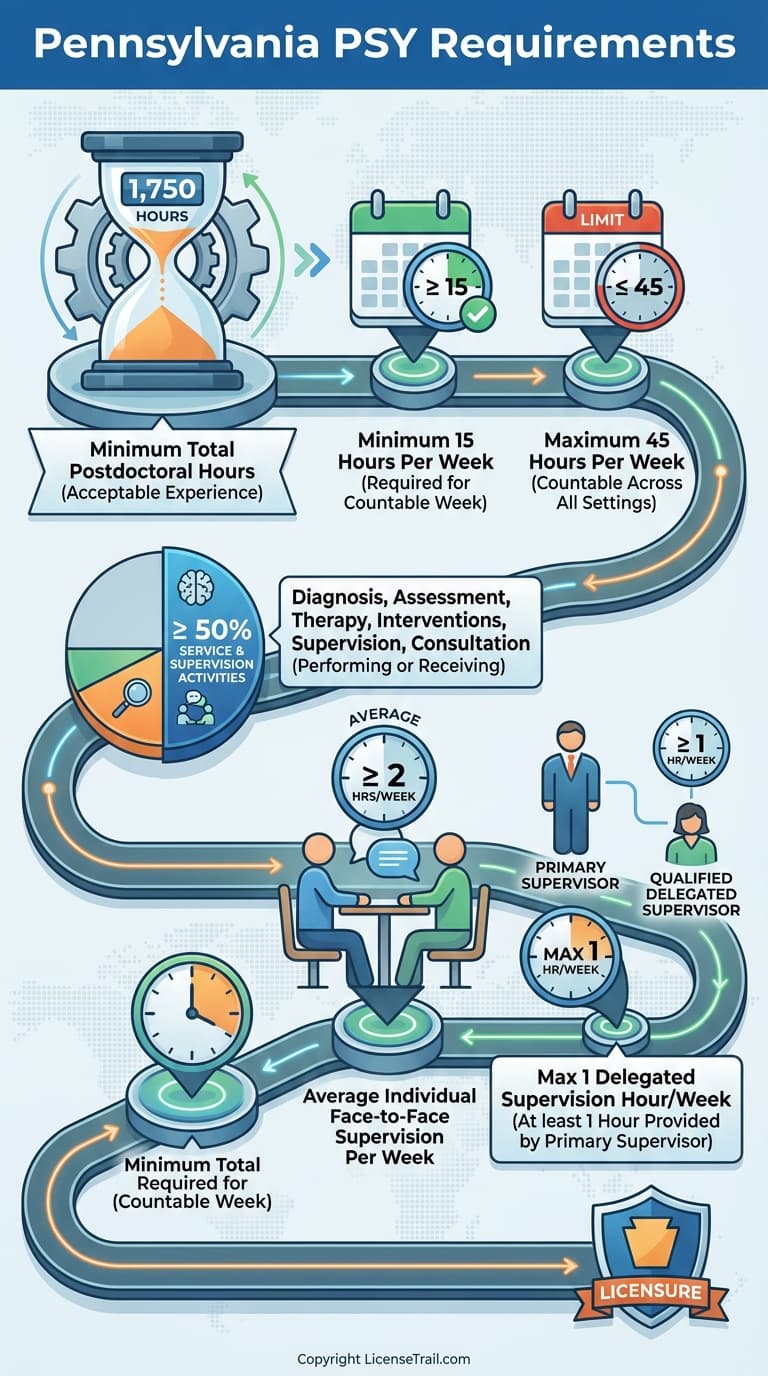
- Second year requirement: minimum 12 months and 1,750 hours; count 15–45 hrs/week; experience must be completed within 10 years of doctoral award (waiver possible)
- Hour content: ≥50% of 1,750 hrs in diagnosis/assessment/therapy/interventions/supervision or consultation (incl. receiving supervision/consultation); remainder may include teaching/research/extra clinical
- Supervision: primary supervisor required per setting; average ≥2 hrs/week individual face-to-face supervision; up to 1 hr/week may be delegated; quarterly evaluations required
- Exams: pass EPPP + Pennsylvania Psychology Law Examination
- Application: submit application/fee + sealed supervisor documentation (verification form, quarterly reports, supervisor letter) + criminal history report dated within 90 days
- Training: 3 hours Board-approved child abuse recognition/reporting CE required for initial licensure (CE required for renewal thereafter)
License Details
Procedures
Licensure as a psychologist (PSY) in Pennsylvania is governed by the State Board of Psychology under Chapter 41 of Title 49 of the Pennsylvania Code. The Board’s framework is built around three pillars: doctoral education, two years of supervised experience, and passing two examinations, plus an application and background check.
Below is a step‑by‑step guide that tracks the Board’s own structure and language.
1. Doctoral Education Requirement
To even be considered for licensure, you must complete a qualifying doctoral degree.
Regulatory standard
The regulation on education states that, to meet the education requirement for licensure, an applicant must complete the requirements for a doctoral degree in psychology or a field related to psychology as defined in the Board’s definitions. (pacodeandbulletin.gov)
For U.S./Canadian programs, the Board requires documentation that the doctoral program is:
- Accredited by the American Psychological Association (APA) or the Canadian Psychological Association (CPA), or
- Designated by the ASPPB/National Register program.
This is verified via a “Verification of Doctoral Program Approval Status” form from your program director and an official transcript. (pacodeandbulletin.gov)
For foreign degrees, the Board relies on evaluation by the National Register (or supplemental APA/CPA‑type training) to determine equivalence. (pacodeandbulletin.gov)
You must have completed all degree requirements before you are eligible to sit for the licensure examinations. (pacodeandbulletin.gov)
2. Supervised Experience: How the “Two Years” Work
Pennsylvania requires the equivalent of two years of supervised experience:
- One year is typically your predoctoral internship (within your APA/CPA‑accredited doctoral program).
- One year is the second year of supervised experience, historically postdoctoral, defined as a minimum of 12 months and 1,750 hours under specific conditions.
The Board’s own “Psychologist Licensure Snapshot” explains this structure:
- “The State Board accepts the predoctoral internship, completed as a part of an APA/CPA accredited doctoral program, as meeting one of the two years of supervised experience.”
- “The second year of supervised experience may be completed after the completion of the predoctoral internship.” (pa.gov)
For those who began an APA/CPA‑accredited doctoral program on or after the fall semester of 2015, the Board allows practicum hours to count toward that second year, under strict conditions (see Section 2C below). (pa.gov)
2A. Predoctoral Internship (First Year of Supervised Experience)
The Board does not set a separate numeric hour requirement for the internship in its own regulations. Instead, it accepts the APA/CPA‑accredited predoctoral internship as satisfying one year of the required supervised experience. (pa.gov)
In practice:
- If you complete an APA/CPA‑accredited doctoral program with an accredited internship, that internship year is treated as your first supervised year.
- The specific number of internship hours is governed by APA/CPA standards and your program, not by a standalone Pennsylvania numeric rule.
2B. Second Year of Supervised Experience: The 1,750‑Hour Requirement
The key numeric requirement appears in 49 Pa. Code § 41.32 (Experience qualifications).
1. Total hours and time frame
To meet the experience requirement, the regulation requires “1 year of acceptable postdoctoral supervised experience.” (pacodeandbulletin.gov)
That year is explicitly defined as:
- At least 12 months, and
- Consisting of at least 1,750 hours of experience. (pacodeandbulletin.gov)
Weekly limits:
- You may count no more than 45 hours and no less than 15 hours of experience per week. (pacodeandbulletin.gov)
Timing limits:
- All required experience must be obtained within 10 calendar years from the award of the doctoral degree, unless the Board grants a hardship/medical waiver. (pacodeandbulletin.gov)
Multiple settings are permitted, but each setting must be at least 6 consecutive months and 15 hours per week, and the total across settings cannot exceed 45 hours per week. (pacodeandbulletin.gov)
2. Types of hours: direct/professional vs. other
The regulation is very specific about the kinds of activities that must make up your 1,750 hours.
It states that “fifty percent of the required hours must be obtained performing diagnosis, assessment, therapy, other interventions, supervision or consultation and receiving supervision or consultation.” (pacodeandbulletin.gov)
This means:
- At least 50% of 1,750 hours (i.e., at least 875 hours) must be in core professional activities, including:
- Psychological diagnosis and assessment
- Therapy and other clinical interventions
- Providing or receiving supervision
- Providing or receiving consultation
There is not a Pennsylvania‑specific rule that says, for example, “1,500 hours of direct client contact and 1,500 hours of supervision.” Instead, the Board uses a single 1,750‑hour requirement, with at least half of those hours in the activities listed above, some of which may be direct client work and some supervision/consultation.
The remaining up to 50% (up to 875 hours) may be in:
- Teaching associated with an organized psychology program or postdoctoral training program
- Psychological research
- Or additional hours in any of the core professional categories (diagnosis, assessment, therapy, interventions, supervision, consultation). (pacodeandbulletin.gov)
3. Acceptable settings and role
Experience must be:
- Consistent with your education and training in psychology, and
- Obtained in a role where you are not practicing independently (for example, not acting as a “qualified member of another recognized profession” under the Act). (pacodeandbulletin.gov)
All experience must be supervised as described below.
2C. Special Rule for Applicants Who Began an APA‑Accredited Program in Fall 2015 or Later
The Board and the Pennsylvania Psychological Association (PPA) have documented a major policy change for those entering APA‑accredited doctoral programs on or after September/Fall 2015:
- The Board has determined that APA‑accredited doctoral programs require successful completion of two years of supervised experience as part of the program.
- For these applicants, the Board has essentially waived the need to document a separate postdoctoral “1,750‑hour year” under § 41.32, provided the program can verify sufficient practicum. (papsy.org)
Specifically, the Board’s licensure snapshot states:
- “Alternatively, an applicant who began an APA/CPA accredited doctoral program on or after the fall semester of 2015 may use practicum experience towards the second year of supervised experience.” (pa.gov)
However, there is a minimum practicum standard:
- The applicant must have completed at least 12 months and at least 1,750 hours of practicum experience.
- If this threshold is not met, the applicant must complete additional supervised experience prior to the issuance of the license. (pa.gov)
The Board requires a letter from the program’s Director of Clinical Training specifying the number of months and hours for each practicum experience to confirm this. (papsy.org)
In other words, the Board still insists on a 12‑month/1,750‑hour supervised year, but for post‑2015 APA‑program graduates it may be fully or partly satisfied by practicum rather than a traditional stand‑alone postdoc.
3. Supervision Structure and Required Supervision Hours
Supervision is governed primarily by § 41.32 (Experience qualifications) and § 41.33 (Supervisors).
3A. Supervision requirement for experience
The regulation states that all experience, including consultation, must be obtained under the supervision of a primary supervisor. (pacodeandbulletin.gov)
- If you earn hours at more than one entity, you must have a primary supervisor for each entity. (pacodeandbulletin.gov)
- The primary supervisor may delegate some supervision to a delegated supervisor (another qualified, licensed professional) for up to 1 hour per week, but remains responsible. (pacodeandbulletin.gov)
3B. Supervisor qualifications and weekly supervision minimum
Under § 41.33, primary and delegated supervisors must:
- Be currently licensed while providing supervision,
- Be qualified by training and experience in your area of supervised practice, and
- Be an owner, employee, or contracted professional with the entity that employs you. (pacodeandbulletin.gov)
Most importantly for hour counting, supervisors must:
- “Meet individually face-to-face with the psychology resident for an average supervisory total of at least 2 hours per week.” (pacodeandbulletin.gov)
Additional supervisory obligations include:
- Reviewing practice and ethical issues with you,
- Keeping notes/records of supervision for at least 10 years or until you are licensed (whichever is longer), and
- Preparing written quarterly evaluations/progress reports that describe your strengths and weaknesses; these must be submitted with your licensure application. (pacodeandbulletin.gov)
This means that while your 1,750 experience hours may include various professional activities, there is a parallel supervisory minimum of about 2 hours per week, on average, throughout the supervised year.
4. Examinations Required
Under § 41.41 (Examinations), before licensure you must:
- Have completed all requirements for the doctoral degree that satisfies § 41.31. (pacodeandbulletin.gov)
- Take and pass two exams:
- The Examination for Professional Practice in Psychology (EPPP), and
- The Pennsylvania Psychology Law Examination (covering state law and regulations). (pacodeandbulletin.gov)
Both passing scores are required to qualify for licensure.
5. Application, Documentation, and Background Check
Once education, supervised experience, and exams are complete, you submit a formal application to the State Board of Psychology.
Under § 41.30 (Qualifications and documentation necessary for licensure), an applicant must:
- Submit a completed application and fee, and
- Provide, in a sealed envelope signed across the flap by the primary supervisors, the following:
- The Board’s verification of postdoctoral (or supervised) experience form,
- The quarterly evaluations/progress reports prepared during supervision, and
- A letter from the supervisor describing the supervisory relationship and giving an overall judgment of the applicant’s potential as a psychologist. (pacodeandbulletin.gov)
You must also submit an updated criminal history records information report, dated within 90 days of the application, unless already provided very recently for another Board purpose. (pacodeandbulletin.gov)
6. Child Abuse Training and Continuing Education
The licensure snapshot clarifies additional training requirements: (pa.gov)
- For initial licensure, applicants must complete 3 hours of Board‑approved continuing education in child abuse recognition and reporting.
- For license renewal, psychologists must complete 30 hours of continuing education each biennium, including:
- At least 3 hours in ethical issues
- 2 hours in child abuse recognition and reporting
- 1 hour in suicide prevention
These are conditions for maintaining licensure, not for earning the license the first time (except the initial 3‑hour child‑abuse course).
7. Summary of the Hour Requirements in Plain Terms
Putting the Board’s rules together for a typical route:
- Education: Doctoral degree in psychology or related field from an APA/CPA‑accredited or ASPPB/National Register‑designated program (or evaluated as equivalent).
- Supervised experience (2 years total):
- Predoctoral internship (within the accredited doctoral program) = Year 1 of supervised experience (no separate PA numeric hour in the regulation; APA/CPA standards apply). (pa.gov)
- Second supervised year, historically postdoctoral:
- Minimum 12 months and 1,750 hours of supervised experience.
- 15–45 hours/week may be counted.
- At least 50% of hours (≥ 875) must be in: diagnosis, assessment, therapy, other interventions, supervision or consultation, and receiving supervision or consultation.
- Remaining hours may be in teaching, research, or additional clinical/supervisory activities.
- At least 2 hours/week of face‑to‑face individual supervision on average with a qualified, licensed supervisor (up to 1 hour/week may be delegated). (pacodeandbulletin.gov)
- For APA‑accredited cohorts starting Fall 2015 or later: the 1,750‑hour/12‑month year may be satisfied via practicum rather than a standalone postdoc, if the program verifies at least 12 months and 1,750 hours of practicum; otherwise additional supervised experience is required. (pa.gov)
- Exams: Pass both the EPPP and the Pennsylvania Psychology Law Examination. (pacodeandbulletin.gov)
- Application: Submit Board application, fee, sealed supervision documentation (verification form, quarterly reports, supervisor letter), and current criminal history check. (pacodeandbulletin.gov)
- Training add‑ons: 3 hours of Board‑approved child‑abuse CE for initial licensure; continuing CE thereafter. (pa.gov)
There is no Pennsylvania rule that divides supervised hours into something like “1,500 direct client hours + 1,500 supervised hours.” Instead, the controlling numeric standard is 1,750 total supervised hours over 12+ months, with at least half of those hours in core professional activities (clinical work and supervision/consultation), under ongoing weekly face‑to‑face supervision by qualified licensed psychologists.
Track your PSY hours with confidence
License Trail checks your direct, indirect, and supervision hours against Pennsylvania PSY requirements continuously and flags mismatches before you submit.
 Start Tracking for Free
No credit card required · Free plan available
Is your spreadsheet hiding Pennsylvania PSY risks?
Stop guessing if your categories match Pennsylvania State Board of Psychology requirements. License Trail checks your direct, indirect, and supervision hours continuously and flags mismatches before you submit.
Import or log
Bring your spreadsheet or start fresh
Upload your existing tracking spreadsheet and we'll map every hour into the right Pennsylvania State Board of Psychology categories automatically.
Verify against Pennsylvania
Catch mismatches before the board does
License Trail checks your direct, indirect, and supervision hours against Pennsylvania PSY requirements continuously.
Export board-ready
One-click clean reports
Generate professional, board-ready reports for supervision meetings and Pennsylvania State Board of Psychology submissions in seconds.
No credit card required · Free plan available