
Rhode-island LICSW Requirements: Hours, Exams & Step-by-Step Guide
Stop guessing if your categories match Rhode-island requirements. License Trail checks your direct, indirect, and supervision hours against LICSW requirements continuously and flags mismatches before you submit.
No credit card required · Free plan available
Quick Requirements Overview
- Regulator/authority: RI Dept. of Health—State Board of Social Work Examiners (RIGL Ch. 5‑39.1; 216‑RICR‑40‑05‑7)
- Education: MSW (CSWE‑accredited) or doctorate in clinical social work
- Prerequisite license: Must hold RI LCSW before applying for LICSW
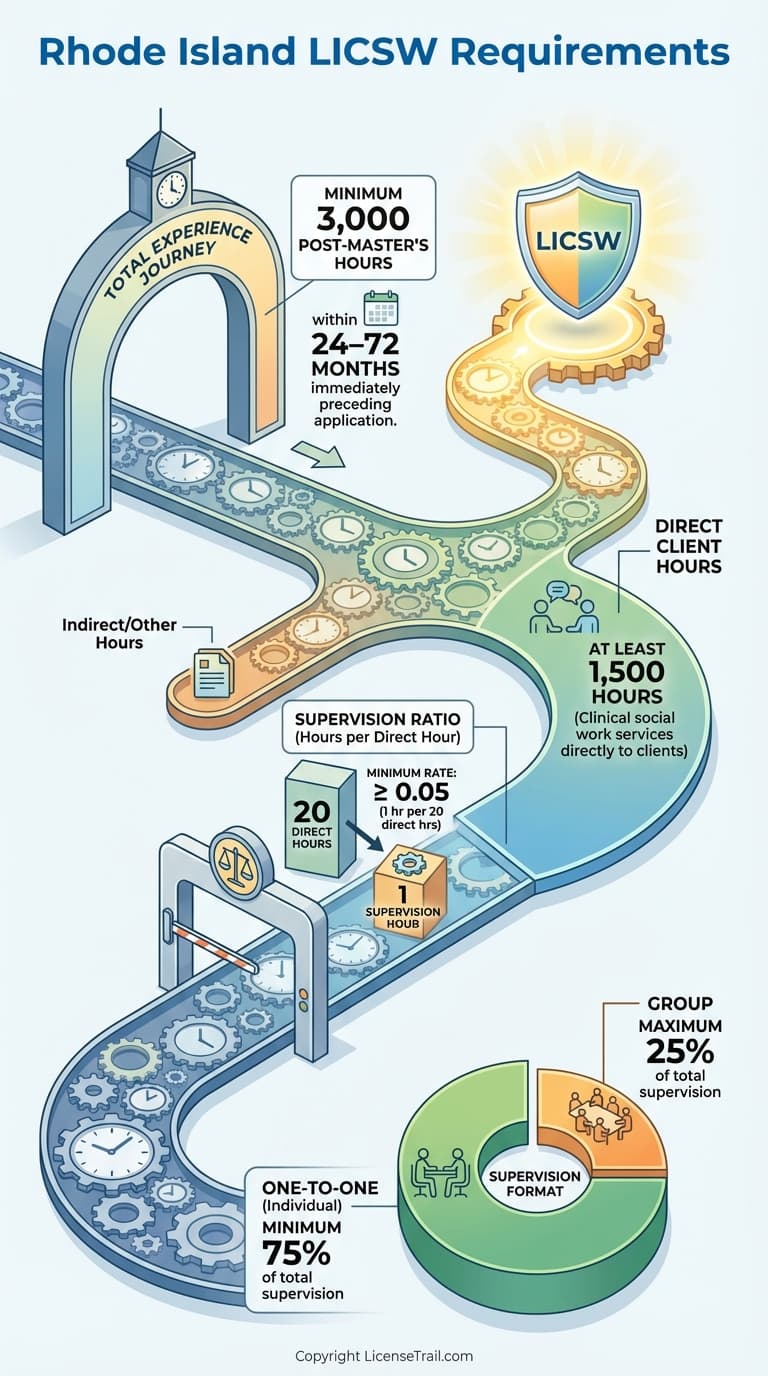
- Post‑MSW experience: 3,000 hours clinical social work in the 24–72 months immediately before application; ≥1,500 hours must be direct client clinical services
- Supervision (by LICSW): Face‑to‑face; ≥2 hrs every 2 weeks and ≥1 hr per 20 direct client hours; ≥75% individual (≤25% group; max 10 supervisees)
- Supervisor restrictions: No relative/household/romantic/domestic relationship; not an employee relationship
- Exam: Pass ASWB Clinical (or Board‑accepted equivalent)
- Continuing education: 30 CE hours/24 months (incl. 3 ethics + 3 cross‑cultural; ≥22 contact hours; ≤8 non‑contact); required for issuance/renewal
License Details
Procedures
Rhode Island regulates Licensed Independent Clinical Social Workers (LICSWs) through the State Board of Social Work Examiners, under Chapter 5‑39.1 of the General Laws and the Department of Health regulations at 216‑RICR‑40‑05‑7. To reach the LICSW level, you must first become a Licensed Clinical Social Worker (LCSW), then complete a defined amount of supervised post‑master’s “experience” as clinical social work, and finally pass the clinical licensing examination.
Below is a step‑by‑step guide, with the hour requirements and key statutory/regulatory language highlighted.
1. Start with the required social work degree
Rhode Island’s regulations for clinical social work licensure require that you:
- Hold either:
- A doctorate in clinical social work from an accredited college or university, or
- A master’s degree in social work (MSW) from a program accredited by the Council on Social Work Education (CSWE). (law.cornell.edu)
This educational requirement applies first when you seek the LCSW license, which is the prerequisite for LICSW.
2. Become a Licensed Clinical Social Worker (LCSW)
Before you can apply for an LICSW, you must hold an LCSW license under Rhode Island law. The regulations state that a license as a “licensed independent clinical social worker” is issued only to someone who is already licensed as a “licensed clinical social worker.” (law.cornell.edu)
Key points at the LCSW stage:
- Education: MSW or DSW/PhD in clinical social work (as above). (law.cornell.edu)
- Examination for LCSW: The rules provide that after August 15, 2025, LCSW applicants must pass a national examination at the appropriate level (the ASWB Clinical/Intermediate level or another exam accepted by the Board). (law.cornell.edu)
- Temporary practice as a new MSW: Recent MSW graduates can practice under specific conditions (e.g., within 18 months of graduation, under direct supervision of an LICSW, and clearly identified as an intern/trainee), but that is a temporary status, not a license. (law.cornell.edu)
Once you are licensed as an LCSW, you can begin accruing the post‑master’s supervised clinical “experience” that is required for LICSW.
3. Understand how Rhode Island defines “experience” and “supervision”
Rhode Island does not simply say “X hours direct, Y hours supervised.” Instead, the law defines “experience” and “supervision” in detail. These definitions are what the Board uses to evaluate LICSW applicants.
3.1 Definition of “experience”
Under R.I. Gen. Laws § 5‑39.1‑2, “experience” is defined for LICSW purposes as: (webserver.rilegislature.gov)
- Total hours:
- 3,000 hours of post‑master’s practice of clinical social work.
- Time frame:
- Those 3,000 hours must be completed within a 24‑ to 72‑month period (i.e., between 2 and 6 years) immediately preceding the date of application for LICSW.
- Direct client work requirement:
- At least 1,500 of the 3,000 hours must be in providing clinical social work services directly to clients.
Put in plain language:
To qualify for LICSW, Rhode Island law requires 3,000 total post‑master’s clinical social work hours within a 2‑ to 6‑year window, and at least 1,500 of those hours must be direct clinical services to clients.
So it is not “1,500 hours of direct experience plus 1,500 hours of separate supervised experience.”
Instead, the structure is:
- 3,000 total clinical social work hours, all occurring post‑master’s and under required supervision, and
- Within that 3,000‑hour total, a minimum of 1,500 hours must be direct clinical work with clients (psychotherapy, assessment, counseling, etc.).
3.2 What counts as “clinical social work practice”
The statute also defines “clinical social work practice” as the professional application of social work theories, methods, and values in the diagnosis, assessment, and treatment of cognitive, affective, and behavioral disorders arising from physical, environmental, or emotional conditions. It includes (among other things) diagnosis, assessment, psychotherapy and counseling for individuals, couples, families, and groups, client‑centered advocacy, consultation, and supervision. (webserver.rilegislature.gov)
Your 3,000 hours should be made up of work that fits within this clinical definition.
4. Supervision requirements for LICSW experience
4.1 Supervisor must be an LICSW
Regulations require that LICSW applicants submit statement(s) documenting the required hours of post‑master’s supervised practice under a licensed independent clinical social worker. (law.cornell.edu)
In other words:
- Your clinical experience must be supervised by an LICSW (or an equivalent in another jurisdiction, as accepted by the Board).
- The Board will look for written documentation from your LICSW supervisor(s) confirming your hours and supervision.
The regulations also state that LICSW experience must be “under appropriate supervision” while you are licensed as an LCSW (when licensure is required where the experience was gained). (law.cornell.edu)
4.2 How Rhode Island defines “supervision”
The statute gives a specific definition of “supervision” for LICSW‑track hours. Supervision is described as face‑to‑face contact with a licensed independent clinical social worker, for the purposes of: (webserver.rilegislature.gov)
- Informing the supervisor about the diagnosis, assessment, and treatment of each client,
- Receiving oversight and guidance from the supervisor in providing clinical services, and
- Being evaluated by the supervisor.
This supervision must meet all of the following minimums: (webserver.rilegislature.gov)
-
Frequency requirement
- At least 2 hours of supervision every 2 weeks.
-
Ratio requirement tied to direct client hours
- At least 1 hour of supervision for every 20 hours of direct client contact.
- This ratio applies even if you have already met the “2 hours every 2 weeks” requirement.
-
Individual vs. group supervision
- At least 75% of supervision must be one‑to‑one (individual) supervision with your LICSW supervisor.
- Up to 25% may be group supervision, and each group session may include no more than 10 supervisees.
-
Restrictions on who can supervise
- Your supervisor cannot be:
- A parent, spouse, former spouse, sibling, child, or employee,
- Anyone sharing your household, or
- Anyone with whom you have a romantic, domestic, or familial relationship. (webserver.rilegislature.gov)
- Your supervisor cannot be:
These conditions define what counts as acceptable supervision for the 3,000‑hour experience requirement.
5. Experience requirement as stated in Board regulations
The Department of Health regulations for social work licensure specify that, for LICSW: (law.cornell.edu)
- A license as a “licensed independent clinical social worker” is issued to an applicant who:
- Is licensed as an LCSW, and
- Has 24 months of experience acceptable to the Board, which is only acceptable if:
- The applicant was licensed as an LCSW (if required in that jurisdiction), and
- The experience was under appropriate supervision, and
- Has fulfilled continuing education requirements for this license, and
- Has satisfactorily completed the required national examination for this license.
The regulation on applications adds that LICSW applicants must submit statement(s) documenting the required hours of post‑master’s supervised practice under a licensed independent clinical social worker. (law.cornell.edu)
These regulatory provisions work together with the statutory definitions of “experience” and “supervision” to shape the concrete hour requirements summarized above.
6. Examination requirement for LICSW
For the LICSW license, Rhode Island regulations require that applicants have “satisfactorily completed a national examination at the appropriate level” for independent clinical social work. (law.cornell.edu)
The regulations specify that, for LICSW:
- The required exam is the clinical level examination administered by the Association of Social Work Boards (ASWB), or another exam the Board considers acceptable. (law.cornell.edu)
You must arrange to take the ASWB Clinical exam (or Board‑accepted equivalent), have your scores sent to the Board, and meet any ASWB and Board conditions for examination and re‑examination.
7. Continuing education (CE) requirements
Rhode Island requires LICSWs to meet continuing education standards for both issuance and renewal of the license.
7.1 CE as a prerequisite for LICSW
The LICSW regulation includes as one of its prerequisites that the applicant “has fulfilled the continuing education requirements for this license.” (law.cornell.edu)
In practice, this typically affects you if you are already licensed and are upgrading or maintaining independent status; it ties LICSW status to ongoing professional education.
7.2 CE for license renewal
For all clinical social work licensees (LCSW and LICSW), the regulations require: (law.cornell.edu)
- 30 hours of continuing social work education every 24 months, including:
- At least 3 hours in cross‑cultural practice, including the alleviation of oppression.
- At least 3 hours in social work professional ethics.
- At least 22 of the 30 hours must be “contact hours” (live or equivalent, not solely self‑study); up to 8 hours may be non‑contact hours.
- You must attest to completion of CE at each renewal (licenses renew biennially, expiring on May 1 of odd‑numbered years).
8. Putting it together: Practical checklist to reach LICSW in Rhode Island
-
Earn your degree
- Complete an MSW from a CSWE‑accredited program (or a clinical social work doctorate). (law.cornell.edu)
-
Obtain LCSW licensure
- Apply to the Rhode Island Department of Health / Board of Social Work Examiners.
- Provide transcripts and required identity documentation.
- Take and pass the required national exam for LCSW (per current exam rules and dates). (law.cornell.edu)
-
Accrue post‑master’s clinical “experience” while an LCSW
- Complete 3,000 hours of post‑master’s clinical social work within 24–72 months immediately before you apply for LICSW.
- Ensure at least 1,500 of those hours are direct clinical services to clients. (webserver.rilegislature.gov)
-
Ensure you meet all supervision requirements
- Supervision is by a Licensed Independent Clinical Social Worker (or equivalent, if accepted by the Board). (law.cornell.edu)
- Receive at least:
- 2 hours of supervision every 2 weeks, and
- 1 hour of supervision per 20 hours of direct client contact.
- Make sure at least 75% of your supervision is one‑to‑one; any group supervision is with no more than 10 supervisees and makes up no more than 25% of total supervision time.
- Confirm your supervisor is not a relative, housemate, romantic partner, or in a similar relationship barred by statute. (webserver.rilegislature.gov)
-
Maintain detailed documentation
- Keep logs of:
- Total hours worked (with start/end dates to show 24–72 month window),
- Direct client hours,
- Supervision hours (dates, duration, individual vs. group),
- Supervisor’s credentials (license number, state).
- Your LICSW application must include statement(s) from your LICSW supervisor(s) documenting these hours. (law.cornell.edu)
- Keep logs of:
-
Meet examination and CE requirements for LICSW
- Register for and pass the ASWB Clinical exam (or Board‑accepted equivalent) at the LICSW level. (law.cornell.edu)
- Ensure you meet the Board’s continuing education requirements for the license period in question (30 CE hours every two years, with ethics and cross‑cultural practice content as specified). (law.cornell.edu)
-
Apply to the Board for LICSW
- Submit the LICSW application to the Rhode Island Department of Health with:
- Application form and fee,
- Proof of current LCSW license,
- Official exam results,
- Supervisor documentation of your 3,000 hours and required supervision,
- Any required CE attestations and license verifications from other states where you have been licensed. (law.cornell.edu)
- Submit the LICSW application to the Rhode Island Department of Health with:
If the Board determines that your education, LCSW status, 3,000 hours of experience (including at least 1,500 direct hours), supervision, examination, and CE all meet the legal definitions and regulatory standards, it may issue you a Licensed Independent Clinical Social Worker (LICSW) license, permitting you to practice clinical social work independently in Rhode Island.
Track your LICSW hours with confidence
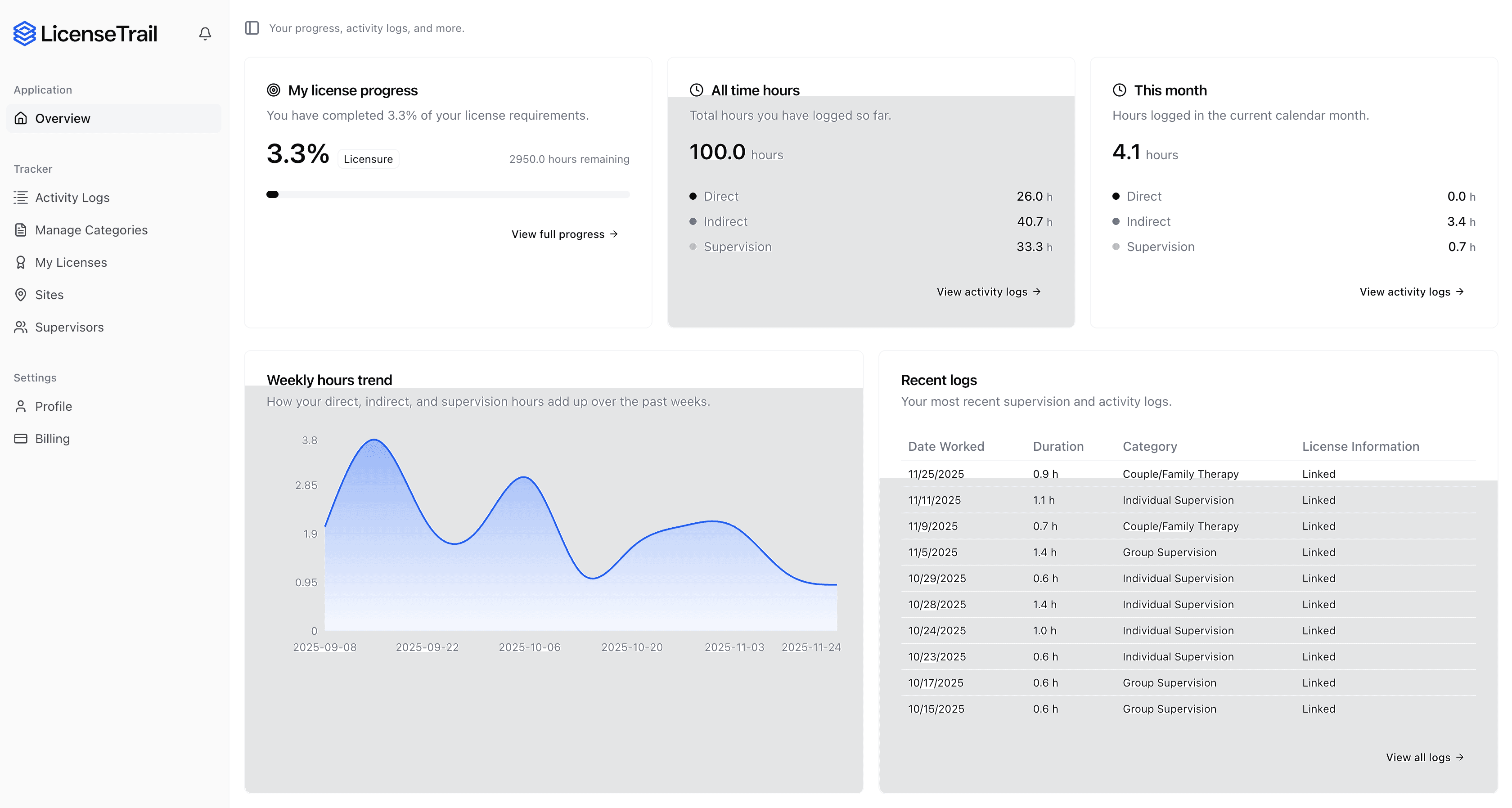
License Trail checks your direct, indirect, and supervision hours against Rhode-island LICSW requirements continuously and flags mismatches before you submit.
 Start Tracking for Free
No credit card required · Free plan available
Is your spreadsheet hiding Rhode-island LICSW risks?
Stop guessing if your categories match Rhode Island Board of Social Work Examiners requirements. License Trail checks your direct, indirect, and supervision hours continuously and flags mismatches before you submit.
Import or log
Bring your spreadsheet or start fresh
Upload your existing tracking spreadsheet and we'll map every hour into the right Rhode Island Board of Social Work Examiners categories automatically.
Verify against Rhode-island
Catch mismatches before the board does
License Trail checks your direct, indirect, and supervision hours against Rhode-island LICSW requirements continuously.
Export board-ready
One-click clean reports
Generate professional, board-ready reports for supervision meetings and Rhode Island Board of Social Work Examiners submissions in seconds.
No credit card required · Free plan available