
Rhode-island LP Requirements: Hours, Exams & Step-by-Step Guide
Stop guessing if your categories match Rhode-island requirements. License Trail checks your direct, indirect, and supervision hours against LP requirements continuously and flags mismatches before you submit.
No credit card required · Free plan available
Quick Requirements Overview
- Regulator/Authority: RI Dept. of Health, Board of Psychology (R.I. Gen. Laws Ch. 5‑44; 216‑RICR‑40‑05‑15)
- Degree: Doctorate in psychology from regionally accredited institution; non‑APA programs must document equivalency (incl. specified coursework/residency expectations)
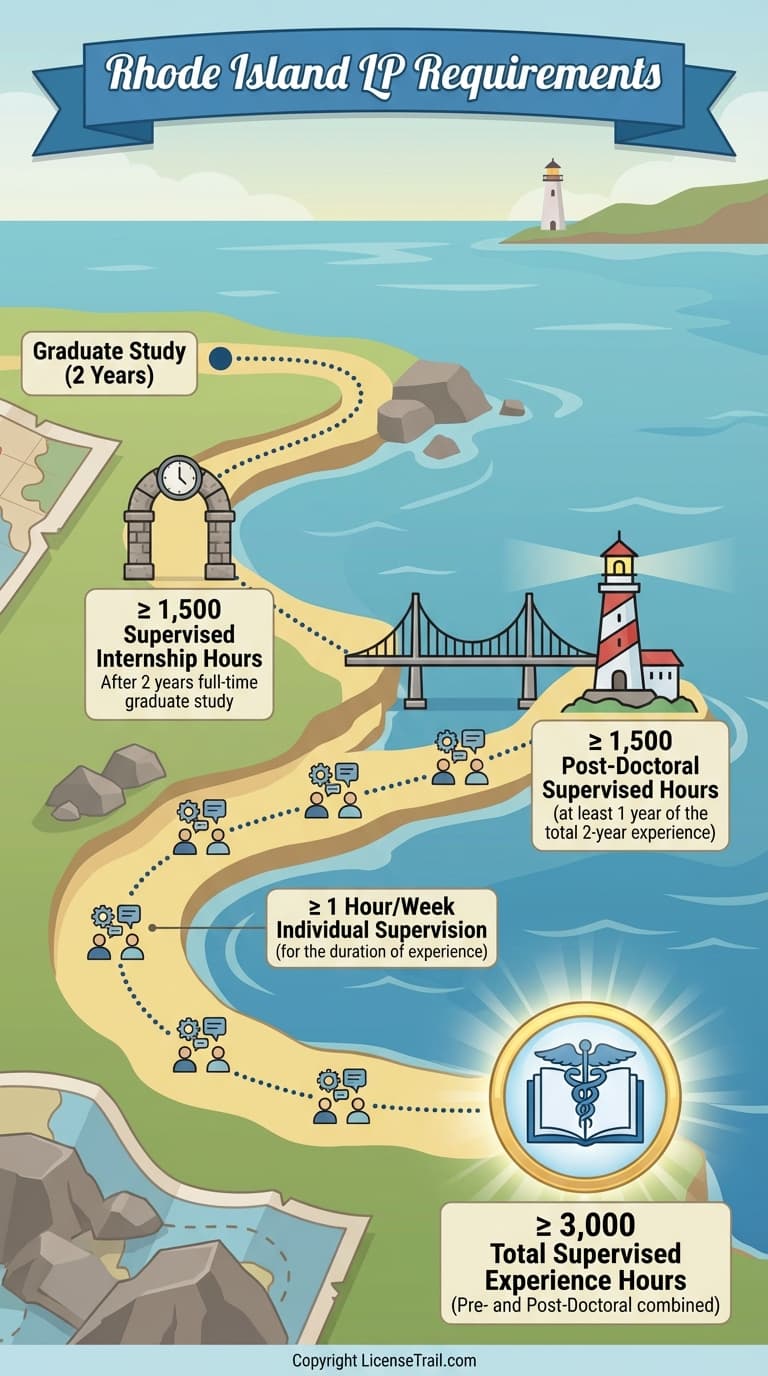
- Supervised experience (total): 3,000 hours minimum over ≥2 years, with ≥1,500 hours postdoctoral
- Internship: 1,500-hour supervised internship after the equivalent of 2 full-time graduate years
- Experience rules: Pre/postdoctoral experience must be separate from coursework practica; obtained in APA/University‑affiliated or Board‑acceptable equivalent settings
- Supervision: By a psychologist licensed/certified in the state of the experience; includes ≥1 hour/week individual supervision plus ongoing availability/responsibility
- Exam: Pass EPPP (ASPPB recommended passing score as adopted by Board)
- Application/Documentation: DOH application + fees, official transcripts, internship affidavit, supervised-hours forms, EPPP scores, and license verifications (if previously licensed)
License Details
Procedures
In Rhode Island, the title “licensed psychologist” (what you’re calling LP) is regulated by the Board of Psychology within the Department of Health under R.I. Gen. Laws Chapter 5‑44 and the Psychologists rules at 216‑RICR‑40‑05‑15.(law.cornell.edu)
Becoming licensed requires (1) a qualifying doctoral degree, (2) specified supervised internship and supervised experience hours, (3) passing the national EPPP exam, and (4) a completed application with documentation. The details below focus on the exact hour requirements and how the Board’s regulations describe them.
1. Degree and Academic Requirements
Doctoral degree requirement
The Board requires that an applicant for licensure:
- “Have received a doctorate degree in psychology which meets the academic requirements of § 15.5.1(A)… or… the equivalent of a doctorate degree in psychology” and
- “Have completed at least two (2) years of supervised experience in accordance with § 15.6 of this Part.” (law.cornell.edu)
The doctorate must be from a regionally accredited institution; if not APA‑accredited, the degree must be shown to be “equivalent… in terms of excellence of education and training.” (law.cornell.edu)
Coursework structure (Board language)
For degrees that must show equivalency, the Board’s regulations specify:
- “A minimum of thirty‑six (36) credit hours shall be earned in residence… through in‑person psychology instruction.”
- “At least seventy‑two (72) semester hours… of graduate course credits… were predominantly psychological in nature,” including ethics, research methods, statistics/psychometrics, history and systems, and a major field of concentration.(law.cornell.edu)
- Within this, there must be at least 3 graduate semester hours (or 5 quarter hours) in each of the following areas:
- Biological bases of behavior
- Cognitive‑affective bases
- Social bases of behavior
- Individual differences(law.cornell.edu)
The academic program must also include dissertation work that is “psychologically oriented,” and the supervised experience and internship must meet § 15.6, which is where the hour requirements come from.(law.cornell.edu)
2. Supervised Internship and Supervised Experience Hours
Rhode Island does not break the hours down in the regulations as “direct” vs “indirect” service. Instead, it defines a total number of supervised hours, how they’re sequenced, and how much must be postdoctoral.
The governing section is 216‑RICR‑40‑05‑15.6 – Supervised Experience and Internship.
Board definition of “supervised experience”
The regulations define:
“Supervised experience” means the practical application of principles, methods and procedures of the science of psychology in accordance with the requirements of § 15.6(A)(2) of this Part. (law.cornell.edu)
“Internship” is separately defined as:
“the one (1) year of supervised experience usually obtained at the pre‑doctoral level.” (law.cornell.edu)
Required structure and hour totals
Under § 15.6, applicants for licensure “shall be required to have completed supervised clinical experience and internship… that meet the following requirements”:
-
Predoctoral supervised internship – 1,500 hours
The Board requires that you have:
“Completed one thousand five hundred (1,500) hours of supervised internship after completion of the equivalent of two (2) years of full‑time graduate study in an integrated organized study program.” (law.cornell.edu)
Key points:
- 1,500 hours must be a supervised internship.
- It must start only after you have completed the equivalent of two full‑time years of graduate study.
- It is “usually obtained at the pre‑doctoral level.”(law.cornell.edu)
-
Total supervised professional experience – 3,000 hours over two years
The Board then describes the second year of experience and the overall total:
“Completed the second (2nd) year of supervised experience after completion of academic requirements for the doctoral degree.” (law.cornell.edu)
This “second year” must:
- Be at least two (2) years in duration, one (1) year of which shall be post‑doctoral;
- “Consist of a minimum of three thousand (3,000) hours, one thousand five hundred (1,500) of which shall be post‑doctoral hours;”
- “Shall be under the supervision of a psychologist certified or licensed pursuant to the statutory provisions of the state in which the supervised experience was obtained.” (law.cornell.edu)
Taken together, the Board’s own structure is:
- Total supervised professional experience required:
- 3,000 hours minimum, over at least 2 years.
- First 1,500 hours: supervised internship (typically predoctoral) after two years of graduate study.
- Second 1,500 hours: additional supervised experience after completion of academic requirements for the doctorate, with at least 1,500 of the 3,000 hours specifically required to be post‑doctoral.(law.cornell.edu)
The regulations do not say, for example, “1,500 hours of direct client service and 1,500 hours of other supervised experience.” Some secondary sources describe typical distributions of direct service versus other activities, but that level of breakdown is not in the Board’s rule text.(psychologist-license.com)
-
Approved settings for these hours
The supervised experience must be obtained:
- “in a setting affiliated with a regionally accredited college or university,” or
- “in a setting approved by the American Psychological Association,” or
- “an equivalent setting satisfactory to the Board.” (law.cornell.edu)
-
Internship and supervised experience must be separate from coursework practica
The Board explicitly states that:
- “The pre‑ and/or post‑doctoral experience must be distinct and separate from any field, laboratory or practical experience required in connection with academic course(s).” (law.cornell.edu)
So you cannot count routine course‑related practica toward the 3,000 supervised hours.
3. Supervision Requirements and Titles While Unlicensed
Supervision standards
The Board requires that supervision:
- Be provided by a licensed psychologist in the state where the experience is obtained. (law.cornell.edu)
- Be conducted “in accordance with acceptable standards of practice” by a psychologist who is responsible for:
- “Establishing an individualized supervisory program” for your professional growth;
- “All aspects of the work of the trainee”;
- “On‑going supervision and availability… at all times during work hours”;
- Weekly one‑to‑one conferences “for at least one (1) hour per week for the duration of the experience in addition to other supervisory case conferences”;
- Providing opportunities for broad experience, seminars, case conferences, consultation;
- Documented assessment of your performance and skills. (law.cornell.edu)
Practically, you must be meeting with your primary supervisor individually for at least one hour per week throughout both predoctoral and postdoctoral supervised experience.
Temporary permit and trainee titles
For the postdoctoral year, you typically practice under a temporary permit:
- A temporary permit to practice psychology under supervision “may be granted to a candidate for licensure who has paid the required fee… and has satisfied the provisions of R.I. Gen. Laws § 5‑44‑13.” (law.cornell.edu)
- Statutory language governing the permit requires that the permit holder:
- Has filed a licensure application with required materials;
- Has earned the doctoral degree;
- Has completed a specified number of supervised hours (currently 1,500) satisfactory to the Board; and
- “Shall only practice under the appropriate supervision of a licensed psychologist.” (webserver.rilin.state.ri.us)
Under the statute as amended, persons practicing under a temporary permit must not use the unrestricted title “psychologist” but instead use titles such as **“psychology student,” “psychology trainee,” “psychology intern,” or “psychology resident.” (webserver.rilin.state.ri.us)
4. Examination Requirement (EPPP)
Licensure is examination‑based unless you qualify for specific endorsement provisions.
The regulations state:
- “Applicants shall be required to pass the Examination of Professional Practice in Psychology (EPPP) offered by the Association of State and Provincial Psychology Boards (ASPPB)… The passing score, as approved by the Board, shall be the ASPPB’s recommended passing score.” (law.cornell.edu)
Rhode Island does not have a separate state jurisprudence exam written into Part 15; the focus is on the national EPPP. Secondary guidance confirms that currently only EPPP Part 1 (Knowledge) is required.(onlinepsychologyprograms.org)
5. Application Documentation and Licensure Grant
What must be submitted
Under § 15.7 – Application for Licensure and Fee, an application must be made on the Department’s forms and accompanied by:(law.cornell.edu)
- Official transcripts and affidavits of internship (to verify your doctoral degree and 1,500‑hour internship).
- The application fee (non‑refundable) as set in the Department’s fee schedule.
- EPPP results sent directly by the exam service.
- Pre‑ and post‑doctoral supervised practice forms, documenting your 3,000 hours and supervision details.
- A Curriculum Summary Form if your doctoral program was not APA‑approved.
- License verification showing you are in good standing in any jurisdiction where you hold or have held a psychology license.
Substantive licensure criteria
Section 15.4 summarizes what you must have achieved to be licensed as a psychologist in Rhode Island:(law.cornell.edu)
- Good moral character.
- A qualifying or equivalent doctoral degree in psychology that meets § 15.5.
- At least two years of supervised experience meeting § 15.6 (i.e., the 3,000 hours described above, with 1,500 internship hours and at least 1,500 postdoctoral hours).
- A passing EPPP score at or above the ASPPB recommended standard.
- Demonstrated areas of competence in line with current APA guidelines, documented by your professional education, training, and experience.
Holders of the ASPPB Certificate of Professional Qualification (CPQ) or the National Register Health Service Provider in Psychology credential “shall be deemed to have met the requirements for licensure as stated in this Part,” simplifying the process for some experienced applicants. (law.cornell.edu)
6. How the Hours Break Down in Practice
Putting the Board’s language into a clear numerical summary:
-
Total supervised professional experience required for RI psychologist licensure:
- 3,000 hours, spread over at least two supervised years.(law.cornell.edu)
-
Predoctoral (internship) component:
- 1,500 hours of supervised internship,
- Obtained after at least two full‑time years of graduate study,
- Usually predoctoral.(law.cornell.edu)
-
Post‑degree supervised experience component:
- Enough additional supervised hours to reach a minimum of 3,000 total,
- With at least 1,500 of those hours explicitly required to be post‑doctoral,
- Conducted under the supervision of a licensed psychologist in an approved setting. (law.cornell.edu)
The regulations do not assign a fixed number of hours that must be “direct client contact” versus assessment, documentation, supervision, consultation, or other professional activities. Where you see statements like “1,500 hours of direct client services,” they are interpretive or advisory from secondary sources, not wording used by the Rhode Island Board itself.(psydprograms.org)
This is the current regulatory framework (as of rules amended effective May 6, 2023) that governs the LP/“licensed psychologist” credential in Rhode Island. For an actual application, you would pair this with the Department of Health’s current forms and fee schedule and confirm there have been no subsequent amendments to Title 216, Chapter 40, Subchapter 05, Part 15.
Track your LP hours with confidence
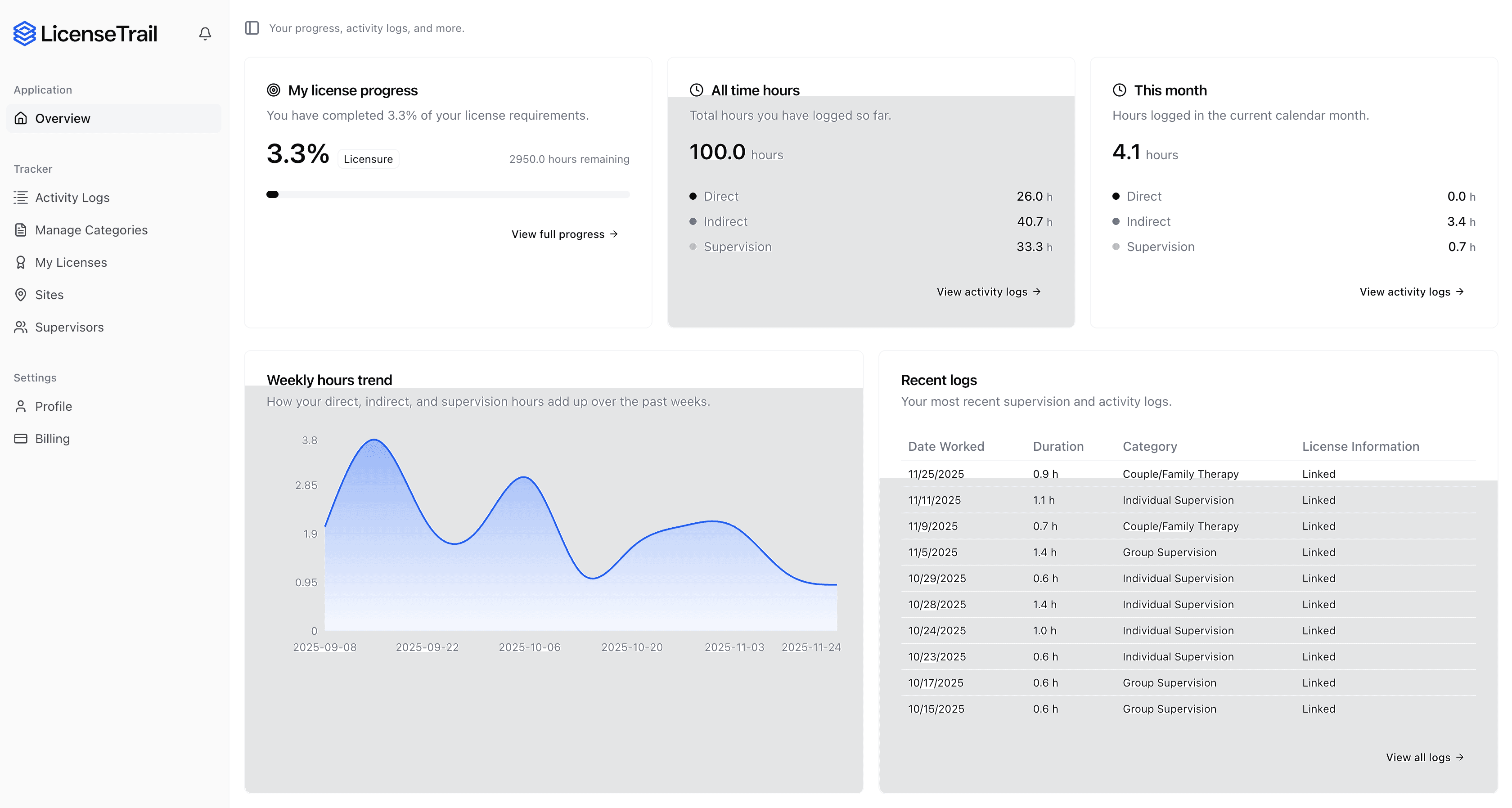
License Trail checks your direct, indirect, and supervision hours against Rhode-island LP requirements continuously and flags mismatches before you submit.
 Start Tracking for Free
No credit card required · Free plan available
Is your spreadsheet hiding Rhode-island LP risks?
Stop guessing if your categories match Rhode Island Board of Psychology requirements. License Trail checks your direct, indirect, and supervision hours continuously and flags mismatches before you submit.
Import or log
Bring your spreadsheet or start fresh
Upload your existing tracking spreadsheet and we'll map every hour into the right Rhode Island Board of Psychology categories automatically.
Verify against Rhode-island
Catch mismatches before the board does
License Trail checks your direct, indirect, and supervision hours against Rhode-island LP requirements continuously.
Export board-ready
One-click clean reports
Generate professional, board-ready reports for supervision meetings and Rhode Island Board of Psychology submissions in seconds.
No credit card required · Free plan available