
Rhode-island LMFT Requirements: Hours, Exams & Step-by-Step Guide
Stop guessing if your categories match Rhode-island requirements. License Trail checks your direct, indirect, and supervision hours against LMFT requirements continuously and flags mismatches before you submit.
No credit card required · Free plan available
Quick Requirements Overview
- Apply through RIDOH Board of Clinical Mental Health Counselors and Marriage & Family Therapists; must hold MFT Associate before LMFT
- Education: Master’s/CAGS/Doctorate in MFT or allied field + 60 semester credits (90 quarter) specializing in MFT (core curriculum required)
- In-program practicum/internship: 12 semester credits supervised practicum + 1 calendar year supervised internship (20 hrs/week or equivalent)
- In-program clinical practice: 500 hours over 12 successive months, incl. 250 hours direct with couples/families present + 100 hours supervision
- Post-degree experience: minimum 2 years relevant postgraduate experience
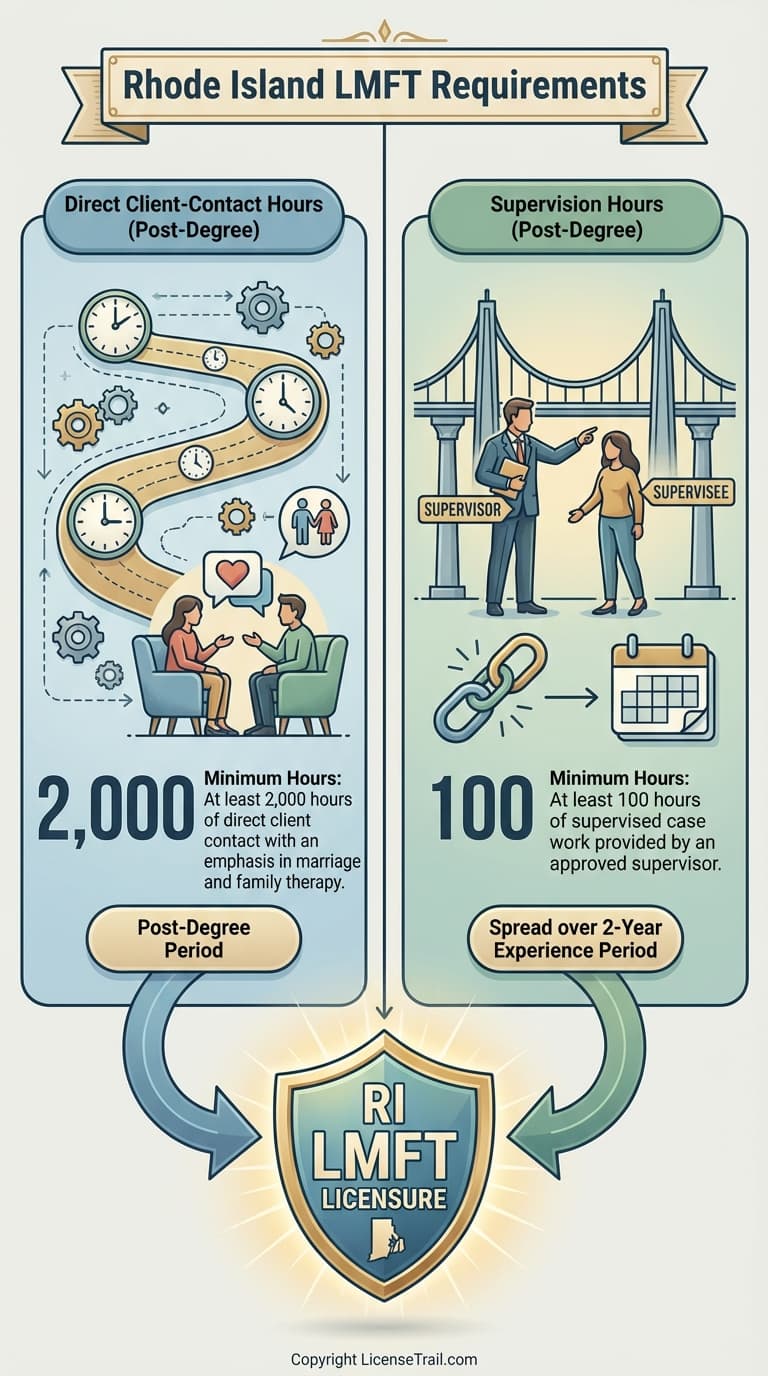
- Post-degree direct client contact: 2,000 hours (direct/face-to-face; emphasis in MFT)
- Post-degree supervision: 100 hours supervised case work over ≥2 years by approved supervisor (AAMFT-approved or RI LMFT meeting criteria)
- Exam: pass AMFTRB National MFT Examination (or other Board-approved exam)
License Details
Procedures
Rhode Island’s path to becoming a Licensed Marriage and Family Therapist (LMFT) is defined in statute (R.I. Gen. Laws § 5‑63.2‑10) and in the Department of Health regulations (216‑RICR‑40‑05‑11). The license is issued by the Rhode Island Department of Health, Board of Clinical Mental Health Counselors and Marriage and Family Therapists. (webserver.rilin.state.ri.us)
Below is a step‑by‑step outline focused on the exact types and amounts of hours the Board requires, using the Board’s own terminology where it matters most.
1. Licenses and Governing Board
- Regulatory authority:
- Rhode Island Department of Health (RIDOH), Board of Clinical Mental Health Counselors and Marriage and Family Therapists. (law.cornell.edu)
- Relevant licenses on the MFT track:
- Marriage and Family Therapist Associate – the post‑graduate, pre‑independent license.
- Licensed Marriage and Family Therapist (LMFT) – full independent license. (regulations.justia.com)
You cannot jump straight to LMFT; you must first meet associate‑level requirements, then complete specific post‑degree hours and pass the exam.
2. Educational Foundation (Graduate Degree and In‑Program Hours)
2.1. Degree and credit requirements
To qualify for a Marriage and Family Therapist Associate license, you must: (regulations.justia.com)
- Hold at least a master’s, CAGS, or doctoral degree in:
- Marriage and family therapy, or
- An “allied field” (e.g., counselor education, psychology, counseling psychology, community mental health, education with a counseling/psychology concentration) with graduate coursework equivalent to an MFT degree, including the required MFT core curriculum. (regulations.justia.com)
- Complete 60 semester credits (or 90 quarter hours) within your graduate or post‑graduate program specializing in marital and family therapy. (regulations.justia.com)
2.2. Core curriculum categories (MFT)
The regulations spell out a core curriculum for MFTs that includes: (regulations.justia.com)
- Theoretical Foundations of Marriage and Family Therapy (6 semester credits)
- Clinical Knowledge (18 credits)
- Human Development and Family Relations (3 credits)
- Ethics and Professional Studies (3 credits)
- Research (3 credits)
- Graduate elective to enhance professional goals (3 credits)
These specific content areas must be evident in your transcript and course descriptions.
2.3. Practicum and internship (educational field experience)
To be licensed as an MFT Associate, the Board requires all of the following graduate‑level field experiences: (regulations.justia.com)
-
Supervised practicum
- Minimum: 12 semester credits (or 18 quarter hours) of supervised practicum within the degree program.
-
Supervised internship
- Minimum: One calendar year of supervised internship consisting of 20 hours per week, or an equivalent arrangement approved by the Board.
-
Supervised clinical practice / direct client hours within the degree
- The core curriculum rules require supervised clinical practice totaling at least 500 hours of clinical work over 12 successive months (this may be on‑site or off‑site under program supervision). (regulations.justia.com)
- Of these 500 hours:
- At least 250 hours (50%) must be direct client contact with couples or families physically present in the room. (regulations.justia.com)
- A minimum of 100 hours of supervision is required during this supervised clinical practice. (regulations.justia.com)
The regulations further clarify how direct client work is counted:
“Direct client contact is defined as face‑to‑face (therapist and client) therapeutic meetings.” (regulations.justia.com)
Activities such as case notes, phone calls, staff meetings, travel, and supervision itself do not count as “direct client contact” for these educational hours. (regulations.justia.com)
3. Step One After Graduation: Marriage and Family Therapist Associate
Once you have the degree and in‑program practicum/internship, you apply to RIDOH for a Marriage and Family Therapist Associate license. (regulations.justia.com)
To obtain the associate license, you must:
- Show you are “of good character”.
- Document:
- The qualifying degree (MFT or allied field with equivalent coursework).
- Completion of 60 graduate credits in MFT.
- Completion of 12 semester credits of supervised practicum.
- Completion of one calendar year of supervised internship at 20 hours/week. (regulations.justia.com)
- Submit the application and fee on RIDOH forms, at least 30 days before a Board meeting. (regulations.justia.com)
Associate license duration:
- Associate licenses (including MFT Associate) are issued for 3 years, with a possible one‑year extension “for good cause shown” to complete all postgraduate requirements, at the Board’s discretion. (regulations.justia.com)
During the associate period, you work under supervision while accruing post‑degree hours toward full LMFT licensure.
4. Core Post‑Degree Requirement: Supervised Experience for LMFT
To move from MFT Associate to full Licensed Marriage and Family Therapist, Rhode Island requires specific post‑degree experience and supervision:
4.1. Duration of post‑degree experience
- You must complete a minimum of two (2) years of relevant postgraduate experience after being awarded the qualifying master’s/doctoral degree. (regulations.justia.com)
4.2. Direct client contact hours (numeric requirement)
Within those two or more years, the Board requires:
- At least 2,000 hours of direct client contact in marriage and family therapy.
The regulation’s wording is that an MFT applicant must have:
“at least two thousand (2,000) hours of direct client contact offering clinical or counseling or therapy services with emphasis in marriage and family therapy” (regulations.justia.com)
Key points about this requirement:
- These are post‑degree hours (after your qualifying degree is awarded). (regulations.justia.com)
- They must be direct client contact, not paperwork, phone calls, staff meetings, or supervision. The same “face‑to‑face therapeutic meetings” standard from the educational regulations is the governing concept. (regulations.justia.com)
- Though the regulations do not specify a required number of couple/family hours in the post‑degree 2,000 hours, your work must focus on marriage and family therapy and be acceptable to the Board as “relevant postgraduate experience.” (regulations.justia.com)
4.3. Supervision hours (numeric requirement)
Separate from the 2,000 direct hours, the Board also requires formal supervision:
- At least 100 hours of post‑degree supervised case work,
- Spread over at least two years,
- Provided by a Board‑approved supervisor. (regulations.justia.com)
The regulations do not frame this as “1,500 hours of supervised experience” or similar. Instead, the Board’s structure is:
- 2,000 hours of direct client contact (post‑degree), plus
- 100 hours of supervision (post‑degree), over a minimum of two years of relevant experience.
In other words, Rhode Island does not split the requirement into “X direct hours + Y other supervised clinical hours” totaling some larger figure; it very specifically requires 2,000 direct client hours and 100 supervision hours.
4.4. Who qualifies as an “approved supervisor”?
For the LMFT post‑degree supervision, an approved supervisor must: (regulations.justia.com)
- Either be duly certified as a supervisor by the American Association for Marriage and Family Therapy (AAMFT),
or - Be a Rhode Island LMFT who:
- Has been licensed in good standing for at least 5 years, and
- Has at least 5 years of clinical experience as a licensee, and
- Has completed an MFT supervision course (either a graduate‑level course in MFT supervision, or an AAMFT/RIAMFT supervision course).
Your supervised hours must be documented on Board‑approved forms and signed by such an approved supervisor.
5. Examination Requirement
Rhode Island requires MFT applicants to pass a national exam:
- The regulations specify that an LMFT candidate must:
- Pass a Board‑conducted or Board‑approved exam, and
- “Successfully complete the Association of Marital and Family Therapy Regulatory Boards (AMFTRB) [national] examination” (or another Board‑approved exam). (regulations.justia.com)
In practice, this means you must pass the AMFTRB National Marriage and Family Therapy Examination.
You typically sit for this exam after or near the end of your required post‑degree experience, and your passing score must be sent to RIDOH.
6. Application for Full LMFT Licensure
Once you have:
- Completed all MFT Associate requirements,
- Logged at least 2 years of relevant post‑degree work,
- Accrued 2,000 hours of post‑degree direct client contact,
- Completed 100 hours of post‑degree supervised case work with an approved supervisor, and
- Passed the AMFTRB exam,
you can apply to the Board for full LMFT licensure. (regulations.justia.com)
Your application will generally include:
- Official transcripts verifying the qualifying degree and 60 credits of MFT‑focused coursework.
- Documentation from your graduate program of practicum, internship, and the 500 hrs of supervised clinical practice (including the 250 relational hours and required supervision).
- Board forms documenting:
- 2,000 post‑degree direct client hours, and
- 100 post‑degree supervision hours,
signed by an approved supervisor.
- Proof of passing the AMFTRB exam.
- Application form and fee submitted to RIDOH.
Under Rhode Island law, a candidate is considered qualified for LMFT licensure upon an affirmative vote of at least four Board members, including at least two MFTs. (webserver.rilin.state.ri.us)
7. After Licensure: Continuing Education (for completeness)
Although not part of the initial licensure path, it is useful to know that once licensed you must maintain the credential:
- The regulations require 40 credits of continuing education every two‑year renewal period,
- At least 20 of those 40 credits must come from “Category I” formal CE (courses, workshops, institutes, including approved web‑based offerings),
- CE must be relevant to clinical mental health counseling or marriage and family therapy and provided or approved by specified professional organizations (e.g., AAMFT, ACA, NBCC, APA, AMA, and their Rhode Island affiliates). (regulations.justia.com)
Failure to meet CE requirements can result in license denial or disciplinary action.
8. Summary of Key Hour Requirements in Rhode Island
During graduate education (to qualify for MFT Associate):
- Supervised practicum:
- 12 semester credits (or 18 quarter hours). (regulations.justia.com)
- Supervised internship:
- 1 calendar year at 20 hours/week. (regulations.justia.com)
- Supervised clinical practice (within the program): (regulations.justia.com)
- 500 hours supervised clinical practice over 12 successive months,
- Including at least 250 hours of direct client contact with couples or families present,
- With 100 hours of supervision during this practice.
After the degree (to qualify for full LMFT): (regulations.justia.com)
- Post‑degree experience duration:
- Minimum 2 years of relevant postgraduate experience.
- Post‑degree direct client contact:
- At least 2,000 hours of direct client contact offering clinical/counseling/therapy services with an emphasis in marriage and family therapy.
- Post‑degree supervision:
- At least 100 hours of supervised case work over at least 2 years, by a Board‑approved supervisor.
- Exam:
- Pass the AMFTRB National MFT Examination (or other exam approved by the Board).
These are the current, Board‑defined requirements as of regulations in effect through June 23, 2025; always confirm with the Rhode Island Department of Health or the official code of regulations before making final plans, as rules can change.
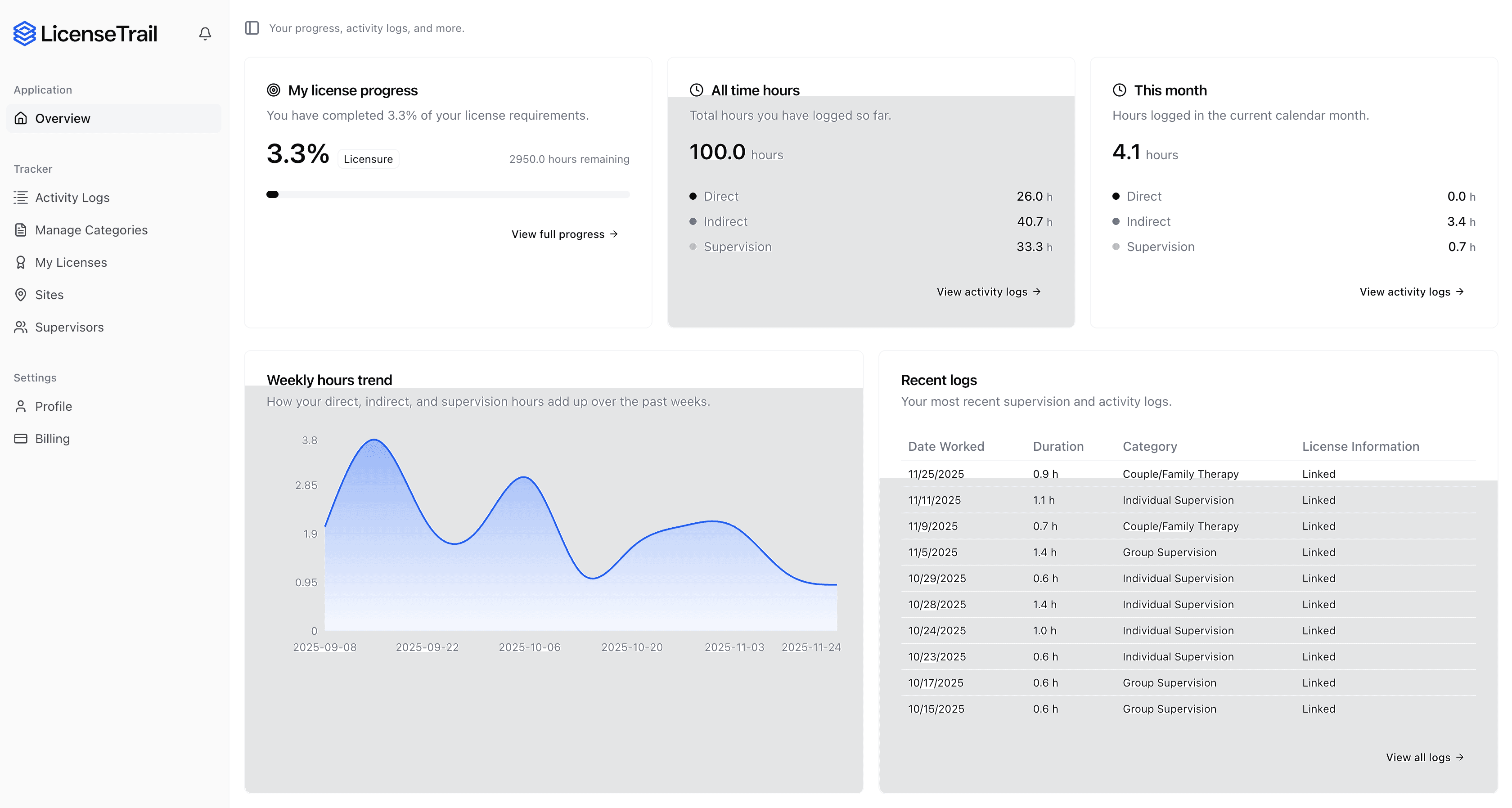
Track your LMFT hours with confidence
License Trail checks your direct, indirect, and supervision hours against Rhode-island LMFT requirements continuously and flags mismatches before you submit.
 Start Tracking for Free
No credit card required · Free plan available
Related Licenses
Is your spreadsheet hiding Rhode-island LMFT risks?
Stop guessing if your categories match Rhode Island Board of Mental Health Counselors and Marriage and Family Therapists requirements. License Trail checks your direct, indirect, and supervision hours continuously and flags mismatches before you submit.
Import or log
Bring your spreadsheet or start fresh
Upload your existing tracking spreadsheet and we'll map every hour into the right Rhode Island Board of Mental Health Counselors and Marriage and Family Therapists categories automatically.
Verify against Rhode-island
Catch mismatches before the board does
License Trail checks your direct, indirect, and supervision hours against Rhode-island LMFT requirements continuously.
Export board-ready
One-click clean reports
Generate professional, board-ready reports for supervision meetings and Rhode Island Board of Mental Health Counselors and Marriage and Family Therapists submissions in seconds.
No credit card required · Free plan available