
South-carolina LISW-CP Requirements: Hours, Exams & Step-by-Step Guide
Stop guessing if your categories match South-carolina requirements. License Trail checks your direct, indirect, and supervision hours against LISW-CP requirements continuously and flags mismatches before you submit.
No credit card required · Free plan available
Quick Requirements Overview
- Age 21+ and good moral character; submit Board application
- MSW/DSW from CSWE-accredited (or Board-equivalent) program; supervised hours must be post-LMSW licensure
- Graduate coursework: 45 academic contact hrs psychopathology + 45 academic contact hrs psychodiagnostics
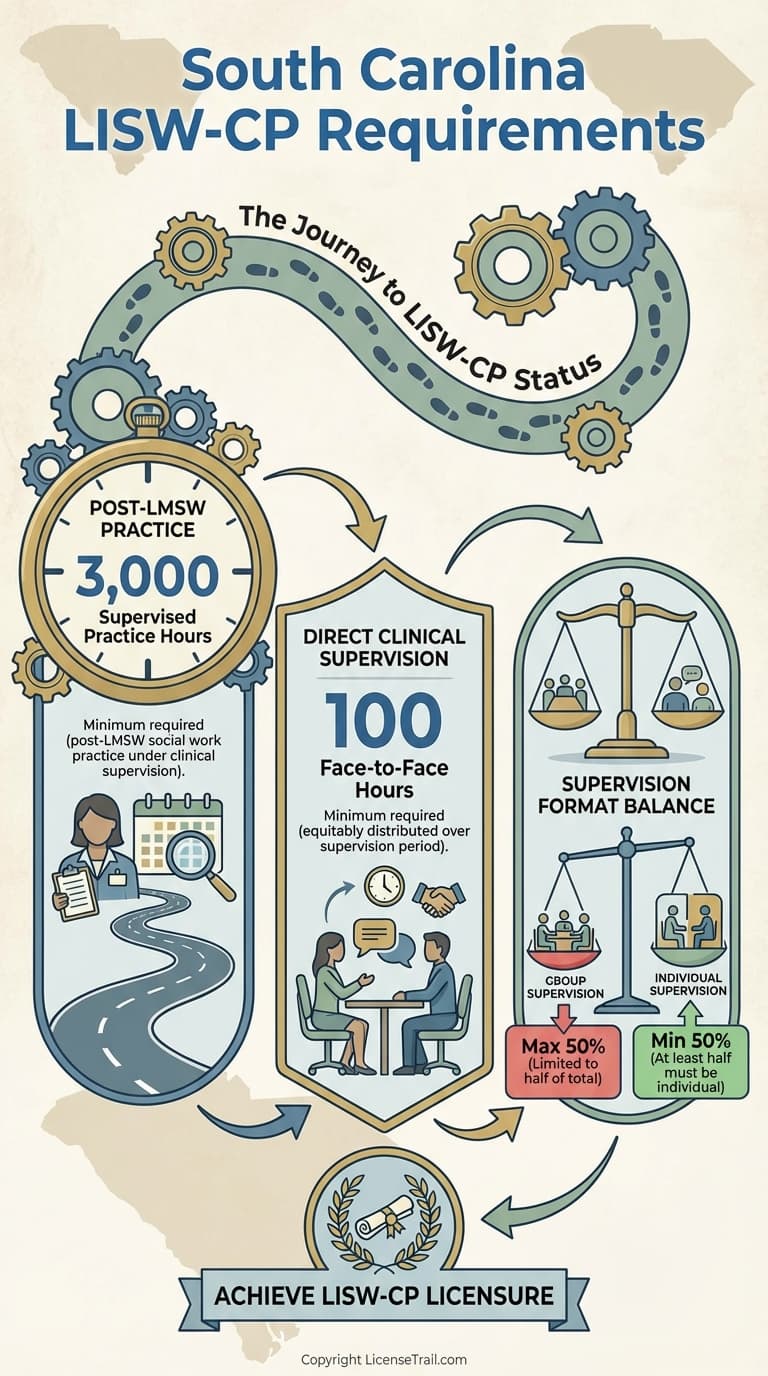
- Supervised experience: 3,000 hrs of clinical social work practice under clinical supervision, completed in 2–4 years
- Supervision meetings: 100 hrs direct (face-to-face) clinical supervision, equitably distributed; HIPAA-compliant video allowed
- Supervision plan/contract must be filed & approved before counting hours; submit termination evaluation/experience report at end
- Exam: pass ASWB Clinical (Board authorization tied to approved supervision contract/education)
- Initial licensure requires SLED + FBI fingerprint-based background checks (for applications after May 22, 2025)
License Details
Procedures
Licensure as a Licensed Independent Social Worker–Clinical Practice (LISW‑CP) in South Carolina
South Carolina regulates LISW‑CPs through statute (Title 40, Chapter 63 of the South Carolina Code of Laws) and by policies of the South Carolina Board of Social Work Examiners. Together, they spell out exactly what education, experience, supervision, and examination are required.
Below is a step‑by‑step description based on that state law and the Board’s own materials.
1. What the LISW‑CP license authorizes
South Carolina law defines the practice of Independent Social Work—Clinical Practice as the professional application of social work theory and methods to restore or enhance psychosocial or biopsychosocial functioning, with an emphasis on assessment, diagnosis, and treatment of mental, emotional, and behavioral disorders through counseling and psychotherapy. LISW‑CPs may practice independently, including in private practice, and may provide activities such as case management, client education, consultation, research, and expert testimony.(scstatehouse.gov)
By contrast, LMSWs may provide clinical services only under clinical supervision in social, medical, or governmental agencies and may not practice privately or independently.(llr.sc.gov)
2. Core statutory eligibility requirements
Under S.C. Code § 40‑63‑240(A), an applicant for LISW‑CP must:(scstatehouse.gov)
- Submit a written application on a Board form.
- Be at least 21 years of age.
- Be of good moral character.
- Hold a master’s or doctorate degree in social work from a program:
- Accredited by a nationally recognized accrediting body for social work programs (i.e., CSWE), or
- Whose standards are at least equivalent, as approved by the Board.
In practice, you must already be licensed at the master’s level (LMSW), because all required supervised hours must occur after licensure as a Masters Social Worker (see Section 4 below).(scstatehouse.gov)
3. Required coursework (beyond the MSW)
State law and the Board’s exam page require specific graduate-level coursework:
a. Psychopathology and psychodiagnostics
S.C. Code § 40‑63‑240(A)(5) requires that coursework include “forty‑five academic contact hours each of: (a) psychopathology; (b) psychodiagnostics.”(scstatehouse.gov)
These hours must be from a CSWE‑accredited (or equivalent) social work program. An "academic contact hour" is defined in the chapter as a 60‑minute clock hour of instruction for CE, and the Board uses similar language for coursework.(scstatehouse.gov)
b. Professional ethics
During the period of supervised practice, you must either:(scstatehouse.gov)
- Obtain 15 academic contact hours in professional ethics, or
- Obtain 20 continuing education contact hours in professional ethics, or
- Complete a Board‑sponsored specialty course in professional ethics.
This ethics requirement is explicitly tied to the professional supervision period.
4. Supervised clinical practice requirement: 3,000 hours
The experience requirement for LISW‑CP is set out in S.C. Code § 40‑63‑240(A)(6). The statute states that the applicant must:
“demonstrate to the board the satisfactory completion of three thousand hours of social work practice under clinical supervision … or demonstrate to the board's satisfaction equivalent supervised experience in the practice of Clinical Social Work.” (scstatehouse.gov)
This “three thousand hours of social work practice under clinical supervision” is the core experience standard. The law does not split these hours into fixed sub‑categories such as “X hours of direct client contact and Y hours of other duties.” Instead, it defines how the hours must be structured and supervised:
a. When the hours must occur
Supervised practice:
- Must have occurred after licensure as a Masters Social Worker (i.e., post‑LMSW), and
- Must be completed over a minimum two‑year and maximum four‑year period.(scstatehouse.gov)
So, you cannot count pre‑licensure practicum or experience before you are licensed as an LMSW, and you must accumulate the 3,000 hours within a 2–4 year window.
b. Type of work settings
The Board’s FAQ clarifies that LMSWs can only engage in supervised clinical practice in social, medical, or governmental agencies and cannot practice privately or independently.(llr.sc.gov)
Since LISW‑CP hours must be completed after LMSW licensure, in practice your 3,000 supervised hours will be completed in those types of agency settings.
c. Required direct clinical supervision hours (100 hours)
Within the 3,000 total hours of supervised practice, the statute requires:(scstatehouse.gov)
“…face‑to‑face meetings between the approved clinical supervisor and the supervisee for a minimum of one hundred hours of direct clinical supervision equitably distributed.”
Key points:
- At least 100 hours of direct clinical supervision are required.
- These are meetings between you and your approved clinical supervisor, not client‑contact hours.
- They must be equitably distributed over the supervision period (not all clustered at the beginning or end).
The Board further clarifies that these 100 hours may be conducted via telehealth, stating that a licensed social worker in South Carolina may obtain the required 100 hours of supervision via an “appropriate, HIPAA‑compliant two‑way video platform,” subject to the same standards as in‑person supervision.(llr.sc.gov)
d. Supervision plan and documentation
The same subsection of the statute requires that the supervised practice:(scstatehouse.gov)
- Be documented by a plan for clinical supervision,
- The plan must be filed with the Board before beginning the period of supervision,
- If supervision changes, the plan must be “properly amended by submission of a notice of the end of supervision and a termination evaluation,” and
- At the end of the supervisory period, a termination evaluation must be submitted to the Board.
The Board implements this by requiring:
- A LISW Supervision Contract to be submitted and approved with a new or existing LISW CP/AP application before you begin counting hours.(llr.sc.gov)
- A Report of Supervised Experience form, completed by your supervisor, verifying the 3,000 hours and 100 hours of direct supervision.(llr.sc.gov)
e. Who can provide LISW‑CP supervision
The statute defines an “Approved Clinical Supervisor” as a “licensed clinical social worker who has met the qualifications as determined by the board.”(scstatehouse.gov)
The Board’s FAQ then specifies the qualifications to become an approved LISW supervisor:
- Must first be a Licensed Independent Social Worker (CP or AP),
- Must have a minimum of 4,500 hours of clinical/advanced practice earned over at least three years beyond receipt of the LISW‑CP/AP license, and
- Must have **45 academic coursework hours or 45 continuing education hours in supervision.(llr.sc.gov)
Your LISW‑CP supervision must be provided by one of these Board‑approved LISW supervisors (or an equivalent out‑of‑state supervisor, if specifically accepted by the Board under its licensure‑by‑credentialing policies).
f. Important clarification about “types of hours”
Using your example: South Carolina does not divide the 3,000 hours into 1,500 “direct experience” and 1,500 “supervised experience.”
The controlling language is:
- “three thousand hours of social work practice under clinical supervision,” plus
- “a minimum of one hundred hours of direct clinical supervision” (supervisor meetings).(scstatehouse.gov)
This means:
- All 3,000 hours must be supervised clinical social work practice.
- Within that total, at least 100 hours must be supervision meetings with your approved clinical supervisor.
- The statute and the Board do not establish a fixed minimum number of direct client‑contact hours within the 3,000, nor a specific split between individual and group supervision in the law itself.
Some secondary websites extrapolate numbers for direct client contact or group vs. individual supervision, but those breakdowns are not in the controlling statutory text or on the Board’s main requirement pages. When planning your hours, you should therefore treat the legally required breakdown as:
- 3,000 hours of supervised clinical social work practice, and
- Within those 3,000, at least 100 hours of direct clinical supervision (face‑to‑face, in person or via HIPAA‑compliant video) with your approved LISW‑CP supervisor.
5. Ethics coursework during the supervision period
As noted above, S.C. Code § 40‑63‑240(A)(7) requires that during your supervised practice you must:(scstatehouse.gov)
- Obtain 15 academic contact hours in professional ethics,
or - Obtain 20 continuing education contact hours in professional ethics,
or - Complete a Board‑sponsored specialty course in professional ethics.
This requirement is distinct from and in addition to the psychopathology/psychodiagnostics coursework.
6. Examination requirement (ASWB Clinical exam)
To qualify for licensure, you must “have successfully passed an examination prescribed by the board.”(scstatehouse.gov)
The Board’s exam page specifies that LISW‑CP applicants must pass the Association of Social Work Boards (ASWB) Clinical exam.(llr.sc.gov)
The Board will not authorize you to sit for the Clinical exam until:
- You have an approved LISW‑CP supervision contract on file, and
- The Board has accepted that you meet the educational prerequisites for LICW‑CP level testing.
7. Application process and fees
The Board’s licensure page sets out application requirements applicable to all social work licenses, with specific additions for LISW‑CP:(llr.sc.gov)
a. Application and identification
You must submit:
- A completed application (online or paper) with a non‑refundable $45 application fee,
- A copy of a valid driver’s license, state ID, passport, or military ID,
- A copy of your Social Security card, and
- Legal documentation for any name change, if applicable.
b. LISW‑specific materials
For LISW applications, the Board specifies that you must also submit:(llr.sc.gov)
- A LISW Supervision Contract (for CP/AP) that the Board must approve before you can begin counting supervised hours toward LISW licensure.
- Official transcripts sent directly from your school(s) to the Board, documenting your MSW/DSW and required coursework.
- Official ASWB Clinical exam scores (if you have already taken the exam).
At the end of supervision, your approved supervisor will submit a Report of Supervised Experience directly to the Board, documenting your 3,000 hours of practice and 100 hours of direct clinical supervision.(llr.sc.gov)
If you have ever held a social work license in another jurisdiction, you must also arrange verification of licensure to be sent from each state’s board.(llr.sc.gov)
8. Criminal background checks (effective May 22, 2025)
A newer statutory section, S.C. Code § 40‑63‑32, now requires that any person applying for initial licensure as a social worker in South Carolina undergo:(scstatehouse.gov)
- A state criminal records check supported by fingerprints through the South Carolina Law Enforcement Division (SLED), and
- A national criminal records check supported by fingerprints through the FBI.
These criminal history checks are now part of the LISW‑CP initial licensure process (for applications submitted after May 22, 2025).
9. Renewal (briefly)
While not part of initial licensure, it is worth noting that all social work licensees, including LISW‑CPs, must complete 40 hours of continuing education every two‑year renewal period to maintain licensure, under the Board’s CE requirements.(llr.sc.gov)
10. Summary of “hours” requirements for LISW‑CP in South Carolina
Putting the state’s language into a concise structure:
-
Practice hours (experience):
- 3,000 hours of “social work practice under clinical supervision” in clinical social work,
- Occurring after licensure as a Masters Social Worker,
- Completed over at least two and not more than four years.(scstatehouse.gov)
-
Supervision hours within those 3,000:
- At least 100 hours of “direct clinical supervision” in face‑to‑face meetings (in person or HIPAA‑compliant video) between you and your approved LISW‑CP supervisor,
- These 100 hours must be equitably distributed over the supervisory period.(scstatehouse.gov)
-
Coursework/education hours related to LISW‑CP:
- 45 academic contact hours in psychopathology,
- 45 academic contact hours in psychodiagnostics,
- During supervision, 15 academic contact hours or 20 CE contact hours in professional ethics, or a Board‑sponsored ethics course.(scstatehouse.gov)
South Carolina law and the Board’s own documents do not impose a fixed breakdown such as 1,500 hours of direct client contact plus 1,500 hours of other experience. Instead, they require 3,000 hours of supervised clinical social work practice overall, with 100 hours of that time devoted specifically to direct clinical supervision meetings under an approved LISW‑CP supervisor.
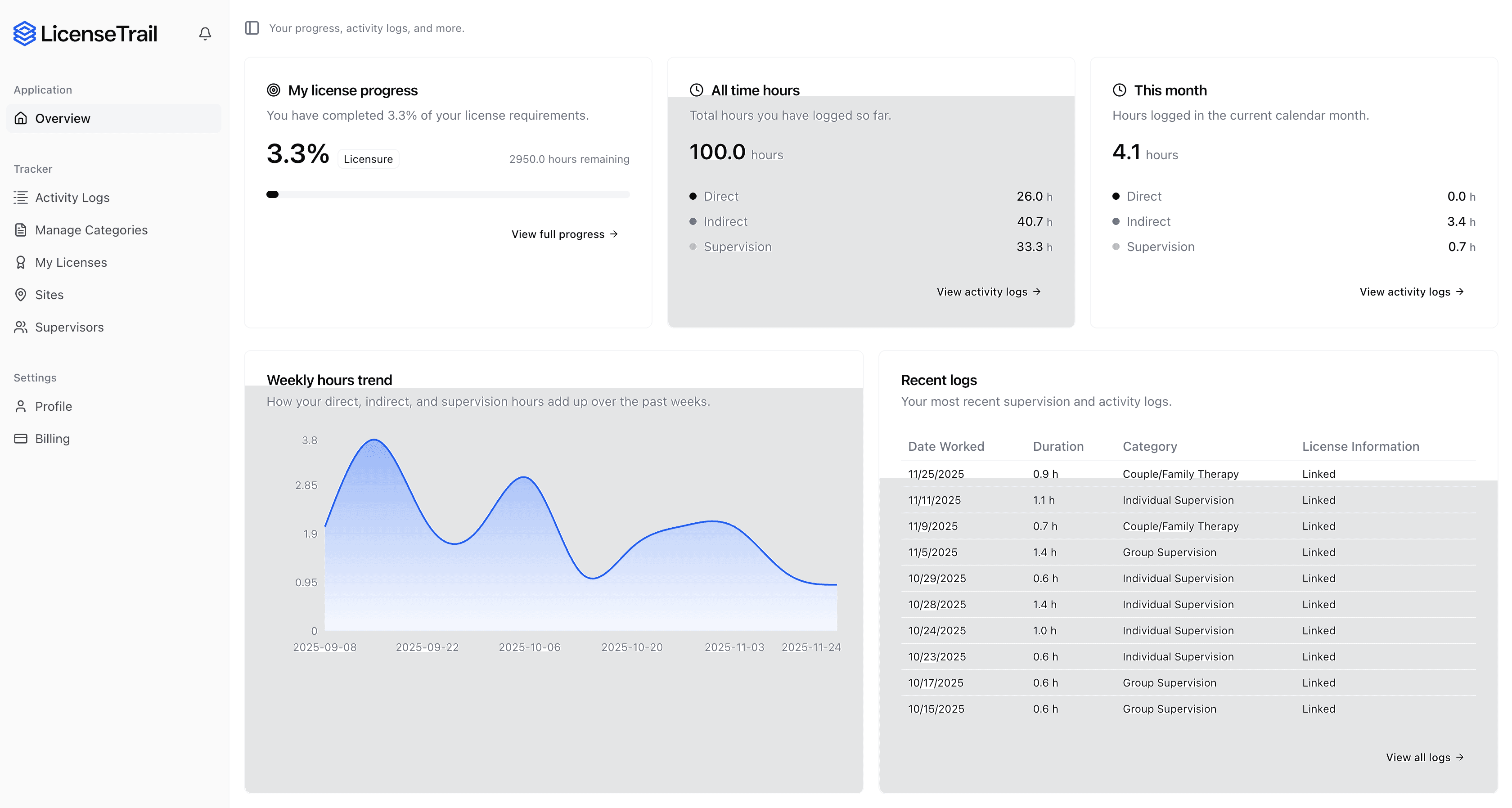
Track your LISW-CP hours with confidence
License Trail checks your direct, indirect, and supervision hours against South-carolina LISW-CP requirements continuously and flags mismatches before you submit.
 Start Tracking for Free
No credit card required · Free plan available
Is your spreadsheet hiding South-carolina LISW-CP risks?
Stop guessing if your categories match South Carolina Board of Social Work Examiners requirements. License Trail checks your direct, indirect, and supervision hours continuously and flags mismatches before you submit.
Import or log
Bring your spreadsheet or start fresh
Upload your existing tracking spreadsheet and we'll map every hour into the right South Carolina Board of Social Work Examiners categories automatically.
Verify against South-carolina
Catch mismatches before the board does
License Trail checks your direct, indirect, and supervision hours against South-carolina LISW-CP requirements continuously.
Export board-ready
One-click clean reports
Generate professional, board-ready reports for supervision meetings and South Carolina Board of Social Work Examiners submissions in seconds.
No credit card required · Free plan available