
South-dakota CSW-PIP Requirements: Hours, Exams & Step-by-Step Guide
Stop guessing if your categories match South-dakota requirements. License Trail checks your direct, indirect, and supervision hours against CSW-PIP requirements continuously and flags mismatches before you submit.
No credit card required · Free plan available
Quick Requirements Overview
- Hold current SD CSW (requires CSWE-accredited MSW/DSW + Board exam)
- Be licensed as a CSW for ≥ 2 years before CSW‑PIP eligibility
- Complete 2 years experience under appropriate supervision in your intended specialization (required for independent/private practice)
- Board-approved supervision agreement required before hours/experience count; update/replace agreement before any setting/status change
- Supervisor must be SD CSW‑PIP/psychologist/psychiatrist, in good standing ≥ 2 years; no temporary permit; supervisor CE required (6 hrs upfront, 3 hrs/2 yrs)
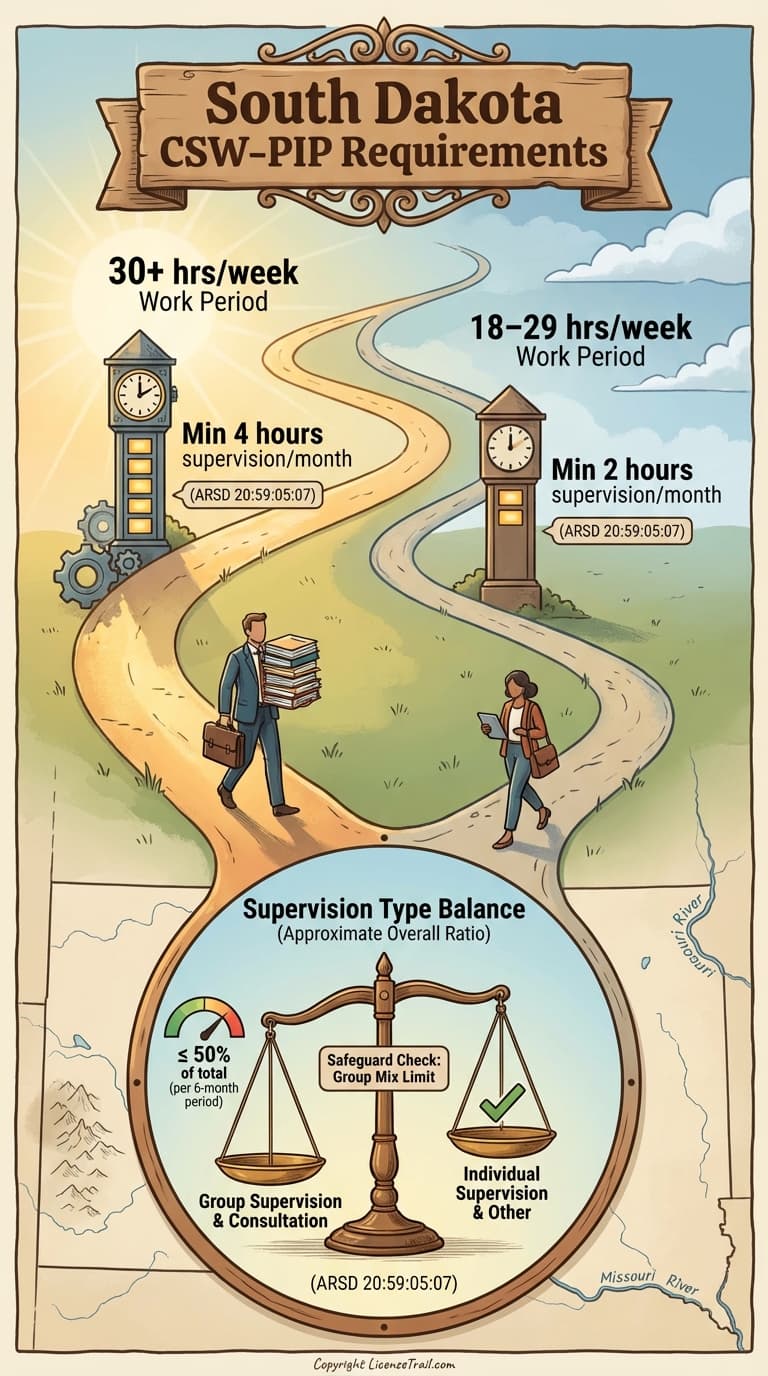
- Supervised practice schedule: Full-time ≥30 hrs/week for 2 yrs + 4 hrs/month individual supervision (group supervision ≤ 50% per 6-month period)
- Part-time alternative: 18–29 hrs/week for 4 yrs + 2 hrs/month individual supervision
- Apply, complete background checks, and pass ASWB Clinical exam to receive CSW‑PIP; renewal CE: 30 hrs/2 yrs incl. 6 ethics
License Details
Procedures
Becoming a Certified Social Worker in Private or Independent Practice (CSW‑PIP) in South Dakota
South Dakota treats the CSW‑PIP as its highest-level social work license. It is the credential that allows you to practice independently, including opening a private practice, providing clinical services without agency oversight, and billing clients directly.(regulations.justia.com)
The requirements come from both statute (SDCL 36‑26‑17) and the Board’s own rules (ARSD 20:59). Below is a step‑by‑step guide, with emphasis on experience, supervision, and how “hours” are actually defined.
1. Meet the baseline education and CSW licensure requirements
Before you can even begin counting CSW‑PIP supervision hours, you must already be a Certified Social Worker (CSW) in South Dakota.
Education (for CSW)
- Doctorate or master’s degree from a school of social work accredited by the Council on Social Work Education.(dss.sd.gov)
CSW license itself
- Meet the education requirement above, and
- Pass an examination “prepared by the Board for this purpose.”(dss.sd.gov)
Time as a CSW before CSW‑PIP
On the Board’s licensing page, the requirements for a CSW‑PIP begin with:
- You must be “licensed under this chapter (SDCL 36‑26) as a certified social worker (for a minimum of two years).”(dss.sd.gov)
So, practically:
- Plan on at least two years as a CSW before you can qualify for CSW‑PIP.
2. Understand what “independent practice” and “experience” mean in South Dakota
Statutory requirement for independent practice
South Dakota Codified Law §36‑26‑17 says no one may engage in private, independent practice unless they:
- Are licensed as a certified social worker.
- Have had “two years of experience under appropriate supervision in the field of specialization in which the applicant will practice (e.g., psychotherapy, community organization, or planning)”.
- Have passed an examination prepared by the Board.(law.justia.com)
That phrase—“two years of experience under appropriate supervision in the field of specialization in which the applicant will practice”—is the key legal standard for your experience.
What counts as “private, independent practice”
The Board’s rules define “private, independent practice” as contracting directly with clients for clinical, consultative, supervisory, or educational services, including billing and direct payment, or otherwise implying you are in private practice as a CSW‑PIP.(regulations.justia.com)
Until you hold the CSW‑PIP license, you may not legally engage in that kind of independent practice.
3. Set up your supervised CSW‑PIP experience correctly
a. You must have a Board‑approved supervision agreement before counting hours
Before you begin the supervised practice that will count toward CSW‑PIP, you and your supervisor must file a “supervision agreement” with the Board and get it approved.(law.cornell.edu)
By rule, that agreement:
- Is in a form specified by the Board.
- Identifies the settings where you will practice.
- Makes the supervisor responsible for your supervision.
- Describes the functions you will perform.
- Must be approved before supervision starts to satisfy the CSW‑PIP requirements.(regulations.justia.com)
If your practice setting or status changes (e.g., you change employers or shift from part‑time to full‑time), you must submit a new or amended supervision agreement and get Board approval before the change.(law.cornell.edu)
b. Who can supervise a CSW‑PIP candidate
Under ARSD 20:59:05:03, your supervisor must:(law.cornell.edu)
- Be a CSW‑PIP, psychologist, or psychiatrist licensed in South Dakota and in good standing for at least two years.
- Complete 6 hours of supervisor‑specific continuing education before submitting your proposed supervision agreement.
- Complete 3 hours of supervisor CE every two years once they begin supervising any candidate.
- Hold a regular license (a person on a temporary permit may not supervise).
Another rule requires that the supervisor primarily practice in the same practice area in which you will practice as a CSW‑PIP, with exceptions only for good cause.(law.cornell.edu)
4. How South Dakota defines the supervised “hours” and time requirements
South Dakota does not use a numeric formula like “1,500 direct hours + 1,500 supervised hours.” Instead, it defines:
- A time period (years under supervision), and
- Minimum weekly work hours, and
- Minimum monthly supervision hours,
which together determine whether you meet the “two years of experience under appropriate supervision” standard.(law.justia.com)
a. Full‑time path (most common)
Under ARSD 20:59:05:07:(law.cornell.edu)
- A CSW‑PIP candidate “shall work at least thirty hours per week.”
- With 30+ hours/week, the rule’s table requires:
- Number of years required supervision: 2 years
- Number of monthly hours of individual supervision: 4 hours/month
What this actually looks like:
-
Practice hours:
- 30 hours/week × 52 weeks × 2 years ≈ 3,120 hours of supervised practice.
- The rules do not break these into “direct clinical” vs. “indirect” hours; they simply require that the work be in your field of specialization and covered by an approved supervision agreement.(law.justia.com)
-
Formal supervision hours:
- 4 hours/month × 24 months = 96 hours of required individual supervision.
Group supervision is allowed, but it may be no more than half of the total supervision time in any six‑month period. So at least half of those ~96 hours must be true one‑on‑one supervision.(law.cornell.edu)
b. Part‑time path
The same rule provides an alternative schedule for part‑time work:(law.cornell.edu)
For 18–29 hours/week:
- Number of years required supervision: 4 years
- Monthly individual supervision: 2 hours/month
Approximate totals on the part‑time track:
-
Practice hours:
- At 18 hours/week × 52 weeks × 4 years ≈ 3,744 hours (at the low end).
- At 29 hours/week, total practice hours are proportionally higher.
-
Formal supervision hours:
- 2 hours/month × 48 months = 96 hours of required individual supervision (same total supervised hours, spread over four years).
Again, there is no breakdown in rule or statute between direct client contact hours and other professional work, only that it is under appropriate supervision and in the field of specialization in which you will practice.(law.justia.com)
c. Tele‑supervision and Board flexibility
The rules allow supervision when the supervisor is not physically present, as long as they are available by telecommunications or technology. The Board may also modify the method and frequency of supervision if it finds that supervision, training, and proficiency remain adequate.(law.cornell.edu)
5. What counts as “supervision” and how it is documented
The Board defines “supervision” for CSW‑PIP candidates as overseeing or directing the activities of a person applying for the CSW‑PIP license.(regulations.justia.com)
Key points from ARSD 20:59:05:07:(law.cornell.edu)
- After your supervision agreement is approved, your supervisor must submit reports every six months on Board forms.
- These reports must show you are:
- Working the required minimum hours (30+ hours/week, or at least 18 hours/week on the part‑time schedule).
- Receiving the minimum monthly supervision (4 hours/month full‑time, 2 hours/month part‑time).
- When supervision is completed, your supervisor submits a final evaluation to the Board verifying that you have satisfied the supervision requirement.(publichealthonline.org)
6. Content and setting of your supervised experience
By law and rule, your two years of experience must be:(law.justia.com)
- Under appropriate supervision (as defined above), and
- In the “field of specialization in which the applicant will practice” (for example, psychotherapy, community organization, or planning).
The supervisor is expected to:
- Primarily practice in the same practice area (e.g., if you intend to provide psychotherapy as a CSW‑PIP, your supervisor’s practice should also be primarily psychotherapy).(law.cornell.edu)
The state’s rules do not spell out sub‑requirements like “X hours of psychotherapy” vs. “Y hours of case management,” nor do they state numeric clinical‑contact minimums. The controlling standard is that the work be in your intended specialization and under Board‑approved supervision, for the required number of years and weekly hours.(law.justia.com)
7. After supervised experience: exam and application steps
Once you have:
- Held a CSW license for at least two years,
- Completed the required supervised experience (two years full‑time or four years part‑time as described above), and
- Had your supervisor submit the Final Evaluation for CSW‑PIP candidate,(publichealthonline.org)
you move to the final steps:
-
Apply for CSW‑PIP licensure with the South Dakota Board of Social Work Examiners, including:
- Application form and cover letter.
- Application fee (listed as $210 on recent guidance).(publichealthonline.org)
- Official transcripts (already on file from CSW in most cases).
- Professional references as required by the Board.
-
Background check
- The Board’s current process includes criminal record and abuse/neglect registry checks (state and federal databases).(socialworkerlicense.com)
-
Pass the ASWB Clinical exam
- The Board approves you to sit for the ASWB Clinical examination once your application is accepted. Passing this exam satisfies the statutory requirement to pass an exam “prepared by the board for this purpose.”(law.justia.com)
-
Issuance of the CSW‑PIP license
- After the Board receives your passing exam score and confirms you meet all supervision and experience requirements, it issues your CSW‑PIP license.(dss.sd.gov)
8. Ongoing obligations after you become a CSW‑PIP
All licensees, including CSW‑PIPs, must complete:(dss.sd.gov)
- 30 contact hours of continuing education every two‑year renewal period,
- Of which 6 hours must be in social work ethics.
If you supervise CSW‑PIP candidates, you must also meet the supervisor‑specific CE mentioned earlier.(law.cornell.edu)
9. Quick summary of “hours” and “verbiage” for South Dakota CSW‑PIP
-
The controlling statutory language is “two years of experience under appropriate supervision in the field of specialization in which the applicant will practice.”(law.justia.com)
-
Board rules transform that into concrete time and supervision requirements:
- Full‑time option:
- At least 30 hours/week of practice for 2 years, with
- At least 4 hours/month of individual supervision (group allowed for up to half of total supervision time).(law.cornell.edu)
- Part‑time option (18–29 hours/week):
- 4 years of supervised practice, with
- At least 2 hours/month of individual supervision.(law.cornell.edu)
- Full‑time option:
-
In approximate numeric terms (not in the statute, but implied by the rules):
- Full‑time path ≈ 3,120+ hours of supervised practice and ~96 hours of documented individual supervision.
- Part‑time path ≈ 3,700–6,000+ hours of supervised practice (depending on weekly hours) and ~96 hours of documented individual supervision.
-
South Dakota does not divide this into fixed “direct client” vs. “indirect” hour quotas the way some other states do (e.g., 1,500 direct + 1,500 supervised). The Board instead focuses on:
- Time in supervised practice (years and weekly hours),
- Supervision dose (hours/month), and
- Whether the work is in the field of specialization you intend to practice as a CSW‑PIP.(law.justia.com)
This combination of statutory language and administrative rules is what the South Dakota Board of Social Work Examiners uses to determine whether an applicant’s supervised experience is sufficient for CSW‑PIP licensure.
Track your CSW-PIP hours with confidence
License Trail checks your direct, indirect, and supervision hours against South-dakota CSW-PIP requirements continuously and flags mismatches before you submit.
 Start Tracking for Free
No credit card required · Free plan available
Related Licenses
Is your spreadsheet hiding South-dakota CSW-PIP risks?
Stop guessing if your categories match South Dakota Board of Social Work Examiners requirements. License Trail checks your direct, indirect, and supervision hours continuously and flags mismatches before you submit.
Import or log
Bring your spreadsheet or start fresh
Upload your existing tracking spreadsheet and we'll map every hour into the right South Dakota Board of Social Work Examiners categories automatically.
Verify against South-dakota
Catch mismatches before the board does
License Trail checks your direct, indirect, and supervision hours against South-dakota CSW-PIP requirements continuously.
Export board-ready
One-click clean reports
Generate professional, board-ready reports for supervision meetings and South Dakota Board of Social Work Examiners submissions in seconds.
No credit card required · Free plan available