
South-dakota Licensed Psychologist Requirements: Hours, Exams & Step-by-Step Guide
Stop guessing if your categories match South-dakota requirements. License Trail checks your direct, indirect, and supervision hours against Licensed Psychologist requirements continuously and flags mismatches before you submit.
No credit card required · Free plan available
Quick Requirements Overview
- Doctoral degree in psychology (PhD/PsyD/EdD) from qualifying accredited U.S. program or recognized Canadian institution; program includes supervised practicum and an internship meeting ARSD standards
- Predoctoral supervised internship: ≥1,800 hours completed within ≤2 consecutive calendar years
- Internship structure: organized training program with a licensed doctoral psychologist responsible; ≥2/3 of supervision by licensed doctoral psychologists
- Internship content/supervision: ≥25% direct client contact; ≥2 hrs/week formal face-to-face individual supervision + ≥1 hr/week additional supervised learning activities
- Postdoctoral requirement: 1 year of supervised postdoctoral psychology practice (no SD-codified total-hour minimum)
- Postdoc supervision/title: supervisor(s) must be actively licensed doctoral-level psychologists; ≥2 hrs/month formal face-to-face supervision; use Board-approved training-status title (e.g., psychology resident/associate/trainee)
- Exams: pass EPPP and the Board oral exam (state law/ethics/jurisprudence)
- Renewal: annual (expires June 30); 15 CE contact hours each licensure period for renewal
License Details

Procedures
Licensure as a psychologist in South Dakota is governed by South Dakota Codified Laws (SDCL) chapter 36‑27A and the South Dakota Administrative Rules (ARSD) 20:60, and administered by the South Dakota Board of Examiners of Psychologists.(sdlegislature.gov)
Below is a step‑by‑step outline focused on what the Board itself specifies, especially around hours and supervision.
1. Earn a qualifying doctoral degree in psychology
South Dakota requires a doctoral degree in psychology from a qualifying program:(sdlegislature.gov)
- Degree level: Doctor of Philosophy (Ph.D.), Doctor of Psychology (Psy.D.), or Doctor of Education (Ed.D.) in psychology.
- Institution:
- Regionally accredited university or professional school of psychology in the U.S., or
- A Canadian institution recognized by the Association of Universities and Colleges of Canada.
- Program standards (summarized from SDCL 36‑27A‑1):
- At least three academic years of full-time graduate study.
- At least two of the three years must be at the degree‑granting institution, with at least one full‑time year in residence there.
- Program must include supervised practicum, field or laboratory training in psychology, and a supervised psychology internship that meets ARSD 20:60:08:01.(law.justia.com)
2. Complete a supervised psychology internship (pre‑doctoral)
Statutory hour requirement
By law, a licensure applicant must have:
“a supervised psychology internship amounting to not less than one thousand eight hundred hours in duration over a period of not more than two consecutive calendar years.”(sdlegislature.gov)
In plain terms:
- Total internship hours required by statute:
- 1,800 hours minimum, completed within no more than 2 consecutive calendar years.
- These 1,800 hours are all supervised psychology internship; South Dakota law does not divide them into separate numeric categories like “X direct hours vs. Y supervised hours.”
How the Board defines an acceptable internship (ARSD 20:60:08:01)
In addition to the 1,800‑hour minimum, ARSD 20:60:08:01 sets qualitative and structural requirements. Key points include:(regulations.justia.com)
-
Organized training program:
- Must be a distinct, organized internship designed as a planned, programmed sequence of training experiences, separate from regular employment.
-
Supervisors and setting:
- Internship agency must have a staff psychologist actively licensed at the doctoral level in that state who is responsible for the integrity and quality of the training program.
- Supervision must be provided by staff or affiliates responsible for the cases; at least two‑thirds of supervision must be by psychologist(s) licensed at the doctoral level.
-
Direct client contact requirement (type of hours):
- At least 25% of the intern’s time must be in direct client contact providing clinical services.
- The rule expresses this as a percentage of time, not a fixed number of hours.
- If you complete exactly 1,800 hours, this translates mathematically to at least 450 hours of direct client contact, but that number is an arithmetic consequence, not a separate Board‑stated figure.
-
Minimum supervision and learning activities (supervision hours):
- At least 2 hours per week of formal, face‑to‑face individual supervision specifically focused on services the intern provides.
- At least 1 additional hour per week of supervised learning activities (e.g., case conferences, group supervision, co‑therapy with staff, team reviews).
-
Training level and title:
- Training must be post‑clerkship, post‑practicum, and post‑externship, after the relevant didactics for the applied/specialty area.
- The trainee must be clearly designated by a title such as “intern,” “resident,” or “trainee” (or similar) that indicates training status.
-
Program description:
- The internship site must have a written description (brochure or similar) outlining goals, content, and expectations for the quantity and quality of work, available to prospective interns.
3. Complete one year of supervised postdoctoral psychology practice
Statutory requirement and Board wording
After the internship and doctoral degree, the Board requires:
“one year of supervised postdoctoral psychology practice.”(sdlegislature.gov)
Important nuances:
- The law uses time (“one year”) rather than a numeric hour requirement.
- As of the current statutes and administrative rules, no specific total‑hour minimum (e.g., 1,500 or 2,000 hours) is written into South Dakota law or ARSD for the postdoctoral year.
- External guides sometimes describe this as “approximately 1,800–2,000 hours,” but those figures are interpretations based on a notional full‑time year, not Board‑promulgated numbers.(counselingpsychology.org)
Supervision during the postdoctoral year (ARSD 20:60:06:01)
ARSD 20:60:06:01 governs supervisory relationships, including for psychologists “pursuing licensure pursuant to SDCL subdivision 36‑27A‑12(4)” (i.e., those completing the postdoctoral supervised practice). Key requirements:(law.cornell.edu)
- Who may supervise:
- Supervision must be by one or more psychologists actively licensed at the doctoral level.
- Role of the supervisor:
- The supervising psychologist is responsible for ensuring the supervisee’s knowledge and clinical skills are appropriate for the services provided.
- Title of the supervisee:
- A person pursuing licensure under the postdoctoral practice requirement may engage in the practice of psychology, but must use a title that clearly reflects training status, such as:
- psychology resident
- psychology associate
- psychologist assistant
- psychologist trainee
- Any other title using “psychology/psychological/psychometrist” must be approved by the Board.
- A person pursuing licensure under the postdoctoral practice requirement may engage in the practice of psychology, but must use a title that clearly reflects training status, such as:
- Minimum supervision time:
- Supervision must consist of at least 2 hours per month of regularly scheduled, formal, face‑to‑face supervision.
Again, the rule sets a minimum supervision frequency, not a total hour requirement for the full year of postdoctoral practice.
Provisional license while completing the postdoc year
South Dakota can issue a provisional license for those in their postdoctoral year:
- The Board may issue a provisional license not to exceed 12 months to an applicant who is completing the one year of supervised postdoctoral psychology practice, provided the person:
- Has met the doctoral degree requirement (36‑27A‑12(1));
- Has passed a written national standardized examination; and
- Has completed the required 1,800‑hour supervised psychology internship.(law.justia.com)
This allows you to practice under supervision while you complete the postdoctoral requirement.
4. Examinations required
The Board’s licensing page and state law indicate the following exam requirements:(dss.sd.gov)
-
National written exam – EPPP
- South Dakota requires a passing score on the Examination for Professional Practice in Psychology (EPPP), a national standardized exam.
-
State/Board oral examination (jurisprudence/ethics content)
- Applicants must also “pass the oral examination before the Board.”
- University licensure disclosures and independent guides describe this as a state‑specific oral exam that addresses ethics and South Dakota law (often referred to as a jurisprudence or oral jurisprudence exam).
-
Sequence as described by the Board:(dss.sd.gov)
- Submit a complete application and supporting materials.
- Once the file is deemed complete and your education approved, the Board authorizes you to take the EPPP.
- To receive a full license, you must:
- Pass the EPPP;
- Pass the Board’s oral examination; and
- Complete the postdoctoral supervised experience.
5. Application procedure and documentation
The Board outlines the procedure for licensure applications as follows:(dss.sd.gov)
-
Submit application materials to the Board office, including:
- Completed application form;
- Cover letter;
- Official transcripts sent directly from the institution;
- Supporting materials (such as documentation of internship and postdoctoral supervision);
- Required fees (payable to “South Dakota Board of Examiners of Psychologists”).
-
Authorization for examination:
- After review and approval of your file, the Board’s education review officer approves you, and the office authorizes you to sit for the national exam (EPPP).
-
Completion of all requirements:
- Before a full license is issued you must:
- Pass the EPPP;
- Pass the Board’s oral exam;
- Complete the one year of supervised postdoctoral psychology practice.
- Before a full license is issued you must:
-
Fees are non‑refundable if the applicant does not meet Board approval.
6. License renewal and continuing education
Licenses are issued through June 30 of each year. For renewal, the Board requires:(dss.sd.gov)
- Annual renewal date:
- All psychologist licenses expire on June 30 each year.
- To renew, you must:
- Submit the renewal application stating that you wish to be relicensed;
- Pay the renewal fee;
- Provide documentation of 15 contact hours of continuing education completed within the previous licensure period.
ARSD 20:60:10:03 adds that the 15 hours must be completed during the 12 months prior to renewal, and that licensees must keep detailed records and third‑party documentation of completed CE for five years.(regulations.justia.com)
7. Pulling the hour requirements together
Focusing strictly on what South Dakota law and Board regulations themselves specify:
-
Pre‑doctoral internship (explicitly quantified):
- 1,800 hours minimum of supervised psychology internship, completed in no more than two consecutive calendar years.(sdlegislature.gov)
- Within that internship:
- At least 25% of time must be direct client contact (≈ ≥450 hours if the internship is exactly 1,800 hours).
- Weekly minimum of 2 hours individual supervision plus 1 additional hour of supervised learning activities.(regulations.justia.com)
-
Postdoctoral supervised psychology practice (time‑based, not hour‑based):
- Statute requires “one year of supervised postdoctoral psychology practice”;
- Neither SDCL chapter 36‑27A nor ARSD 20:60 specifies a numeric hour requirement (e.g., 1,500 or 2,000 hours) for that year.(sdlegislature.gov)
- During this year, supervision must include at least 2 hours per month of formal, face‑to‑face supervision by one or more doctoral‑level licensed psychologists, and the supervisee must use a training‑status title such as psychology resident.(law.cornell.edu)
-
Total supervised experience in practice (as commonly described vs. as codified):
- Many external licensure guides summarize South Dakota as requiring 3,600 hours of supervised professional experience (1,800 pre‑doctoral internship + 1,800 postdoctoral), or describe the postdoc as roughly a “full‑time year” (≈2,000 hours).(counselingpsychology.org)
- Those totals are interpretive. What is actually in state law/rules is:
- A numerical minimum for the internship (1,800 hours); and
- A time‑based requirement of “one year” of supervised postdoctoral psychology practice with certain supervision conditions, but no codified total‑hour number.
Practical takeaway
To become a Licensed Psychologist under the South Dakota Board of Examiners of Psychologists, you must:
- Complete a qualifying doctoral program in psychology that meets SDCL 36‑27A‑1 requirements.
- Complete a supervised psychology internship of at least 1,800 hours (≤2 consecutive years), meeting ARSD 20:60:08:01 (including at least 25% time in direct client contact and specified weekly supervision).
- Complete one year of supervised postdoctoral psychology practice under doctoral‑level supervision, with at least 2 hours of face‑to‑face supervision per month and use of an appropriate training title.
- Pass the EPPP and the South Dakota Board’s oral (jurisprudence/ethics) exam.
- Submit all required application materials and fees, and be approved by the Board.
- After licensure, renew annually by June 30 with 15 CE hours each year.
Track your Licensed Psychologist hours with confidence
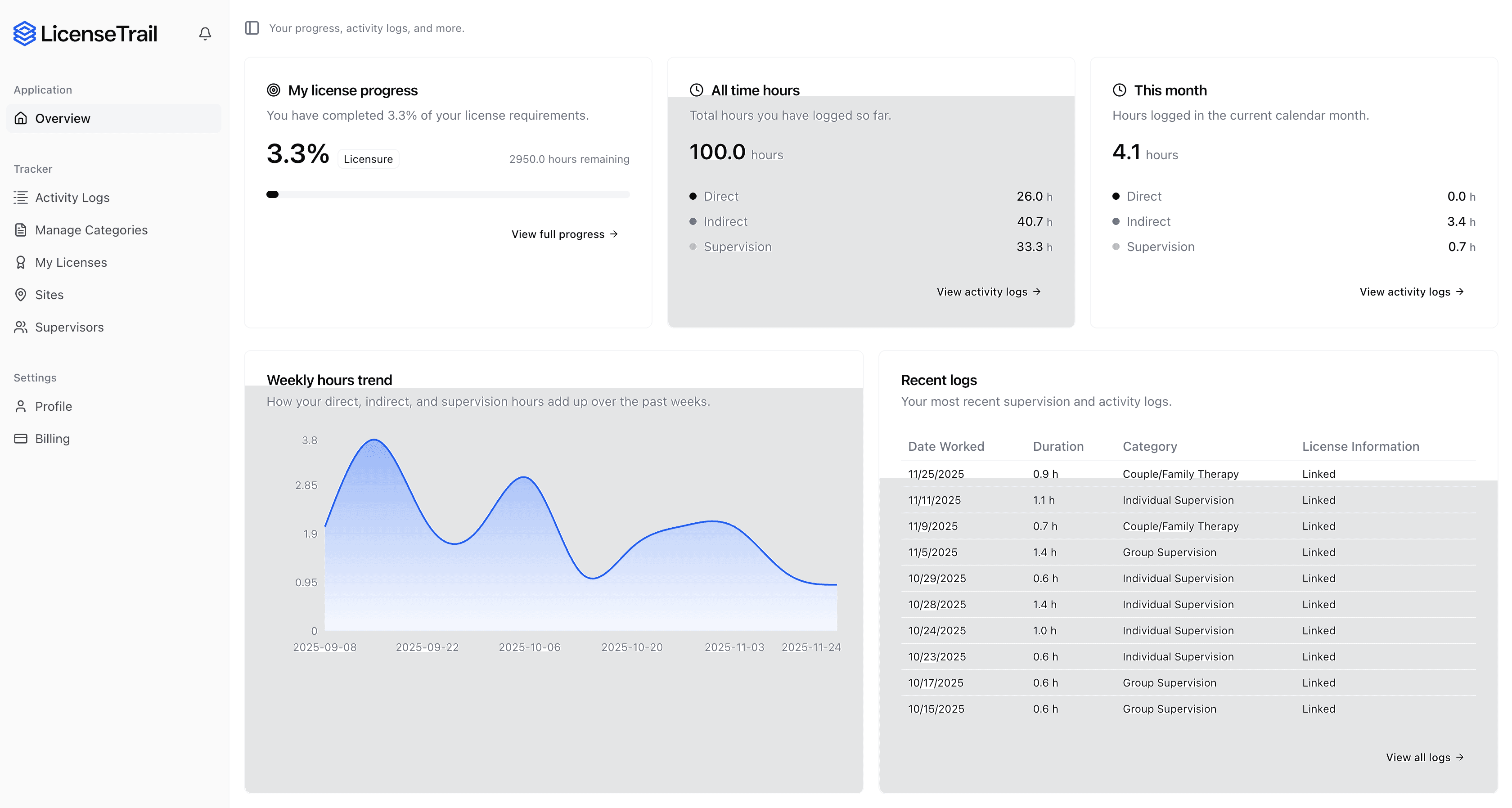
License Trail checks your direct, indirect, and supervision hours against South-dakota Licensed Psychologist requirements continuously and flags mismatches before you submit.
 Start Tracking for Free
No credit card required · Free plan available
Is your spreadsheet hiding South-dakota Licensed Psychologist risks?
Stop guessing if your categories match South Dakota Board of Examiners of Psychologists requirements. License Trail checks your direct, indirect, and supervision hours continuously and flags mismatches before you submit.
Import or log
Bring your spreadsheet or start fresh
Upload your existing tracking spreadsheet and we'll map every hour into the right South Dakota Board of Examiners of Psychologists categories automatically.
Verify against South-dakota
Catch mismatches before the board does
License Trail checks your direct, indirect, and supervision hours against South-dakota Licensed Psychologist requirements continuously.
Export board-ready
One-click clean reports
Generate professional, board-ready reports for supervision meetings and South Dakota Board of Examiners of Psychologists submissions in seconds.
No credit card required · Free plan available