
Tennessee LCSW Requirements: Hours, Exams & Step-by-Step Guide
Stop guessing if your categories match Tennessee requirements. License Trail checks your direct, indirect, and supervision hours against LCSW requirements continuously and flags mismatches before you submit.
No credit card required · Free plan available
Quick Requirements Overview
- Degree: CSWE-accredited MSW or doctoral social work degree
- Prerequisite license: Hold active LMSW or temporary LMSW before accruing LCSW hours (licensure by exam pathway)
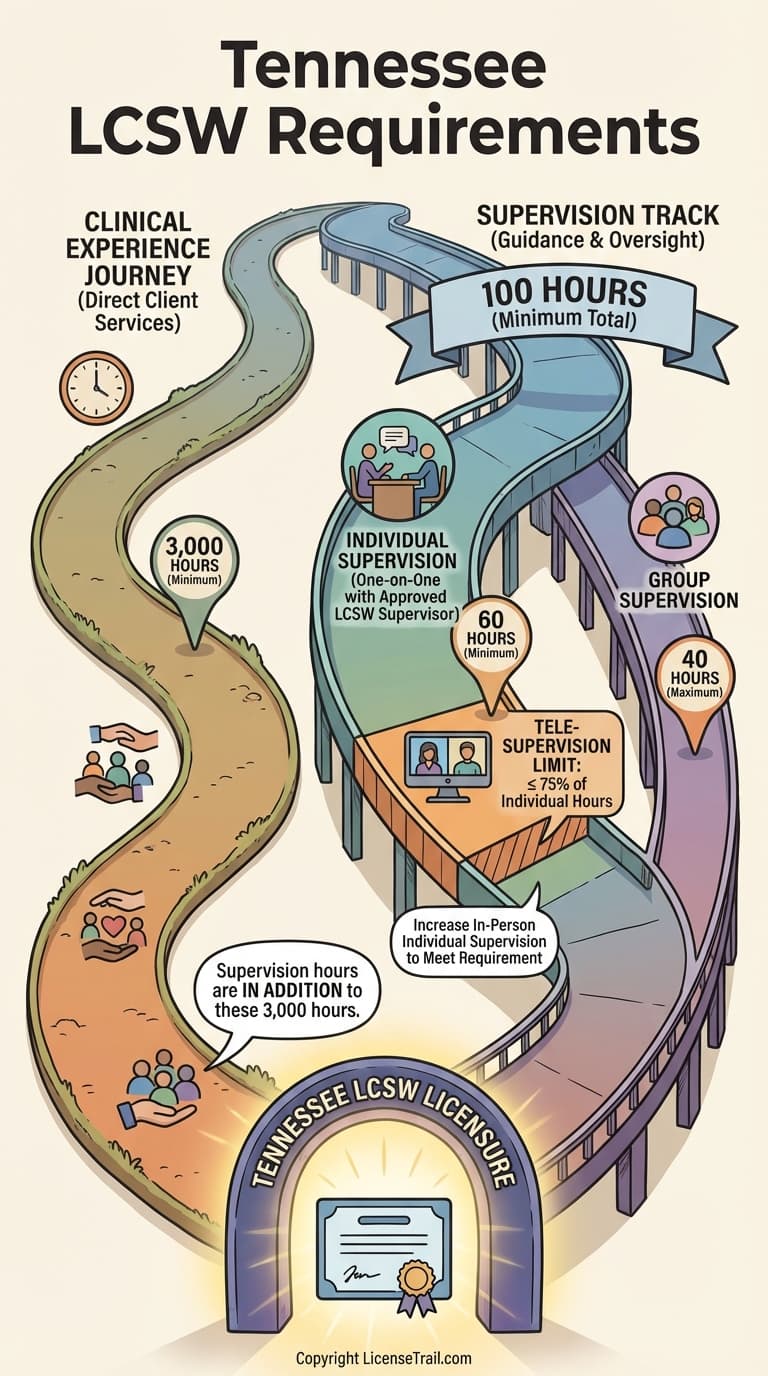
- Post-master clinical experience: 3,000 hours of direct clinical client services (as TN defines “clinical experience”), completed as an LMSW/temp LMSW and under LCSW supervision
- Timeframe: Clinical experience completed over ≥ 2 years and ≤ 8 years (tied to date Board receives LCSW application + fee)
- Supervision (additional): 100 supervisor-contact hours in addition to the 3,000 hours; approx. 1 hour supervision per 30 clinical hours
- Supervision format limits: ≥ 60 hours individual; ≤ 40 hours group (max 4 supervisees); ≤ 75% of individual supervision via approved video/teleconferencing (no email/text-only)
- Supervisor qualifications: Must be an LCSW (no other disciplines), continuously licensed ≥ 3 years; conflict-of-interest relationships prohibited; supervision/logs must be documented/verified
- Exam: Pass the ASWB Clinical exam and apply for TN LCSW by examination with required documentation/fees
License Details
Procedures
Becoming a Licensed Clinical Social Worker (LCSW) in Tennessee is governed by the Tennessee Board of Social Worker Licensure through its statutes and administrative rules. The Board is very specific about the types of hours, how they are defined, and how supervision must occur.
This guide focuses on licensure by examination (i.e., not via reciprocity).
1. Basic pathway to the LCSW in Tennessee
In Tennessee, the LCSW is a post‑master, clinical license. The usual sequence is:
- Earn a CSWE‑accredited MSW or doctoral degree in social work. (law.cornell.edu)
- Obtain a Licensed Master Social Worker (LMSW) or temporary LMSW license. (law.cornell.edu)
- Complete post‑master supervised clinical experience as an LMSW or temporary LMSW under a qualified LCSW supervisor. (law.cornell.edu)
- Pass the ASWB Clinical exam. (law.cornell.edu)
- Apply to the Board for LCSW licensure by examination and receive the credential.
The critical details for most applicants are in steps 2–3: what counts as clinical experience and supervision and how many hours of each are required.
2. Board definitions of “clinical experience” and “hours of experience”
The Board’s definitions rule (Tenn. Comp. R. & Regs. 1365‑01‑.01) is where the official “verbiage” comes from.
“Clinical experience”
The Board defines clinical experience as the application of social work theory, knowledge, methods, values, and the professional use of self to restore or enhance functioning for individuals, couples, families, groups, or others adversely affected by psychosocial or health issues. It specifically includes work such as: (law.cornell.edu)
- Assessment, diagnosis, and/or treatment of mental, emotional, and behavioral disorders (including serious mental illness and serious emotional disturbance).
- Individual, couple, family, and group therapy; mediation; counseling; supportive counseling.
- Advanced case management, psychotherapy, direct private practice, crisis assessment, and treatment planning.
Crucially, in the Board’s own wording, clinical experience “is designated as the actual time spent providing direct services to clients.” (law.cornell.edu)
There is no internal split such as “1,500 direct hours and 1,500 supervised hours.” In Tennessee’s system:
- All 3,000 required experience hours are “clinical experience,” and by definition they are direct client services.
- Supervision hours are separate and additional (see below).
“Hours of experience”
The rules define “Hours of Experience” as “the number of actual hours of supervised experience necessary for the advancement of an L.M.S.W. to a higher level of licensure as either an L.A.P.S.W. or an L.C.S.W.” (law.cornell.edu)
“Actual hours” means clock hours you personally spend providing qualifying services, not FTE estimates or caseload counts.
3. The core post‑master hours for LCSW: 3,000 clinical hours + 100 supervision hours
The LCSW licensure rules appear in Tenn. Comp. R. & Regs. 1365‑01‑.04 (Licensure Requirements) and 1365‑01‑.08 (Supervision). (law.cornell.edu)
3,000 hours of clinical experience (client‑therapist contact)
For LCSW by examination, the Board requires: (law.cornell.edu)
- At least 3,000 hours of clinical experience,
- Completed after you have become a licensed master social worker or temporary LMSW,
- Completed under the supervision of an LCSW,
- Within a time window of no less than two (2) years and no more than eight (8) years from the date your LCSW application and fee are received by the Board.
Because “clinical experience” is defined as “actual time spent providing direct services to clients,” all 3,000 hours must be direct client work in qualifying clinical roles, as outlined in the definition above. (law.cornell.edu)
This is different from models that split hours into “direct” vs. “indirect” or “supervised” vs. “unsupervised.” Tennessee’s regulation treats:
- 3,000 hours = actual direct clinical service to clients, and
- Supervision = separate, additional hours of supervisor‑supervisee contact.
100 hours of supervisor contact (in addition to the 3,000 hours)
In addition to the 3,000 clinical hours, the Board requires at least 100 hours of supervision. The rule describes this as “supervisor contact hours (supervisor‑supervisee)” and specifies that they must be: (regulations.justia.com)
- In addition to the 3,000 clinical experience hours, and
- Distributed at approximately one (1) hour of supervision for every thirty (30) clinical experience hours (a 1:30 ratio),
- Spread throughout the entire clinical experience timeframe, not clumped at the beginning or end.
The required 100 supervision hours are further broken down:
- At least 60 hours must be individual supervision, defined as a live, face‑to‑face meeting (including approved video‑based formats) between one supervisor and one supervisee. (law.cornell.edu)
- Up to 40 hours may be group supervision, in which no more than four supervisees meet with the supervisor at once. (regulations.justia.com)
- No more than 75% of the individual supervision hours may be provided via teleconferencing, video, or similar visual technologies; the rest must be in‑person. (regulations.justia.com)
The supervision rule also clarifies that these 100 hours are in addition to any routine administrative supervision, staff meetings, or seminars; such activities do not substitute for the required clinical supervision hours. (regulations.justia.com)
4. How supervision itself is defined and structured
What “supervision” means
The definitions rule describes supervision as ongoing, direct review (clinical or nonclinical) provided by an LCSW or LAPSW supervisor who: (law.cornell.edu)
- Monitors your performance with clients, and
- Provides regular, documented, face‑to‑face contact, guidance, and instruction on your clinical skills and competencies.
The supervision rule adds that supervision must: (regulations.justia.com)
- Focus on data from your work (case reports, direct observation, audio/video),
- Involve jointly set goals for learning, and
- Include review and evaluation of your skills.
Supervision may occur via teleconferencing or video technologies, but cannot occur via email, text, or other non‑visual formats. (regulations.justia.com)
Timing and securing a supervisor
Key timing rules for LCSW supervision: (regulations.justia.com)
- A supervisor must be secured before you begin accumulating LCSW‑qualifying clinical experience hours.
- Supervision must occur at reasonable intervals and continue throughout the whole period of clinical experience until you meet the hours and are licensed.
- All 3,000 clinical hours must fall within a window of 2–8 years from the date the Board receives your LCSW application and fee.
Supervisor qualifications and conflicts of interest
For LCSW licensure, your supervisor must: (regulations.justia.com)
- Hold an active LCSW license,
- Have been continuously licensed as an LCSW for at least three (3) years prior to the start of your supervision, and
- Beginning January 1, 2023, have completed 12 hours of continuing education related specifically to supervision, including 3 hours on Tennessee licensing rules. These 12 hours are cumulative, not annual, and can count toward the supervisor’s general CE requirement. (regulations.justia.com)
The rules explicitly prohibit “conflict of interest” supervision. You cannot count supervision provided by: (regulations.justia.com)
- Parents, spouse, former spouse, siblings, children, cousins, in‑laws, step‑children, grandparents, grandchildren, aunts, uncles,
- Your employees, or
- Anyone who shares your household or a romantic/domestic relationship.
Additionally, the Board specifies that no other mental health or medical discipline (e.g., psychologists, psychiatrists, LPCs) can qualify as an approved supervisor for LCSW licensure; the supervisor must be an LCSW. (regulations.justia.com)
Both the supervisor and supervisee must keep written logs of experience and supervision. At application, both parties submit verification (the Board recommends supervision logs signed by both). (regulations.justia.com)
5. LMSW prerequisite and practice period
To begin accruing LCSW‑qualifying clinical hours you must first: (law.cornell.edu)
- Hold an LMSW or temporary LMSW license issued by the Board.
- Practice as an LMSW (or temp LMSW) for at least two years under LCSW supervision while you accumulate your 3,000 hours.
- Maintain the LMSW/temporary LMSW license in active status throughout the supervised experience and until the LCSW license is issued.
The statutes separately define master’s social work practice as supervised practice that may include clinical activities but does not permit independent clinical practice or private practice. (law.justia.com)
6. Examination requirement
The Board requires proof that the applicant has “successfully passed the Association of Social Work Board’s clinical licensing examination” for LCSW licensure by examination. (law.cornell.edu)
Typically, your application materials are reviewed by the Board first; once approved, you’re authorized to sit for the ASWB Clinical exam. After you pass, the Board can issue your LCSW license.
7. Licensure by reciprocity (brief overview)
Tennessee also allows LCSW licensure by reciprocity for social workers already licensed in another state. The Board’s rules require, among other things: (law.cornell.edu)
- Completed reciprocity application and fees,
- Criminal background check,
- Letter of good standing from the other state showing your license is/was active,
- Evidence you have not previously failed the required exam, and
- Residence or employment in Tennessee.
If an applicant does not fully qualify for reciprocity (e.g., supervision structure doesn’t match Tennessee’s rules), they may have to proceed via licensure by examination using documentation of their supervised clinical experience that meets Tennessee standards. (law.cornell.edu)
8. After licensure: continuing education requirements for LCSWs
Once licensed, LCSWs must satisfy the Board’s continuing education rules (Tenn. Comp. R. & Regs. 1365‑01‑.09 and the Board’s CE guidance): (tn.gov)
- 30 clock hours of continuing education every two calendar years,
- 6 of the 30 hours must be in social work ethics,
- 1 hour must be specific to Tennessee statutes and Board rules (Tenn. Code Ann. § 63‑23‑101 et seq. and Board regulations),
- 2 hours of suicide prevention training at least once every four years, and
- For those providing supervision, the additional 12 hours of supervision‑specific CE noted earlier.
You must keep CE documentation for at least four years and provide proof upon request.
9. Practical hour breakdown summary
Putting the Board’s requirements into a numerical summary for LCSW (by exam) in Tennessee:
-
Degree:
- MSW or doctoral degree in social work from a CSWE‑accredited program.
-
Prerequisite license:
- LMSW or temporary LMSW, active and in good standing during your supervised experience.
-
Post‑master clinical experience: (law.cornell.edu)
- 3,000 hours of “clinical experience”
- All 3,000 hours are direct clinical services to clients (assessment, diagnosis, treatment, psychotherapy, crisis work, etc.), as defined by the Board.
- Must be completed as an LMSW/temporary LMSW under LCSW supervision.
- Must be completed over at least 2 years and no more than 8 years from the date the Board receives your LCSW application and fee.
- 3,000 hours of “clinical experience”
-
Supervision requirements:
- 100 supervisor contact hours total, in addition to the 3,000 clinical hours.
- Approximate ratio of 1 hour of supervision per 30 hours of clinical experience.
- ≥ 60 hours individual supervision, ≤ 40 hours group supervision (max 4 supervisees per group).
- Up to 75% of individual supervision hours may be via approved telehealth technologies; group supervision may also use such technologies.
- Supervisor must be a Tennessee LCSW with 3+ years of continuous licensure and (from 2023 onward) 12 hours of supervision‑related CE (including 3 hours on Tennessee licensing rules).
- Supervisor must be secured before you begin counting LCSW clinical hours, and both parties must maintain signed supervision logs.
-
Examination:
- Pass the ASWB Clinical exam.
-
Application package:
- Board‑prescribed application form, fees, recent passport photo, background check results, official transcript showing MSW/doctoral degree, proof of exam passage, and documentation verifying the 3,000 clinical hours and 100 supervision hours.
This is the structure and language the Tennessee Board of Social Worker Licensure uses to define the LCSW pathway. The pivotal points are that all 3,000 hours are direct clinical experience as the Board defines it, and the 100 hours of supervision sit on top of those 3,000 hours, with clear requirements for who can supervise and how that supervision must be delivered and documented.
Track your LCSW hours with confidence
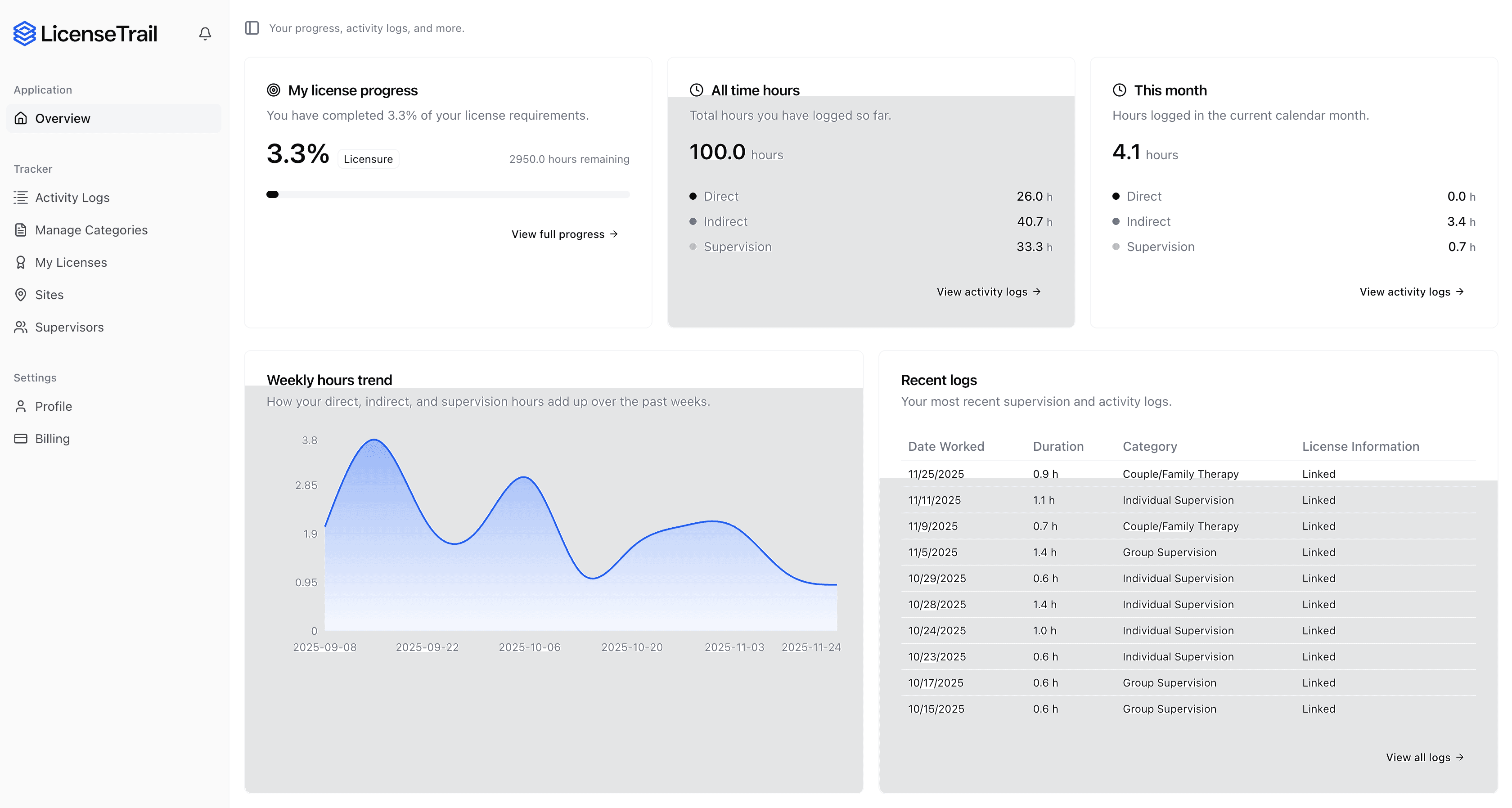
License Trail checks your direct, indirect, and supervision hours against Tennessee LCSW requirements continuously and flags mismatches before you submit.
 Start Tracking for Free
No credit card required · Free plan available
Is your spreadsheet hiding Tennessee LCSW risks?
Stop guessing if your categories match Tennessee Board of Social Worker Licensure requirements. License Trail checks your direct, indirect, and supervision hours continuously and flags mismatches before you submit.
Import or log
Bring your spreadsheet or start fresh
Upload your existing tracking spreadsheet and we'll map every hour into the right Tennessee Board of Social Worker Licensure categories automatically.
Verify against Tennessee
Catch mismatches before the board does
License Trail checks your direct, indirect, and supervision hours against Tennessee LCSW requirements continuously.
Export board-ready
One-click clean reports
Generate professional, board-ready reports for supervision meetings and Tennessee Board of Social Worker Licensure submissions in seconds.
No credit card required · Free plan available