
Tennessee Psychologist Requirements: Hours, Exams & Step-by-Step Guide
Stop guessing if your categories match Tennessee requirements. License Trail checks your direct, indirect, and supervision hours against Psychologist requirements continuously and flags mismatches before you submit.
No credit card required · Free plan available
Quick Requirements Overview
- Regulator: Tennessee Board of Examiners in Psychology (Rules Chapters 1180‑01 & 1180‑02)
- To provide “health services,” you must be licensed as a Psychologist and hold Health Service Provider (HSP) designation
- Education: Doctoral degree in psychology from an APA-accredited professional program or ASPPB/CNRHSPP Designated Doctoral Program (clinical/counseling/school/combined for HSP)
- Predoctoral internship (HSP): 1,900 hours over 1 full-time year (or 2 half-time years), in an organized health-service setting; not employment; after all doctoral requirements except dissertation; supervised by ≥2 HSP-credentialed psychologists
- Total supervised experience for HSP: 3,800 hours = 1,900 internship + 1,900 postdoctoral
- Postdoctoral supervised experience: 1,900 hours under an HSP psychologist; ≥1 hour/week face-to-face individual supervision tied to clinical services; administrative supervision doesn’t count
- If earning postdoc hours in TN outside APA/APPIC postdoc, you generally need a provisional license; only provisionally-licensed hours count (APA/APPIC postdocs may be exempt)
- Exams: EPPP (scaled ≥500/ASPPB standard) + Ethics & Jurisprudence exam (open-book, ≥90%) plus background check and required references/verification
License Details

Procedures
Licensure as a psychologist in Tennessee is governed by the Tennessee Board of Examiners in Psychology under Chapters 1180‑01 and 1180‑02 of the Tennessee rules. To work with clients as a health service provider, you must hold both:
- A license as a Psychologist, and
- A Health Service Provider (HSP) designation on that license. (law.cornell.edu)
The HSP designation is what triggers the detailed internship and postdoctoral hour requirements. Below is a step‑by‑step breakdown with the specific hours and board terminology.
1. Educational foundation: doctoral degree
For licensure as a Psychologist, Tennessee requires a doctoral degree in psychology that meets one of two main pathways: (regulations.justia.com)
- A doctoral program listed in the ASPPB/CNRHSPP publication “Designated Doctoral Programs in Psychology” (for HSP, it must be designated in clinical, counseling, school, or a combined professional program), or
- A doctoral program accredited by the APA Committee on Accreditation as a professional psychology program (clinical, counseling, school, or combined).
Candidates with older degrees (before January 1, 1982) have a discretionary equivalency path if they have long-standing licensure and practice in another jurisdiction, but that is a special waiver route. (regulations.justia.com)
2. Understanding the HSP designation and when hours are required
- A license alone allows you to use the title “Psychologist.” (law.cornell.edu)
- Health services (direct assessment and therapeutic services to individuals whose functioning is impaired or at risk) may be provided only by Psychologists with HSP designation. (law.cornell.edu)
The extensive supervised‑experience hours are tied specifically to HSP designation. If your goal is independent clinical practice with clients, you should plan on meeting all HSP requirements.
3. Predoctoral internship: 1,900 hours
Definition and setting
The Board defines “Internship” as an organized, planned, continuous training experience in a professionally recognized program that is formal in structure and designed to provide 1,900 hours of predoctoral training under qualified supervision in professional psychology. (law.cornell.edu)
Key points for a qualifying internship for HSP designation: (regulations.justia.com)
- Duration and hours
- At least one (1) calendar year full‑time, or
- Two continuous years if half‑time.
- Must include a minimum of 1,900 hours of internship experience in psychology.
- Nature of the site
- Conducted at a site where health services are normally provided.
- The internship must be part of an organized, integrated training program sponsored by an institution or organization with broader health service objectives than the internship itself.
- Distinct from practicum or employment
- It is explicitly separate from any practicum or course‑related laboratory experience, regardless of title.
- It is not “on‑the‑job training” or regular supervised work; you cannot be both an intern and an employee of the same site for purposes of meeting this requirement.
- Timing within the doctoral program
- Must occur after completion of all doctoral requirements except the dissertation.
- Supervision
- Supervision at the internship site must be provided by at least two licensed Psychologists with HSP designation (or equivalent under the rules).
How Tennessee expects internship status to be documented
For HSP designation, at least one recommendation letter must come from your internship director or supervisor, detailing: (regulations.justia.com)
- Types of clients seen
- Range of services you provided
- Nature of the internship or practicum site
- An overall evaluation of the quality of your services
4. Total supervised experience required for HSP: 3,800 hours
For HSP designation, Tennessee requires two full years of supervised professional experience, each consisting of 1,900 hours, for a total of 3,800 hours: (regulations.justia.com)
- Predoctoral qualifying internship – 1,900 hours (described above)
- Postdoctoral supervised experience – 1,900 hours (described next)
The Board does not subdivide these 3,800 hours into fixed minimums for “direct client contact” versus “other” activities in the rule text. Instead, it frames all of them as supervised experience in psychology/health services, with detailed expectations for supervision and the nature of the work.
5. Postdoctoral supervised experience: 1,900 hours
Basic requirement and overall structure
Under Rule 1180‑02‑.02(2)(d), “postdoctoral supervised experience” is required in addition to the qualifying internship for HSP designation. The postdoctoral year must consist of at least 1,900 hours of supervised experience. (regulations.justia.com)
Key elements:
- Minimum hours:
- 1,900 hours of creditable supervised experience after the internship.
- Supervisor qualifications:
- All 1,900 hours must be under the direct supervision of a Psychologist with HSP designation (or equivalent as recognized in the rules). (regulations.justia.com)
- Nature of the supervision:
- At least one hour per week of individual supervision is required.
- Supervision must be face‑to‑face and connected to the direct provision of health services in psychology by the supervisee to individual or group clients.
- Supervision related solely to administrative matters does not count toward the required weekly hour.
- Your own personal therapy, encounter groups, and your supervision of others do not count, except in a narrow carve‑out:
- Fellows in an APA‑ or APPIC‑listed postdoctoral program or full‑time tenure‑track psychology faculty may count some supervision they provide to practicum students or interns if that supervision itself is supervised by a Psychologist with HSP designation and is part of a formal training program. (regulations.justia.com)
- Excluded experiences:
- Classroom work, practicum experiences, and other course‑related training do not count toward the postdoctoral hours.
- Supervisor’s final responsibility:
- At the end of the postdoctoral year, the supervising psychologist must attest that you have reached a satisfactory level of proficiency in:
- Psychological assessment
- Intervention
- Legal and ethical knowledge and its application
- The supervisor must also report to the Board on the frequency/nature of supervision and the types of clients seen. (regulations.justia.com)
- At the end of the postdoctoral year, the supervising psychologist must attest that you have reached a satisfactory level of proficiency in:
Where and under what license you can earn these hours
Tennessee distinguishes between supervised experience gained in Tennessee and that gained elsewhere or in formal postdoctoral programs:
- If you are doing your postdoctoral supervised experience in Tennessee (outside of a formal APA/APPIC postdoc):
- You must hold a provisional license as a Psychologist with HSP designation in process.
- Only experience obtained under a provisional license counts toward the 1,900 postdoctoral hours. (law.cornell.edu)
- If you obtain postdoctoral hours in a Tennessee, APA‑accredited, or APPIC‑listed post‑internship, postdoctoral fellowship training program, you are exempt from the requirement to hold a provisional license while in trainee status. (regulations.justia.com)
6. Provisional license for postdoctoral supervision (when needed)
The provisional license is a time‑limited license specifically for applicants who have completed: (law.cornell.edu)
- The doctoral academic coursework, and
- The qualifying internship,
but have not yet completed the postdoctoral supervised experience required for HSP.
Key features:
- It allows you to perform psychological functions only under qualified supervision and only while working toward the required 1,900 hours of postdoctoral supervised experience.
- The provisional license is valid for one year, and the Board may extend it for additional years to allow completion of the required hours (with specific provisions for tenure‑track faculty and for documented disabilities that limit practice below half‑time).
- You must:
- Undergo a criminal background check, and
- Take the EPPP within one year of issuance; failure to take it within that time, or two failures of the EPPP or the ethics/jurisprudence exam, render the provisional license invalid. (law.cornell.edu)
7. Examinations: EPPP and Ethics & Jurisprudence
Tennessee requires all psychologist applicants to pass two examinations: (law.cornell.edu)
-
Written examination – EPPP (Examination for Professional Practice in Psychology)
- Method: computer‑delivered (or paper and pencil).
- Content: broad coverage of basic psychological science, applied practice, and ethics.
- Passing score (computer‑delivered): a scaled score of at least 500, or the passing score set by ASPPB for psychologists. (law.cornell.edu)
- You must take the exam within the eligibility window specified by the testing service; if you miss it, you must re‑enter the process.
- You may retake the exam if unsuccessful, but no more than four times in a 12‑month period, with at least 60 days between administrations under current rules. (law.cornell.edu)
-
Ethics and Jurisprudence examination
- Required for all applicants; it cannot be waived. (law.cornell.edu)
- Administered by the Board at its administrative office.
- Open‑book; the Board supplies copies of the applicable Tennessee statutes, rules, and APA Ethical Standards for use during the exam.
- Time limit: two hours.
- Passing standard: at least 90% of questions answered correctly. (law.cornell.edu)
- Content areas include:
- Selected Tennessee statutes on mental health and professional practice (Titles 33, 37, 63),
- The Board’s own rules (Chapters 1180‑01 to 1180‑04), and
- The APA Ethical Standards portion of the Ethical Principles of Psychologists and Code of Conduct. (law.cornell.edu)
8. Application and documentation requirements
Once you have met the educational, internship, supervised experience, and examination requirements, you complete the formal licensure application under Rule 1180‑02‑.03. The Board’s process includes: (regulations.justia.com)
- Application packet
- Request from the Board’s administrative office and submit all required fees.
- Identity and education documentation
- Two signed passport‑type photographs taken within the past 12 months.
- Certified or notarized birth certificate copy.
- Official transcripts of all graduate coursework sent directly from the institution to the Board, showing your highest degree and bearing the official seal.
- Evidence of good moral character
- At least three original letters of recommendation, sent directly to the Board on the letterhead of the endorsers.
- For Psychologist applicants: all three letters must be from Psychologists, two of whom must be licensed.
- For HSP designation: at least two endorsers must be HSP‑designated Psychologists (or HSP‑equivalent Psychologists from other jurisdictions).
- For HSP, at least one letter must be from an internship director or supervisor, giving details about:
- Types of clients,
- Range of services,
- Nature of the internship/practicum site, and
- Overall evaluation of service quality.
- Criminal background check
- Results must be submitted directly from the vendor specified in the Board materials.
- Licensure verification (if you have ever held any psychology license elsewhere)
- Another jurisdiction must send a “certificate of fitness” or equivalent verification directly to the Board indicating whether your license is/was in good standing and whether it has been disciplined.
For applicants seeking licensure by reciprocity, the Board may expedite review but still requires evidence of a qualifying doctoral program, qualifying internship, and postdoctoral supervised experience for HSP designation, and it never waives the internship and postdoctoral year for HSP applicants. (regulations.justia.com)
After all documentation and exams are complete, the Board meets (within about 90 days of exam completion) to review completed applications and examination results for the purpose of granting licensure. (law.cornell.edu)
9. Hour requirements summarized
For a psychologist in Tennessee who wishes to provide health services (i.e., hold HSP designation), the Board’s requirements can be summarized this way:
-
Doctoral education
- Qualifying doctoral degree in psychology from an ASPPB/CNRHSP “Designated Doctoral Program” or an APA‑accredited professional psychology program (clinical, counseling, school, or combined). (regulations.justia.com)
-
Supervised experience totals (HSP)
- Predoctoral internship:
- 1,900 hours in an organized, formal health‑service psychology internship program.
- At least one full‑time year (or two half‑time years), at a site offering health services, under supervision by at least two licensed Psychologists with HSP designation. (regulations.justia.com)
- Postdoctoral supervised experience:
- 1,900 hours of postdoctoral supervised experience in health services.
- All hours under the direct supervision of a Psychologist with HSP designation; at least one hour per week of face‑to‑face individual supervision focused on your direct clinical work. (regulations.justia.com)
- Predoctoral internship:
-
Total supervised professional experience for HSP designation:
- 3,800 hours (1,900 predoctoral internship + 1,900 postdoctoral supervised experience). (regulations.justia.com)
-
Licensure and exams
- Successful completion of the EPPP at or above the Board‑recognized passing score, and
- Successful completion of the open‑book Ethics and Jurisprudence exam with at least 90% correct,
- Plus submission of a complete application, background check, and all required recommendations and verifications. (law.cornell.edu)
Tennessee’s rules are periodically amended, and new rulemaking for Chapters 1180‑01 and 1180‑02 is scheduled for hearings in 2025, so it is wise to check the Board or Secretary of State rule pages for any changes that occur after June 26, 2025. (tnsos.org)
Track your Psychologist hours with confidence
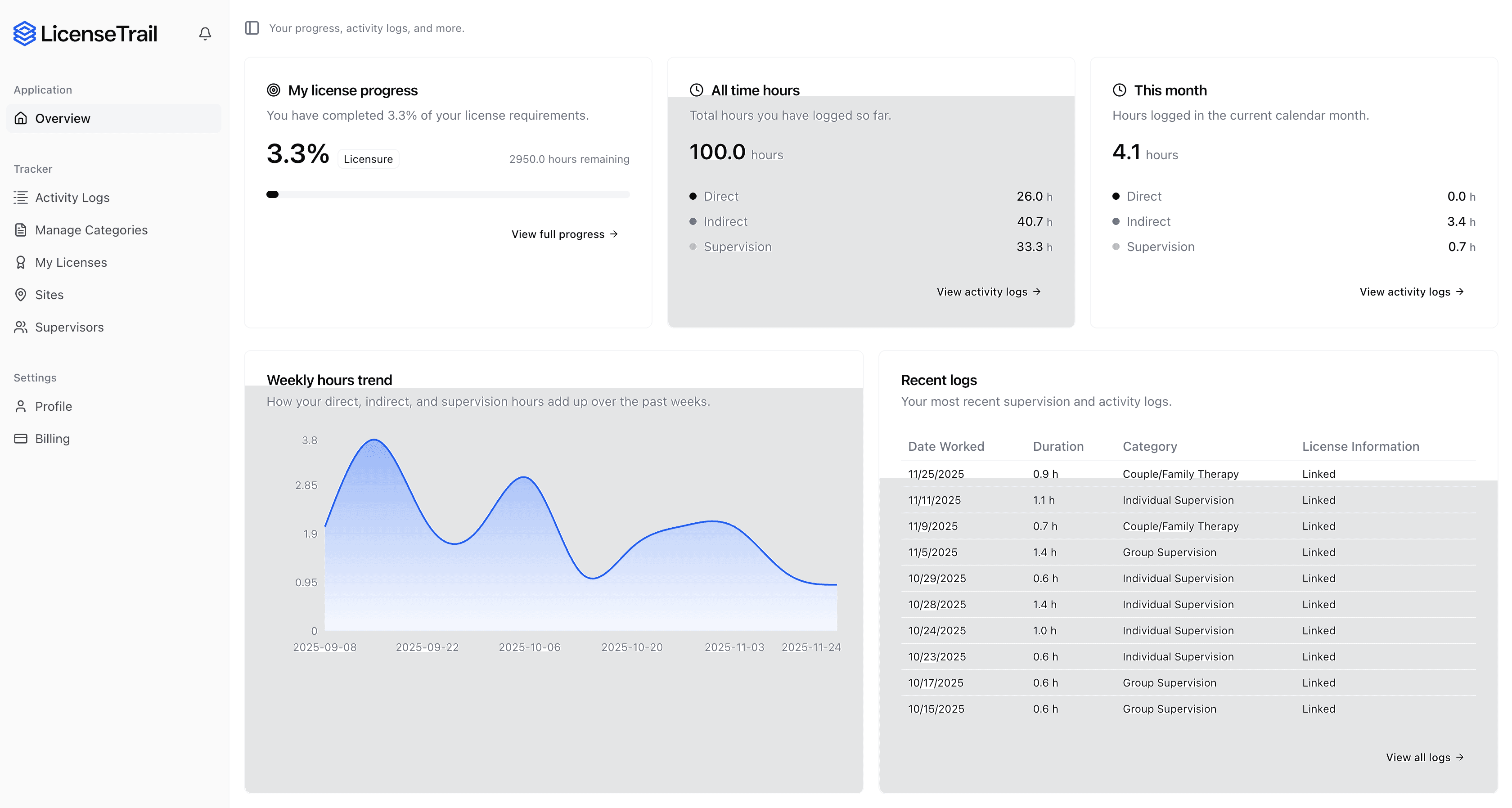
License Trail checks your direct, indirect, and supervision hours against Tennessee Psychologist requirements continuously and flags mismatches before you submit.
 Start Tracking for Free
No credit card required · Free plan available
Is your spreadsheet hiding Tennessee Psychologist risks?
Stop guessing if your categories match Tennessee Board of Examiners in Psychology requirements. License Trail checks your direct, indirect, and supervision hours continuously and flags mismatches before you submit.
Import or log
Bring your spreadsheet or start fresh
Upload your existing tracking spreadsheet and we'll map every hour into the right Tennessee Board of Examiners in Psychology categories automatically.
Verify against Tennessee
Catch mismatches before the board does
License Trail checks your direct, indirect, and supervision hours against Tennessee Psychologist requirements continuously.
Export board-ready
One-click clean reports
Generate professional, board-ready reports for supervision meetings and Tennessee Board of Examiners in Psychology submissions in seconds.
No credit card required · Free plan available