
Texas LMFT Requirements: Hours, Exams & Step-by-Step Guide
Stop guessing if your categories match Texas requirements. License Trail checks your direct, indirect, and supervision hours against LMFT requirements continuously and flags mismatches before you submit.
No credit card required · Free plan available
Quick Requirements Overview
- Two-stage pathway: LMFT Associate → complete supervised experience → upgrade to full LMFT (22 TAC Ch. 801)
- Graduate practicum minimums: 150 direct client-contact hours, incl. 75 with couples/families
- Pre-Associate exams: Pass AMFTRB national MFT exam + complete TX MFT Jurisprudence Exam
- LMFT Associate application essentials: online app/fee, official transcript, practicum verification, fingerprints + NPDB self-query; Supervisory Agreement with LMFT-S (after passing national exam)
- Associate time limit: license expires 60 months from issuance (must reapply if not completed; hours transferable)
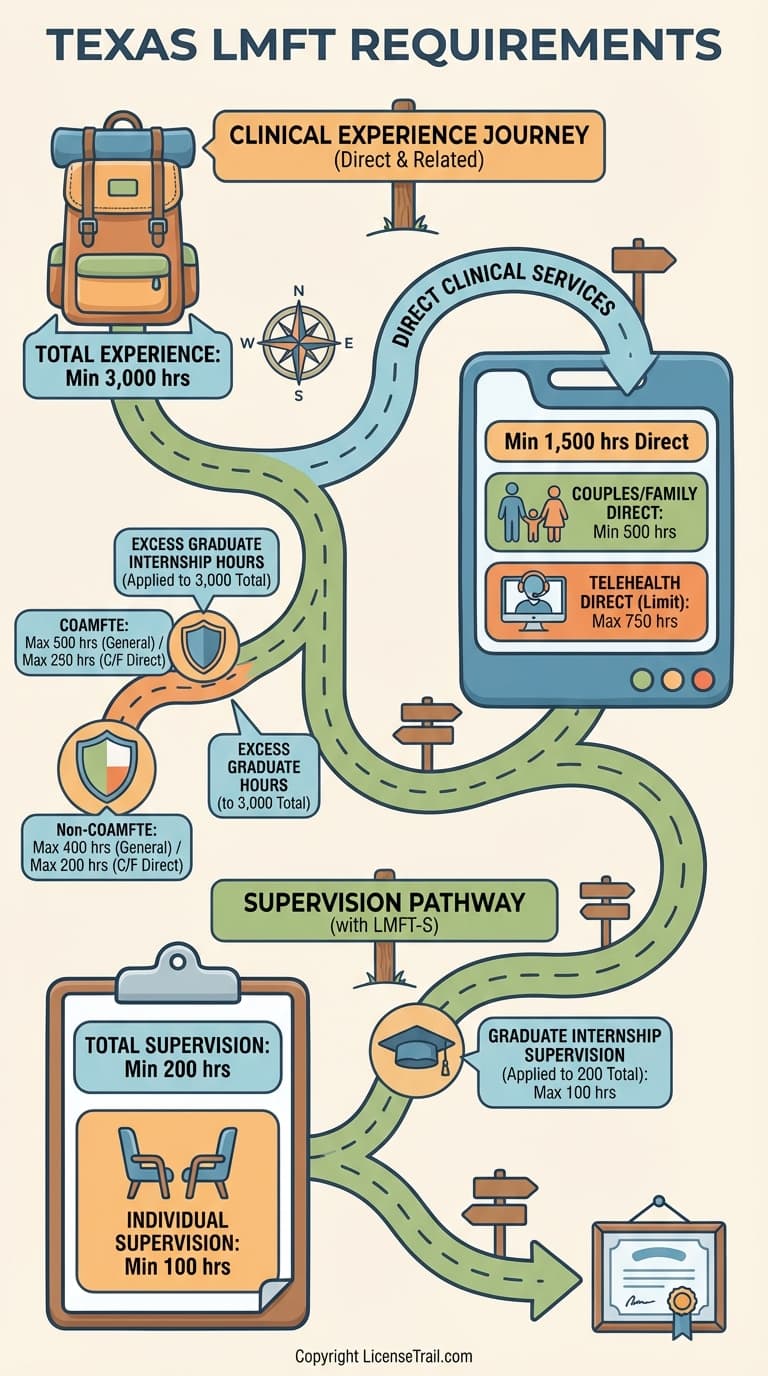
- Post-grad supervised experience: 3,000 hours over ≥24 months, incl. 1,500 direct (≥500 couples/families; ≤750 tech-assisted direct hours)
- Supervision requirement: 200 supervision hours by LMFT-S (≥100 individual); generally 1 hr/week; max 2 supervisors at a time (unless approved)
- Upgrade to full LMFT: active Associate + submit upgrade app/fee, jurisprudence completion, supervised experience verification forms, NPDB self-query (national exam/transcript on file)
License Details
Procedures
Licensure as a Licensed Marriage and Family Therapist (LMFT) in Texas is a two‑stage process: first you become an LMFT Associate, then you complete post‑graduate supervised clinical experience and upgrade to full LMFT. The Texas State Board of Examiners of Marriage and Family Therapists operates under the Texas Behavioral Health Executive Council (“the council”), and its requirements are written into the Texas Administrative Code (TAC).
Below is an organized guide, emphasizing the exact hour requirements and the terminology the board uses.
1. Educational foundation and practicum
To enter the LMFT licensure pipeline you must meet the “General Academic Requirements” in 22 TAC §801.112 and the “Academic Course Content” in §801.114. In practice, this means:
- A graduate degree in marriage and family therapy or a related field that meets Texas’ coursework and practicum standards. (txrules.elaws.us)
- Your graduate practicum/internship must include at least:
- 150 hours of direct client contact, and
- 75 hours of direct client contact with couples and families. (txrules.elaws.us)
The board refers to these as “direct client contact hours” within your pre‑graduate internship or practicum.
Excess practicum beyond the minimum may later be credited toward post‑graduate supervised clinical experience within specific limits (see Section 4). (txrules.elaws.us)
2. Examinations required before LMFT Associate
Before you can be licensed as an LMFT Associate, you must:
-
Pass the national licensure examination
- The board calls this the “licensure examination”, defined as the national exam administered by the Association of Marital and Family Therapy Regulatory Boards (AMFTRB) (or the California MFT exam). (txrules.elaws.us)
-
Complete the Texas Jurisprudence Examination for MFT
- This is an online exam on Texas law and rules that must be completed for both the associate license and, later, for upgrade to full LMFT. (bhec.texas.gov)
3. Applying for the LMFT Associate license
The LMFT Associate license is the status under which you earn your post‑graduate supervised hours.
Key board terminology
- “LMFT Associate” – the council‑approved term for a provisionally licensed marriage and family therapist; other abbreviations (like “LMFT‑A”) are not approved. (txrules.elaws.us)
- “Supervisor” / “LMFT‑S” – an LMFT with supervisor status who meets §801.143 Supervisor Requirements. (txrules.elaws.us)
Core application elements for LMFT Associate
According to the council’s “Licensing Questions – MFT” and the TAC provisions, an LMFT Associate applicant must: (bhec.texas.gov)
- Submit an online application and fee.
- Provide an official transcript showing the conferral date of the qualifying graduate degree.
- Submit a Supervised Clinical Practicum and Experience Verification Form documenting graduate practicum.
- Pass the AMFTRB national exam.
- Complete the Texas MFT Jurisprudence Exam.
- Submit:
- A self‑query report from the National Practitioner Data Bank.
- Electronic fingerprints for a criminal history check.
- A Supervisory Agreement Form signed with a board‑approved LMFT‑S (submitted after you pass the licensure exam).
LMFT Associate license term
- The LMFT Associate license expires 60 months from the date of issuance.
- If the Associate does not complete the supervised experience within 60 months, they must re‑apply for a new Associate license; accrued hours can be transferred to the new license. (regulations.justia.com)
4. Post‑graduate supervised clinical experience (the 3,000 hours)
This is the part the board calls “Supervised Clinical Experience Requirements and Conditions” in 22 TAC §801.142. (regulations.justia.com)
Overall requirement
- You must complete a minimum of two years of work experience in marriage and family therapy, which includes at least
3,000 hours of supervised clinical practice.
In the council’s public FAQ, this is framed as completing “3,000 or more total hours of supervised practice (direct and indirect combined)” over not less than 24 months. (bhec.texas.gov)
Breakdown of the 3,000 supervised hours
The 3,000 hours of “supervised clinical practice” (the board’s term) must include all of the following:
-
Direct clinical services (client contact) – 1,500 hours minimum
The rule states that within the total 3,000 hours, you must have “at least 1,500 hours providing direct clinical services”. (regulations.justia.com)
- At least 1,500 hours = direct clinical services (face‑to‑face, live video, or other approved modalities where you are actively providing therapy to clients).
- Of those 1,500 direct hours:
- At least 500 hours must be providing direct clinical services to couples or families. (regulations.justia.com)
- No more than 750 hours may be provided via technology‑assisted services, as approved by your supervisor (e.g., telehealth/online sessions). (regulations.justia.com)
The board’s FAQ summarizes this as “1,500 or more hours of supervised direct counseling practice (at least 500 family or couples).” (bhec.texas.gov)
-
Indirect / related experience – remainder of the 3,000 hours
After you meet the required 1,500 direct hours, the remaining hours (to reach 3,000) may be made up of:
- Documentation (e.g., case notes).
- Consultation with referral sources.
- Workshops and other related professional activities.
- Other “related experiences” as specified in the rule. (regulations.justia.com)
The TAC explicitly allows these “related experiences” to count toward the non‑direct portion of the 3,000 hours.
-
Supervision hours – 200 hours within the 3,000
Within those same 3,000 supervised hours, you must receive formal supervision from an LMFT Supervisor (LMFT‑S). The rule requires: (regulations.justia.com)
- A minimum of 200 hours of supervision by an LMFT‑S during the 3,000 hours.
- At least 100 of the 200 supervision hours must be individual supervision.
- The remaining supervision hours may be group supervision, subject to supervisor rule limitations.
The BHEC FAQ describes this identically as “200 hours of direct supervision (at least 100 of which must be individual).” (bhec.texas.gov)
Supervision format and frequency:
- The board defines “supervision for licensure” as guidance in the provision of clinical services by an LMFT Associate, conducted for at least one supervision hour (50 minutes) each week, except for good cause. (txrules.elaws.us)
- Supervision may be provided in person, by live video, or (when in‑person/live video is not accessible) by telephone. (regulations.justia.com)
Counting graduate supervision toward the 200 hours:
- You may count up to 100 hours of graduate internship supervision toward the 200 required supervision hours for LMFT licensure. (regulations.justia.com)
Minimum time frame and supervision structure
- The supervised clinical experience must be completed in no less than 24 months (two years); this is expressly stated in the BHEC in‑state licensure FAQ. (bhec.texas.gov)
- While providing services, an LMFT Associate must receive a minimum of one hour of supervision every week, again “except for good cause shown.” (regulations.justia.com)
- An LMFT Associate may have no more than two council‑approved supervisors at one time, unless the council approves an exception. (regulations.justia.com)
Where hours can be earned
The rule states that an LMFT Associate may practice under supervision “in any setting,” including: (regulations.justia.com)
- Private practice
- Public or private agencies
- Hospitals, and similar clinical settings
All such practice must be under the oversight of an LMFT‑S who meets Supervisor Requirements in §801.143.
Credit for excess graduate internship hours
For applicants who began their qualifying graduate program before September 1, 2025, the board may credit some excess internship hours beyond the minimum required practicum toward the 3,000 supervised hours, with caps depending on program accreditation: (regulations.justia.com)
- From a COAMFTE‑accredited program:
- Up to 500 excess internship hours may count, including:
- No more than 250 as direct couple/family hours.
- Up to 500 excess internship hours may count, including:
- From a non‑COAMFTE program:
- Up to 400 excess internship hours, including:
- No more than 200 as direct couple/family hours.
- Up to 400 excess internship hours, including:
- Additionally, no more than 100 excess graduate internship supervision hours may be counted toward the 200 supervision hours requirement.
Applicants with a qualifying master’s degree may also count supervision and experience completed after the master’s degree as part of a doctoral program, provided the doctoral program itself qualifies under the LMFT academic rules. (regulations.justia.com)
5. Applying for full LMFT licensure (upgrade from Associate)
Once the supervised experience requirements are met, you apply to “upgrade” from LMFT Associate to full LMFT.
According to 22 TAC §801.76 Application for LMFT and the council’s LMFT FAQs, you must: (law.cornell.edu)
- Hold an active LMFT Associate license in Texas.
- Complete the supervised clinical experience meeting §801.142:
- At least 3,000 hours of supervised clinical practice over no fewer than 24 months.
- At least 1,500 hours providing direct clinical services.
- At least 500 of those direct hours with couples or families.
- 200 hours of supervision, at least 100 individual.
- Submit an application for upgrade with:
- Application and fee.
- A new (or current) Texas Jurisprudence Examination completion.
- Supervised Experience Documentation / Supervised Experience Verification Form(s) completed by your LMFT‑S.
- A self‑query report from the National Practitioner Data Bank.
- Have proof on file of a passing score on the national licensure exam and your qualifying transcript (already submitted for Associate, but required elements are cross‑referenced in §801.76).
6. After licensure: Continuing obligations (briefly)
While your question focuses on pre‑licensure and hour requirements, it’s useful to note:
- Licensed LMFTs must complete 30 hours of continuing education for each renewal period, including:
- 6 hours in ethics, and
- 3 hours in cultural diversity or competency. (txrules.elaws.us)
This CE requirement applies to the full LMFT license, not the LMFT Associate license (which is a fixed 60‑month term and does not require CE for renewal). (bhec.texas.gov)
Summary of the key hour requirements in board language
To meet Texas State Board / council requirements and become a fully licensed LMFT, you must complete:
- Graduate practicum with at least:
- 150 hours of direct client contact, including
- 75 hours with couples and families. (txrules.elaws.us)
- Post‑graduate supervised clinical experience as an LMFT Associate:
- Minimum 3,000 hours of supervised clinical practice over at least two years.
- Within those 3,000 hours:
- At least 1,500 hours providing direct clinical services, with
- At least 500 hours providing direct clinical services to couples or families.
- No more than 750 direct hours via technology‑assisted services, as approved by the supervisor. (regulations.justia.com)
- A minimum of 200 hours of supervision by an LMFT‑S, of which:
- At least 100 must be individual supervision. (regulations.justia.com)
- The remaining hours may be “related experiences” (documentation, workshops, consultation, etc.). (regulations.justia.com)
- At least 1,500 hours providing direct clinical services, with
These figures and terms (“supervised clinical practice,” “direct clinical services,” “council‑approved supervision,” “technology‑assisted services,” and “LMFT Associate”) come directly from the Texas State Board of Examiners of Marriage and Family Therapists’ rules in 22 TAC Chapter 801 and the Texas Behavioral Health Executive Council’s official guidance.
Track your LMFT hours with confidence
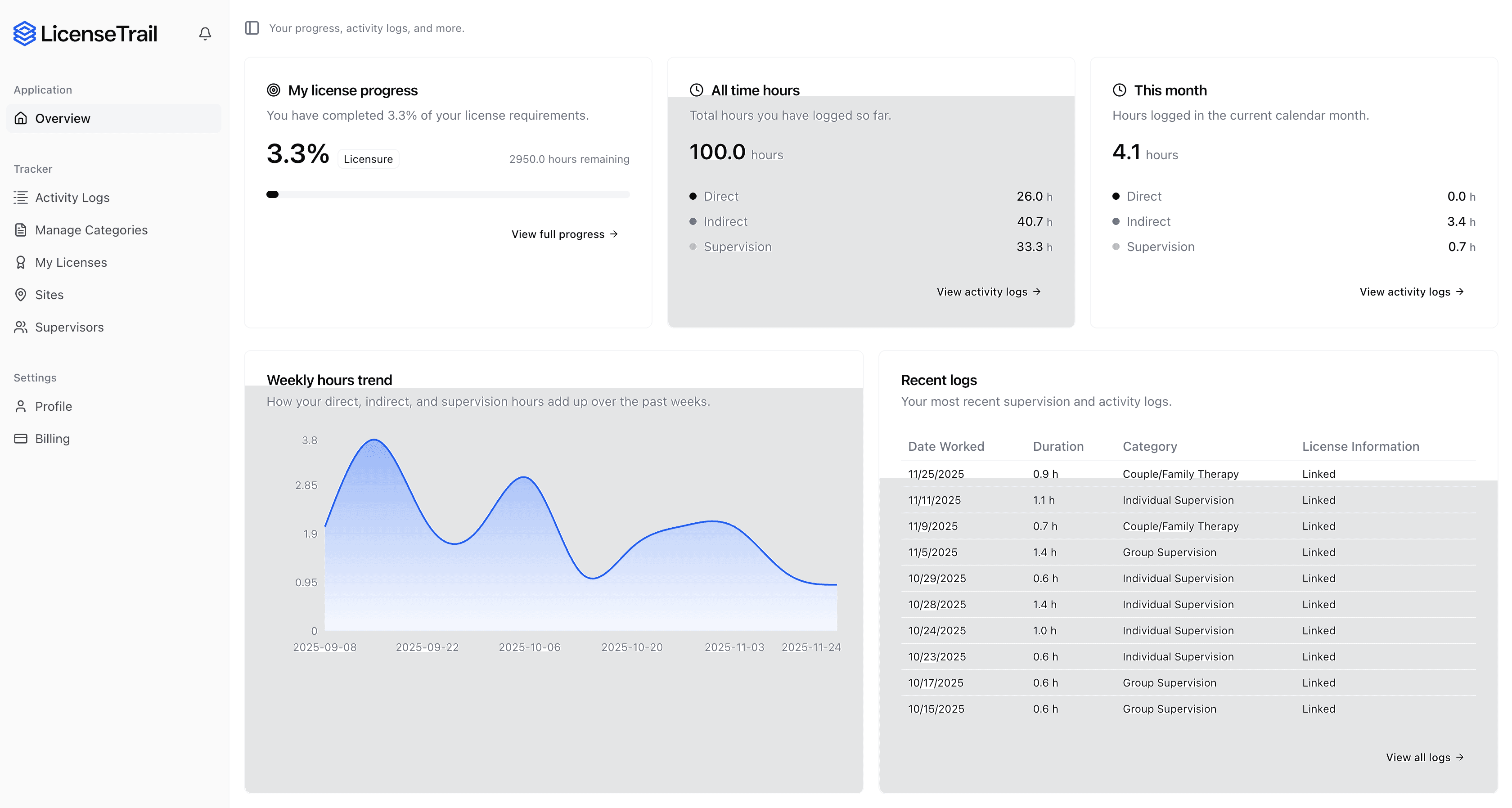
License Trail checks your direct, indirect, and supervision hours against Texas LMFT requirements continuously and flags mismatches before you submit.
 Start Tracking for Free
No credit card required · Free plan available
Is your spreadsheet hiding Texas LMFT risks?
Stop guessing if your categories match Texas State Board of Examiners of Marriage and Family Therapists requirements. License Trail checks your direct, indirect, and supervision hours continuously and flags mismatches before you submit.
Import or log
Bring your spreadsheet or start fresh
Upload your existing tracking spreadsheet and we'll map every hour into the right Texas State Board of Examiners of Marriage and Family Therapists categories automatically.
Verify against Texas
Catch mismatches before the board does
License Trail checks your direct, indirect, and supervision hours against Texas LMFT requirements continuously.
Export board-ready
One-click clean reports
Generate professional, board-ready reports for supervision meetings and Texas State Board of Examiners of Marriage and Family Therapists submissions in seconds.
No credit card required · Free plan available