
Utah CMHC Requirements: Hours, Exams & Step-by-Step Guide
Stop guessing if your categories match Utah requirements. License Trail checks your direct, indirect, and supervision hours against CMHC requirements continuously and flags mismatches before you submit.
No credit card required · Free plan available
Quick Requirements Overview
- Regulator: Utah DOPL (Utah Code 58-60-405; Utah Admin Code R156-60c)
- Education: Master’s/doctorate in CMHC/related (CACREP or equivalent) with ≥60 semester credits (90 quarter)
- Program clinical training: 700 hrs supervised practicum/internship incl. 240 direct therapy (for equivalent programs); cannot count toward post-grad hours
- Associate step: Hold ACMHC while accruing post-grad supervised experience (typical path)
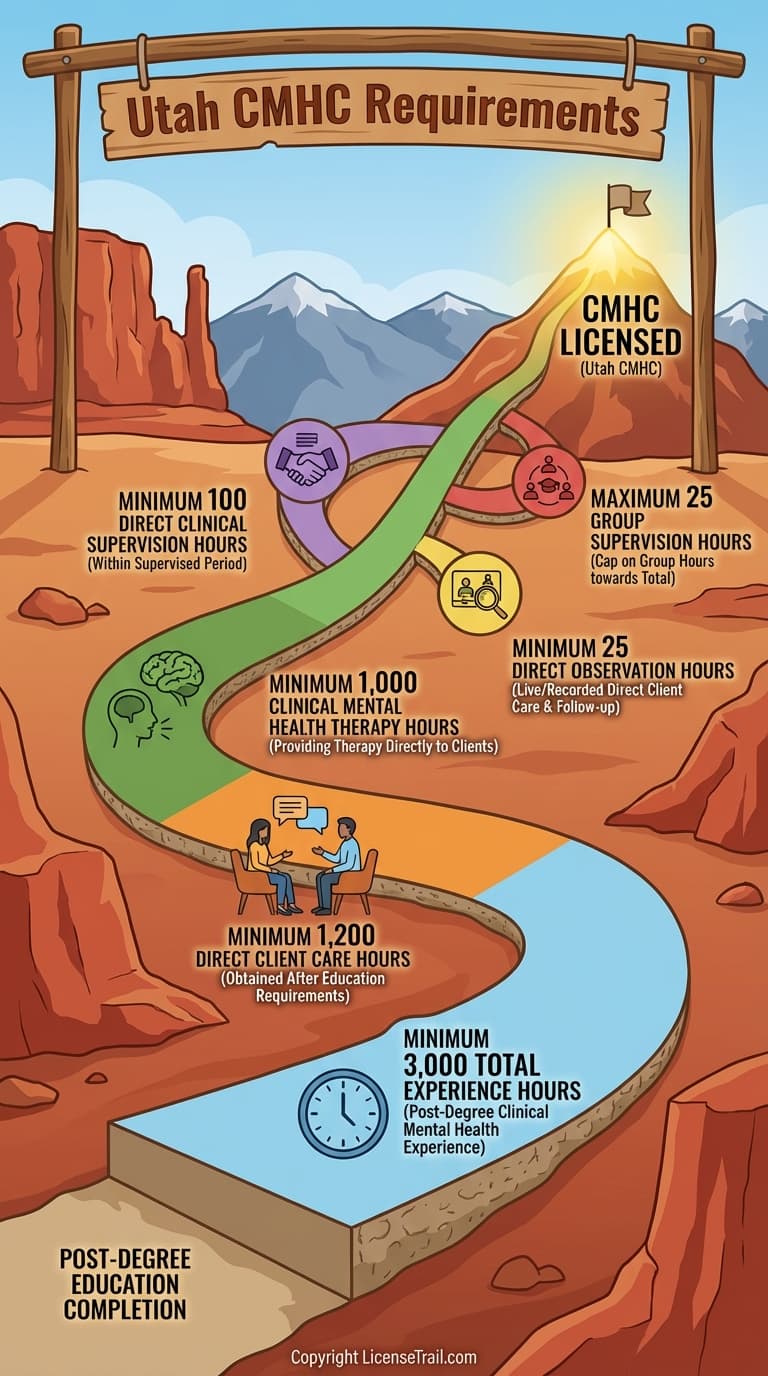
- Post-grad experience: 3,000 hrs clinical mental health experience after degree, over ≥18 months, generally as a W-2 employee in approved settings
- Direct hours minimum: Within the 3,000, ≥1,200 direct client care hrs (post-degree)
- Supervision structure: Within direct hours, ≥100 hrs direct clinical supervision, incl. ≥25 hrs direct observation; ≤25 hrs may be group supervision
- Other requirements: Pass NCMHCE (score sent from NBCC) + 2 hrs DOPL-approved suicide-prevention training; application includes supervision verification/forms (plus fees/background check)
License Details
Procedures
Utah’s path to licensure as a Clinical Mental Health Counselor (CMHC/LCMHC) is built around a specific mix of education, practicum/internship hours, and tightly defined post‑graduate supervised experience.
What follows focuses on the official requirements found in Utah statute (Utah Code 58‑60‑405) and in the Clinical Mental Health Counselor Licensing Act Rule (Utah Admin. Code R156‑60c), plus the Utah Division of Occupational and Professional Licensing (DOPL) application instructions.
1. Who regulates CMHC licensure in Utah
Licensure is handled by:
- Utah Department of Commerce – Division of Occupational and Professional Licensing (DOPL)
- Under the Clinical Mental Health Counselor Licensing Act (Utah Code 58‑60‑4xx) and Clinical Mental Health Counselor Licensing Act Rule (Utah Admin. Code R156‑60c). (law.cornell.edu)
DOPL currently recognizes two main counseling licenses on this path:
- Associate Clinical Mental Health Counselor (ACMHC) – pre‑licensure, used while accruing supervised experience. (dopl.utah.gov)
- Clinical Mental Health Counselor (CMHC/LCMHC) – full, independent license. (dopl.utah.gov)
2. Graduate education and practicum/internship hours
2.1 Degree and credit requirements
To qualify for Utah CMHC licensure you must complete, at minimum: (law.justia.com)
- A master’s or doctorate in:
- Clinical Mental Health Counseling, Clinical Rehabilitation Counseling, or Counselor Education and Supervision from a CACREP‑accredited program, or
- Clinical Mental Health Counseling or an equivalent field from a program at a CHEA‑recognized institution.
- At least 60 semester credits or 90 quarter credits of graduate coursework in counseling.
For “equivalent field” programs, Utah’s rule requires specific graduate coursework (social and cultural diversity, group counseling, human development, etc.) and a defined amount of clinical training (below). (law.cornell.edu)
2.2 Required practicum/internship (“supervised clinical training”)
Utah’s rule defines the minimum clinical training built into your degree as follows for “equivalent field” programs: (law.cornell.edu)
- At least 700 documented hours of supervised clinical training (from one or more practicums/internships);
- At least 240 of those hours must be providing therapy directly to clients.
On the ACMHC application, DOPL restates this as:
A practicum or internship that includes at least 700 documented hours of supervised clinical mental health counselor training, of which at least 240 hours consist of providing clinical therapy directly to clients under the direction of an educational institution. (dopl.utah.gov)
These practicum/internship hours do not count toward the post‑graduate supervised experience required for full CMHC licensure. The rule explicitly says the supervised experience “may not include any clinical internship or practicum hours.” (regulations.justia.com)
3. Step one after graduation: Associate CMHC (ACMHC) license
After you finish the qualifying degree, Utah expects you to hold an Associate Clinical Mental Health Counselor (ACMHC) license while you accumulate post‑graduate hours (with a special “extern” option for those with limited coursework deficiencies). (dopl.utah.gov)
You apply to DOPL as an ACMHC with:
- Official transcripts documenting the qualifying degree and clinical training;
- Educational course requirement forms if your program is not CACREP;
- Other items listed on DOPL’s ACMHC webpage (fees, etc.). (dopl.utah.gov)
The ACMHC credential is what allows you to begin counting post‑graduate “clinical mental health experience” toward independent CMHC licensure.
4. Core of licensure: post‑graduate supervised experience
This is where Utah’s hour requirements become very specific. You can think of them in three layers:
- Total post‑graduate hours (“clinical mental health experience” / “post graduate mental health practice hours”)
- Minimum direct client care hours within that total
- Minimum supervised/observed hours within the direct hours
4.1 Total hours: 3,000 post‑graduate “clinical mental health experience” hours
Under Utah Admin. Code R156‑60c‑302a and the CMHC application instructions, you must complete: (regulations.justia.com)
- 3,000 hours of post‑graduate “clinical mental health experience” (also called “post graduate mental health practice hours”).
DOPL’s CMHC application states:
Supervision for Post Graduate Mental Health Practice Hours. NOTE: The hours from all forms must total 3,000. (dopl.utah.gov)
Rule R156‑60c‑102(5) defines “clinical mental health experience” broadly as including both direct therapy hours and activities such as: intake and mental status evaluations, biopsychosocial assessments, treatment planning, caseload management, learning intervention techniques, and working in integrated or legal system contexts. (law.cornell.edu)
Timeline requirement: R156‑60c‑302a requires that supervised experience be obtained “in not less than 18 months.” You cannot compress all 3,000 hours into a shorter time; in practice most candidates take 2–3 years. (regulations.justia.com)
4.2 Where and how the 3,000 hours must be completed
The same rule and related definitions further require that your 3,000 hours: (regulations.justia.com)
- Are obtained after completion of the degree required by Utah Code 58‑60‑405 (no practicum/internship double‑counting);
- Are normally accrued while you hold an ACMHC license (with narrow exceptions for equivalent training in other jurisdictions);
- Are completed while you are an “employee”, defined as a W‑2 employee, not a 1099 contractor; (law.cornell.edu)
- Occur in one of the following types of facilities:
- Mental health agency;
- In‑patient or out‑patient hospital;
- Educational institution;
- Non‑profit organization;
- Government agency. (regulations.justia.com)
Supervision must also comply with separate sections on supervision contracts and supervisor eligibility (R156‑60c‑305a and 305b): your supervisor must be a qualified mental health therapist (e.g., CMHC, LCSW, LMFT, psychologist, psychiatrist, qualified APRN) and the supervision relationship must be documented in a Division‑approved contract and on Supervisor Verification forms. (law.cornell.edu)
4.3 Minimum direct client care within the 3,000 hours
Utah law was updated in 2024 to put a statutory floor on intensive, hands‑on work with clients.
Under Utah Code 58‑60‑405(1)(e), an applicant must: (law.justia.com)
- “Document successful completion of not less than 1,200 direct client care hours,”
- Obtained after completion of the graduate education; and
- Subject to the specific supervision structure below.
“Direct client care hours” are not separately defined, but they sit alongside the code’s definition of “clinical mental health therapy” in the Mental Health Professional Practice Act—i.e., the direct practice of assessment, diagnosis, and treatment with individuals, couples, families, or groups. (law.cornell.edu)
Earlier, and still present in R156‑60c‑302a, Utah’s rule also states that, within the 3,000 hours of clinical mental health experience: (regulations.justia.com)
- At least 1,000 hours must be “providing clinical mental health therapy… directly to clients.”
Because the statute now requires 1,200 direct client care hours, the higher statutory number is controlling. In practice, plan for:
3,000 total post‑graduate hours, of which at least 1,200 must be direct client care with clients.
4.4 Minimum supervision, direct supervision, and observation hours
Within those 1,200 direct client care hours, Utah now requires a specific pattern of clinical supervision under 58‑60‑405(1)(e): (law.justia.com)
- At least 100 hours of “direct clinical supervision”, meaning:
- Supervisor meets with you face‑to‑face in the same room, or
- Via synchronous audio‑video that allows real‑time visual and audio interaction, consistent with the supervision contract (this is how Utah defines “direct supervision”). (law.cornell.edu)
- Within those 100 supervised hours:
- At least 25 hours must be “direct observation” – your supervisor directly observes you providing clinical services (live or via live telehealth); (law.justia.com)
- No more than 25 hours may be group supervision conducted concurrently with more than one other applicant. (law.justia.com)
Earlier administrative language in R156‑60c‑302a specified 75 hours of clinical mental health therapy under direct supervision as the minimum within the 3,000 hours. (regulations.justia.com) The newer statute (100 hours + observation requirements) is stricter; you should meet the statutory 100‑hour/25‑observation/25‑group framework to be safe and compliant.
5. Summary of hour requirements in plain numbers
Putting the above together, the current Utah requirements for a typical in‑state applicant look like this:
During the degree (practicum/internship)
- 700 hours of supervised clinical training (for “equivalent field” programs), with at least
- 240 hours providing therapy directly to clients. (law.cornell.edu)
(Accredited CACREP CMHC programs must still meet CACREP’s own practicum/internship minimums; Utah uses the 700/240 standard to define adequacy of “equivalent” programs.)
After the degree (toward independent CMHC licensure)
- 3,000 hours of post‑graduate “clinical mental health experience” / “post graduate mental health practice hours,”
- Accrued:
- After degree completion,
- In not less than 18 months,
- While licensed as an ACMHC (with narrow exceptions),
- As a W‑2 employee in approved settings (mental health agency, hospital, school, non‑profit, government). (regulations.justia.com)
- Accrued:
- Within those 3,000 hours:
- At least 1,200 hours must be “direct client care” hours with clients (post‑degree). (law.justia.com)
- Within those 1,200 direct hours:
- At least 100 hours must be “direct clinical supervision” (face‑to‑face or synchronous audio‑video meetings with your supervisor);
- At least 25 of those 100 must be “direct observation” of your work by the supervisor;
- No more than 25 of those 100 may be group supervision with more than one supervisee. (law.justia.com)
Earlier rule language still on the books says that at least 1,000 of the 3,000 hours must be direct clinical mental health therapy and at least 75 must be under direct supervision; those thresholds are now effectively nested within the higher statutory minimums of 1,200 direct and 100 supervised hours. (regulations.justia.com)
6. Examination and suicide‑prevention training
6.1 Required examination
Utah currently requires a passing score on the National Clinical Mental Health Counseling Examination (NCMHCE) for CMHC licensure. (dopl.utah.gov)
- The DOPL CMHC application specifically asks for an official NCMHCE score report sent directly from NBCC. (dopl.utah.gov)
- A prior requirement to also pass the NCE was removed from the CMHC rule, except for a narrow category of applicants with certain rehabilitation counseling degrees described in Utah Code 58‑60‑405(3). (rules.utah.gov)
6.2 Suicide‑prevention training
Before licensure, you must: (law.justia.com)
- Complete at least two hours of training in suicide prevention after finishing your degree, in a course approved by DOPL (see R156‑60c‑302d).
7. Application for full Clinical Mental Health Counselor license
Once you have:
- Completed the qualifying degree (60+ credits with required coursework),
- Become licensed as an ACMHC,
- Accrued 3,000 post‑graduate clinical mental health experience hours meeting the breakdown above,
- Completed 1,200+ direct client care hours with 100+ hours of direct clinical supervision including 25+ hours of direct observation (and ≤25 group supervision hours),
- Completed the 2‑hour suicide‑prevention course, and
- Passed the NCMHCE (or, in limited cases, satisfied the alternative pathway),
you may apply to DOPL for full Clinical Mental Health Counselor licensure. (dopl.utah.gov)
The CMHC application will require:
- Supervision verification forms documenting the 3,000 hours and supervision structure; (dopl.utah.gov)
- Official NCMHCE score report;
- Background check and fees, as required under Utah Code 58‑60‑405(1)(h) and DOPL policy. (law.justia.com)
8. Alternative licensure pathway (exam‑alternative option)
Utah’s 2024 reforms (SB 26, codified in the current 58‑60‑405) also created an alternative pathway if an applicant does not pass the licensing examination: (law.justia.com)
If you have attempted the required exam at least once and did not pass, you may qualify by instead documenting:
- An additional 500 direct client care hours,
- Of which at least 25 are direct clinical supervision hours, and
- At least 5 are direct observation hours by a qualified clinical supervisor; plus
- A recommendation letter from your direct clinical supervisor, and
- A letter from another licensed mental health therapist who has directly observed your work and is not your direct supervisor. (law.justia.com)
This route is designed as a safety valve; most applicants will still pursue licensure by passing the NCMHCE.
9. Key phrases Utah uses (and how they map to hours)
To match the Board/DOPL’s terminology:
- “Clinical mental health experience” – the entire 3,000‑hour post‑graduate package, including both therapy and related clinical activities. (law.cornell.edu)
- “Clinical mental health therapy” – direct assessment, diagnosis, and treatment of mental disorders and emotional/behavioral problems with individuals, couples, families, or groups. These hours are a subset of your direct client care hours. (law.cornell.edu)
- “Direct client care hours” – hands‑on client work after the degree; statute requires at least 1,200 such hours. (law.justia.com)
- “Direct clinical supervision hours” / “direct supervision” – live, synchronous supervision meetings (in person or audio‑video) with your supervisor focusing on your clinical work; statute requires at least 100 hours, including direct observation and with limits on group hours. (law.justia.com)
- “Direct observation hours” – a subset of supervision where your supervisor directly observes you providing services; at least 25 such hours are required within the supervised hours. (law.justia.com)
- “Employee” – explicitly defined as a W‑2 employee; supervised experience must be accumulated in that employment status at qualifying facilities. (law.cornell.edu)
These are the terms DOPL and the Clinical Mental Health Counselor Licensing rules use when they review supervision forms and verify that your hours and settings meet Utah’s requirements.
Track your CMHC hours with confidence
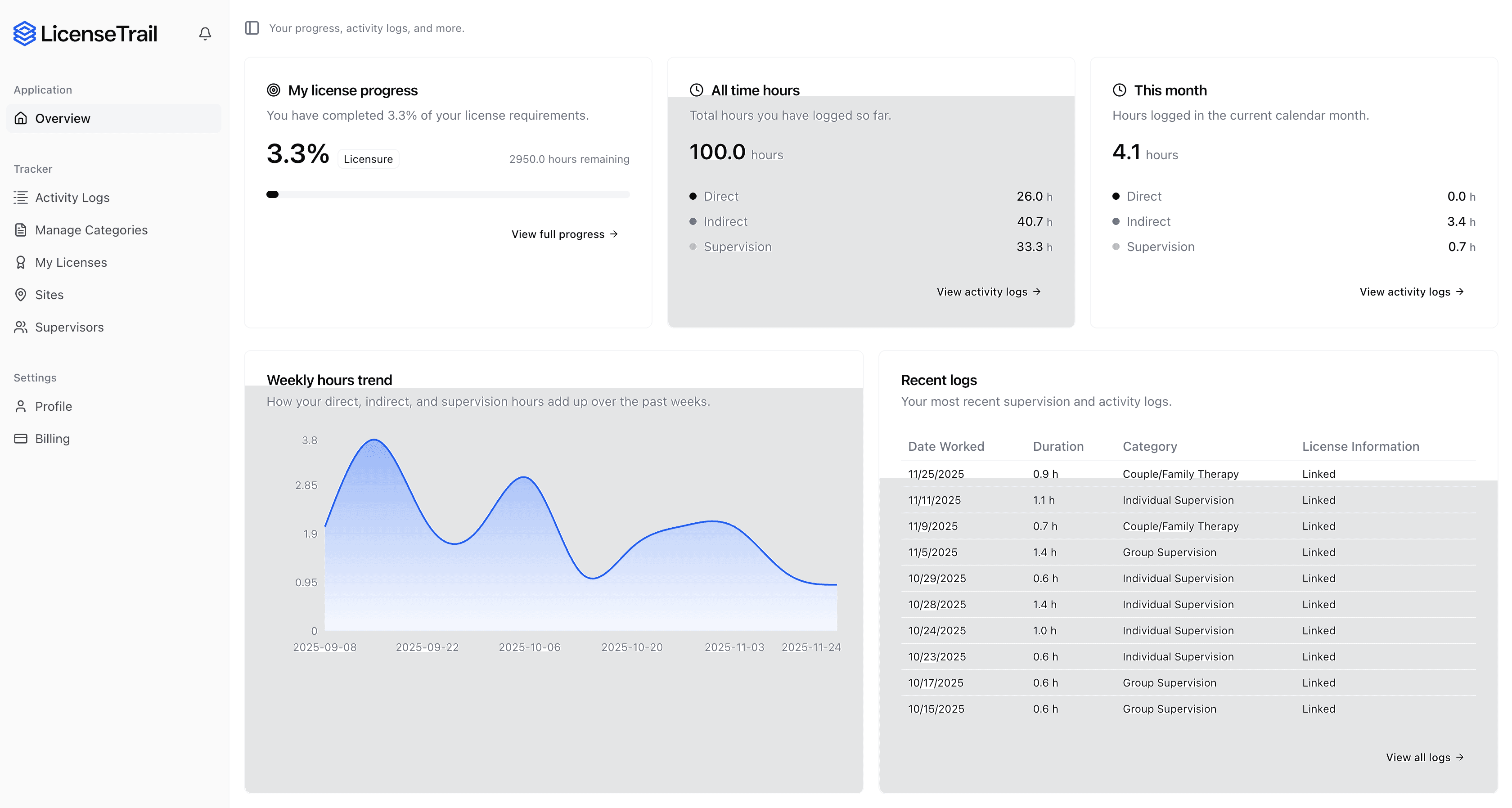
License Trail checks your direct, indirect, and supervision hours against Utah CMHC requirements continuously and flags mismatches before you submit.
 Start Tracking for Free
No credit card required · Free plan available
Is your spreadsheet hiding Utah CMHC risks?
Stop guessing if your categories match Utah Clinical Mental Health Counselor Licensing Board requirements. License Trail checks your direct, indirect, and supervision hours continuously and flags mismatches before you submit.
Import or log
Bring your spreadsheet or start fresh
Upload your existing tracking spreadsheet and we'll map every hour into the right Utah Clinical Mental Health Counselor Licensing Board categories automatically.
Verify against Utah
Catch mismatches before the board does
License Trail checks your direct, indirect, and supervision hours against Utah CMHC requirements continuously.
Export board-ready
One-click clean reports
Generate professional, board-ready reports for supervision meetings and Utah Clinical Mental Health Counselor Licensing Board submissions in seconds.
No credit card required · Free plan available