
Utah LMFT Requirements: Hours, Exams & Step-by-Step Guide
Stop guessing if your categories match Utah requirements. License Trail checks your direct, indirect, and supervision hours against LMFT requirements continuously and flags mismatches before you submit.
No credit card required · Free plan available
Quick Requirements Overview
- Degree: Clinical master’s/doctorate in MFT (COAMFTE) or equivalent clinical master’s from a CHEA/ACE-accredited institution (with required content areas).
- In-program practicum: 400 hours total = 100 hours direct supervision + 300 hours supervised therapy, incl. ≥150 hours couple/family therapy (2+ clients).
- Associate step: Must hold AMFT (or be a qualifying doctoral student) to accrue post-grad hours.
- Employment setting: Post-grad supervised experience must be as a W‑2 employee at a qualifying facility (not 1099/independent contractor).
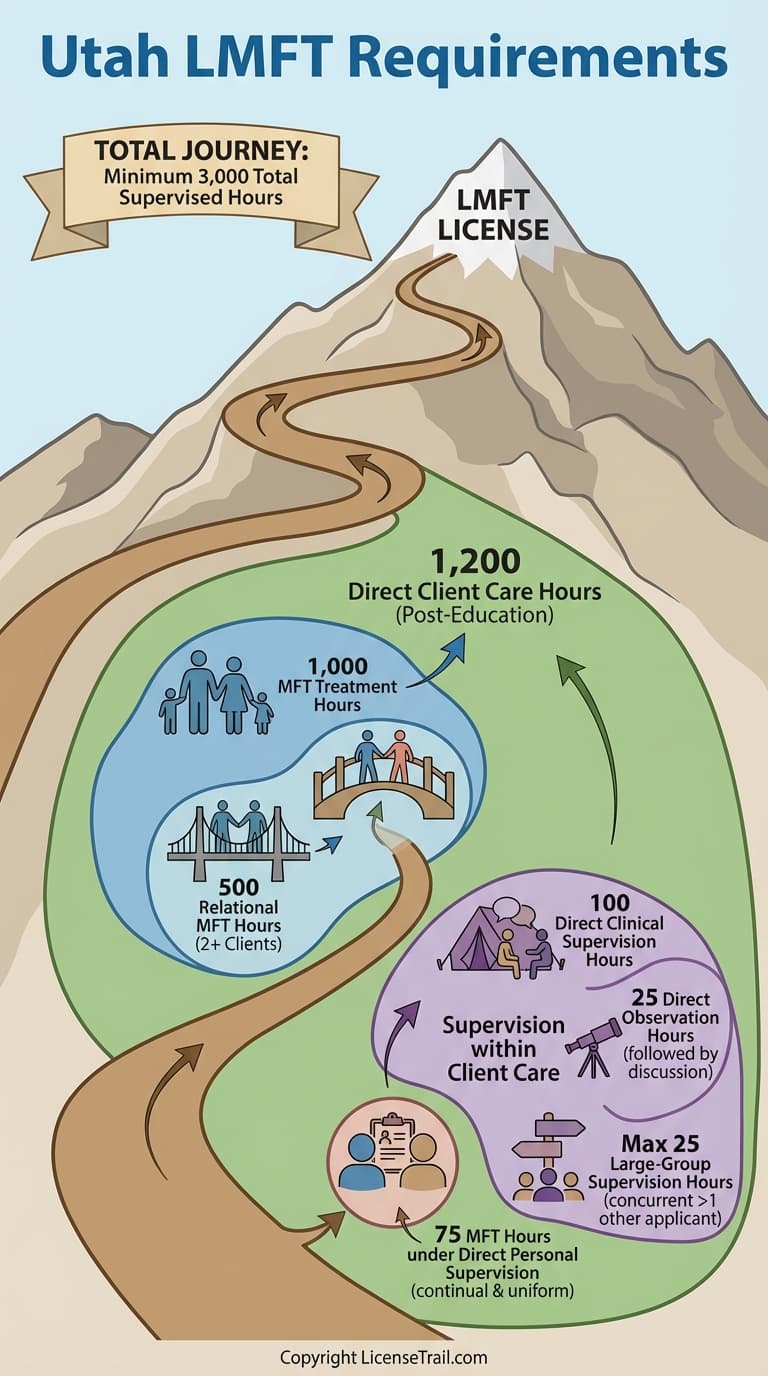
- Post-grad experience: 3,000 supervised hours over ≥18 months, including 1,000 MFT client-contact hours with ≥500 hours (2+ clients participating).
- Supervision requirement: 75 hours “continually and uniformly” under direct personal supervision; group hours count only as primary/co-therapist.
- Supervisor: LMFT in good standing ≥2 years and meets Utah-approved supervision-qualification/training standards.
- Other requirements: Pass board-approved national MFT exam + complete 2-hour suicide-prevention course (approved sponsor/content per rule).
License Details
Procedures
Utah’s Licensed Marriage and Family Therapist (LMFT) credential is regulated by the Utah Division of Professional Licensing (DOPL) under the Marriage and Family Therapist Licensing Act and Rule R156‑60b. What follows is a step‑by‑step outline of the current requirements, with emphasis on the types and amounts of hours you must complete and the wording used by the Utah board.
1. Educational foundation
Acceptable degree
You must complete one of the following graduate degrees in marriage and family therapy:
- A clinical master’s or doctorate degree in marriage and family therapy from a program accredited by the Commission on Accreditation for Marriage and Family Therapy Education (COAMFTE). (regulations.justia.com)
- OR a clinical master’s degree in marriage and family therapy or equivalent from an institution accredited by a professional accrediting body approved by the Council for Higher Education Accreditation (CHEA) or the American Council on Education at the time you obtained the degree. (regulations.justia.com)
The Utah rule then specifies minimum content areas in semester/quarter hours (theoretical foundations, assessment/treatment, human development and family studies, ethics, research, and MFT electives). (regulations.justia.com)
Required practicum in the degree
Your MFT graduate program must include a clinical practicum under supervision that totals at least 400 hours, consisting of: (law.cornell.edu)
- 100 hours of direct supervision; and
- 300 hours of mental health therapy under direct supervised clinical practice, with at least 150 hours in couple or family therapy with two or more clients participating.
Utah also has a slightly different 600‑hour practicum standard specifically referenced on the DOPL website for associate/extern pathways, but the current rule text for education requirements uses the 400‑hour minimum above; always reconcile your program with DOPL before you apply. (dopl.utah.gov)
2. Step 1 after graduation: become an Associate Marriage and Family Therapist (AMFT)
Before accruing post‑graduate supervised hours toward full LMFT, you must be licensed as an Associate Marriage and Family Therapist (AMFT) (or be an eligible doctoral student). Utah law ties the supervised experience to holding the AMFT license or its equivalent. (regulations.justia.com)
Key points from Utah’s experience rule:
- Supervised experience must be obtained “while the individual is a licensed associate marriage and family therapist or as a doctoral program student” and not as a 1099 independent contractor. (regulations.justia.com)
- You must be a W‑2 employee providing clinical mental health therapy at a qualifying facility (e.g., mental health agency, hospital, educational institution, nonprofit, or government agency), unless you qualify under specific out‑of‑state or exemption provisions. (regulations.justia.com)
3. Post‑graduate supervised experience requirements for LMFT
Total supervised experience hours
Utah’s current rule states that “the minimum 3,000 hours of supervised marriage and family therapy experience” are required to obtain LMFT licensure. (law.cornell.edu)
This 3,000‑hour total is your post‑degree, supervised professional experience—not the same as your graduate practicum.
Required sub‑components within the 3,000 hours
The rule breaks these 3,000 hours into specific elements.
-
Direct marriage and family therapy hours (client contact)
Within the 3,000 hours, you must complete: (law.cornell.edu)
- 1,000 hours providing marriage and family therapy, as defined in Utah statute; and
- Of those 1,000 hours, a minimum of 500 hours including two or more clients participating (i.e., couple or family sessions).
Utah explicitly emphasizes marriage and family therapy with multiple people present, not just individual therapy.
-
Direct personal supervision hours
The rule further requires: (law.cornell.edu)
- 75 hours of marriage and family therapy performed continually and uniformly under direct personal supervision (using the board’s term “direct personal supervision” as defined elsewhere in R156‑60b‑102).
These 75 hours are not client hours; they refer to time in which you are practicing under intensive, direct personal supervision as defined by rule.
-
Range of clinical activities expected
Utah specifies that marriage and family therapy experience shall include all of the following: (law.cornell.edu)
- Individual, couple, family, and group therapy
- Crisis intervention
- Mediating relationships
- Breaking dysfunction cycles
This language signals that your caseload and duties must be broad enough to cover these functions.
-
Group therapy limitation
Hours from group settings are countable only if you functioned as the primary therapist or co‑therapist. (law.cornell.edu)
Time frame for completing the 3,000 hours
Utah gives a minimum time frame:
- Supervised experience must be completed in not less than 18 months. (law.cornell.edu)
There is no explicit maximum timeframe in the rule text, but DOPL may apply general recency standards; you must verify with them if your hours are spread over many years.
4. Supervision conditions and supervisor qualifications
Where and how supervised experience is obtained
As summarized in the experience rule, supervised experience must be obtained: (law.cornell.edu)
- While you are a licensed AMFT (or qualifying doctoral student) and
- While you are a W‑2 employee at one of the following:
- Mental health agency
- In‑patient or out‑patient hospital
- Educational institution
- Non‑profit organization
- Government agency
- Under a supervisor who meets Utah’s supervisory requirements in Sections R156‑60b‑305a and 58‑60‑307.
- In compliance with additional supervision‑experience details in R156‑60b‑305b.
Utah’s older bulletin and current rule on supervisors require that a marriage and family therapist supervisor: (rules.utah.gov)
- Has been licensed as a marriage and family therapist in good standing for at least two years, and
- Is currently licensed as an LMFT in the state where the training occurs, and
- Meets one of several board‑approved supervision‑training options (e.g., AAMFT‑approved supervisor or equivalent training).
5. Examination and suicide‑prevention training
National exam
To be licensed as a Utah LMFT, you must pass the national marriage and family therapy licensing examination approved by the board (typically the AMFTRB/National MFT Exam). This requirement appears in the underlying statute and DOPL application materials, even though the specific exam title is not spelled out in the experience rule itself. (mft-license.com)
Suicide‑prevention course (licensure requirement)
Utah has a specific rule titled “Qualifications for Licensure – Suicide Prevention Course.” It states that, under statute, a two‑hour suicide‑prevention course is required to obtain marriage and family therapist licensure. (law.cornell.edu)
Key elements:
- The two‑hour course must be approved, sponsored, or conducted by: an accredited college/university, a county/state/federal agency, a professional association involved in clinical mental health therapy, or a mental health agency providing clinical mental health services. (law.cornell.edu)
- The content must be relevant to mental health therapy and suicide prevention and include components such as suicide concepts and facts; suicide risk assessment, crisis intervention, and first aid; evidence‑based interventions; continuity of care; and therapeutic alliances for suicide‑risk intervention. (law.cornell.edu)
6. Application to upgrade from AMFT to LMFT
Once you have:
- Completed an acceptable MFT graduate program with the required practicum; (law.cornell.edu)
- Held an AMFT (or qualifying doctoral status) and accumulated 3,000 hours of supervised marriage and family therapy experience, including:
- 1,000 hours providing marriage and family therapy, with at least 500 hours with two or more clients participating, and
- 75 hours performed continually and uniformly under direct personal supervision; (law.cornell.edu)
- Completed at least 18 months of supervised practice; (law.cornell.edu)
- Passed the board‑approved national MFT exam; (mft-license.com)
- Completed the two‑hour suicide‑prevention course that meets R156‑60b‑302d; (law.cornell.edu)
you may apply to DOPL for full LMFT licensure. The application requires:
- Official transcripts and documentation of your qualifying degree; (dopl.utah.gov)
- Verification forms from supervisors documenting:
- Total supervised hours
- Breakdown of hours in marriage and family therapy and couple/family sessions
- Supervision hours and supervisor qualifications
- Proof of passing the exam
- Proof of the suicide‑prevention course
- Applicable fees and completed forms through the DOPL online or manual process. (dopl.utah.gov)
7. After licensure: Continuing education (for completeness)
While not part of initial licensure, the same board rule also sets continuing education (CE) requirements once you are licensed:
- 40 hours of CE every two‑year renewal cycle beginning October 1 of even‑numbered years.
- The 40 hours must include:
- Six hours in ethics of clinical practice, law, or technology, with at least three hours directly related to marriage and family therapy; and
- Two hours in suicide prevention meeting the suicide‑prevention course rule. (regulations.justia.com)
- At least 15 of the 40 hours must be directly related to marriage and family therapy. (regulations.justia.com)
8. Quick hour‑requirement snapshot
Putting the Utah Marriage and Family Therapist Licensing Board’s current language into a concise checklist:
During your degree (practicum): (law.cornell.edu)
- Minimum 400 practicum hours, including:
- 100 hours of direct supervision
- 300 hours of mental health therapy, with ≥150 hours in couple/family therapy (two or more clients)
Post‑degree (toward LMFT): (law.cornell.edu)
- Minimum 3,000 hours of supervised marriage and family therapy experience, taking at least 18 months, including:
- 1,000 hours providing marriage and family therapy,
- with ≥500 hours including two or more clients participating
- 75 hours performed continually and uniformly under direct personal supervision
- 1,000 hours providing marriage and family therapy,
These are the central hour‑based requirements as defined in Utah’s current administrative rule for LMFT licensure. For any edge cases (e.g., out‑of‑state training, partially non‑COAMFTE degrees, extern status), DOPL expects you to demonstrate that your education and hours are “equivalent to and in all respects” meeting Utah standards, so checking directly with the board before unusual plans is important.
Track your LMFT hours with confidence
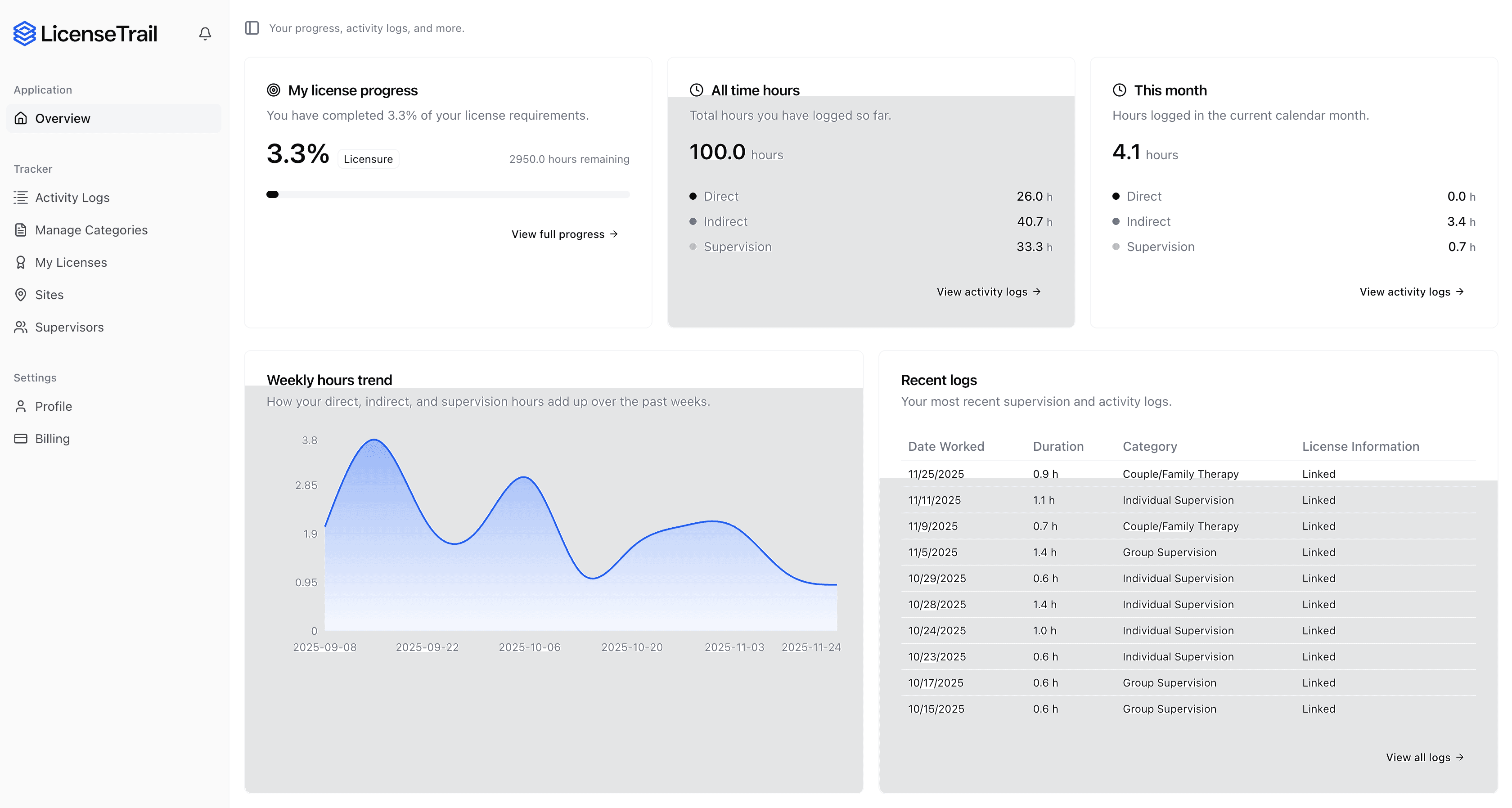
License Trail checks your direct, indirect, and supervision hours against Utah LMFT requirements continuously and flags mismatches before you submit.
 Start Tracking for Free
No credit card required · Free plan available
Is your spreadsheet hiding Utah LMFT risks?
Stop guessing if your categories match Utah Marriage and Family Therapist Licensing Board requirements. License Trail checks your direct, indirect, and supervision hours continuously and flags mismatches before you submit.
Import or log
Bring your spreadsheet or start fresh
Upload your existing tracking spreadsheet and we'll map every hour into the right Utah Marriage and Family Therapist Licensing Board categories automatically.
Verify against Utah
Catch mismatches before the board does
License Trail checks your direct, indirect, and supervision hours against Utah LMFT requirements continuously.
Export board-ready
One-click clean reports
Generate professional, board-ready reports for supervision meetings and Utah Marriage and Family Therapist Licensing Board submissions in seconds.
No credit card required · Free plan available