
Vermont LICSW Requirements: Hours, Exams & Step-by-Step Guide
Stop guessing if your categories match Vermont requirements. License Trail checks your direct, indirect, and supervision hours against LICSW requirements continuously and flags mismatches before you submit.
No credit card required · Free plan available
Quick Requirements Overview
- Regulator: VT Secretary of State, Office of Professional Regulation (OPR)
- Education: MSW or doctoral social work degree from a CSWE-accredited program
- Pre-hour status: Before accruing supervised clinical hours—LMSW must register supervised practice with OPR; non‑LMSW must be on the Roster of Nonlicensed, Noncertified Psychotherapists (unregistered hours won’t count)
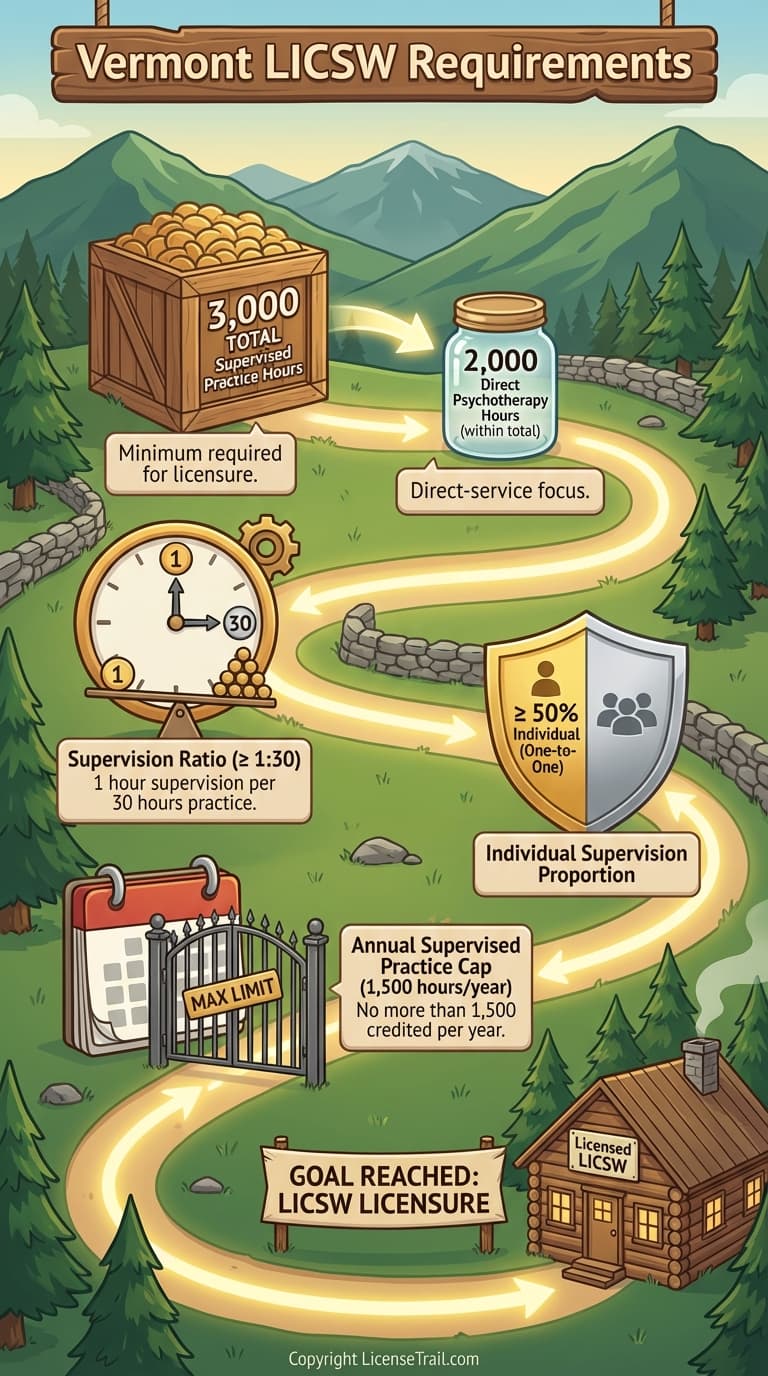
- Supervised experience: 3,000 post-degree hours over ≥2 years (max 1,500 hours/year credited; <16 hrs/week doesn’t count; ≥50% of hours within 5 years)
- Hour content: ≥2,000 hours direct psychotherapy; remaining 1,000 may be direct and/or indirect services
- Supervision requirements: 1 hr supervision per 30 hrs practice; face-to-face (incl. HIPAA-compliant video); ≥50% individual; group up to 8 supervisees
- Supervisor qualifications: LICSW, LCMHC, psychologist, or psychiatrist (MD/DO w/ psychiatry residency) or equivalent; unencumbered, currently practicing; ≥4,500 hrs over ≥3 years licensed practice
- Exams / other: ASWB Clinical + VT jurisprudence (must be within required 5-year window); application with criminal background check (as required by OPR)
License Details
Procedures
In Vermont, the Licensed Independent Clinical Social Worker (LICSW) credential authorizes independent clinical social work practice, including psychotherapy and mental health diagnosis, under the regulation of the Secretary of State’s Office of Professional Regulation (OPR), not a stand‑alone “Board of Social Work Examiners.”(regulations.justia.com)
Below is a structured, step‑by‑step guide based on Vermont statute (26 V.S.A. § 3205a) and the Administrative Rules for Licensed Clinical Social Workers.
1. Core eligibility for LICSW in Vermont
Under 26 V.S.A. § 3205a, to be eligible for licensure as an LICSW you must:(legislature.vermont.gov)
- Hold a master’s or doctoral degree in social work from an accredited social work education program.
- Have passed the examinations designated by the Director (ASWB Clinical exam plus Vermont jurisprudence exam) within five years prior to applying.
- Have completed 3,000 hours of supervised practice of independent clinical social work, under specific types of qualified supervisors, as defined by rule.(legislature.vermont.gov)
The rest of this guide unpacks precisely what those supervised hours, supervision, and steps actually look like in Vermont.
2. Step One – Earn the qualifying social work degree
- Degree required: Master of Social Work (MSW) or Doctor of Social Work (DSW/PhD in social work).
- Program accreditation: The program must be accredited by the Council on Social Work Education (CSWE), as specified in the LICSW rules.(regulations.justia.com)
You will typically not begin accruing LICSW‑qualifying supervised hours until after the master’s (or doctoral) degree is awarded.
3. Step Two – Obtain initial Vermont status (LMSW and/or roster)
Vermont has two key statuses relevant to your supervised clinical practice:
-
Licensed Master’s Social Worker (LMSW)
- The LMSW is governed by Part 2 of the LICSW rules. To become an LMSW, you must have the MSW/DSW, pass the ASWB Master’s exam, and pass the Vermont jurisprudence exam; there is no supervised practice requirement for LMSW itself.(regulations.justia.com)
-
Roster of Nonlicensed, Noncertified Psychotherapists
- By statute, anyone who is not licensed as a master’s social worker and who engages in post‑master’s supervised practice in Vermont toward LICSW must be entered on this roster.(legislature.vermont.gov)
The administrative rules make registration explicit for both groups before LICSW supervised practice begins:(regulations.justia.com)
-
If you are an LMSW:
You must register with OPR for supervised practice before doing any supervised LICSW practice or providing psychotherapy as part of that supervised practice in Vermont. -
If you are not an LMSW:
You must first be placed on the Roster of Nonlicensed, Noncertified Psychotherapists and remain on it for the entire supervised practice period.
Any supervised practice or psychotherapy provided in Vermont without being properly licensed/registered/rostered is treated as unauthorized practice and :
- May subject you and your supervisor to discipline, and
- Will not be counted toward the required LICSW supervised hours.(regulations.justia.com)
4. Step Three – Complete Vermont’s supervised practice requirements
4.1. Total hours and allowed timeframe
Vermont requires:
- 3,000 hours of supervised practice of independent clinical social work.(legislature.vermont.gov)
- Hours must be post‑MSW (or post‑doctoral social work degree).(publichealthonline.org)
- The supervised practice must be completed in no less than two years.(regulations.justia.com)
- No more than 1,500 hours per year may be credited toward the 3,000‑hour requirement, which effectively creates a minimum 2‑year accumulation period.(regulations.justia.com)
- Part‑time practice of less than 16 hours per week does not count toward supervised practice.(regulations.justia.com)
- To ensure current competence, at least half of the supervised hours must occur within five years of completing all requirements for licensure.(regulations.justia.com)
In functional terms, Vermont expects you to complete the 3,000 hours over roughly 2–5 years, at no more than 1,500 hours credited per year.
4.2. Required breakdown of the 3,000 hours
The rules are very explicit about the type of hours that must be included:(regulations.justia.com)
-
Total supervised practice:
- 3,000 hours of supervised practice of independent clinical social work.
-
Psychotherapy (direct service psychotherapy services):
- At least 2,000 hours must be “the provision of direct service psychotherapy services.”(regulations.justia.com)
-
Remaining hours (1,000 hours):
- The remaining 1,000 hours can be either direct or indirect social work services (or a mix of both).(regulations.justia.com)
Vermont’s definitions:
-
“Direct service” means time spent directly with the client, regardless of setting, or consulting with another professional about that client (including phone or emergency contacts), and overall “involves being with the client or the client’s other service providers.”(regulations.justia.com)
-
“Indirect services” include activities such as case notes, staff meetings, supervision, workshops, conferences, general consultation, teaching, case management, advocacy and policy work, and other social work that is not direct client contact.(regulations.justia.com)
Put simply in numbers:
- 2,000 hours minimum – direct psychotherapy with clients (or consultations directly about clients).
- Up to 1,000 hours – may be indirect activities (documentation, meetings, training, case management, advocacy) or additional direct service hours.
4.3. What “supervised practice” means
The rules define “supervised practice toward licensure as an L.I.C.S.W.” as:(regulations.justia.com)
- Clinical social work carried out under a qualified supervisor who:
- Is familiar with your clinical activities,
- Monitors the quality of your work,
- Contributes to your self‑knowledge and clinical skill, and
- Is responsible for your work.
Additionally:
- The supervised practice must include psychotherapy (as defined in 26 V.S.A. § 3201(4)), making those psychotherapy hours central rather than optional.(regulations.justia.com)
4.4. Supervision hours and format
Vermont specifies both a ratio and a format for supervision:(regulations.justia.com)
-
Supervision ratio:
- At least 1 hour of supervision for every 30 hours of supervised practice.
-
Supervision must be face‑to‑face.
- Face‑to‑face supervision can include HIPAA‑compliant electronic media (e.g., secure video).(regulations.justia.com)
-
Individual vs. group supervision:
- Supervision may be individual or group, but
- At least half of all supervision hours must be individual (one‑on‑one with the supervisor).
- Group supervision may include the supervisor and up to eight supervisees.(regulations.justia.com)
4.5. Who may supervise you
The statute and rules together specify the categories of permissible supervisors:
-
By statute, your 3,000 hours must be supervised by one of the following (or substantial equivalent, including out‑of‑state/Canadian equivalents):(legislature.vermont.gov)
- Licensed Independent Clinical Social Worker (LICSW)
- Licensed Clinical Mental Health Counselor
- Licensed Psychologist
- Licensed physician or osteopathic physician who has completed a psychiatry residency
- Or a person licensed/certified in another state or Canada in one of these professions or their substantial equivalent
-
By rule, for supervision that commences after the effective date of the rules, your supervisor must:(regulations.justia.com)
- Have at least 4,500 hours of licensed practice over no fewer than three years, and
- Hold an unencumbered license in one of the permitted professions for the entire supervision period, and
- Be currently engaged in licensed practice.
-
If supervision occurs in another state or Canadian province, the supervisor’s licensure must be verified directly to OPR by that jurisdiction before Vermont will review the supervision reports.(regulations.justia.com)
Certain people cannot serve as your clinical supervisor:
- Spouses, life partners, former spouses, or family members.
- Supervisors where personal relationships make a professional relationship difficult.
- Supervisors providing only administrative supervision (e.g., only a manager’s oversight without genuine clinical supervision).
- Classes, workshops, seminars, consultation, staff development, orientation, or role‑playing activities in place of current clinical practice also do not count as clinical supervision toward licensure.(regulations.justia.com)
4.6. Recording and reporting your hours
- You and your supervisor are expected to be familiar with the rules and to use the OPR supervision form.
- The supervisor ultimately submits a Report of Supervision or similar documentation to OPR to verify:
- Your total hours,
- The distribution of direct vs. indirect hours,
- The supervision hours and format, and
- Their assessment of your competence.(regulations.justia.com)
5. Step Four – Pass the required examinations
Under statute and rules, LICSW applicants must:(legislature.vermont.gov)
-
ASWB Clinical Examination
- This is the national Association of Social Work Boards (ASWB) Clinical‑level exam.
- Vermont requires it be taken within five years of completing all licensure requirements, and the statute requires that you have passed the examinations designated by the Director within five years before applying.
-
Vermont Social Work Jurisprudence Examination
- A state‑specific, open‑book exam on Vermont statutes, rules, professional conduct, and ethics for social work and psychotherapy practice.
- Must be successfully completed for both LMSW and LICSW licensure.(regulations.justia.com)
You typically apply to OPR for LICSW, OPR then authorizes you to sit for the ASWB Clinical exam once your supervised hours and other requirements have been verified.(publichealthonline.org)
6. Step Five – Criminal background check and application
Because social work licensure is regulated through OPR under 3 V.S.A. chapter 5, LICSW applicants are subject to criminal background check requirements:(legislature.vermont.gov)
- The Office may obtain:
- Vermont criminal history record,
- Out‑of‑state criminal history record,
- Federal Bureau of Investigation (FBI) record (fingerprint‑supported).
- Applicants must consent to the release of these records on forms developed by the Vermont Crime Information Center.
- The law states that criminal convictions are not an automatic bar to licensure; OPR assesses relevance and rehabilitation.
Practical process (summarized from OPR and social‑work‑specific guides):(socialworkerlicense.com)
- Create or log into your OPR online account.
- Submit the LICSW application and pay the required fees.
- Arrange required criminal background check/fingerprints as instructed by OPR.
- Have your supervisor(s) submit verification of supervised practice to OPR.
- Have ASWB send your exam score(s) directly to OPR.
- Once all items are received and approved, OPR issues your LICSW license.
7. Alternative routes: Licensure by endorsement and “five‑year rule”
If you are already licensed in another jurisdiction, Vermont offers two alternative pathways:(regulations.justia.com)
-
Licensure by endorsement (substantial equivalence):
- You hold an active independent clinical social work (or equivalent) license in another U.S. or Canadian jurisdiction whose requirements are determined to be substantially equivalent to Vermont’s.
- You must pass the Vermont jurisprudence exam.
-
Five‑year rule (experience‑based licensure when other jurisdiction isn’t equivalent):
- You hold an active, unencumbered independent clinical social work license elsewhere,
- Have practiced at least 1,200 hours per year for a minimum of five years,
- Have no disciplinary history, and
- Pass the Vermont jurisprudence exam.(regulations.justia.com)
OPR also operates a Fast Track Endorsement process for certain professionals who have been independently licensed in good standing in another state for at least three years; whether and how this applies in a given LICSW case is determined under OPR’s general endorsement policy.(sos.vermont.gov)
8. Condensed checklist of Vermont LICSW supervised practice requirements
From Vermont statute and rules, by‑examination LICSW applicants must complete:
-
Education
- MSW or DSW/PhD in social work from a CSWE‑accredited social work program.(regulations.justia.com)
-
Registration status before practice
- If LMSW: register your supervised practice with OPR before beginning.
- If not LMSW: be on the Roster of Nonlicensed, Noncertified Psychotherapists before any supervised LICSW practice or psychotherapy in Vermont.(regulations.justia.com)
-
Supervised practice hours
- 3,000 total supervised hours of independent clinical social work after the qualifying degree.
- At least 2,000 hours must be direct service psychotherapy with clients (or direct consultations about clients).
- 1,000 remaining hours may be additional direct service or indirect services (documentation, meetings, supervision, training, case management, advocacy, etc.).(regulations.justia.com)
-
Timeframe and work schedule
- Minimum 2 years to accumulate 3,000 hours (no more than 1,500 hours per year count).
- Hours below 16 hours/week of practice do not count.
- At least half of the hours must be accrued within five years of completing licensure requirements.(regulations.justia.com)
-
Supervision structure
- At least 1 hour of supervision per 30 hours of supervised practice.
- Supervision must be face‑to‑face (in person or via HIPAA‑compliant video).
- At least 50% of supervision hours must be individual; remaining may be group with up to eight supervisees.(regulations.justia.com)
-
Supervisor qualifications
- Supervisor must be one of: LICSW, Licensed Clinical Mental Health Counselor, Licensed Psychologist, psychiatrist (MD/DO with psychiatry residency), or out‑of‑state/Canadian equivalent.(legislature.vermont.gov)
- Supervisor must have at least 4,500 hours of licensed practice over three or more years, hold an unencumbered license, and be currently practicing in their profession.(regulations.justia.com)
-
Examinations
- ASWB Clinical exam, taken within the five‑year timing window set by statute/rules.
- Vermont jurisprudence exam on laws, rules, and ethics.(legislature.vermont.gov)
-
Background check and application
- Consent to criminal history checks (state, out‑of‑state, FBI) as required under 3 V.S.A. chapter 5.
- Submit online application, fees, supervision verification, and exam scores via OPR’s online services platform.(legislature.vermont.gov)
These are the current statutory and rule‑based requirements as of late 2025 for becoming a Vermont Licensed Independent Clinical Social Worker through the standard supervised‑experience pathway.
Track your LICSW hours with confidence
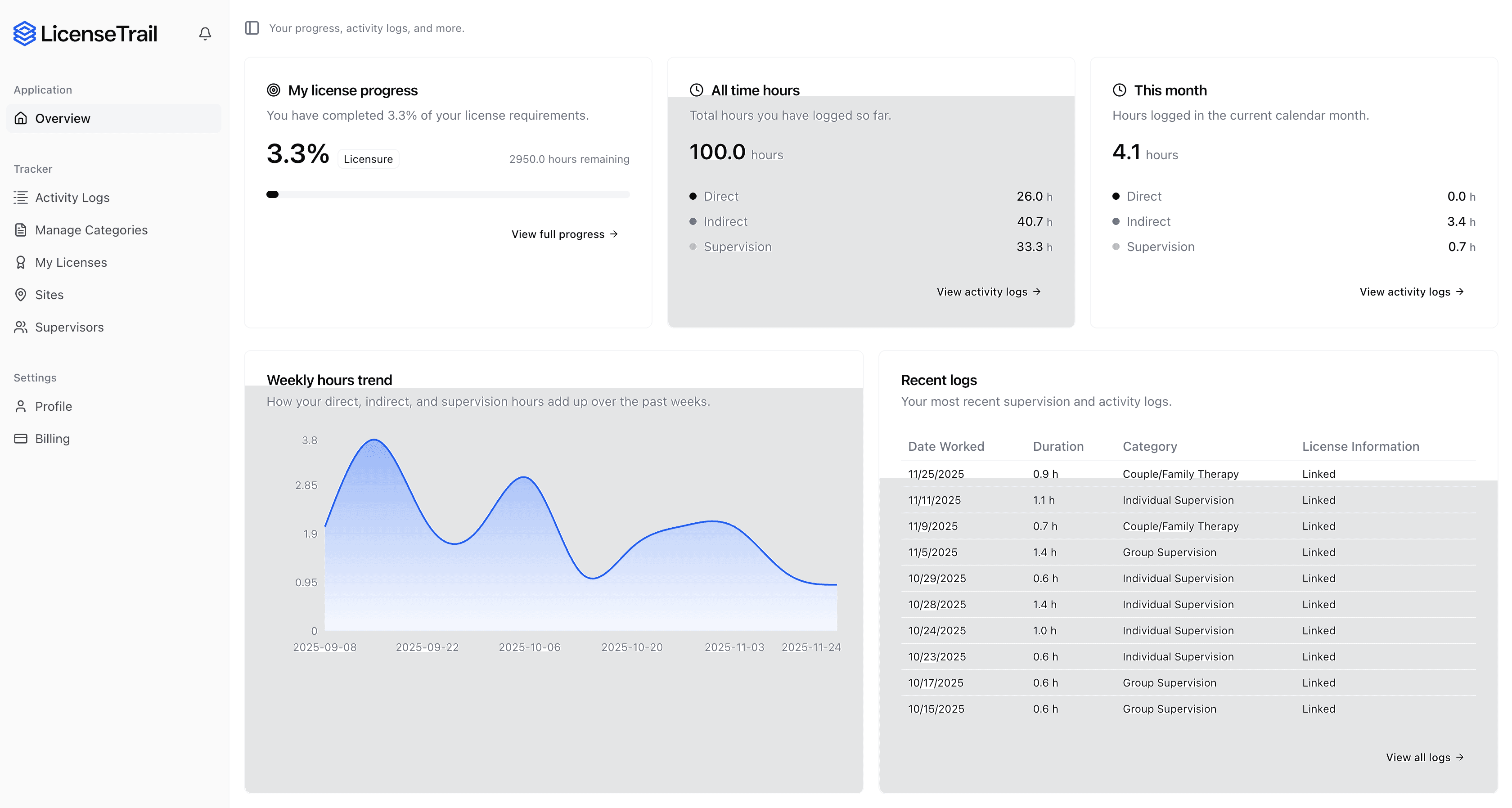
License Trail checks your direct, indirect, and supervision hours against Vermont LICSW requirements continuously and flags mismatches before you submit.
 Start Tracking for Free
No credit card required · Free plan available
Is your spreadsheet hiding Vermont LICSW risks?
Stop guessing if your categories match Vermont Board of Social Work Examiners requirements. License Trail checks your direct, indirect, and supervision hours continuously and flags mismatches before you submit.
Import or log
Bring your spreadsheet or start fresh
Upload your existing tracking spreadsheet and we'll map every hour into the right Vermont Board of Social Work Examiners categories automatically.
Verify against Vermont
Catch mismatches before the board does
License Trail checks your direct, indirect, and supervision hours against Vermont LICSW requirements continuously.
Export board-ready
One-click clean reports
Generate professional, board-ready reports for supervision meetings and Vermont Board of Social Work Examiners submissions in seconds.
No credit card required · Free plan available