
Vermont Psychologist-Master Requirements: Hours, Exams & Step-by-Step Guide
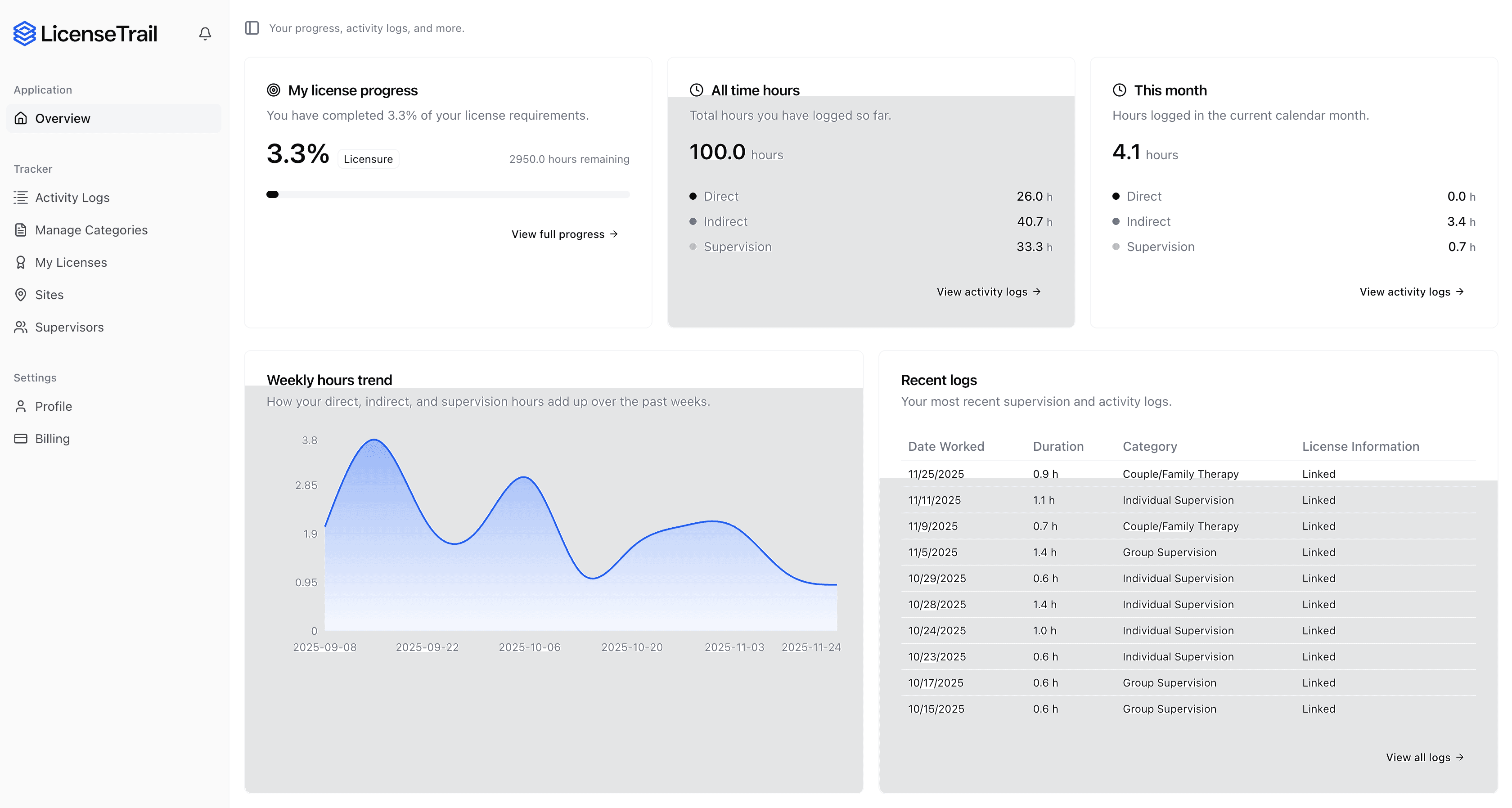
Stop guessing if your categories match Vermont requirements. License Trail checks your direct, indirect, and supervision hours against Psychologist-Master requirements continuously and flags mismatches before you submit.
No credit card required · Free plan available
Quick Requirements Overview
- Eligibility: Age 18+
- Education: Master’s in psychology from CAMPP member program or Board‑approved equivalent (incl. required grad coursework + supervised practicum/internship)
- Exams: Pass EPPP (or Board‑approved exam) + VT jurisprudence exam
- Supervised practice hours: 4,000 total supervised practice hours; ≥2,000 post‑master’s
- Hour counting limits: ≥700 hours/year to count (absent exceptions); max 40 hours/week countable; hours must be within 5 years of application
- Supervision rules: At least 1 hour supervision per 20 practice hours (i.e., 2 hours/40; ≥1 hour individual in‑person, other may be group if allowed)
- Supervisors: Supervised by licensed psychologist (unencumbered; 3+ years licensed); ≥2 supervisors total; each must supervise ≥500 practice hours
- Registration & documentation: If practicing in VT and not otherwise licensed as specified, must register on psychotherapist roster before hours; submit required supervision reports + summary of supervised experience (unregistered hours won’t count)
License Details

Procedures
Licensure as a Psychologist‑Master in Vermont is tightly defined in statute (26 V.S.A. Chapter 55) and in the Administrative Rules of the Board of Psychological Examiners. What follows aligns directly with that language and emphasizes the hour requirements and how Vermont defines “supervised practice.”
1. License type and legal framework
Vermont recognizes two psychologist licenses under the Board of Psychological Examiners:
- Psychologist‑Doctorate
- Psychologist‑Master
“Psychologist‑master” simply means a person licensed as a psychologist at the master’s level under Chapter 55. (legislature.vermont.gov)
All applicants for either level are governed by:
- 26 V.S.A. § 3011a (Applications) (legislature.vermont.gov)
- The Administrative Rules of the Board of Psychological Examiners (Code of Vermont Rules 04‑030‑270). (law.cornell.edu)
The sections below focus on the Psychologist‑Master route.
2. Core requirements for a Psychologist‑Master license
To become licensed at the master’s level by examination, an applicant must meet all of the following (Board Rule § 3.2): (law.cornell.edu)
-
Age
- Be at least 18 years of age.
-
Degree
- Hold a master’s degree in psychology that meets the Board’s requirements (described in Section 3 below).
-
Examinations
- Successfully complete:
- The Examination for Professional Practice in Psychology (EPPP) or another examination approved by the Board; and (law.cornell.edu)
- The Board’s jurisprudence (statutes and rules) examination. (law.cornell.edu)
- Successfully complete:
-
Supervised practice hours
- “Have completed 4,000 hours of supervised practice, of which no fewer than 2,000 hours were completed after the master’s degree in psychology was received.” (law.cornell.edu)
-
Application & documentation
- Submit a complete application, including supervision reports and a summary of supervised experience, in the format the Board requires. (law.cornell.edu)
The key numerical requirement for a Psychologist‑Master in Vermont is therefore:
4,000 hours of supervised practice, with at least 2,000 of those hours completed after the master’s degree.
Note that Vermont does not split these 4,000 hours into separate statutory categories such as “direct clinical hours” versus “other supervised hours” with separate numeric minimums. Instead, it treats them as a unified pool of “supervised practice”, subject to detailed supervision rules (see Section 4).
3. Educational requirements for the Psychologist‑Master
3.1. Acceptable master’s degree
The Board rules require that an applicant for master’s‑level licensure: (law.cornell.edu)
- Possess a master’s degree in psychology obtained through a professional psychology training program; and
- The program must be offered by a full member of the Council of Applied Master’s Programs in Psychology (CAMPP), or be determined “equivalent” by the Board (Rules §§ 3.3–3.5).
For “equivalent” programs, the Board requires, among other things: (law.cornell.edu)
- Regional accreditation (or Canadian/foreign equivalent),
- A planned program integrating the science and practice of psychology,
- Required coursework in:
- Assessment,
- Intervention,
- Psychopathology,
- Statistical methods/research methods,
- Professional ethics,
- A supervised practicum and internship as part of the degree.
The rules also lay out detailed minimum credit hours in those content areas (e.g., 6 credits in assessment, 6 in intervention, 6 in psychopathology, 3 in statistics/research methods, 3 in ethics) and prohibit substituting undergraduate coursework or “work experiences” for the required graduate courses. (law.cornell.edu)
4. Supervised practice: how Vermont defines and structures the 4,000 hours
4.1. What “supervised practice” means
The Board’s rules define supervised practice in Part 4: Post Graduate Degree – Supervised Practice for Applicants for Licensure by Examination.
Definition (Rule § 4.1):
“Supervised practice means post graduate degree clinical work that is supervised by a licensed psychologist who is familiar with the nature of the individual’s clinical activities and who monitors the quality of the work and contributes to the enhancement of the individual’s knowledge of self and of clinical work. Supervised practice is always in person.” (law.cornell.edu)
Key points embedded in that definition:
- The hours must be clinical work, not purely administrative or research.
- The work must be supervised by a licensed psychologist who:
- Knows the supervisee’s clinical activities;
- Monitors quality;
- Aims at developing the supervisee’s clinical competence and self‑awareness.
- Supervised practice is described as “always in person” in the rule; applicants should check current Board guidance for any updates related to telehealth supervision.
4.2. Total hours and timing
From statute and rules together: (legislature.vermont.gov)
- Total supervised practice required:
- 4,000 hours.
- Post‑master’s minimum:
- At least 2,000 hours must be completed after the master’s degree is received.
- Minimum duration:
- Supervised practice “may not be completed in less than one (1) year” (applies to both master’s and doctoral routes) (Rule § 4.12(a); see also § 3.14). (law.cornell.edu)
- Minimum annual hours for a year to “count”:
- “Absent exceptional unforeseen circumstances, a year which contains fewer than 700 hours of supervised practice will not count toward the supervised practice requirement” (Rule § 4.12(b)). (law.cornell.edu)
- Recency requirement:
- For applications received after the effective date of the rules, only supervised practice hours acquired within 5 years of completion of the application will be counted (Rule § 4.12(c)). (law.cornell.edu)
- Weekly cap:
- “No more than **40 hours of practice may count as ‘supervised practice’ in any one week period” (Rule § 4.14). (law.cornell.edu)
4.3. Supervision ratio and frequency
Vermont doesn’t specify a fixed number of supervision hours (like “100 supervision hours”), but it builds the supervision requirement into a mandatory ratio and schedule.
Relevant rules:
- Rule § 4.10 – Type and frequency of supervision: (law.cornell.edu)
- “No person engaged in supervised practice toward licensure may practice more than forty hours without receiving 2 hours of supervision.”
- “One of the two hours of the supervision must be in a formal, individual, in person setting.”
- “The second hour of supervision may occur in a group supervision setting.”
- Rule § 4.13 – Insufficient supervision: (law.cornell.edu)
- “A ratio of one hour of supervision to 20 or fewer practice hours must be maintained.”
- If a trainee receives more than one but less than two hours of supervision for 40 hours of practice, only 20 of those practice hours may be counted toward the required total.
Taken together, the Board effectively requires:
- Supervision ratio:
- At least 1 hour of clinical supervision for every 20 hours of supervised practice.
- Per 40 hours of practice:
- 2 hours supervision minimum; if you fall short, not all 40 hours will be counted.
While these rules guarantee a high density of supervision, the Board still describes the requirement in terms of “practice hours” plus a required supervision ratio, rather than separate numeric bins of “direct service” and “supervision hours.”
4.4. Supervisors and structure of supervision
- Supervisor qualifications (Rule § 4.4): (law.cornell.edu)
- Must hold a valid, unencumbered psychologist license in the state where supervision occurs;
- Must have a minimum of three years of licensed practice in good standing before supervision begins;
- Must supervise only in areas where they have sufficient education, training, and experience.
- Supervisor responsibilities (Rule § 4.5):
- The clinical supervisor assumes full professional and legal responsibility for the supervisee’s work and must maintain supervision consistent with professional standards. (law.cornell.edu)
- Nature of supervision (Rule § 4.6):
- Both administrative and clinical supervision may be provided, but only clinical supervision counts toward the supervised practice requirement. (law.cornell.edu)
- Multiple supervisors (Rule § 4.9):
- The applicant must have at least two supervisors over the course of supervised practice.
- Each supervisor must oversee no fewer than 500 hours of clinical practice for that supervision to be accepted. (law.cornell.edu)
- Part‑time practice (Rule § 4.11):
- If the applicant averages less than 20 hours/week of clinical practice, all required supervision must be individual; group supervision cannot be counted for the ratio. (law.cornell.edu)
4.5. Registration while accruing supervised hours
Vermont requires individuals accruing post‑degree supervised hours in Vermont to be properly registered:
- Mandatory registration (Rule § 4.2): (law.cornell.edu)
- Anyone engaging in post‑degree supervised practice toward psychologist licensure, who is not already licensed as a clinical mental health counselor, marriage and family therapist, licensed independent clinical social worker, or licensed master social worker, must:
- Be registered on the roster of psychotherapists who are nonlicensed and noncertified, and
- Pay the applicable registration fee.
- No supervised practice may occur in Vermont until the supervisee is registered.
- Anyone engaging in post‑degree supervised practice toward psychologist licensure, who is not already licensed as a clinical mental health counselor, marriage and family therapist, licensed independent clinical social worker, or licensed master social worker, must:
- Penalties & counting of hours (Rule § 4.3):
- Unregistered supervised practice is “unauthorized practice” and may subject both supervisee and supervisor to discipline.
- Unregistered supervised practice will not be counted toward the 4,000‑hour requirement. (law.cornell.edu)
Supervisees must identify themselves to clients as “psychological trainees” or “psychological interns” and may not hold themselves out as psychologists prior to licensure (Rule § 4.8). (law.cornell.edu)
5. Documentation of supervised practice
To receive credit for the 4,000 hours, both supervisor and applicant must maintain and submit specific documentation:
- Supervisor records (Rule § 4.16): (law.cornell.edu)
- Supervisor must maintain a record of:
- Dates and numbers of individual supervision hours;
- Dates and numbers of group supervision hours;
- Records must be retained for four years and made available to the Board upon request.
- Supervisor must maintain a record of:
- Supervisor reports (Rule § 4.17):
Each clinical supervisor must submit a Supervision Report (Board template), including:- Practice dates, total practice hours, supervisee’s duties,
- Description and assessment of clinical skills, ethical practice, and relevant professional readings,
- Supervisor’s license information and their opinion of the applicant’s readiness for independent practice. (law.cornell.edu)
- Applicant’s summary (Rule § 4.18):
- The applicant must submit a “Summary of Supervised Experience” documenting:
- Practice settings and how practice was supervised,
- Total number of supervised practice hours,
- Names of all supervisors,
- Number of individual and group supervision hours. (law.cornell.edu)
- The applicant must submit a “Summary of Supervised Experience” documenting:
6. Examination requirements in more detail
For a Psychologist‑Master applicant:
- Professional exam (Rule §§ 3.10–3.13): (law.cornell.edu)
- Must pass the EPPP (or another exam approved by the Board and announced in advance).
- Exam must have been passed within 5 years of application for those not previously licensed.
- Board is notified of the score by the exam provider and tells the applicant if they passed.
- Jurisprudence exam (Rules §§ 1.6, 2.21, 3.2(e)): (law.cornell.edu)
- All applicants must also pass the Board’s jurisprudence examination on Vermont statutes and rules.
7. Application process overview
The Board rules lay out a structured process in Part 5 – Application Process: (law.cornell.edu)
- Obtain and file an application through the Vermont Office of Professional Regulation (OPR).
- Submit transcripts and educational documentation so the Board can determine whether degree requirements are met.
- Register on the psychotherapist roster (if accruing Vermont supervised practice and not otherwise licensed as a qualifying mental health professional).
- Accrue supervised practice in compliance with:
- 4,000 total hours (2,000+ post‑master);
- At least 700 hours per qualifying year;
- Max 40 hours/week counted;
- Supervision ratio of at least 1:20;
- Minimum two supervisors, each covering 500+ hours.
- Have supervisors submit supervision reports and submit your own Summary of Supervised Experience.
- Obtain Board approval to sit for the EPPP, pass the exam, and pass the jurisprudence exam.
- Complete any remaining Board requirements and pay relevant fees for issuance of the Psychologist‑Master license.
8. How Vermont’s hour structure compares to “direct vs. supervised” models
Some states spell out requirements such as “X hours direct client contact” plus “Y hours of supervision.” Vermont takes a different approach:
- Uses a single global requirement of 4,000 hours of “supervised practice”, not split numerically into direct/indirect categories. (law.cornell.edu)
- Defines supervised practice as clinical work under a licensed psychologist, and then:
- Caps countable practice at 40 hours per week,
- Demands a minimum supervision ratio (1 hour supervision per 20 hours practice),
- Requires at least two supervisors with defined qualifications,
- Imposes recency and minimum‑year thresholds.
The rules therefore prioritize:
- The total volume of clinical work (4,000 hours),
- The quality and intensity of clinical supervision,
- And the recency and structure of that experience,
rather than separate numeric targets for “direct” vs. “indirect” hours.
Bottom line:
To be licensed as a Psychologist‑Master in Vermont, you must complete a qualifying master’s degree in psychology, pass the EPPP and jurisprudence exam, and document 4,000 hours of supervised practice (with at least 2,000 hours after the master’s degree), all under Board‑compliant supervision (ratio of at least 1:20, at least two qualified supervisors, 700+ hours per qualifying year, no more than 40 hours/week counted, and all required registration and documentation). (law.cornell.edu)
Track your Psychologist-Master hours with confidence
License Trail checks your direct, indirect, and supervision hours against Vermont Psychologist-Master requirements continuously and flags mismatches before you submit.
 Start Tracking for Free
No credit card required · Free plan available
Related Licenses
Is your spreadsheet hiding Vermont Psychologist-Master risks?
Stop guessing if your categories match Vermont Board of Psychological Examiners requirements. License Trail checks your direct, indirect, and supervision hours continuously and flags mismatches before you submit.
Import or log
Bring your spreadsheet or start fresh
Upload your existing tracking spreadsheet and we'll map every hour into the right Vermont Board of Psychological Examiners categories automatically.
Verify against Vermont
Catch mismatches before the board does
License Trail checks your direct, indirect, and supervision hours against Vermont Psychologist-Master requirements continuously.
Export board-ready
One-click clean reports
Generate professional, board-ready reports for supervision meetings and Vermont Board of Psychological Examiners submissions in seconds.
No credit card required · Free plan available