
Wyoming PSY Requirements: Hours, Exams & Step-by-Step Guide
Stop guessing if your categories match Wyoming requirements. License Trail checks your direct, indirect, and supervision hours against PSY requirements continuously and flags mismatches before you submit.
No credit card required · Free plan available
Quick Requirements Overview
- Doctoral degree from a regionally accredited university: APA-CoA program or non-APA program meeting WY curriculum + residency standards (2 academic years full-time residency or 1,500 face-to-face student–faculty contact hours)
- Required doctoral curriculum must cover core areas (e.g., research/statistics/psychometrics; bio/cognitive/social bases; ethics/diversity; psychopathology; assessment/diagnosis; intervention; consultation/supervision)
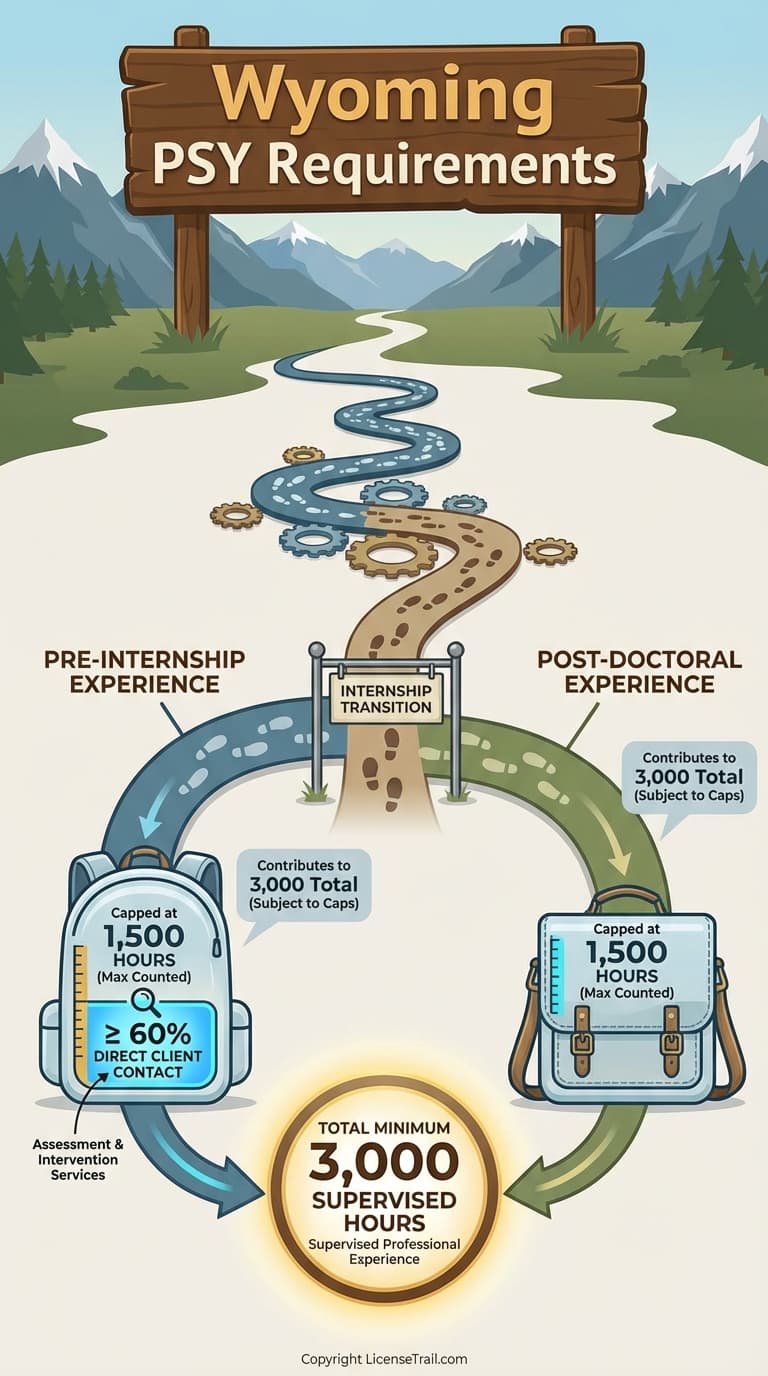
- Supervised Professional Experience: 3,000 hours minimum over ≥2 years (1 year = 1,500 hours)
- Must include a pre-doctoral internship that is APA-CoA accredited, APPIC member, or Board-accepted equivalent (commonly treated as ~1,500 hours within the 3,000)
- Pre-internship/practicum may count up to 1,500 hours; ≥60% must be direct assessment/intervention; per 20 hours requires 2 hrs individual F2F supervision + 2 hrs structured learning; ≥75% supervision by a licensed psychologist
- Post-doc (if needed) may count up to 1,500 hours; supervision typically 2 hrs per 40 hrs (incl. 1 hr individual F2F with a psychologist); WY requires a Board Supervision Agreement for in-state post-doc and recordkeeping
- Exams: EPPP pass at ≥70% or scaled 500 (must pass within 2 years of permission; possible waiver if recently passed elsewhere) plus WY jurisprudence exam
- Application/documentation: Board forms verifying doctoral program + each supervised experience segment; fingerprints/background check; EPPP score transfer as required
License Details
Procedures
Licensure as a doctoral‑level psychologist (“PSY” license) in Wyoming is governed by the Wyoming Board of Psychology through its Psychology Practice Act and “Chapter 5 – Licensure Requirements” in the Board’s rules. The requirements below are drawn directly from those rules (current through mid‑2025) and related state materials.
1. Type of license and governing rules
The Board issues a license as a psychologist once an applicant:
- Has a doctoral degree meeting the Board’s educational standards, and
- Has met the “education, supervised or professional experience, and examination requirements” laid out in Chapter 5 of the rules. (studylib.net)
Alternative routes based on CPQ, National Register, or ABPP are also recognized for some applicants by endorsement, but the core pathway is doctoral education plus supervised experience plus exams. (studylib.net)
2. Educational requirements (doctoral degree)
2.1 Level of degree
All applicants “must possess a doctoral degree from a regionally accredited university.” (studylib.net)
That requirement can be met in either of two ways:
- A doctoral program in psychology accredited by the APA Commission on Accreditation (CoA), or
- A non‑APA program that meets the Board’s detailed criteria for curriculum, residency, and supervised professional training. (studylib.net)
2.2 Required curriculum
The doctoral program must include core graduate coursework (generally ≥3 semester hours in each) in at least these areas, among others: (studylib.net)
- History and systems of psychology
- Research design and methodology
- Statistics and psychometrics
- Biological bases of behavior
- Cognitive‑affective bases of behavior
- Social bases of behavior
- Individual differences (e.g., personality, development)
- Professional standards and ethics
- Cultural and individual diversity
- Psychopathology or dysfunctional behaviors
- Theories and methods of assessment and diagnosis
- Psychological intervention and evaluation of efficacy
- Consultation and supervision
2.3 Residency (in‑person training)
The doctoral degree program must include substantial in‑person engagement:
- At least two continuous academic years of full‑time residency at the degree‑granting institution, or
- A minimum of 1,500 hours of student‑faculty contact in face‑to‑face individual or group educational meetings, with specific conditions (e.g., mostly conducted by psychology faculty, with documented faculty‑student and student‑student interaction). (studylib.net)
3. Supervised Professional Experience (“Experience Requirement”)
3.1 Overall hour requirement and time frame
The Wyoming rules set a single experience requirement:
- The applicant must complete 3,000 hours of supervised professional experience related to the practice of psychology.
- This must be done “in no less than two (2) years,” and the Board defines 1,500 hours of supervised professional experience as equal to one year. (studylib.net)
In practice:
- Total supervised hours required: 3,000
- Minimum duration: 2 years of supervised professional experience
- Supervision may be distributed across pre‑internship practicum, the pre‑doctoral internship, and post‑doctoral experience, as long as all Board conditions are met. (studylib.net)
Crucially, the 3,000 hours must include a pre‑doctoral internship that, at the time you were in it, was either:
- Accredited by the APA Commission on Accreditation, or
- A member of the Association of Psychology Postdoctoral and Internship Centers (APPIC), or
- A documented equivalent accepted by the Board. (studylib.net)
Multiple national summaries interpret the rules as functionally requiring:
- 1,500 hours (one year) in a qualifying pre‑doctoral internship, and
- 1,500 hours that may be met by pre‑internship practicum and/or post‑doctoral supervised experience, for a total of 3,000 hours. (psychologist-license.com)
3.2 Pre‑internship (doctoral practicum, clerkship, etc.)
The rules allow up to 1,500 hours (one year) of the 3,000 to come from structured pre‑internship training—practicum, clerkship, or other training activities required in the doctoral program. (studylib.net)
Key Board language and requirements for pre‑internship:
- Pre‑internship training is described as an “organized, sequential series of supervised professional experiences of increasing complexity, serving to prepare the student for internship.” (studylib.net)
- It must follow appropriate academic preparation, be overseen by the graduate training program, and be an extension of coursework (not services outside the scope of the student’s education). (studylib.net)
The Board specifies how those hours must be structured:
-
Agreement and documentation before starting
Before beginning pre‑internship, the student, the doctoral program, and the pre‑internship site must agree in writing on:- Goals for the experience,
- The student’s expectations,
- The nature of the experience, and
- How the experience will be evaluated. (studylib.net)
-
Direct client contact requirement
- At least 60% of pre‑internship hours must be “direct client contact providing assessment and intervention services.” (studylib.net)
-
Supervision and training ratio for pre‑internship
For every 20 hours of pre‑internship experience, the rules require: (studylib.net)- At least 2 hours of formal, face‑to‑face individual supervision focused on the direct psychological services the student provided; and
- At least 2 hours of other structured learning activities, such as case conferences, seminars on applied issues, co‑therapy with discussion, or group supervision.
So, in effect, each 20 hours of pre‑internship includes a minimum of 4 hours of supervision/structured training.
-
Who can supervise pre‑internship hours?
- The experience must be supervised by the person(s) responsible for the assigned casework.
- At least 75% of the supervision must be provided by a licensed psychologist.
- Up to 25% may be provided by:
- A psychiatrist with ≥3 years’ experience beyond residency,
- A licensed mental health counselor with ≥3 years’ post‑license experience,
- A licensed marriage and family therapist with ≥5 years’ post‑license experience, or
- A licensed clinical social worker with ≥3 years’ post‑license experience. (studylib.net)
3.3 Pre‑doctoral internship
The rules require that your 3,000 hours “shall include a pre‑doctoral internship program” meeting one of the accreditation or membership criteria above (APA CoA, APPIC, or documented equivalent). (studylib.net)
The regulations do not spell out a fixed number of internship hours, but:
- A “year” of supervised professional experience is explicitly defined as 1,500 hours, and
- State and national guidance uniformly interpret Wyoming’s rules as requiring one full‑time year (about 1,500 hours) of qualifying pre‑doctoral internship as part of the 3,000‑hour total. (allpsychologyschools.com)
3.4 Post‑doctoral supervised professional experience
If by the time you finish the doctoral degree you have not yet accumulated the full two years (3,000 hours) of supervised professional experience, you may complete up to 1,500 hours of post‑doctoral supervised experience to satisfy the total requirement. (studylib.net)
Post‑doctoral experience can be obtained in either of two ways:
-
Formal post‑doctoral training program
- A post‑doctoral training program that was, at the time you participated, APA CoA‑accredited or a member of APPIC. (studylib.net)
-
Board‑standard post‑doctoral supervised work experience
If not in an APA/APPIC post‑doc, the supervised post‑doctoral work must meet detailed criteria, including: (studylib.net)
- Supervision ratio:
- “Two hours of supervision for every forty (40) hours of supervised professional experience,”
- One of those two hours must be individual face‑to‑face supervision with a psychologist;
- The other supervision may be provided by a psychologist or licensed allied mental health professional.
- Supervisor qualifications: At least 2 years of practice, and sufficient training and competence to oversee the services you provide.
- Scope of practice: The supervisor may allow you to perform only those functions “for which the supervisee has training and experience.”
- Supervision agreement in Wyoming:
- When post‑doc work is done in Wyoming, the supervisor must submit a Supervision Agreement form to the Board with details of the arrangement (names, addresses, phone numbers, nature of supervision).
- Any changes must be reported to the Board within 10 days.
- Record‑keeping: The supervisor must maintain records documenting both the nature and number of hours of supervision and the nature and number of hours of acceptable post‑doctoral supervised professional experience.
- Supervision ratio:
There are also title and disclosure requirements during post‑doctoral supervised practice:
- You may use the title “Psychological Resident” only in connection with supervised training that counts toward licensure requirements.
- You may not use the term “Psychologist” or be advertised as such while in resident status.
- Clients must be informed in writing of the supervised nature of your work and given your supervisor’s name, address, and telephone number, and the supervisor must co‑sign professional reports and correspondence (except for certain provisional license holders). (studylib.net)
For post‑doctoral experience completed outside Wyoming, you must demonstrate that the experience was “substantially equivalent” to Wyoming’s post‑doctoral requirements. (studylib.net)
3.5 How the hours break down in practical terms
Putting it together, the Board’s rules contemplate the following typical pattern:
-
Year 1 (≈1,500 hours)
- Structured pre‑doctoral internship (APA‑ or APPIC‑qualifying, or equivalent), counted toward the 3,000‑hour total.
-
Year 2 (≈1,500 hours)
- A combination of:
- Pre‑internship practicum hours (if not already fully used), and/or
- Post‑doctoral supervised experience meeting the 2‑hours‑per‑40‑hours supervision standard.
- A combination of:
From a planning standpoint, the State (and multiple official summaries) often describe this as:
- “Two full‑time years” of supervised experience totaling 3,000 hours, with one year (1,500 hours) in a pre‑doctoral internship, and the other 1,500 hours either pre‑ or post‑doctoral. (ecpcta.org)
Note that Wyoming does not divide the requirement into “direct” vs. “indirect” hours in a 1,500/1,500 split. Instead, it:
- Sets 3,000 supervised hours total,
- Requires at least 60% of pre‑internship hours to be direct client assessment and intervention, and
- Governs the amount and type of supervision (per 20 or 40 hours, depending on pre‑ vs post‑doc).
4. Examination requirements
4.1 National exam – EPPP
The Board accepts the Examination for Professional Practice in Psychology (EPPP) as its primary licensure exam. (studylib.net)
Key points from Chapter 5:
- Every applicant must achieve at least 70% correct or a scaled score of 500 to pass. (studylib.net)
- You must pass the EPPP within two years of the Board’s initial notice granting permission to take it; otherwise you must wait two more years and reapply. (studylib.net)
- If you previously took the EPPP within five years before your Wyoming application and obtained a passing score by Wyoming’s standard, the Board may waive retaking the exam. (studylib.net)
4.2 Wyoming jurisprudence exam
While the jurisprudence exam details are not in the Chapter 5 excerpt above, multiple current licensure guides that cite the Wyoming Board indicate that psychologist applicants must also pass a Wyoming jurisprudence examination covering the Psychology Practice Act and Board rules. (research.com)
The format, scoring, and administration of this jurisprudence exam are specified in the Board’s current application materials and rules as updated October 2, 2025; applicants are expected to follow those materials closely.
5. Provisional license option (for post‑doc completion in rural settings)
Wyoming rules also provide a provisional psychologist license primarily for rural community mental health centers when a full psychologist is not otherwise available. Under this pathway: (studylib.net)
- The applicant must have completed the doctoral degree and internship and meet all licensure requirements except the full supervised‑experience and EPPP requirements.
- The provisional licensee must complete the required supervised professional experience within two years, receiving 52 hours of supervision per year, and may have up to 20% of supervision hours by telephone.
- The provisional license expires after one year and may be renewed only once (maximum two years total).
6. Application process and supporting documentation
The Board’s forms site lists the required documents for a standard psychologist application, including: (sites.google.com)
- Application for Licensure (current form for psychologists)
- Verification of Doctoral Program form completed by the program
- Supervised Pre‑Internship Experience Verification
- Supervised Pre‑Doctoral Internship Verification
- Supervised Post‑Doctoral Work Experience Verification
- Fingerprint card instructions (for state and national criminal history background checks)
- Request for transfer of EPPP score from ASPPB
In practice, to become licensed as a PSY psychologist in Wyoming, you must be able to document:
- A qualifying doctoral degree meeting the Board’s curriculum and residency requirements.
- 3,000 hours of supervised professional experience related to the practice of psychology, spread over at least two years, including:
- A qualifying pre‑doctoral internship (≈1,500 hours), and
- Additional qualifying pre‑internship and/or post‑doctoral supervised experience (up to 1,500 hours),
all meeting the detailed direct‑service, supervision, and supervisor‑qualification standards above.
- Passing scores on the EPPP (≥70% / 500 scaled) and the Wyoming jurisprudence exam.
- Completion of all Board forms, fee payments, and fingerprint‑based background checks, with all verifications sent directly to the Board.
Those elements, taken together, constitute the Board‑defined pathway to a PSY psychologist license in Wyoming.
Track your PSY hours with confidence
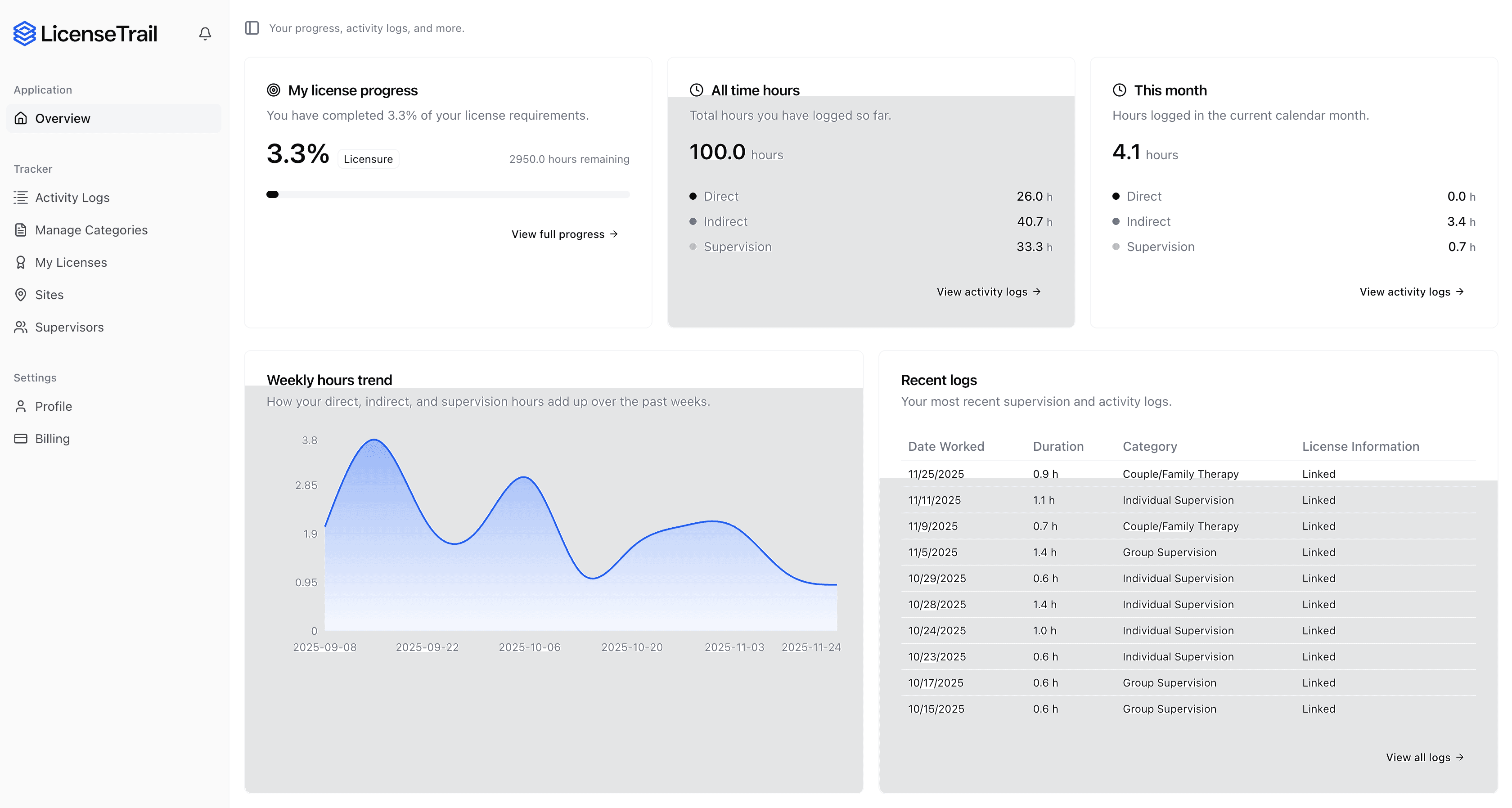
License Trail checks your direct, indirect, and supervision hours against Wyoming PSY requirements continuously and flags mismatches before you submit.
 Start Tracking for Free
No credit card required · Free plan available
Is your spreadsheet hiding Wyoming PSY risks?
Stop guessing if your categories match Wyoming State Board of Psychology requirements. License Trail checks your direct, indirect, and supervision hours continuously and flags mismatches before you submit.
Import or log
Bring your spreadsheet or start fresh
Upload your existing tracking spreadsheet and we'll map every hour into the right Wyoming State Board of Psychology categories automatically.
Verify against Wyoming
Catch mismatches before the board does
License Trail checks your direct, indirect, and supervision hours against Wyoming PSY requirements continuously.
Export board-ready
One-click clean reports
Generate professional, board-ready reports for supervision meetings and Wyoming State Board of Psychology submissions in seconds.
No credit card required · Free plan available