
Alabama ALC Requirements: Hours, Exams & Step-by-Step Guide
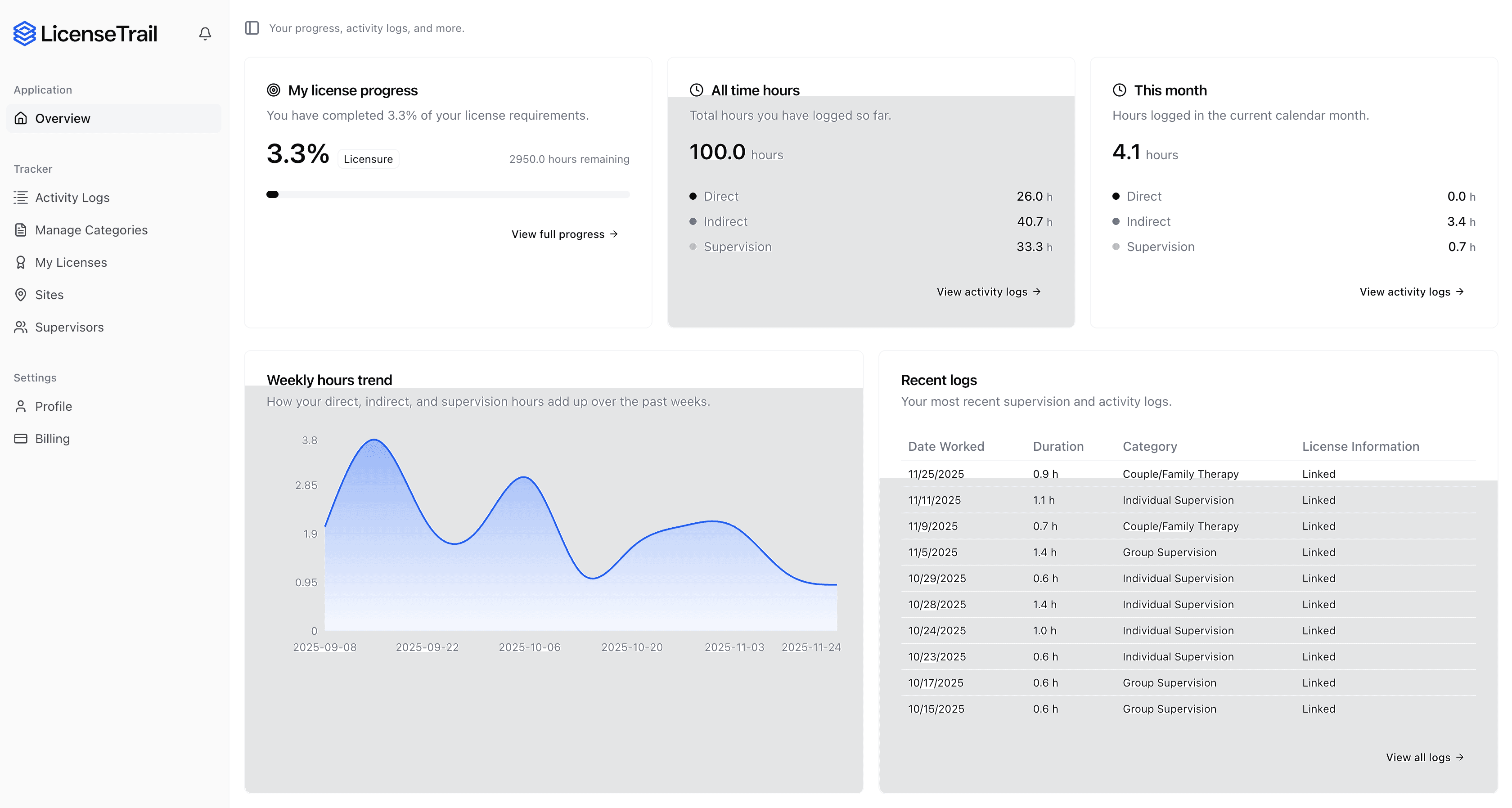
Stop guessing if your categories match Alabama requirements. License Trail checks your direct, indirect, and supervision hours against ALC requirements continuously and flags mismatches before you submit.
No credit card required · Free plan available
Quick Requirements Overview
- Education: Master’s in counseling (CACREP/CORE or equivalent) with 60 semester hours (90 quarter) covering required core content areas
- Graduate practicum: 100 hrs total; 40 direct client hrs (≥80% counseling sessions); weekly 1 hr individual + 1.5 hrs group faculty supervision
- Graduate internship: 600 hrs total; 240 direct client hrs (≥80% counseling sessions); weekly 1 hr individual + 1.5 hrs group faculty supervision
- ALC status: 1-year license; cannot practice without board-approved supervision and approved Proposed Plan of Supervision (PPoS); no experience hours count until ALC issued
- Supervision rules (annual): 100 supervision hrs/year by the LPC-S named on the license; ≥50 direct supervision hrs; ≥25 must be 1:1, in-person, real-time; “other” (group/virtual) generally ≤50 hrs (virtual limits depend on LPC-S training)
- Client location: Services (in-person/telehealth) must be to clients located in Alabama at time of service
- Post-master experience toward LPC: 3,000 hrs total after licensure: 2,250 direct counseling + 750 indirect; only hours supervised by the named LPC-S count; records retained up to 3 years after supervision ends
- Fees & CE: Apply via ABEC with fees ($200 application + $150 license); renew ALC with 10 CE hrs per period including 2 ethics (also used when upgrading to LPC)
License Details
Procedures
Becoming an Associate Licensed Counselor (ALC) in Alabama is the mandatory first step toward full Licensed Professional Counselor (LPC) status. The Alabama Board of Examiners in Counseling (ABEC) defines very specific education, supervision, and experience requirements, including the exact types of hours that must be completed.
Below is a step‑by‑step outline, with the state board’s terminology highlighted.
1. Understand what the ALC license is
Under Alabama law, an Associate Licensed Counselor:
- Must meet the base qualifications in Alabama Code § 34‑8A‑7(1)–(4) (age, character, degree, etc.). (law.cornell.edu)
- Is issued a one‑year license that “will be issued for a period of one year and will expire twelve (12) months from the date of issue.” (regulations.justia.com)
- “May not practice without direct supervision by a licensed professional counselor. The plan for supervision of the associate licensed counselor is to be approved by the board prior to any actual performance of counseling.” (law.justia.com)
Your actual post‑master experience hours toward LPC do not start until the ALC license is granted.
“No accrual of required supervised experience shall occur until the Associate Licensed Counselor license has been issued.” (law.cornell.edu)
2. Meet the educational requirements (including practicum & internship hours)
2.1 Degree and coursework
ABEC requires that ALC applicants meet the same educational standard as LPC applicants:
-
Degree level and program
Effective January 1, 2024, an applicant must have a master’s degree in counseling that:- Is from a CACREP or CORE–accredited program, or a regionally accredited program with CACREP/CORE‑equivalent content, and
- Includes at least 60 graduate semester hours (or 90 quarter hours). (law.cornell.edu)
-
Coursework must cover at least nine core areas (Counseling Theory, Human Growth and Development, Social and Multicultural Foundations, Helping Relationships, Group Dynamics, Lifestyle and Career Development, Appraisal of Individuals, Research and Evaluation, Professional Orientation). (law.cornell.edu)
ALC rule 255‑X‑3‑.02(2) explicitly incorporates these LPC educational requirements. (law.cornell.edu)
2.2 Required practicum clock hours
Your graduate practicum must meet all of the following: (law.cornell.edu)
- Total hours:
- “A total of one hundred (100) clock hours.”
- Direct client contact:
- “A minimum of forty (40) clock hours must be direct service work with clients.”
- At least 80% of these direct service hours must be in counseling sessions (not testing).
- Supervision in practicum:
- At least 1 clock hour per week of individual supervision by program faculty.
- At least 1.5 clock hours per week of group supervision.
2.3 Required internship clock hours
Your graduate internship must meet: (law.cornell.edu)
- Total hours:
- “A minimum of six hundred (600) clock hours.”
- Direct client contact:
- At least 240 hours of direct service work with clients.
- At least 80% of these direct hours must be in counseling sessions (again, testing/assessment may not exceed 20%).
- Supervision in internship:
- A minimum of 1 hour per week of individual supervision by program faculty.
- A minimum of 1.5 hours per week of group supervision.
These practicum and internship hours are educational hours, not the post‑master 3,000 supervised experience hours toward LPC. But you must complete them to qualify for ALC.
3. Satisfy basic statutory qualifications (Alabama Code § 34‑8A‑7)
To be issued an ALC license, you must meet § 34‑8A‑7(1)–(4), including: (law.justia.com)
- Be of good moral character.
- Not be in violation of the counseling chapter or its rules.
- Hold a qualifying master’s degree in counseling from a regionally accredited institution, primarily professional counseling in content.
- Be a U.S. citizen or legally present non‑citizen with appropriate federal documentation (this is § 34‑8A‑7(7), but is applied for licensure generally). (law.justia.com)
ABEC’s licensure rule then states:
“The Board shall issue a license to practice as an associate licensed counselor to all persons who meet the qualifications set out in Code of Ala. 1975, § 34‑8A‑7(1), (2), (3), and (4).” (regulations.justia.com)
4. Arrange supervision and complete the Proposed Plan of Supervision (PPoS)
4.1 Choose a Supervising Counselor (LPC‑S)
You must be supervised by a Supervising Counselor who is an ABEC‑approved LPC‑Supervisor. The ALC rule requires: (law.cornell.edu)
- The ALC must furnish a Proposed Plan of Supervision (PPoS) on a board‑approved form,
- The PPoS must be signed by the Supervising Counselor, and
- The hours of supervision listed in the plan are to be provided by that Supervising Counselor.
All supervision of an ALC must be provided by the Supervising Counselor identified on the ALC’s license, and concurrent supervision by more than one supervisor for the same clients (for other agencies/credentials) is prohibited. (regulations.justia.com)
4.2 Annual supervision hour requirements (type and format)
ABEC is very specific about the supervision hours a Supervising Counselor must provide to an ALC:
- The Supervising Counselor “must personally provide to the ALC a minimum annual average of one hundred (100) hours.” (law.cornell.edu)
Those 100 hours per year are divided into:
- Direct supervision hours (face‑to‑face, one‑to‑one, in person)
- Other supervision hours (group/virtual/other formats)
Direct supervision (minimum and format)
The ALC rule and ABEC FAQ together define “direct supervision” as:
- Individual, in‑person, one‑to‑one, face‑to‑face supervision, with the supervisor physically present, and
- Devoted to oversight of care provided by the ALC to clients. (abec.alabama.gov)
Requirements each year:
- At least 50 of the 100 total hours must be direct supervision.
- Of those 50 direct hours:
- At least 25 hours must be conducted individually, in‑person, one‑to‑one, real‑time, primarily focusing on client care. (law.cornell.edu)
If the supervisor has NOT completed the required 2‑hour training in virtual supervision:
- Then all 50 direct supervision hours must be in person (no virtual substitution). (law.cornell.edu)
If the supervisor has completed that 2‑hour virtual supervision training:
- At least 25 hours must still be in‑person, one‑to‑one.
- The remaining 25 direct and up to 50 “other” hours may be delivered virtually, within board rules. (law.cornell.edu)
“Other supervision” (maximum and definition)
ABEC defines “Other Supervision” as any supervision that is not direct, including: (abec.alabama.gov)
- Group supervision, and
- Supervision delivered via virtual/digital formats (real‑time, synchronous).
Key limits:
- Maximum 50 of the 100 hours annually may be in the “other supervision” category, unless the virtual supervision ratio is expanded under the training rule. (law.cornell.edu)
- Even in “other” formats, the Supervising Counselor must be present in real time with the ALC.
Weekly supervision expectation when less than a full year
The FAQ clarifies the weekly rate:
- “Supervision provided for a period of time less than a full year must be a minimum weekly average of two (2) hours which must include at least fifty percent (50%) of one‑to‑one, face‑to‑face personal individual supervision.” (abec.alabama.gov)
Two hours per week over approximately 50 weeks corresponds to around 100 total supervision hours per year.
Location of clients during ALC service
The board also specifies:
- ALCs must provide in‑person and virtual counseling service hours to clients located within the State of Alabama at the time of service. (law.cornell.edu)
5. Apply for the ALC license
Once you meet the educational and base statutory requirements and have a Supervising Counselor and PPoS:
- Complete the ALC Initial License Application through ABEC. (abec.alabama.gov)
- Submit the Proposed Plan of Supervision signed by your LPC‑S. (law.cornell.edu)
- Pay required fees, which the board currently lists as:
- Application fee: $200
- Associate Licensed Counselor license fee: $150 (abec.alabama.gov)
- Provide references/endorsements as required by the board’s application forms, satisfying the “Character and Professional Integrity” requirement. (law.cornell.edu)
Once approved, ABEC issues your ALC license, valid for 12 months.
6. Begin accruing post‑master supervised experience hours toward LPC
After your ALC license is issued, you may begin accumulating the supervised experience required to become an LPC.
6.1 Total supervised experience hours required
ABEC’s LPC rule states:
“Applicants must have three thousand (3000) hours of supervised experience in professional counseling with Board approved supervision.” (law.cornell.edu)
These 3,000 hours must be accrued after your master’s degree and under your approved LPC‑S as an ALC (or equivalent status recognized by ABEC).
6.2 Direct vs indirect counseling service hours (exact breakdown)
Within those 3,000 hours, the board requires this specific distribution of your clinical work:
-
Direct counseling service hours – 2,250 hours
The rule specifies:
“Two thousand, two hundred and fifty (2,250) hours will be direct counseling service with individuals, couples, families, or groups.” (law.cornell.edu)
“Direct counseling service” means actual face‑to‑face clinical work (which may be in‑person or telehealth when allowed) where you are providing counseling to clients—individuals, couples, families, or groups.
-
Indirect counseling service hours – 750 hours
The rule continues:
“Seven hundred and fifty (750) hours will be indirect counseling services to include, but not limited to, documentation, consultation, referral development, etc.” (law.cornell.edu)
“Indirect counseling services” are activities in support of counseling (charting, treatment planning, consultations, case conferences, developing referral resources, etc.), not direct client sessions.
In other words:
- 3,000 total supervised experience hours
- 2,250 hours = direct counseling service
- 750 hours = indirect counseling services
6.3 How extra graduate coursework can reduce the 3,000 hours
Alabama law and ABEC rules allow advanced graduate coursework to partially substitute for supervised experience hours:
- An applicant “may subtract one thousand hours of the required professional experience for every 15 graduate semester hours or 22.5 quarter hours obtained beyond the master's degree” in specified counseling content areas. (law.cornell.edu)
- However:
- You cannot reduce below 1,000 total supervised experience hours.
- Graduate coursework used to reduce supervised hours cannot also count as continuing education for license renewal. (law.cornell.edu)
If ABEC grants a reduction, the board specifies how the 1,000 hours removed are allocated:
“If a reduction of supervised experience hours is granted, the 1,000 hours of client hours subtracted from the required professional experience will be applied as follows: 750 hours will be applied to the direct counseling service requirement, and 250 hours will be applied to the indirect counseling service requirement.” (law.cornell.edu)
So, for example:
- If you earn 15 qualifying graduate semester hours beyond your master’s:
- Required supervised experience can drop from 3,000 to 2,000 hours,
- With 1,500 direct and 500 indirect hours remaining, because 750 direct and 250 indirect were credited via coursework. (law.cornell.edu)
But in all cases, you must complete at least 1,000 total supervised hours (with the corresponding direct/indirect breakdown after reduction).
6.4 Whose hours “count”
The ALC rule is explicit that only certain supervised experience may be counted:
- “Only counseling experience supervised by the Supervising Counselor whose name appears on the ALC's license may accrue toward meeting the supervised experience requirements in 255‑X‑3‑.01(3)(b).” (regulations.justia.com)
You and your supervisor must:
- Maintain ongoing records of:
- Supervision sessions
- Direct counseling service hours
- Indirect counseling service hours
These records must be available to both the ALC and the Supervising Counselor and may be examined by the board for up to three years after termination of supervision. (regulations.justia.com)
7. Examination timing and moving from ALC to LPC
7.1 When you may take the exam
The ALC rule allows flexibility:
- “Applicants for associate licensed counselor may opt for examination at the completion of their educational requirement … or they may defer examination until completion of the experience requirement.” (law.cornell.edu)
In practice, many candidates take a national counselor exam (such as the NCE) after finishing their degree but while working as an ALC.
7.2 Additional requirements when applying for LPC
Once you have:
- Met the 3,000 hours (or reduced minimum) of supervised experience with the required direct/indirect breakdown, and
- Passed the counseling exam,
you can petition the board for licensure as an LPC:
- Alabama Code § 34‑8A‑8(3) notes that an ALC “after meeting the requirements specified in subdivisions (5) and (6) of Section 34‑8A‑7 may petition the board for licensure as a professional counselor.” (law.justia.com)
When you apply for LPC from ALC, you must also document continuing education:
- ALCs must show they accrued 0.83 CE hours per month (rounded up) since their last ALC renewal, with at least 2 hours in ethics. (law.cornell.edu)
8. Maintaining ALC status while you complete your hours
8.1 Continuing education for ALC renewal
For each ALC renewal period, the board requires:
- “A minimum of ten (10) formal contact clock hours of relevant professional and continued education experience shall be required for renewal of an ALC license.”
- Of these 10 hours, at least 2 clock hours must be in ethics (practice, assessment, supervision, or research). (law.cornell.edu)
8.2 Continuous supervision requirement
ALC supervision must not lapse:
- The rules state that licensees must “continue supervision to maintain their ALC license. If a licensee is no longer under LPC‑S supervision their ALC license is invalid, and they cannot provide clinical services.” (law.cornell.edu)
If supervision ends:
- You must stop clinical services,
- Return your ALC license certificate to ABEC, and
- Re‑submit a new PPoS and be re‑issued a new ALC license certificate once a new supervisor is approved. (law.cornell.edu)
9. Summary of the key “hour” requirements defined by ABEC
To put the main hour‑related requirements in one place:
-
Graduate training (practicum & internship) – as part of the master’s degree:
- Practicum:
- 100 total clock hours
- 40 direct client hours (≥80% in counseling sessions)
- Weekly 1 hour individual + 1.5 hours group supervision (law.cornell.edu)
- Internship:
- 600 total clock hours
- 240 direct client hours (≥80% in counseling sessions)
- Weekly 1 hour individual + 1.5 hours group supervision (law.cornell.edu)
- Practicum:
-
ALC supervision each year (while accruing experience):
- 100 total supervision hours per year from the LPC‑S
- At least 50 hours of “direct” supervision
- At least 25 must be one‑to‑one, in‑person, real‑time, focused on client care
- If LPC‑S lacks virtual supervision training, all 50 direct hours must be in‑person
- Up to 50 hours (or more when the virtual ratio is approved) may be “other” supervision (group or virtual). (law.cornell.edu)
-
Post‑master supervised experience hours required to qualify for LPC (earned as an ALC):
- 3,000 hours total of board‑approved supervised experience in professional counseling:
- 2,250 hours of direct counseling service with individuals, couples, families, or groups
- 750 hours of indirect counseling services, including documentation, consultation, referral development, etc. (law.cornell.edu)
- 3,000 hours total of board‑approved supervised experience in professional counseling:
-
Possible reduction with extra graduate coursework:
- For every 15 graduate semester hours (22.5 quarter hours) beyond the master’s, in board‑approved counseling content, you may subtract 1,000 hours from the 3,000 requirement, but never below 1,000 total hours.
- Any 1,000‑hour reduction is allocated as 750 direct + 250 indirect hours removed. (law.cornell.edu)
-
Continuing education for ALC renewal:
- 10 CE hours per renewal period, with at least 2 hours in ethics. (law.cornell.edu)
All of these requirements come directly from Alabama statute and ABEC’s administrative rules and FAQs, and they operate together to define what counts as direct counseling service, indirect counseling services, direct supervision, and other supervision for an Associate Licensed Counselor in Alabama.
Track your ALC hours with confidence
License Trail checks your direct, indirect, and supervision hours against Alabama ALC requirements continuously and flags mismatches before you submit.
 Start Tracking for Free
No credit card required · Free plan available
Related Licenses
Is your spreadsheet hiding Alabama ALC risks?
Stop guessing if your categories match Alabama Board of Examiners in Counseling requirements. License Trail checks your direct, indirect, and supervision hours continuously and flags mismatches before you submit.
Import or log
Bring your spreadsheet or start fresh
Upload your existing tracking spreadsheet and we'll map every hour into the right Alabama Board of Examiners in Counseling categories automatically.
Verify against Alabama
Catch mismatches before the board does
License Trail checks your direct, indirect, and supervision hours against Alabama ALC requirements continuously.
Export board-ready
One-click clean reports
Generate professional, board-ready reports for supervision meetings and Alabama Board of Examiners in Counseling submissions in seconds.
No credit card required · Free plan available