
Alabama LBSW Requirements: Hours, Exams & Step-by-Step Guide
Stop guessing if your categories match Alabama requirements. License Trail checks your direct, indirect, and supervision hours against LBSW requirements continuously and flags mismatches before you submit.
No credit card required · Free plan available
Quick Requirements Overview
- Education: CSWE-accredited/candidacy BSW from accredited college/university
- Age: 19+
- Exam: Pass ASWB Bachelor’s exam (Board-prescribed)
- Application/fees: Submit Board application + required documents (e.g., official transcript, lawful presence); pay Board fee ($75 noted)
- Post-licensure supervision: 96 hours total, completed over 2–3 years (within 36 months) while licensed
- Supervision cadence: ≥4 hrs/month for 24 months (limits on clustering noted in rule)
- Employment during supervision: Supervision concurrent with work; ≥10 hrs/week in social work practice
- Supervisor/plan: Board-approved supervisor (eligible LBSW/LMSW/LICSW per rule); Board-approved supervision contract/plan + required evaluations/verification forms submitted
License Details
Procedures
Licensure Requirements for a Licensed Bachelor Social Worker (LBSW) in Alabama
Becoming an LBSW in Alabama involves two distinct pieces:
- qualifying for and obtaining the initial LBSW license, and
- completing a defined period of board‑mandated supervision after you are licensed.
Alabama does not use a “1,500 hours direct / 1,500 hours supervised” model. Instead, it requires:
- A CSWE‑approved bachelor’s degree in social work,
- Passing the ASWB Bachelor’s examination (the exam “prescribed by the Board”), (law.cornell.edu)
- Meeting basic statutory requirements (age, ethics, fees), (law.justia.com)
- Then completing at least 96 hours of supervision over a minimum of 2 and a maximum of 3 years, while working at least 10 hours per week in social work practice. (regulations.justia.com)
Below is a step‑by‑step guide with the specific hour‑related requirements and the Alabama Board’s own terminology.
1. Meet statutory eligibility for LBSW licensure
Under Alabama law, the State Board of Social Work Examiners issues an LBSW license only to applicants who meet all of the following: (law.justia.com)
-
Age requirement
- You must be at least 19 years of age.
-
Education requirement (degree and program accreditation)
- You must hold a baccalaureate degree in social work from an accredited college or university.
- The social work program must be “approved, accredited, or in candidacy” by the Council on Social Work Education (CSWE). (law.justia.com)
-
Ethics requirement
- You must ascribe to a professional code of ethics developed and adopted by the Board (this is part of the statutory qualifications for all levels of social work licensure). (law.justia.com)
-
Examination requirement
- You must “pass an examination prepared by the state board for that purpose.” In practice this is the ASWB Bachelor’s level exam, which the Alabama Board uses as its prescribed exam for LBSW candidates. (law.cornell.edu)
-
Fee requirement
- You must pay the initial examination/licensure fee “established by the board.” The current paper application specifies a $75 non‑refundable licensure/exam fee, paid by money order, cashier’s check, or business check. (socialwork.alabama.gov)
2. Submit an LBSW application to the Alabama Board
Application route
You can apply either online or with the paper packet:
- Online Application for Social Work Licensure/Exam (Bachelor level option), or
- “Application for Licensed Bachelor Social Worker” (PDF). (apps.socialwork.alabama.gov)
Typical supporting items
According to the Bachelor’s application packet, you must submit: (socialwork.alabama.gov)
- Completed, signed application for Bachelor Social Worker licensure,
- Official transcript sent directly from your school to the Board, showing the CSWE‑accredited BSW degree,
- $75 application/exam fee (non‑refundable),
- Immigration Compliance form with acceptable documentation of lawful presence,
- Any required disclosures and explanations (discipline, criminal history, prior licensure, etc.).
Your application is not considered complete until all documents and fees have been received.
3. Be approved to sit for – and pass – the ASWB Bachelor’s Exam
Once the Board reviews and approves your application, it authorizes you to take the ASWB Bachelor’s exam. The statute states that an LBSW candidate must “pass an examination prepared by the state board for that purpose”; the Board uses the ASWB exam to fulfill this requirement. (law.justia.com)
Key points from the application packet: (socialwork.alabama.gov)
- Exam approvals expire 12 months from the approval date.
- If you fail the exam, you must wait 90 days before retesting and pay both the Board’s re‑examination fee and ASWB’s exam fee again.
After you pass the exam and all other conditions are met, the Board issues your Licensed Bachelor Social Worker license.
4. Understand the post‑licensure supervision requirement
Once you are licensed as an LBSW, Alabama law requires you to practice under continuing supervision for a defined period. This is where the “hours” come in.
4.1. Overall supervision requirement
The Alabama Administrative Code provides that: (regulations.justia.com)
- “After receiving a license … the licensed bachelor social worker must obtain at least 96 hours of supervision” under the supervision rules.
- The Board requires LBSWs to work “under the continuing supervision of a Board approved supervisor … for two (2) years obtaining a minimum 96 hours of supervision according to section 850‑X‑3‑.04.”
So the key numbers for supervision are:
- Total required supervision:
- 96 hours of supervision (this is total supervisory contact time, not total work hours).
- Duration window:
- Must be completed over at least 2 years and no more than 3 years of post‑baccalaureate social work practice that is authorized by law.
- Minimum monthly supervision rate:
- At least 4 hours of supervision per month for 24 months within that 36‑month period (the Board notes that no more than 2 hours should be obtained in any two‑week period). (regulations.justia.com)
The Board’s “Supervision Statement of Understanding for LBSWs” restates this clearly: an LBSW must have “a minimum of four (4) hours per month of supervision … for 24 months, to total 96 hours of required supervision,” and all of this must be completed within 36 months beginning with employment. (socialwork.alabama.gov)
4.2. Work‑hour requirement during supervision
Supervision is explicitly tied to employment:
- “Supervision must be concurrent with employment.”
- Employment must constitute at least 10 hours per week of social work practice. (regulations.justia.com)
There is no specified total number of practice hours (for example 1,500 or 3,000 hours) for LBSWs in the rule. Instead, the Board controls:
- The amount of supervision (96 hours),
- The intensity and duration (4 hours per month over at least 24 months, within a 36‑month window), and
- The minimum weekly practice level (10 hours per week).
If you are looking for a formula like “X hours of direct client contact and Y hours of supervision,” Alabama does not define LBSW requirements in those terms; it defines supervision hours and employment conditions, not total direct‑practice hours.
4.3. Who may supervise an LBSW?
Supervision must be provided by a Board‑approved supervisor. For LBSWs, the Administrative Code allows the following license types to supervise, provided they have completed their own supervised‑practice requirements and have the requisite experience: (regulations.justia.com)
- A Licensed Bachelor Social Worker with:
- Completed supervised‑practice requirements and
- Five years of full‑time practice as an LBSW;
- A Licensed Master Social Worker (LMSW) with:
- Completed supervised‑practice requirements and
- Three years of full‑time practice as an LMSW;
- A Licensed Independent Clinical Social Worker (LICSW) who has completed the supervised‑practice requirements.
The LBSW supervision acknowledgment form simplifies this by noting that supervision “must be provided by an LMSW or LICSW,” reflecting common practice; however, the rule itself also permits certain experienced LBSWs to supervise. (socialwork.alabama.gov)
4.4. Supervision contract and documentation
Before supervision begins, a written contract (supervision plan) is required:
- A contract must be negotiated between supervisor and supervisee and approved by the Board. (socialwork.alabama.gov)
- The plan or accompanying documentation must, at minimum, specify:
- Methods of supervision (e.g., individual, group, in‑person, secure video),
- Types of social work practice to be supervised,
- Number of supervision hours, and
- Conditions of termination of the supervisory relationship. (socialwork.alabama.gov)
When supervision ends (for any reason):
- The supervisor must submit evaluation and termination forms within 30 days,
- And must certify the total number of supervised hours at termination. (socialwork.alabama.gov)
The Board also requires supervisors to file a supervision plan and later verification of supervised practice on its official forms as part of license renewal and documentation. (socialwork.alabama.gov)
4.5. Content and modality of supervision
The supervision rule emphasizes professional growth and communication quality: (regulations.justia.com)
- Supervision must promote professional growth and involve clear, accurate communication about practice, including case‑based discussion that preserves confidentiality.
- While in‑person supervision is favored, the Board allows secure technology (e.g., video platforms) if it allows true face‑to‑face interaction and protects confidentiality.
- Supervision must address content areas such as:
- Professional values and responsibilities,
- Practice skills,
- Authorized scope of practice,
- Continuing competence,
- Ethical standards and professional values,
- Human development and behavior, diversity and bias, assessment, work with individuals/families/groups/communities, service delivery, and case analysis. (law.cornell.edu)
4.6. When supervision ends
When you have:
- Completed at least 96 hours of supervision,
- Met the time‑frame and employment conditions described above, and
- Received a satisfactory evaluation from your supervisor,
the Administrative Code states that an LBSW who has fulfilled these supervision requirements “is not required to be supervised further” and “may practice without supervision after the period of supervised practice.” (law.cornell.edu)
The acknowledgment form also specifies that after 24 or more months and 96 hours of continuing supervision, an LBSW may practice social work without further licensing supervision, as long as they remain in the same type of social work practice. (socialwork.alabama.gov)
5. Summary of hour‑related requirements for Alabama LBSWs
Putting the Alabama Board’s requirements into a concise checklist:
Pre‑licensure (to obtain the LBSW license)
- No specific minimum practice hours are defined.
- Instead, you must:
- Hold a CSWE‑approved BSW degree,
- Be at least 19,
- Agree to the Board’s professional code of ethics,
- Pay the Board’s fees (currently $75 for LBSW application/exam), and
- Pass the Board‑prescribed exam (ASWB Bachelor’s exam). (law.justia.com)
Post‑licensure (mandatory supervised practice as an LBSW)
- Total supervision hours required:
- 96 hours of supervision.
- Pace and duration:
- Minimum 4 hours of supervision per month for 24 months,
- All 96 hours must be completed within 36 months of beginning LBSW employment,
- Supervision must be concurrent with employment. (regulations.justia.com)
- Employment requirement during supervision:
- You must work at least 10 hours per week in social work practice. (regulations.justia.com)
- Supervisors:
- Board‑approved LBSW (with 5 years’ full‑time post‑supervision practice), LMSW (with 3 years’ full‑time post‑supervision practice), or LICSW who has completed supervision requirements. (regulations.justia.com)
- Documentation:
- A Board‑approved supervision contract/plan filed before supervision begins;
- Evaluation and termination forms and verification of supervised hours submitted by the supervisor. (socialwork.alabama.gov)
Once these supervision requirements are met, you continue as an LBSW without further mandatory Board supervision, provided your practice remains within the authorized scope for that level of license. (law.cornell.edu)
Track your LBSW hours with confidence
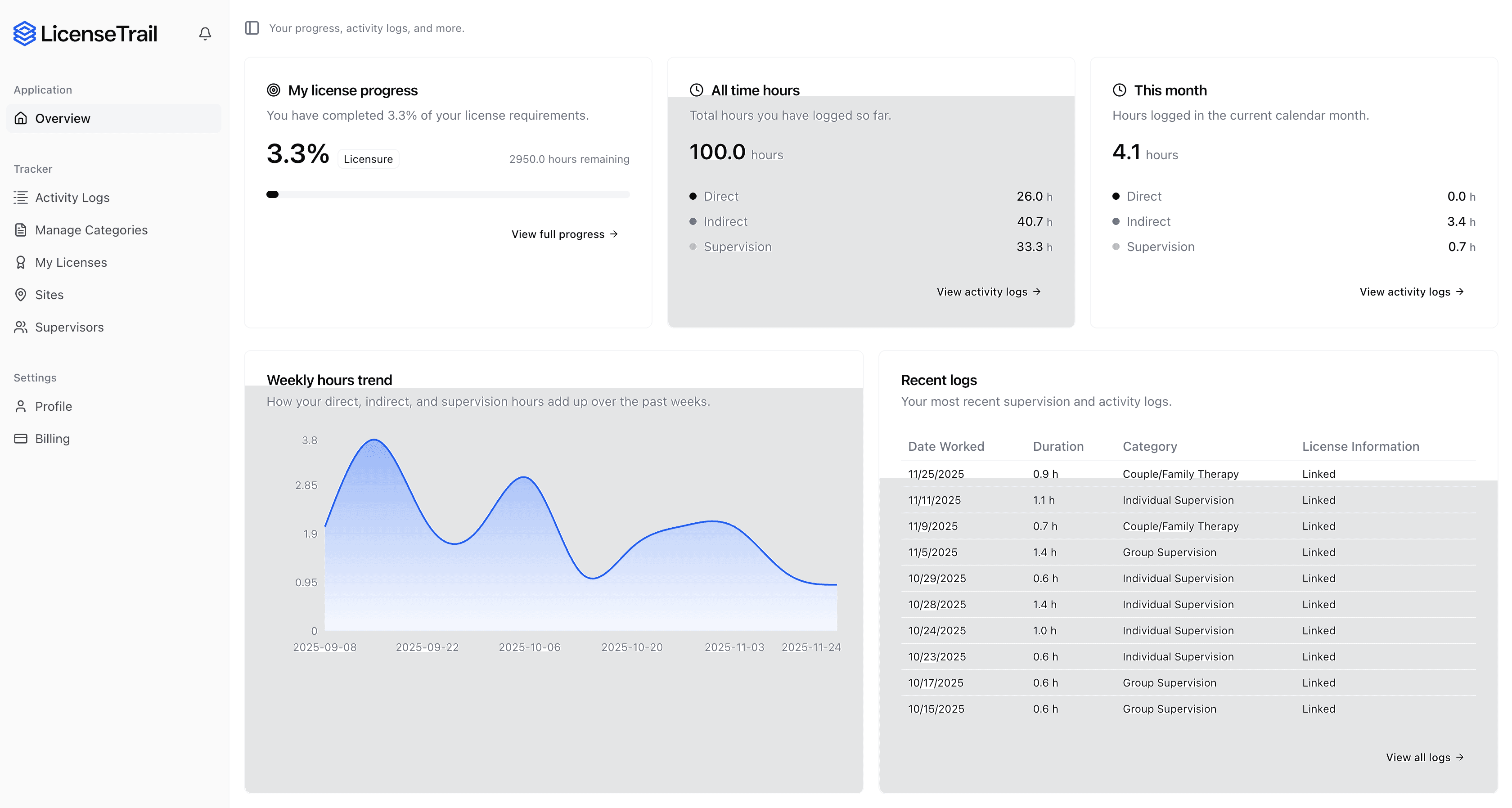
License Trail checks your direct, indirect, and supervision hours against Alabama LBSW requirements continuously and flags mismatches before you submit.
 Start Tracking for Free
No credit card required · Free plan available
Is your spreadsheet hiding Alabama LBSW risks?
Stop guessing if your categories match Alabama State Board of Social Work Examiners requirements. License Trail checks your direct, indirect, and supervision hours continuously and flags mismatches before you submit.
Import or log
Bring your spreadsheet or start fresh
Upload your existing tracking spreadsheet and we'll map every hour into the right Alabama State Board of Social Work Examiners categories automatically.
Verify against Alabama
Catch mismatches before the board does
License Trail checks your direct, indirect, and supervision hours against Alabama LBSW requirements continuously.
Export board-ready
One-click clean reports
Generate professional, board-ready reports for supervision meetings and Alabama State Board of Social Work Examiners submissions in seconds.
No credit card required · Free plan available