
Alabama LMSW Requirements: Hours, Exams & Step-by-Step Guide
Stop guessing if your categories match Alabama requirements. License Trail checks your direct, indirect, and supervision hours against LMSW requirements continuously and flags mismatches before you submit.
No credit card required · Free plan available
Quick Requirements Overview
- Eligibility: ≥19 years old; U.S. citizen or legally present with federal documentation; meet character/fitness expectations.
- Education: MSW or DSW from a CSWE-accredited/approved (or candidacy) program.
- Application: Apply to AL Board (online/paper), submit official transcript + required forms/ID, pay fees.
- Exam: Board approval to test + pass ASWB Master’s exam (score reported to Board).
- Designation at issuance: Choose LMSW Non‑Clinical or LMSW Clinical.
- Post-licensure supervision (both): 96 supervision hours minimum, 4 hrs/month for 24 months (within 36 months); concurrent with employment; ≥10 hrs/week social work practice.
- Supervisor requirements: Non‑Clinical: Board-approved LMSW (qualified) or LICSW; Clinical: LICSW only.
- Clinical track extra hours: Supervision must occur within ≥3,000 post‑master’s work hours (completed in 2–4 years); no “direct vs indirect” hour split specified.
License Details
Procedures
Licensure as a Licensed Master Social Worker (LMSW) in Alabama is governed primarily by Alabama Code §34‑30‑22 (qualifications of applicants) and Alabama Administrative Code rules 850‑X‑2‑.02 (classification of social workers) and 850‑X‑3‑.04 (supervision).(law.justia.com)
The Board’s system is not framed as “X hours of direct experience and Y hours of supervised experience” for LMSW. Instead, it uses:
- Education + exam + application for the initial LMSW license, and
- Clearly defined supervision hours and, for the clinical route, total work hours after licensure.
Below is a step‑by‑step outline using the Board’s own terminology and structure.
1. Confirm basic statutory eligibility
Under Alabama Code §34‑30‑22, the State Board of Social Work Examiners issues an LMSW license to an applicant who meets several general conditions, including:(law.justia.com)
-
Age requirement
- Must be at least 19 years of age.
-
Citizenship / legal presence
- Must be a U.S. citizen or a person legally present in the United States with appropriate federal documentation.
-
Fees and examination
- Must have paid the initial examination fee established by the Board and
- Must pass an examination prepared by the Board (this is the ASWB master’s exam, administered under Board approval).
-
Good standing / legal fitness
- Must meet general character and legal‑fitness expectations implied by licensure statutes (e.g., no disqualifying criminal conduct).
2. Complete the required graduate social work degree
For the LMSW classification, the statute and Board rules require a specific graduate degree:(law.justia.com)
- You must hold a Master of Social Work (MSW) or Doctor of Social Work (DSW) from a college or university whose social work program is:
- Approved, accredited, or in candidacy with the Council on Social Work Education (CSWE).
No specific practicum hour counts beyond what CSWE‑accredited programs already require are listed in the licensing rules; the Board relies on CSWE accreditation to ensure appropriate graduate field education.
3. Apply to the Alabama State Board and be approved to test
The Board provides an “Application for Licensed Master Social Worker” (paper) and an online application for social work licensure/exam.(socialwork.alabama.gov)
In broad terms, you will:
-
Submit an LMSW application to the Board
- Via online portal or the “Application for Licensed Master Social Worker” PDF.
- Pay the application / examination fees.
-
Provide documentation
- Official transcript showing your MSW or DSW from a CSWE‑approved/accredited (or candidate) program.(law.justia.com)
- Any Board‑required identification and immigration‑compliance form.(socialwork.alabama.gov)
-
Receive Board approval to sit for the exam
- Once your application is reviewed and approved, the Board authorizes you to schedule the ASWB master’s exam.
4. Pass the Master’s‑level social work examination
Alabama law requires that the candidate for the LMSW level pass an exam as prescribed by the Board.(law.cornell.edu)
In practice, this means:
- Passing the ASWB Master’s examination within the approval window the Board gives you.
- Having your passing score reported to the Alabama Board.
After you pass, the Board completes its review, and—if all other conditions are satisfied—issues your Licensed Master Social Worker (LMSW) license.
At the time of issuance, you must choose a designation:
- LMSW Non‑Clinical, or
- LMSW Clinical.(law.cornell.edu)
This designation determines how your post‑licensure supervision and hours must unfold.
5. Understand what “LMSW Non‑Clinical” vs “LMSW Clinical” means
The Alabama Administrative Code describes the LMSW category and its two designations as follows (paraphrased):(law.cornell.edu)
-
LMSW Non‑Clinical
- May practice in social casework, community organization, social work research, and social work administration (non‑clinical functions).
- Must work under continuing supervision of a Board‑approved supervisor (LMSW or LICSW) for two years, obtaining a minimum of 96 hours of supervision.
-
LMSW Clinical
- May practice in all non‑clinical areas listed above plus clinical practice (assessment, diagnosis, treatment, etc., as defined by the Board).
- Must work under the continuing supervision of a Board‑approved supervisor who is a Licensed Independent Clinical Social Worker (LICSW) for two years, obtaining a minimum of 96 hours of supervision.
The same 96 supervision hours is required for both designations; the difference is:
- Who may supervise you, and
- For the clinical track, that supervision is tied to 3,000 post‑master’s work hours (discussed below).
6. Post‑licensure supervision requirements and hour types
Once you are licensed as an LMSW, Alabama requires structured supervision. These are licensure supervision hours, not separate “pre‑licensure” practice hours.
6.1 LMSW Non‑Clinical: supervision hours and timing
For the non‑clinical route, the supervision rule (Admin. Code r. 850‑X‑3‑.04(2)(a)–(e)) sets out the following requirements (paraphrased):(law.cornell.edu)
-
Total supervision hours
- You must complete at least 96 hours of supervision.
-
Minimum monthly supervision
- You must receive a minimum of four (4) hours per month of supervision for 24 months within a 36‑month period.
- The rule notes it is recommended that you do no more than two hours of supervision within any two‑week period (i.e., spacing sessions out).
-
Timeframe
- These supervision hours must be obtained within a minimum of 2 years and a maximum of 3 years of post‑master’s social work practice “authorized by law.”
-
Concurrent with employment and minimum work hours
- Supervision “must be concurrent with employment”, and
- Employment must be “no less than 10 hours per week of social work practice.”
- The rule does not break those 10 hours/week into “direct” vs “indirect” practice; it speaks in terms of social work practice generally.
-
Type and content of supervision
- The Board defines licensure supervision as supervision that “promotes professional growth” and requires clear, accurate, case‑appropriate communication that protects confidentiality.
- Supervision content must cover core areas such as:
- Professional values and responsibilities
- Practice skills
- Scope of practice
- Ensuring continuing competence
- Ethical standards
- Human behavior in the social environment, diversity, assessment, intervention, administration, research use, service delivery, and case analysis.(law.cornell.edu)
-
Supervisor qualifications (Non‑Clinical)
- The supervisor must meet the general requirements in 850‑X‑3‑.01 and must be either:
- A licensed master social worker with at least three years of full‑time LMSW practice and completion of their own supervision requirements, or
- A licensed independent clinical social worker who has completed supervision requirements.(law.cornell.edu)
- The supervisor must meet the general requirements in 850‑X‑3‑.01 and must be either:
-
Verification and outcome
- Supervisor and supervisee must file a supervision plan with the Board before supervision starts and later submit verification of supervised practice at renewal.(law.cornell.edu)
- Once the LMSW Non‑Clinical has completed the 96 hours under the rule, that LMSW is no longer required to be supervised for ongoing practice in that area.(law.cornell.edu)
6.2 LMSW Clinical: supervision hours and total work hours
For the clinical designation, the Board layers both supervision hours and total work hours into the requirements.
Key provisions in Admin. Code r. 850‑X‑3‑.04(2)(g)–(j) and 850‑X‑3‑.04(3) state (paraphrased):(law.cornell.edu)
-
Total clinical supervision hours
- You must complete a total of 96 hours of clinical supervision.
-
Monthly supervision schedule
- A minimum of four (4) hours per month of supervision is required
for 24 months within a 36‑month period, with the same recommendation that you do no more than two hours within two weeks.
- A minimum of four (4) hours per month of supervision is required
-
Overall timeframe
- The clinical supervision must be “obtained within a minimum of 2 years and a maximum of 3 years post‑master’s social work practice authorized by law.”
-
Concurrent with employment and 3,000 work‑hour requirement
- Supervision must be concurrent with employment, and employment is again defined as no less than 10 hours per week of social work practice.
- Crucially, the rule adds that:
- The required clinical supervision “must be obtained in no less than 3,000 work hours of post masters experience”, and
- Those 3,000 work hours must be completed within a minimum of 2 years and a maximum of 4 years of post‑master’s practice.(law.cornell.edu)
In other words:
- Supervision hours: 96 hours of clinical supervision.
- Work hours: At least 3,000 work hours of post‑MSW social work practice during which that supervision occurs.
Alabama rules do not split those 3,000 work hours into, for example, “1,500 direct client hours and 1,500 indirect hours.” The controlling phrase is “3,000 work hours of post masters experience” in social work practice.
-
Supervisor qualifications (Clinical)
- Clinical supervision for LMSW Clinical must be provided by a Licensed Independent Clinical Social Worker (LICSW) who meets Board supervisory requirements.(law.cornell.edu)
-
Content and documentation
- Clinical supervision must still meet the Board’s definition of supervision that promotes professional growth and covers a similar, expanded list of content areas, now including:
- Assessment
- Treatment modalities
- Clinical knowledge and skills, in addition to the non‑clinical content list.(law.cornell.edu)
- As with non‑clinical supervision, a Board‑approved supervision plan is required, and verification of supervised practice must be submitted when the LMSW renews or later applies for the LICSW license.(law.cornell.edu)
- Clinical supervision must still meet the Board’s definition of supervision that promotes professional growth and covers a similar, expanded list of content areas, now including:
-
Pathway to LICSW
- After completion of not less than 3,000 work hours and 96 hours of clinical supervision, an LMSW is eligible to apply for the Licensed Independent Clinical Social Worker (LICSW) license, according to 850‑X‑3‑.04(3) and 850‑X‑2‑.02(3).(law.cornell.edu)
7. How Alabama’s hours compare to your example
Your example phrased requirements as something like 1,500 hours of direct experience and 1,500 hours of supervised experience. That is not how the Alabama State Board defines LMSW requirements.
Instead, for LMSW in Alabama:
- There is no pre‑licensure hour requirement beyond the CSWE‑accredited degree and its built‑in field education.
- After licensure:
- LMSW Non‑Clinical must complete:
- 96 hours of supervision
- Delivered at ≥4 hours/month for 24 months, over 2–3 years,
- While employed at ≥10 hours/week of social work practice.(law.cornell.edu)
- LMSW Clinical must complete:
- 96 hours of clinical supervision, also at ≥4 hours/month for 24 months, over 2–3 years,
- And at least 3,000 total work hours of post‑master’s social work practice, completed in 2–4 years,
- All under a Board‑approved LICSW supervisor.(law.cornell.edu)
- LMSW Non‑Clinical must complete:
So Alabama’s framework centers on:
- Supervision hours (96 hours), and
- For clinical licensure, total work hours (3,000 post‑master’s work hours),
rather than on separate “direct” vs “indirect” hour buckets.
8. Recap: Checklist to become an LMSW in Alabama
-
Earn your degree
- MSW or DSW from a CSWE‑approved/accredited (or candidate) program.(law.justia.com)
-
Ensure basic eligibility
- At least 19 years old.
- U.S. citizen or legally present non‑citizen with federal documentation.(law.justia.com)
-
Apply to the Alabama State Board
- Submit LMSW application (online or paper), pay fees, supply transcript and required forms.(socialwork.alabama.gov)
-
Obtain Board authorization and pass the ASWB Master’s exam
- Meet the statutory requirement to pass an examination prepared by the Board for master social workers.(law.justia.com)
-
Receive your LMSW license and choose designation
- Designate Non‑Clinical or Clinical at the time of licensure.(law.cornell.edu)
-
Complete required post‑licensure supervision
- Non‑Clinical: 96 hours of supervision over 2–3 years, concurrent with practice (≥10 hours/week).
- Clinical: 96 hours of clinical supervision + at least 3,000 post‑MSW work hours completed in 2–4 years, all under an LICSW supervisor.(law.cornell.edu)
Those are the core requirements and hour structures as defined by the Alabama State Board of Social Work Examiners and its governing statutes and rules, current through the most recent updates of the Alabama Code and Administrative Code.
Track your LMSW hours with confidence
License Trail checks your direct, indirect, and supervision hours against Alabama LMSW requirements continuously and flags mismatches before you submit.
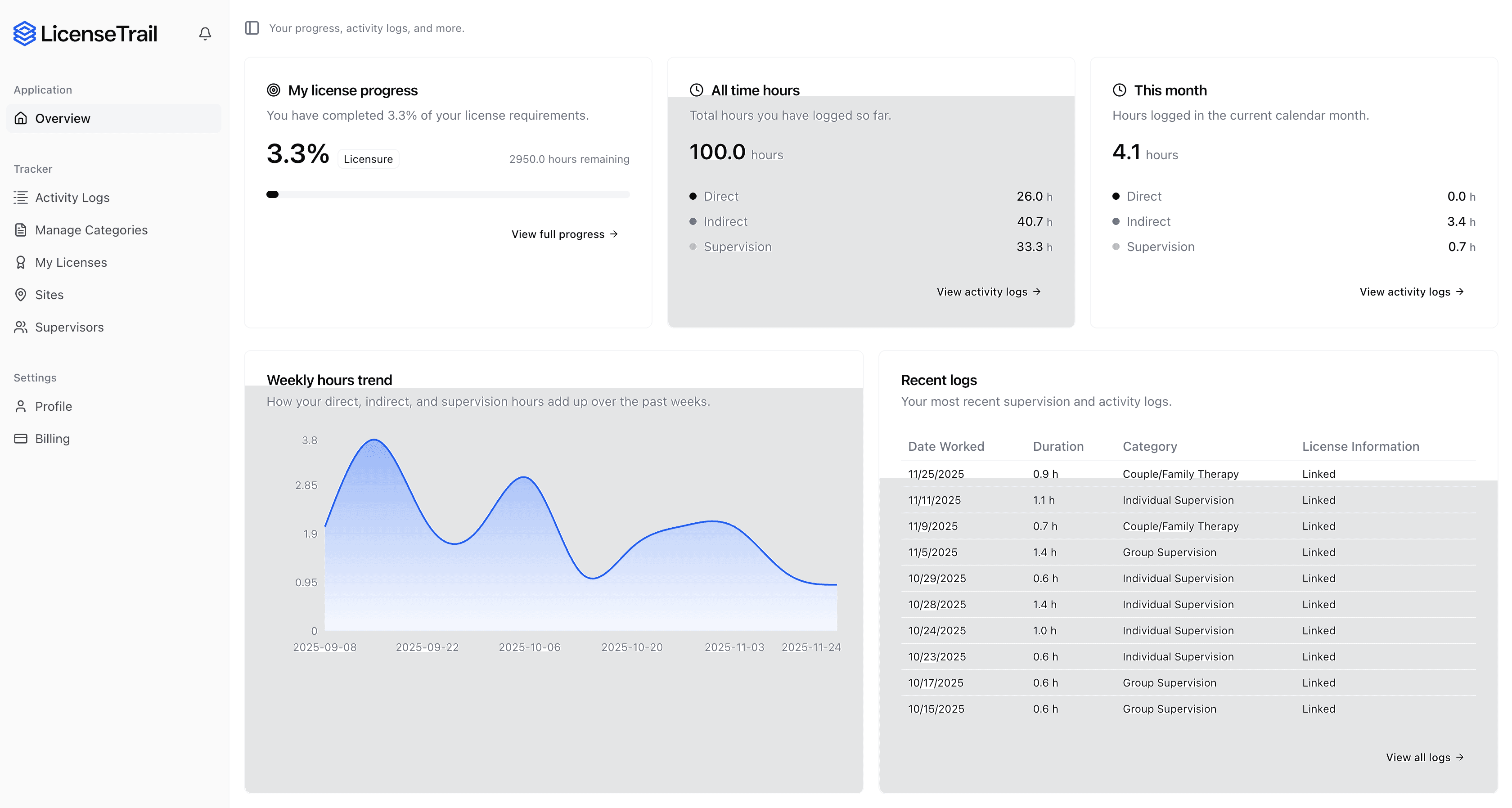 Start Tracking for Free
No credit card required · Free plan available
Is your spreadsheet hiding Alabama LMSW risks?
Stop guessing if your categories match Alabama State Board of Social Work Examiners requirements. License Trail checks your direct, indirect, and supervision hours continuously and flags mismatches before you submit.
Import or log
Bring your spreadsheet or start fresh
Upload your existing tracking spreadsheet and we'll map every hour into the right Alabama State Board of Social Work Examiners categories automatically.
Verify against Alabama
Catch mismatches before the board does
License Trail checks your direct, indirect, and supervision hours against Alabama LMSW requirements continuously.
Export board-ready
One-click clean reports
Generate professional, board-ready reports for supervision meetings and Alabama State Board of Social Work Examiners submissions in seconds.
No credit card required · Free plan available