
Alaska PA Requirements: Hours, Exams & Step-by-Step Guide
Stop guessing if your categories match Alaska requirements. License Trail checks your direct, indirect, and supervision hours against PA requirements continuously and flags mismatches before you submit.
No credit card required · Free plan available
Quick Requirements Overview
- Degree: Earned master’s in psychology (clinical/counseling or Board‑equivalent) with ≥48 grad semester credits + practicum; program must meet 12 AAC 60.082/.084 core content requirements.
- Practicum vs. experience: Master’s practicum does not count toward required post‑master supervised experience.
- Post‑master experience: 2 years Board‑approved supervised experience in specialty area (AS 08.86.160; 12 AAC 60.070).
- Hours definition: Each “year” = ≥1,500 hours over 10–24 consecutive months, 20–40 hrs/week ⇒ ≥3,000 post‑master hours total (12 AAC 60.080).
- Supervision structure: Year 1: 2 hrs/week face‑to‑face supervision (incl. ≥1 hr individual) + 2 hrs/week learning activities; Year 2: ≥1 hr/week individual face‑to‑face supervision.
- Supervisor mix: ≥80% under licensed psychologist/ABPP diplomate/Board‑qualified doctoral psych; up to 20% under certain other licensed clinicians if specialty‑qualified.
- Service mix: Must include “direct services”; ≥50% of supervised experience must be face‑to‑face patient contact.
- Gating + exams: Hours count only after application + supervised practice plan approved and temporary license issued; must pass EPPP (≥450 computerized/≥60% paper) + AK Law & Ethics exam (≥70%).
License Details
Procedures
Alaska licenses master’s‑level practitioners under the title “Psychological Associate.” The license is issued by the Alaska Board of Psychologist and Psychological Associate Examiners under AS 08.86 and 12 AAC 60, with detailed experience and examination standards in regulation as of July 2025. (commerce.alaska.gov)
Below is a step‑by‑step outline of what the Board requires and how the hours are defined.
1. Educational foundation
1.1. Required degree
The Board “shall issue a psychological associate license” only to someone who: (commerce.alaska.gov)
- Holds an earned master’s degree in psychology from an academic institution whose master’s program meets Board criteria, in:
- Clinical psychology, or
- Counseling psychology, or
- Education in a specialization the Board deems equivalent.
Under the “qualifications for associates’ examination,” the master’s degree must have primary emphasis on psychology and include: (commerce.alaska.gov)
- At least 48 semester credit hours of graduate coursework directly related to the specialty in which licensure is requested,
- A practicum in that specialty area.
Regulation 12 AAC 60.082 and 60.084 add that the master’s program must be in a regionally‑accredited institution, be clearly identified as a psychology program, and include core coursework across seven major content areas (methodology/history, biological bases, cognitive‑affective bases, social bases, individual differences, ethics, and an appropriate supervised practicum or lab). (commerce.alaska.gov)
1.2. Practicum vs. post‑master experience
The Board explicitly treats the master’s practicum as separate from post‑degree experience. In its FAQ it states that the supervised practicum required for a master’s degree is distinct from a pre‑doctoral internship and from the supervised experience required for licensure. (commerce.alaska.gov)
Practicum hours therefore do not substitute for the two years of post‑master supervised experience described below.
2. Supervised post‑master experience: how many hours and what kind
2.1. Statutory requirement: two years post‑master
Under AS 08.86.160(a)(3), a psychological associate must complete “two years of post master’s supervised experience approved by the board.” (commerce.alaska.gov)
Regulation 12 AAC 60.070(c) clarifies that this requirement is met by two years of supervised experience in a specialty area the same as or similar to the field of psychology in which the applicant was educated and trained. (commerce.alaska.gov)
2.2. How Alaska defines a “year” of experience
The critical detail is in 12 AAC 60.080, “Criteria for evaluation of experience.” For both psychologists and psychological associates, the Board defines a qualifying year of experience as: (regulations.justia.com)
- At least 1,500 clock hours of supervised experience,
- Completed in no less than 10 months and no more than 24 consecutive calendar months,
- With 20–40 hours per week of supervised experience during weeks you work.
Because psychological associates must complete two years, the minimum supervised experience for licensure works out to:
At least 3,000 clock hours of supervised experience post‑master’s
(2 years × 1,500 hours per year),
accrued in accordance with the time‑frame and weekly limits above.
2.3. Required structure of supervision within those hours
12 AAC 60.080 further specifies the pattern of supervision and related activities: (regulations.justia.com)
-
First year of post‑master supervised experience
- Minimum 2 hours per week of face‑to‑face supervision with your supervisor.
- At least 1 of those hours must be individual face‑to‑face supervision focused on your direct services.
- Additional 2 hours per week of “learning activities.”
- “Learning activities” (defined in 12 AAC 60.990(a)(10)) include things like case conferences, consultation groups, topic‑relevant workshops, and similar professional development, as approved by your supervisor. (law.cornell.edu)
- Minimum 2 hours per week of face‑to‑face supervision with your supervisor.
-
Second year of post‑master supervised experience
- Minimum 1 hour per week of individual face‑to‑face supervision focused on direct services.
-
Who may supervise
- At least 80% of your supervised experience must be under:
- A licensed psychologist,
- A diplomate of the American Board of Professional Psychology, or
- A person with a doctoral degree in psychology whom the Board considers qualified to supervise.
- Up to 20% of your supervised experience may be under:
- A licensed psychiatrist, licensed psychological associate, licensed clinical social worker, licensed marriage and family therapist, or licensed professional counselor, provided the person is qualified in your specialty area. (regulations.justia.com)
- At least 80% of your supervised experience must be under:
-
What counts as “supervised experience”
- “Supervised experience” expressly includes direct client contact and preparation for that contact, staff meetings, case conferences, report writing, co‑therapy, in‑service training, and psychodiagnostic assessment. (law.cornell.edu)
2.4. Direct services and face‑to‑face contact requirements
The regulations also define “direct services” and require that a substantial portion of supervised hours involve direct and face‑to‑face work with patients:
- Direct services are activities directly related to providing psychological services to a patient, including individual or family psychotherapy, psychological testing, report writing, studying test results, case consultations, and reviewing literature related to the patient’s needs. (law.cornell.edu)
- 12 AAC 60.080(a)(9) adds that a specified share of supervised experience must consist of direct services, and at least 50% of the supervised experience must be face‑to‑face contact with patients. (regulations.justia.com)
In practice, this means:
- Within your minimum 3,000 supervised hours, at least half of all hours must involve direct, in‑person patient contact (e.g., therapy, assessment, feedback).
- The remaining hours can be other supervised professional activities (report writing, case conferences, preparation), but still must fall under the Board’s definition of supervised experience.
2.5. What does not count
The Board is explicit that certain activities do not count toward your required supervised experience:
- Unsupervised independent private practice,
- Unsupervised practicums, clerkships, or externships. (commerce.alaska.gov)
Only supervised work that fits the criteria above, under an approved supervision plan, will be credited.
3. Temporary license and when hours start counting
You cannot simply start working and later ask the Board to count those hours.
Under 12 AAC 60.020 and the Board’s FAQ: (commerce.alaska.gov)
-
To accrue qualifying post‑master experience in Alaska, you must:
- Submit a psychological associate application (by examination) with supporting documents (fees, transcripts, vita, proof of practicum, and required recommendations). (commerce.alaska.gov)
- Submit a supervised practice plan detailing where and how you will obtain your two years of supervised experience.
- Obtain Board approval of your application and supervision plan, and
- Receive a temporary license to practice psychology under supervision as a psychological associate.
-
The Board states that “for supervision hours to count towards your full licensure, you must have your application and supervised practice plan approved by the Board prior to beginning your supervised experience.” (commerce.alaska.gov)
Key points about the temporary license (12 AAC 60.020): (commerce.alaska.gov)
- It is valid for two years from the date of issue.
- It may be extended if needed to complete the supervised experience.
- You may practice only under supervision as defined in 12 AAC 60.070 and 60.080.
- You may not begin post‑master supervised experience in Alaska until the temporary license is issued.
4. Examination requirements
4.1. EPPP (national exam)
Before the Board will issue a psychological associate license by examination, you must show proof of passing the Examination for Professional Practice in Psychology (EPPP). (commerce.alaska.gov)
Regulation 12 AAC 60.140 specifies that for a psychological associate the passing score on the EPPP is the Association of State and Provincial Psychology Boards (ASPPB) recommended cut score—either 450 or higher on the computerized EPPP or **60% or higher on the non‑computerized version. (commerce.alaska.gov)
4.2. Alaska State Law & Ethics Examination
All licensure applicants must also pass a state law and ethics exam: (commerce.alaska.gov)
- It is administered by the Board several times per year (regulations call for four administrations annually).
- Candidates must achieve at least 70% to pass.
- Questions cover AS 08.86, relevant sections of Alaska mental health statutes, the Board’s regulations, and the APA Ethics Code.
You must ultimately provide verification of passing both EPPP and the state law & ethics exam to complete the licensure process. (commerce.alaska.gov)
5. Application and licensure sequence in practice
Putting the pieces together, the process to become a licensed psychological associate in Alaska generally follows this sequence:
-
Complete an approved master’s degree in psychology
- Ensure the program meets 12 AAC 60.082 and 60.084 standards and includes a supervised practicum in your intended area of practice. (commerce.alaska.gov)
-
Prepare and submit the Psychological Associate Application (by examination)
- Use the Board’s form #08‑4362 (revised February 13, 2025) or the online MY LICENSE portal. (commerce.alaska.gov)
- Include:
- Application fees,
- Official undergraduate and graduate transcripts,
- Curriculum vitae,
- Proof of master’s practicum,
- Required recommendations (including a recommendation from an immediate supervisor who is a licensed psychologist, or from two licensed doctoral‑level psychologists). (commerce.alaska.gov)
-
Submit a supervised practice plan and apply for a temporary license
- Detail your intended supervised practice (sites, supervisors, hours).
- Once the Board approves your plan and issues a temporary license, you may begin accruing the two years (minimum 3,000 hours) of supervised experience. (commerce.alaska.gov)
-
Accrue the required supervised experience
- At least 3,000 clock hours over two years, meeting:
- 1,500 hours per “year” of experience,
- 20–40 supervised hours per week in qualifying settings,
- Required weekly supervision and learning activities patterns,
- Direct‑service and face‑to‑face contact requirements. (regulations.justia.com)
- At least 3,000 clock hours over two years, meeting:
-
Pass both examinations
- EPPP at the psychological associate cut score (≥450 or ≥60%).
- Alaska State Law & Ethics Exam (≥70%). (commerce.alaska.gov)
-
Apply for full psychological associate licensure
- Once supervised experience and exams are complete, submit documentation (including supervisor verification forms) to the Board.
- The Board reviews your file and, if all statutory and regulatory requirements are met, issues the Psychological Associate license. (commerce.alaska.gov)
6. Summary of hour‑based requirements, in the Board’s terms
Drawing directly from the statutes and regulations, Alaska’s hour requirements for psychological associate licensure can be summarized as:
- Two years of post‑master supervised experience in the applicant’s specialty field, as required by AS 08.86.160(a)(3) and defined in 12 AAC 60.070(c). (commerce.alaska.gov)
- Each year of experience must consist of at least 1,500 clock hours of supervised experience, completed over 10–24 consecutive months with 20–40 hours/week when working (12 AAC 60.080(a)(2)). (regulations.justia.com)
- Across these two years, a minimum of 3,000 supervised clock hours post‑master’s are therefore required, with:
- Weekly supervision and learning‑activity requirements as detailed in 12 AAC 60.080(a)(3),
- At least 80% of hours under a psychologist/diplomate/doctoral‑level supervisor,
- A significant portion of hours in “direct services,” and at least 50% of total supervised hours as face‑to‑face contact with patients (12 AAC 60.080(a)(4), (9); 12 AAC 60.990(a)(9)). (regulations.justia.com)
These provisions—combined with the master’s‑level education and required examinations—constitute the Alaska Board’s current requirements for a Psychological Associate license.
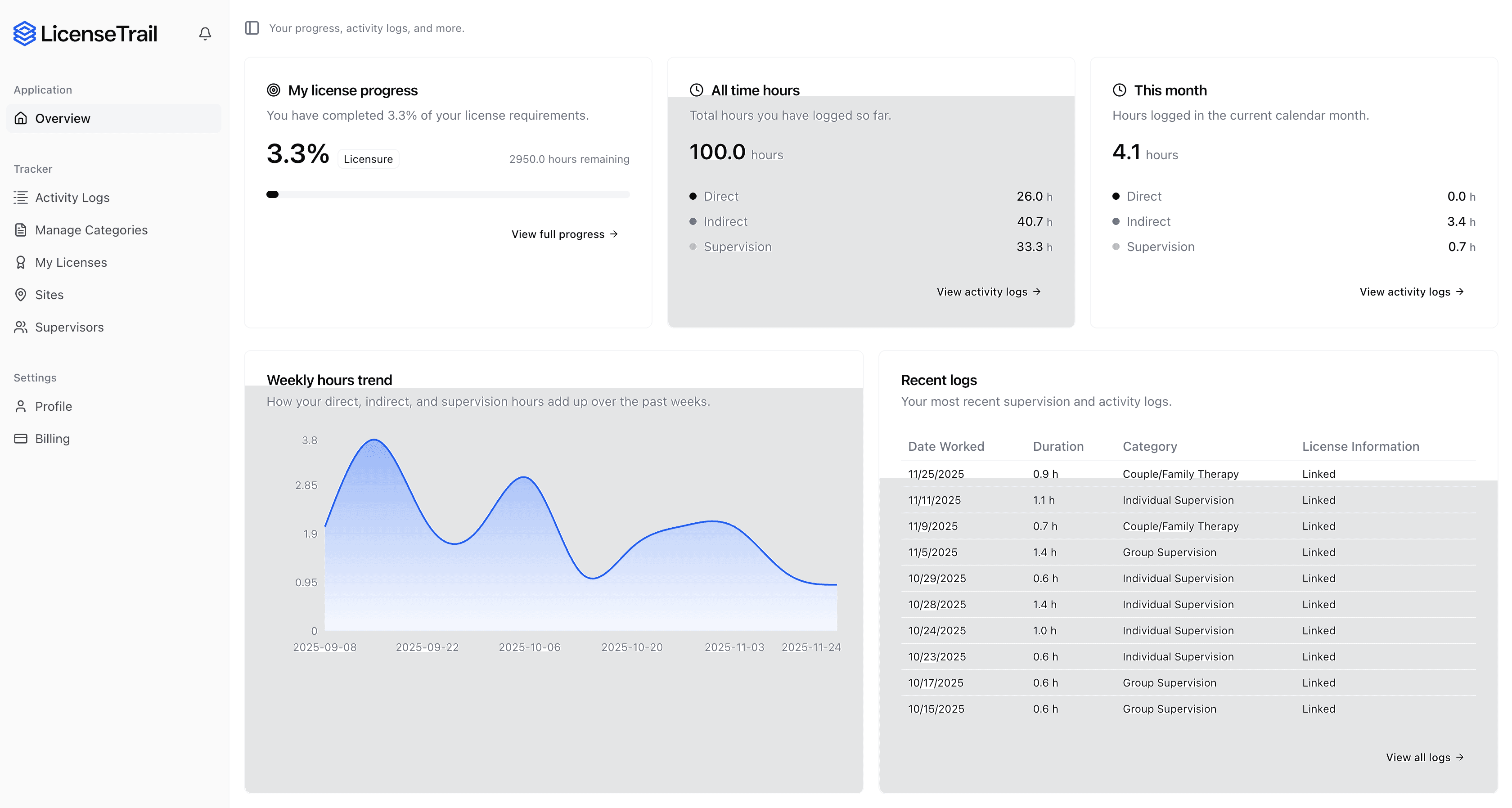
Track your PA hours with confidence
License Trail checks your direct, indirect, and supervision hours against Alaska PA requirements continuously and flags mismatches before you submit.
 Start Tracking for Free
No credit card required · Free plan available
Is your spreadsheet hiding Alaska PA risks?
Stop guessing if your categories match Alaska Board of Psychologist and Psychological Associate Examiners requirements. License Trail checks your direct, indirect, and supervision hours continuously and flags mismatches before you submit.
Import or log
Bring your spreadsheet or start fresh
Upload your existing tracking spreadsheet and we'll map every hour into the right Alaska Board of Psychologist and Psychological Associate Examiners categories automatically.
Verify against Alaska
Catch mismatches before the board does
License Trail checks your direct, indirect, and supervision hours against Alaska PA requirements continuously.
Export board-ready
One-click clean reports
Generate professional, board-ready reports for supervision meetings and Alaska Board of Psychologist and Psychological Associate Examiners submissions in seconds.
No credit card required · Free plan available