
Alaska PSY-CT Requirements: Hours, Exams & Step-by-Step Guide
Stop guessing if your categories match Alaska requirements. License Trail checks your direct, indirect, and supervision hours against PSY-CT requirements continuously and flags mismatches before you submit.
No credit card required · Free plan available
Quick Requirements Overview
- Eligibility: Non‑resident of Alaska; hold a current independent psychologist license in good standing in another jurisdiction with standards ≥ Alaska equivalent
- Exam: Must have passed EPPP; provide official score verification (board or ASPPB transfer)
- Practice limit: Max 30 days of practice in any 12‑month period; only one courtesy license per lifetime
- Scope: No general practice—must stay within the specific dates and scope approved/listed on the courtesy license
- Disqualifiers/attestations: No prior AK courtesy license; no license suspension/revocation; no AK psychology license denial within past 4 years (plus fitness/discipline disclosures)
- Application timing: Submit complete application ≥30 days before intended practice start (waiver possible for cause)
- Documentation & fees: Application + $250 total ($50 app + $200 license); primary‑source verification from each jurisdiction ever licensed; EPPP verification
- Ongoing obligation: File monthly courtesy reports during practice period; comply with AK statutes/regulations and board discipline authority
License Details
Procedures
Alaska’s Psychologist Courtesy License (often coded as PSY‑CT in the state’s licensing system) is designed for already‑licensed psychologists who need very short‑term practice privileges in Alaska. It is not a training or supervised‑experience license, and it does not impose new clinical hour requirements beyond what you already met for your primary psychologist license.
Below is a structured summary of what the Alaska Board of Psychologist and Psychological Associate Examiners requires, based on current statutes, regulations, and the official courtesy license application (form 08‑4230, revised February 13, 2025). (regulations.justia.com)
1. What the Alaska Psychologist Courtesy License Allows (and Limits)
Under Alaska regulation 12 AAC 60.035 and the board’s own instructions: (regulations.justia.com)
- The courtesy license authorizes you to practice psychology in Alaska for no more than 30 days within a 12‑month period.
- Only one courtesy license will ever be issued to you in your lifetime.
- The license does not allow you to conduct a general psychology practice in Alaska. Your activities must stay within the specific scope of practice you identify in the application and that is listed on the courtesy license.
- You must submit a monthly courtesy report to the division during the courtesy license period, listing the number of days practiced in Alaska in that month (form 08‑4758). (commerce.alaska.gov)
- You must abide by the Alaska psychology statutes and regulations (AS 08.86 and 12 AAC 60) and are subject to the board’s ethics and disciplinary authority while practicing under the courtesy license. (regulations.justia.com)
Although the board’s general licensing system uses a two‑year cycle (licenses expiring June 30 of odd‑numbered years), the functional limit for a courtesy license is still 30 practice days in any 12‑month period and only once per lifetime, regardless of that administrative cycle. (commerce.alaska.gov)
2. Experience and Hour Requirements
2.1. Hours required for the courtesy license itself
The PSY‑CT courtesy license does not have its own new clock‑hour or supervision‑hour requirements.
Instead, Alaska requires that you already hold a full, independent psychologist license in another jurisdiction whose licensing standards are at least equivalent to Alaska’s. In other words, your previous licensure pathway (education, supervised experience, and exams) must meet or exceed Alaska’s baseline requirements for a psychologist license. (regulations.justia.com)
Alaska verifies this equivalency through:
- Verification of current independent psychologist licensure in good standing from every jurisdiction where you have ever held a psychology license. Each must show that your license meets or exceeded Alaska’s standards for the scope of practice you are requesting. (regulations.justia.com)
- Verification that you passed the EPPP with a qualifying score (see below). (regulations.justia.com)
There is no separate requirement such as “1,500 hours of direct experience plus 1,500 hours of supervised experience” specifically attached to the courtesy license.
2.2. Underlying Alaska hour requirement for a regular psychologist license (context)
To judge equivalence, it helps to know the baseline standard Alaska uses for its own psychologist licenses:
- Alaska statute AS 08.86.130 requires one year of postdoctoral supervised experience approved by the board as part of psychologist licensure. (law.justia.com)
- In practice, Alaska defines that year as no fewer than 1,500 clock hours of supervised experience, completed in not less than 10 months and not more than 24 consecutive months, with 20–40 hours per week of supervised experience during weeks worked. (ecpc-personnel-standards.dev.i3.uconn.edu)
So while the courtesy license doesn’t ask you to re‑document 1,500 hours directly, your home‑state license must have been granted under standards at least this stringent (or higher) for the board to deem it equivalent.
3. Eligibility Criteria for the PSY‑CT Courtesy License
Under 12 AAC 60.035 and the official application instructions, you must meet all of the following: (regulations.justia.com)
-
Non‑resident of Alaska
- You must not be a resident of Alaska.
-
Current independent psychologist license in another jurisdiction
- You must hold a current license in good standing to practice psychology independently in at least one other jurisdiction (state, territory, province, or foreign country).
- The licensing requirements in that jurisdiction must be at least equivalent to Alaska’s requirements for the scope of practice you want in Alaska.
- Alaska requires primary‑source verification sent directly from each licensing board (or via a clearly identified primary‑source online verification). (commerce.alaska.gov)
-
EPPP Examination
- You must have passed the Examination for Professional Practice in Psychology (EPPP) with a score that meets Alaska’s standard in 12 AAC 60.140. (commerce.alaska.gov)
- If your home jurisdiction cannot report your EPPP score, you must obtain an official EPPP Score Transfer directly from ASPPB. (commerce.alaska.gov)
-
Time‑frame for application
- Your completed application package (including fees and supporting documents) must normally be postmarked at least 30 days before the first day you plan to practice in Alaska. (regulations.justia.com)
- The board may waive this 30‑day advance requirement if you show “reasonable cause or excusable neglect.” (regulations.justia.com)
-
Scope and dates of practice
- You must clearly specify:
- The exact dates within a 12‑month period when you intend to practice under the courtesy license (not to exceed 30 total days), and
- A description of the scope of practice for which the courtesy license is requested (e.g., specific assessments, consultations, or workshops). (commerce.alaska.gov)
- You must clearly specify:
-
Attestations regarding prior discipline and Alaska applications You must be able to attest all of the following: (regulations.justia.com)
- You have never previously been issued a psychologist courtesy license in Alaska.
- You have never had a psychologist license suspended or revoked in any jurisdiction.
- You have not been denied a license to practice psychology in Alaska within the past four years.
If any of these are not true, you are not eligible for a courtesy license under 12 AAC 60.035.
-
Professional fitness and honesty
- The application includes broader “professional fitness” questions (discipline history, criminal convictions beyond minor traffic offenses, malpractice settlements, impairment, and substance use). “Yes” answers require detailed written explanations and supporting documentation; they do not automatically bar licensure, but concealment or falsification does. (commerce.alaska.gov)
- You must sign under penalty of law that all statements and documents are true; misrepresentation can be grounds for denial or discipline and may constitute a criminal offense (unsworn falsification). (commerce.alaska.gov)
-
Agreement to comply with Alaska law
- You must certify that you have reviewed and will abide by Alaska’s psychology statutes and regulations (AS 08.86 and 12 AAC 60) while practicing under the courtesy license. (commerce.alaska.gov)
4. Application Components and Fees
The courtesy license application packet (form 08‑4230) and 12 AAC 02.330 set out the required submissions and fees. (commerce.alaska.gov)
4.1. Forms and documents
You must submit:
-
Completed Application Form (08‑4230, pages 1–4)
- Personal and contact information, Social Security number (or exemption form), and email preference.
- List of all psychology licenses ever held (state, territory, province, or foreign), with license numbers and dates. (commerce.alaska.gov)
-
Fees
- As of the February 13, 2025 revision:
- Application fee (non‑refundable): $50
- Courtesy license fee: $200
- Total due with application: $250, payable to “State of Alaska.” (commerce.alaska.gov)
- As of the February 13, 2025 revision:
-
Verification of Licensure
- Official verification sent directly to the Alaska division from each jurisdiction where you now hold or have ever held a psychologist license.
- Each verification must state the license status and any disciplinary history, and must qualify as primary‑source verification (either mailed by the board or via an official online verification system clearly identified as primary source). (commerce.alaska.gov)
-
Verification of EPPP Score
- Documentation showing you passed the EPPP with the score required in 12 AAC 60.140, sent either:
- From the jurisdiction that administered the EPPP, or
- Directly from ASPPB via their EPPP Score Transfer Service. (commerce.alaska.gov)
- Documentation showing you passed the EPPP with the score required in 12 AAC 60.140, sent either:
-
Statement of Dates and Scope of Practice
- On the application, you must list:
- State of residence
- Start and end dates for the courtesy license within a 12‑month window
- A narrative description of the professional activities (scope of practice) you will perform in Alaska. (commerce.alaska.gov)
- On the application, you must list:
-
Attestations and Signature Page
- Answer all professional fitness questions.
- Certify the three key courtesy‑license eligibility statements (no prior Alaska courtesy license, no license revocation/suspension, no Alaska license denial in last four years).
- Sign the Agreement section affirming that all information is true and that you understand misrepresentation can lead to denial or discipline. (commerce.alaska.gov)
4.2. Submission and processing
- Applications are processed in order received; you are advised to apply well in advance of your planned Alaska practice dates. (commerce.alaska.gov)
- If an application sits with no contact from you for 12 months, Alaska may treat it as abandoned under 12 AAC 02.910, deny it without prejudice, and retain the application fee. Some other fees may be refundable upon timely written request. (commerce.alaska.gov)
5. Obligations After the Courtesy License Is Granted
Once you receive the PSY‑CT courtesy license, you must:
-
Track and report days practiced
- File a Courtesy Monthly Report (form 08‑4758) for each month in which you practice in Alaska, stating the number of days practiced that month. (commerce.alaska.gov)
- Ensure you do not exceed 30 total days of practice in Alaska during the relevant 12‑month period.
-
Stay within the approved scope
- Limit your work to the specific scope of practice you described in your application and that appears on the courtesy license.
- Do not expand into general ongoing psychological practice in Alaska (e.g., open a clinic or begin ongoing therapy caseloads beyond your stated short‑term purpose). (regulations.justia.com)
-
Maintain good standing in all jurisdictions
- If your home‑state license is disciplined, suspended, revoked, or lapses, this can affect your courtesy license status and expose you to discipline in Alaska as well. (regulations.justia.com)
-
Follow Alaska’s ethics and legal standards
- Adhere to the ethical rules and practice standards in 12 AAC 60.185 and related provisions. Violations can result in disciplinary action under Alaska’s general professional licensing laws (AS 08.01.075) and psychology‑specific laws (AS 08.86.204). (regulations.justia.com)
6. Key Takeaways About Hours and “Verbiage”
- No separate Alaska clinical‑hour requirement is imposed for the PSY‑CT courtesy license. The board instead requires that you already hold an independent psychologist license from another jurisdiction with requirements at least equivalent to Alaska’s, and you must verify that licensure and your EPPP score. (regulations.justia.com)
- Alaska’s underlying standard for a full psychologist license (against which equivalence is judged) includes:
- A doctoral degree in clinical or counseling psychology (or equivalent field);
- One year of board‑approved postdoctoral supervised experience, which practice materials describe as ≥1,500 clock hours over 10–24 consecutive months, with 20–40 hours of supervised experience per week during weeks worked; and
- A passing EPPP score at or above the Alaska minimum. (law.justia.com)
If your current psychologist license was earned under standards that meet or exceed those benchmarks, and you satisfy the non‑resident status, good‑standing verifications, time‑limit, and attestation requirements, you will typically meet the experience‑related expectations for an Alaska PSY‑CT Psychologist Courtesy License.
Track your PSY-CT hours with confidence
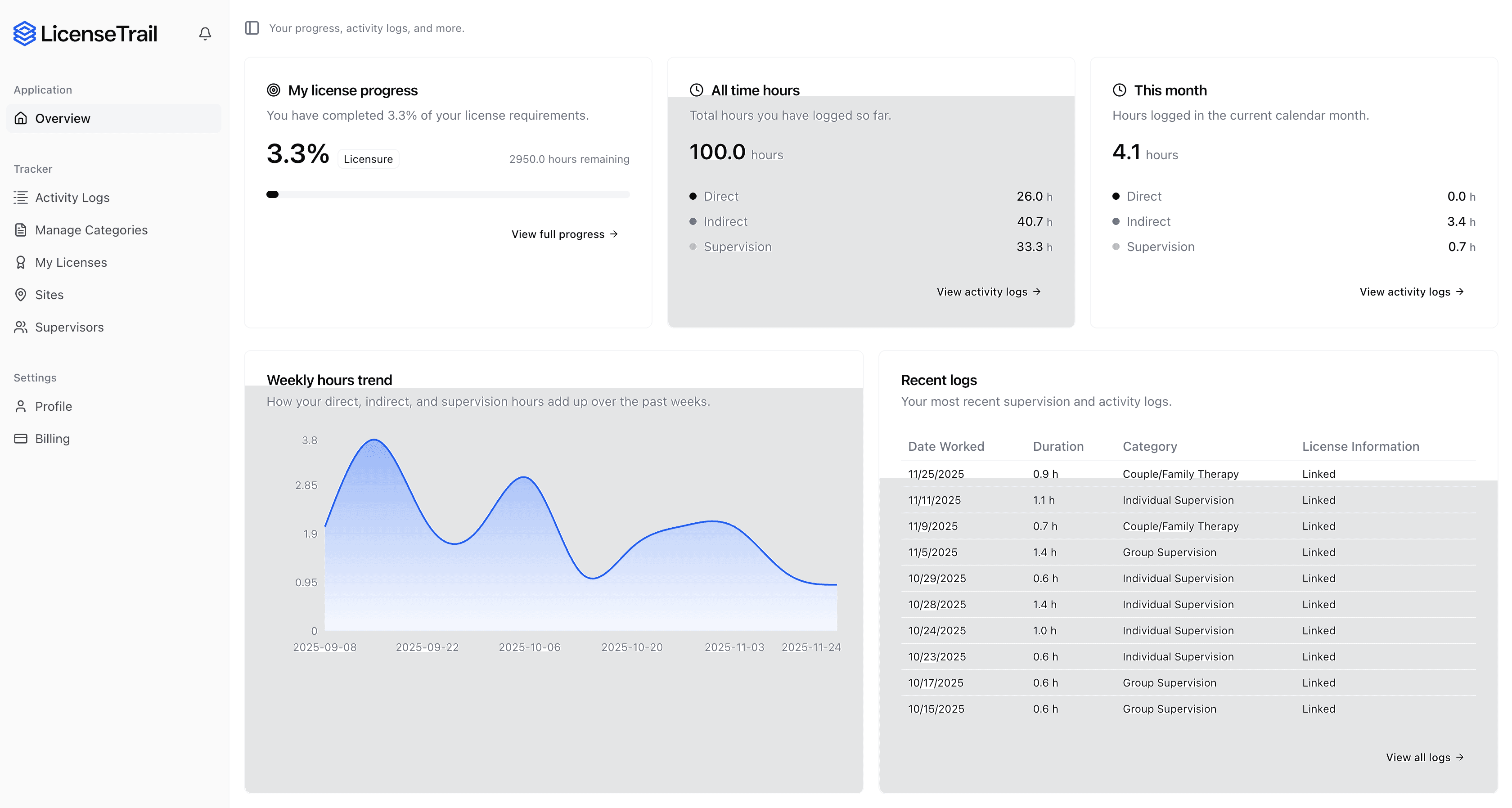
License Trail checks your direct, indirect, and supervision hours against Alaska PSY-CT requirements continuously and flags mismatches before you submit.
 Start Tracking for Free
No credit card required · Free plan available
Is your spreadsheet hiding Alaska PSY-CT risks?
Stop guessing if your categories match Alaska Board of Psychologist and Psychological Associate Examiners requirements. License Trail checks your direct, indirect, and supervision hours continuously and flags mismatches before you submit.
Import or log
Bring your spreadsheet or start fresh
Upload your existing tracking spreadsheet and we'll map every hour into the right Alaska Board of Psychologist and Psychological Associate Examiners categories automatically.
Verify against Alaska
Catch mismatches before the board does
License Trail checks your direct, indirect, and supervision hours against Alaska PSY-CT requirements continuously.
Export board-ready
One-click clean reports
Generate professional, board-ready reports for supervision meetings and Alaska Board of Psychologist and Psychological Associate Examiners submissions in seconds.
No credit card required · Free plan available