
California PTT Requirements: Hours, Exams & Step-by-Step Guide
Stop guessing if your categories match California requirements. License Trail checks your direct, indirect, and supervision hours against PTT requirements continuously and flags mismatches before you submit.
No credit card required · Free plan available
Quick Requirements Overview
- Credential type: Board of Psychology registration (not psychologist license); effective 1/1/2024 (SB 1428; BPC §2999.100+).
- Scope limits: May administer/score standardized objective tests and observe/describe test behavior; cannot select tests, interpret results, write reports, or give feedback; use only PTT/Neuropsychological Testing Technician titles.
- Education: Qualifying BA/grad degree (regionally accredited) in Psychology or Education w/ specialization in educational/counseling/school psychology; or current enrollment in a qualifying grad program.
- Training: 80 hours total—20 hrs in-person direct observation (10 hrs w/ licensed psychologist + 10 hrs w/ licensed psychologist or registered PTT) + 40 hrs administering/scoring in-person in presence of licensed psychologist + 20 hrs law/ethics/confidentiality/best practices.
- Supervision (practice): All services under direct supervision of a licensed psychologist in same work setting; supervisor available (in-person/phone/tech) and must notify client PTT is providing services.
- Background check: Fingerprint-based DOJ/FBI (Live Scan in-state; FD-258 cards out-of-state); include Live Scan form copy with application.
- Fees/renewal: $75 initial registration; $75 annual renewal; $25 to add/change supervisor (per statute/board process).
- Application: Apply via BreEZe; upload Training & Education Verification form(s) (single PDF), provide supervisor/work info; official transcripts (or registrar enrollment letter) sent directly to Board.
License Details
Procedures
California now recognizes a distinct role called the Psychological Testing Technician (PTT) under the Board of Psychology. This is a registration, not a psychologist license, and it became effective January 1, 2024, through Senate Bill 1428, which added Article 10 (starting at Business and Professions Code §2999.100) to the Psychology Licensing Law. (legiscan.com)
Below is a step‑by‑step guide to meeting the official state requirements and applying for registration, with the key statutory language highlighted where it matters.
1. Understand What a Psychological Testing Technician Is (and Is Not)
Statutory definition
Under Business and Professions Code §2999.100(a), a “psychological testing technician” is:
- “an individual not otherwise authorized to provide psychological and neuropsychological testing under this chapter who is registered with the board” and who is authorized to:
- “Administer and score standardized objective psychological and neuropsychological tests.”
- “Observe and describe clients’ test behavior and test responses.” (legiscan.com)
Prohibited functions
By law, a psychological testing technician may not do any of the following:
- Select tests or versions of tests
- Interpret test results
- Write test reports
- Provide test feedback to clients (legiscan.com)
You may only use the titles “psychological testing technician” or “neuropsychological testing technician.” You may not use “psychologist” or any title incorporating the word “psychologist.” (legiscan.com)
2. Meet the Education Requirement
To register as a Psychological Testing Technician, you must provide proof of one of the following (Business and Professions Code §2999.101(b)): (legiscan.com)
- A bachelor’s degree or graduate degree from a regionally accredited university, college, or professional school in:
- Psychology, or
- Education, with a field of specialization in:
- Educational psychology
- Counseling psychology
- School psychology
OR
- Proof of current enrollment in a graduate degree program (at a regionally accredited institution) in one of the same qualifying subjects above. (legiscan.com)
The Board is explicit that degrees outside those specializations (for example, a general “special education” degree) do not meet the requirement. (psychology.ca.gov)
3. Complete the Required 80 Hours of Education and Training
The law requires “proof of completion of a minimum of 80 hours total of education and training relating to psychological or neuropsychological test administration and scoring” (Bus. & Prof. Code §2999.101(c)(1)). (legiscan.com)
Those 80 total hours must break down as follows:
-
Direct observation – at least 20 hours
The statute requires:
- “At least 20 hours of direct observation, including at least 10 hours of direct observation of a licensed psychologist administering and scoring tests, and at least 10 hours of direct observation of either a licensed psychologist or registered psychological testing technician administering and scoring tests.” (legiscan.com)
The Board’s FAQs clarify that:
- Direct observation must be in-person. Watching pre‑recorded or live video does not count. (psychology.ca.gov)
-
Administering and scoring tests – at least 40 hours
The statute requires:
- “At least 40 hours of administering and scoring tests in the presence of a licensed psychologist.” (legiscan.com)
The Board further clarifies that this “in the presence of” requirement is also intended to be in‑person, not remote. (psychology.ca.gov)
-
Law/ethics and best practices education – at least 20 hours
The statute requires:
- “At least 20 hours of education on topics including law and ethics, confidentiality, and best practices for test administration and scoring.” (legiscan.com)
Taken together, the required minimum hour distribution is:
- 20 hours – direct observation (with the 10/10 split specified above)
- 40 hours – administering and scoring tests in the presence of a licensed psychologist
- 20 hours – didactic education in law, ethics, confidentiality, best practices
Total: 80 hours of education and training
These are not expressed by the Board as “1,500 hours of direct experience” or “1,500 hours of supervised experience.” Instead, California’s Psychological Testing Technician category is governed specifically by 80 hours with the defined sub‑components above.
4. How You Can Earn Those 80 Hours
The statute allows flexibility in how you obtain the required education and training. Business and Professions Code §2999.101(c)(2) states that education and training may be obtained by any combination of: (legiscan.com)
- “Participating in individual or group instruction provided by a licensed psychologist.”
- “Engaging in independent learning directed by a licensed psychologist.”
- “Completing graduate-level coursework at a regionally accredited university, college, or professional school.”
- “Taking continuing education courses from organizations with board approval pursuant to Section 2915.”
Importantly, the law also says:
“Nothing in this chapter shall prevent a person engaged in gaining the experience required by this subdivision from administering and scoring psychological and neuropsychological tests.” (legiscan.com)
So you can be administering and scoring tests while accumulating those hours, as long as you are doing so under the proper supervision conditions.
5. Supervision Requirements
All services provided by a Psychological Testing Technician must be under direct supervision of a licensed psychologist. SB 1428 (now codified) and the Board’s summary explain that the supervising psychologist must: (psychology.ca.gov)
- Be employed in the same work setting as the psychological testing technician.
- Be available in‑person, by telephone, or by other appropriate technology while services are provided.
- Be responsible for:
- Ensuring the “extent, kind, and quality” of services are consistent with the technician’s training and experience.
- Monitoring the technician’s compliance with laws and regulations.
- Informing the client that a psychological testing technician will be rendering services. (psychology.ca.gov)
The law also authorizes the Board to charge a separate fee when you add or change supervisors (set by statute at $25). (legiscan.com)
6. Criminal Background Check and Fingerprinting
Under Business and Professions Code §2999.106, the Board must require a fingerprint-based state and national criminal history background check: (california.public.law)
- You must submit electronic fingerprint image scans (Live Scan) to the California Department of Justice and FBI.
- In-state applicants use Live Scan; out‑of‑state applicants use fingerprint hard cards (FD-258), requested from the Board. (psychology.ca.gov)
A copy of your completed Request for Live Scan Services form must be attached to the online application.
7. Fees and Registration Cycle
Under SB 1428 and the Board’s instructions: (psychology.ca.gov)
- Initial registration fee: $75 (paid online through BreEZe).
- Annual renewal fee: $75 (statutory cap; implemented by the Board per its fee schedule).
- Fee to add or change a supervisor: $25 (per statute; charged when you file the “Add or Change a Supervisor” application).
The Board’s site notes that an application without the required fee will not be processed. (psychology.ca.gov)
8. Step‑by‑Step Application Process with the Board of Psychology
The California Board of Psychology outlines a specific process for registering as a Psychological Testing Technician. (psychology.ca.gov)
Step 1 – Gather documentation
You will need:
-
Training and Education Verification Form(s)
- Download and have it completed by each licensed psychologist or registered psychological testing technician who supervised your training and education.
- Each supervisor completes a separate form.
- You will scan and combine all forms into a single PDF for upload. (psychology.ca.gov)
-
Supervisor and work information
- Supervisor’s name, license number, and contact information
- Organization name and street address where testing services will be provided (work setting).
-
Fingerprint documentation
- Complete the Request for Live Scan Services form and get fingerprinted.
- Attach a copy of the completed Live Scan request form to your online application. (psychology.ca.gov)
Step 2 – Submit the online application (BreEZe)
- Use the “Psychological Testing Technician Registration Application” in the BreEZe online system.
- Upload:
- Your combined Training and Education Verification PDF.
- Your Live Scan form copy.
- Pay the $75 application fee online. (psychology.ca.gov)
Step 3 – Submit official proof of education
- Official transcripts for your qualifying degree must be sent directly from the institution to the Board (by mail or, if allowed, by secure email).
- If you are qualifying based on current enrollment in a graduate program, the Board also requires a verification letter from the Registrar that includes:
- Your name
- Enrollment status and date
- Degree type and major
- Field of specialization (if applicable) (psychology.ca.gov)
Step 4 – Registering with more than one supervisor
- If you plan to work under multiple supervisors, you must file a separate “Psychological Testing Technician Add or Change a Supervisor Application” via BreEZe for each additional supervisor.
- There is no fee to add an additional supervisor (the $25 fee set in statute is the maximum; the Board currently lists no fee for the “add” application itself).
- Board approval is required before you begin working under any additional supervisor(s). (psychology.ca.gov)
Step 5 – Acknowledgment and review
- The Board will send an acknowledgment email after it receives your application and supporting documents.
- Once complete, your application is placed into a processing queue.
- A licensing analyst reviews the materials and notifies you of your application status via email. (psychology.ca.gov)
Step 6 – Approval or denial
- Approval: You receive notice by email when your Psychological Testing Technician registration is approved.
- Denial: You are notified by email or certified mail if the application is denied. (psychology.ca.gov)
9. After You’re Registered: Ongoing Requirements
While the Board’s primary page emphasizes initial registration, SB 1428 and its summaries specify that: (legiscan.com)
- You must renew your registration annually (with the required fee).
- You must continue to work only under direct supervision of a licensed psychologist who meets the statutory criteria.
- You must comply with all laws and regulations governing Psychological Testing Technicians and psychologists in California.
Failure to comply with the title and scope limitations in §2999.100 is grounds for disciplinary action. (legiscan.com)
10. Summary of Key Hour and Content Requirements (Board Language)
The California Board of Psychology and the codified SB 1428 requirements can be summarized in the Board’s own structure:
- “A minimum of 80 hours total of education and training relating to psychological or neuropsychological test administration and scoring that includes the following:” (legiscan.com)
- “At least 20 hours of direct observation, including at least 10 hours of direct observation of a licensed psychologist administering and scoring tests, and at least 10 hours of direct observation of either a licensed psychologist or registered psychological testing technician administering and scoring tests.”
- “At least 40 hours of administering and scoring tests in the presence of a licensed psychologist.”
- “At least 20 hours of education on topics including law and ethics, confidentiality, and best practices for test administration and scoring.”
There is no California requirement for thousands of hours (e.g., “1,500 hours of direct experience”) for this specific registration. The controlling requirement is the 80-hour structure above, coupled with the qualifying degree/enrollment, supervision, and background check.
Track your PTT hours with confidence
License Trail checks your direct, indirect, and supervision hours against California PTT requirements continuously and flags mismatches before you submit.
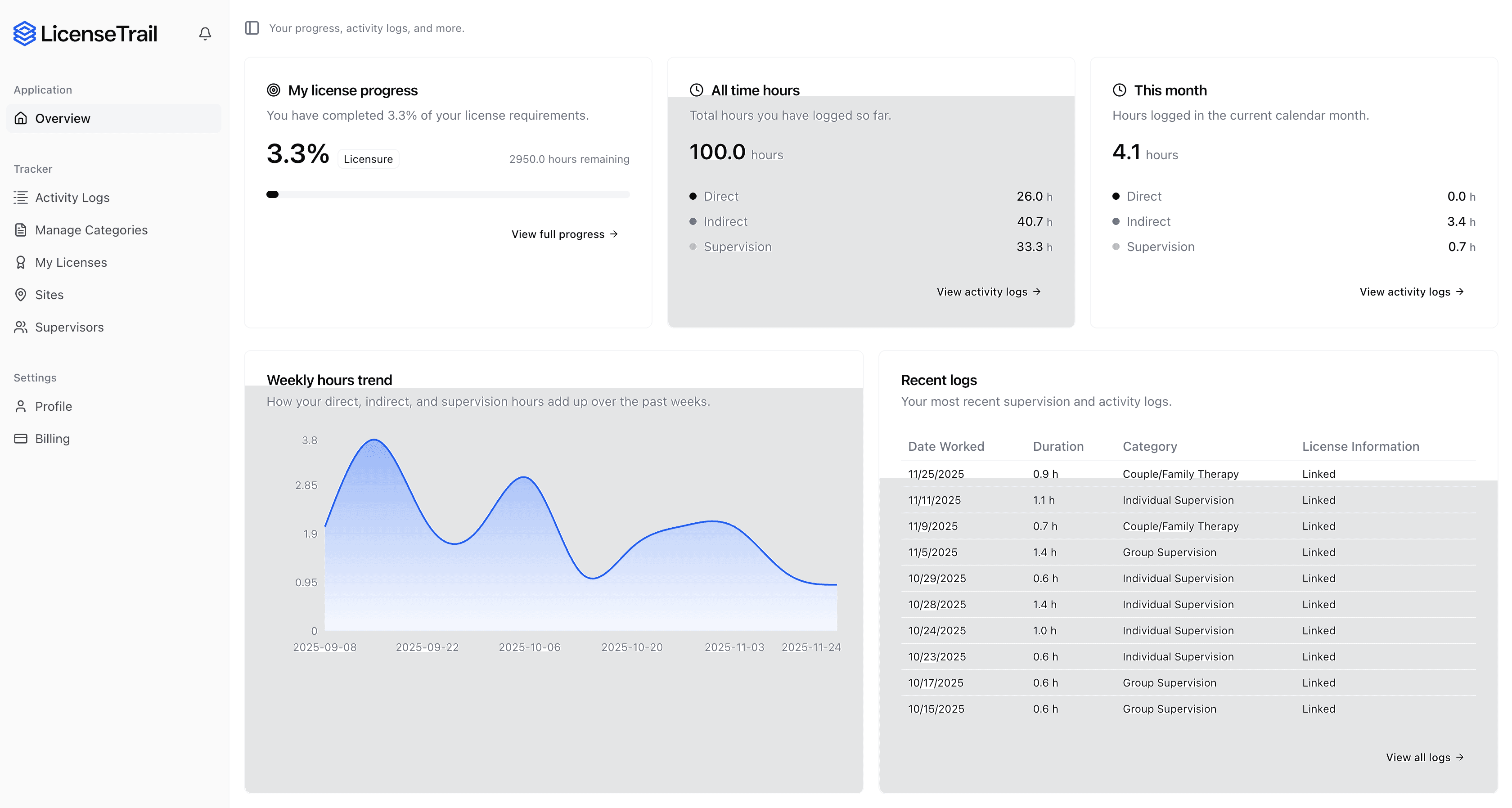 Start Tracking for Free
No credit card required · Free plan available
Related Licenses
Is your spreadsheet hiding California PTT risks?
Stop guessing if your categories match California Board of Psychology requirements. License Trail checks your direct, indirect, and supervision hours continuously and flags mismatches before you submit.
Import or log
Bring your spreadsheet or start fresh
Upload your existing tracking spreadsheet and we'll map every hour into the right California Board of Psychology categories automatically.
Verify against California
Catch mismatches before the board does
License Trail checks your direct, indirect, and supervision hours against California PTT requirements continuously.
Export board-ready
One-click clean reports
Generate professional, board-ready reports for supervision meetings and California Board of Psychology submissions in seconds.
No credit card required · Free plan available