
California PSB Requirements: Hours, Exams & Step-by-Step Guide
Stop guessing if your categories match California requirements. License Trail checks your direct, indirect, and supervision hours against PSB requirements continuously and flags mismatches before you submit.
No credit card required · Free plan available
Quick Requirements Overview
- Registration (PSB “Registered Psychological Associate”) required to perform psychological functions while unlicensed and accrue SPE toward psychologist licensure.
- Education prerequisite: qualify via master’s (psychology or specified education specializations) or doctoral candidacy meeting Board criteria or qualifying doctoral degree.
- Apply: PSB 100 + $424 fee; official transcripts/degree or candidacy verification; Live Scan (DOJ/FBI).
- To count hours: submit Supervision Agreement & Plan before experience starts; hours before agreement don’t count; maintain weekly log; supervisor completes Verification of Experience at end.
- Supervision: primary supervisor = CA licensed psychologist in same setting; available 100% while services provided; supervision ≥10% of weekly hours incl. ≥1 hr/week direct individual face-to-face; max 3 associates per supervisor.
- SPE hour rules: 3,000 total hours (2 years) with ≥1,500 postdoctoral; max 44 credited hrs/week; each 1,500-hr year within 30 consecutive months (60 months if both postdoc).
- Registration limits: cumulative max 72 months; annual renewal; 72-month clock runs unless cancelled/inactivated.
- Practice restrictions: work only under supervision; no direct client payment/independent practice; advertising must list RPA title + reg # + supervisor name/license #; clients must be told you’re unlicensed; no renting/subleasing office from supervisor/employer.
License Details
Procedures
California uses the title “Registered Psychological Associate” (registration numbers begin with PSB) for unlicensed trainees who are accruing supervised professional experience toward psychologist licensure. This is a registration, not a full license, but it is one of the primary pathways for earning the supervised hours the Board requires.
Below is a concise, regulation‑based walkthrough of:
- What you must have to register as a PSB Registered Psychological Associate
- How to apply
- How the Board defines and counts your hours (“supervised professional experience”)
- Ongoing supervision and practice restrictions
1. Role and purpose of the Registered Psychological Associate
Under California Business and Professions Code (BPC) § 2913, a person who is not yet a licensed psychologist may perform psychological functions in preparation for licensure only if they:
- Are registered with the Board as a “registered psychological associate,” and
- Meet specified education and supervision conditions. (california.public.law)
This registration allows you to function as a psychology trainee under supervision and to count qualifying time toward the two years / 3,000 hours of supervised professional experience (SPE) required for psychologist licensure. (psychology.ca.gov)
2. Educational prerequisites (what you must have before you can register)
To qualify to register as a Registered Psychological Associate, you must meet one of the educational statuses listed in BPC § 2913(b). In Board language, you must have completed or be any of the following: (california.public.law)
- Completed a master’s degree in psychology, or
- Completed a master’s degree in education with a specialization in:
- Educational psychology, or
- Counseling psychology, or
- School psychology; or
- Admitted candidate for a doctoral degree in either:
- Psychology with a specialization in clinical, counseling, school, consulting, forensic, industrial, or organizational psychology; or
- Education, with specialization in educational, counseling, or school psychology; or
- A field specifically designed to prepare graduates for the professional practice of psychology, after at least three years of postgraduate education in psychology and successful completion of preliminary doctoral exams; or
- Completed a qualifying doctoral degree that meets the psychologist licensure degree standard in BPC § 2914. (california.public.law)
The Board makes the final determination on whether a particular degree meets these criteria.
3. Registration limits and status
- Maximum registration period: Registration as a psychological associate is limited to a cumulative total of six years (72 months). (psychology.ca.gov)
- The 72‑month clock continues to run unless the registration is formally cancelled or placed in inactive status. (psychology.ca.gov)
- Registration must be renewed annually according to Board regulations. (california.public.law)
4. Step‑by‑step: How to apply for PSB registration
The Board’s instructions for “How to Apply for Registration as a Psychological Associate” (PSB 100) set out the process. (psychology.ca.gov)
Step 1 – Application and fee
- Complete the Board’s Application for Registration as a Psychological Associate (PSB 100).
- Pay the application fee of $424, as specified in BPC § 2987(f). (california.public.law)
- Mail the signed application and check to the California Board of Psychology (Sacramento address listed on the Board site). (psychology.ca.gov)
Step 2 – Official transcripts / degree verification
- Arrange for official transcripts for your qualifying degree to be sent directly from the institution to the Board.
- If you are applying based on doctoral candidacy rather than a completed degree, your registrar or dean must send a letter directly to the Board confirming:
- Your admission to candidacy, with the date;
- Completion of three or more years of postgraduate education in psychology; and
- Successful completion of preliminary doctoral exams. (psychology.ca.gov)
Step 3 – Fingerprinting / background check
- Complete the Board’s Request for Live Scan Services.
- Submit fingerprints via Live Scan to DOJ and FBI for a criminal history check, then send a copy of the Live Scan form to the Board. (psychology.ca.gov)
Step 4 – Supervision Agreement and Plan (if you want hours to count toward licensure)
- If you intend to accrue supervised professional experience (SPE) toward licensure in this role, the Board requires a Supervision Agreement and Plan:
- Completed and signed by you and your primary supervisor (and any delegated supervisors, if applicable);
- Submitted to the Board with your application. (psychology.ca.gov)
- The Board recommends using this form even if you do not initially plan to count the hours toward licensure. (psychology.ca.gov)
Step 5 – Adding additional supervisors
- To add or change a primary supervisor or service location:
- Submit the Notification to Add or Change Supervisor or Service Location for a Psychological Associate (PSB 101);
- Include a $210 fee for each additional primary supervisor;
- If you will accrue hours with that supervisor, also submit a new Supervision Agreement and Plan. (psychology.ca.gov)
You may not provide psychological services as a psychological associate until the Board approves and issues your registration. Providing services before registration is issued is considered unlicensed practice. (psychology.ca.gov)
5. Supervision structure for a Registered Psychological Associate
5.1 Who must supervise you
Under BPC § 2913(c) and 16 CCR § 1391.5:
- Your primary supervisor must be a licensed psychologist. (california.public.law)
- That supervisor must be employed in the same setting where you provide services. (psychology.ca.gov)
- The primary supervisor is responsible for ensuring that:
- The extent, kind, and quality of services you perform match both your training and theirs, and
- You comply with the Psychology Licensing Law and Board regulations. (california.public.law)
- A licensed psychologist may not supervise more than three registered psychological associates at any given time. (california.public.law)
5.2 Availability and supervision time
For supervised professional experience that will count toward licensure, 16 CCR § 1387 sets out the minimum standards, which also apply to hours earned as a Registered Psychological Associate: (law.cornell.edu)
- Supervisor availability: The primary supervisor must be available 100% of the time you are providing professional services (in person, phone, pager, or other appropriate technology). (law.cornell.edu)
- Weekly supervision minimum:
- You must receive supervision for at least 10% of the total time worked each week.
- At least one hour per week must be direct, individual, face‑to‑face supervision with the primary supervisor. (psychology.ca.gov)
- Maximum weekly credited hours:
- No more than 44 hours per week can be credited toward supervised professional experience.
- This 44‑hour limit includes the supervision time. (psychology.ca.gov)
5.3 Relationship and payment restrictions
- The primary supervisor must not have familial, intimate, or conflicting business relationships with you that would compromise supervision. (psychology.ca.gov)
- You cannot pay a fee, monetary or otherwise, for supervision, and you generally cannot be required to supply the provisions necessary to practice as a psychological associate. (psychology.ca.gov)
6. How the Board defines and counts your hours
6.1 The big picture: 3,000 hours of supervised professional experience (SPE)
To become a licensed psychologist in California, you must: (psychology.ca.gov)
- Complete two years (3,000 hours) of supervised professional experience (SPE), and
- Ensure that at least 1,500 hours are accrued post‑doctorally.
16 CCR § 1387(a) defines one year of SPE as 1,500 hours and requires that: (law.cornell.edu)
- At least one year (1,500 hours) must be postdoctoral;
- Each 1,500‑hour year must be completed within a 30‑consecutive‑month period;
- If both years (all 3,000 hours) are completed postdoctorally, they must be completed within 60 months.
6.2 Where those hours can be earned
For both predoctoral and postdoctoral SPE, you can accrue qualifying hours in several settings, including as a Registered Psychological Associate.
Under 16 CCR § 1387(a): (law.cornell.edu)
- Up to 1,500 hours (one year) may be accrued pre‑doctorally, but only:
- In a formal internship that meets APA/APPIC/CAPIC criteria (no Board registration required), or
- As an employee in an exempt setting under BPC § 2910 (no registration required), or
- As a Registered Psychological Associate under BPC § 2913 (Board registration required), or
- Under a qualifying state waiver (Welfare & Institutions Code § 5751.2).
- At least 1,500 hours must be postdoctoral, and can likewise be accrued:
- In an approved postdoctoral training program, or
- In an exempt setting, or
- As a Registered Psychological Associate, or
- Under a waiver. (law.cornell.edu)
So, California does not split the 3,000 hours into “1,500 direct” + “1,500 supervised” hours the way some states do. Instead, all hours are categorized as “supervised professional experience (SPE)”, and must meet supervision and setting criteria. Some of these SPE hours will involve direct client contact; others may be support or training activities, but all must fit within the Board’s definition.
6.3 Definition of “Supervised Professional Experience (SPE)”
16 CCR § 1387 defines SPE as an organized program consisting of a “planned, structured and administered sequence” of professionally supervised training experiences that: (law.cornell.edu)
- Build on your skills and competencies in a logical sequence;
- Socialize you into the profession of psychology; and
- Integrate psychological concepts and current scientific knowledge into the delivery of services.
The regulation further specifies that:
- SPE includes only time spent in psychological activities that directly prepare you for independent practice once licensed.
- SPE does not include purely custodial or clerical tasks such as filing, transcribing, or similar duties. (law.cornell.edu)
6.4 Documentation of hours
If you are a Registered Psychological Associate accruing hours toward licensure, the Board requires: (psychology.ca.gov)
- A Supervision Agreement and Plan prepared and signed before the experience begins; hours accrued before this agreement do not count.
- A written weekly log (SPE log) detailing all hours of supervised experience that will be submitted with your licensure application.
- At the end of each SPE placement, your primary supervisor must provide:
- A copy of the original Supervision Agreement (if not already on file), and
- A Verification of Experience form in a sealed envelope for submission with your psychologist license application.
7. Practice limitations while registered
Under BPC § 2913 and related regulations: (california.public.law)
- You are legally unlicensed and may only provide services as a trainee under supervision.
- You must not:
- Provide psychological services to the public except in your trainee role under this section;
- Receive payment directly from clients (you are paid, if at all, by the employer or setting);
- Advertise yourself as an independent practitioner. If listed in ads or on a website, it must clearly state you are a Registered Psychological Associate, your registration number, and the name and license number of your supervising psychologist. (psychology.ca.gov)
- You cannot rent or sublease office space from your supervisor or employer for the purpose of functioning as a psychological associate. (psychology.ca.gov)
Your primary supervisor must inform each client, before you render services, that you are unlicensed and are working under their direction and supervision. (psychology.ca.gov)
8. Putting it together: What is actually required
To summarize the Board‑defined requirements and hour structure for becoming and using a PSB Registered Psychological Associate:
- Meet education criteria in BPC § 2913(b) (master’s in psychology or specialized education field, doctoral candidacy in an accepted specialization, or qualifying doctoral degree). (california.public.law)
- Obtain supervision from a licensed psychologist who:
- Works in the same setting,
- Is available 100% of the time you render services,
- Provides at least one hour per week of direct individual supervision, and
- Ensures you receive supervision totaling at least 10% of your weekly hours. (law.cornell.edu)
- Apply for registration (PSB 100), provide transcripts/degree verification, complete Live Scan, pay the statutory application fee of $424, and, if counting hours, submit a Supervision Agreement and Plan. (psychology.ca.gov)
- Once registered, accrue supervised professional experience (SPE) that:
- Ultimately totals 3,000 hours across your training (at least 1,500 hours postdoctoral);
- Is obtained in approved settings and roles, including as a Registered Psychological Associate;
- Follows the SPE requirements in 16 CCR § 1387 (structured program, appropriate supervision, max 44 hours/week, non‑clerical activities). (law.cornell.edu)
- Stay within the 72‑month cap on psychological associate registration and renew annually as required. (regulations.justia.com)
California’s scheme centers everything on “supervised professional experience (SPE)” rather than a fixed split between “direct” versus “supervised” hours. As a Registered Psychological Associate, your role is to function as a supervised trainee under these rules while accumulating the 3,000 hours of SPE needed for psychologist licensure.
Track your PSB hours with confidence
License Trail checks your direct, indirect, and supervision hours against California PSB requirements continuously and flags mismatches before you submit.
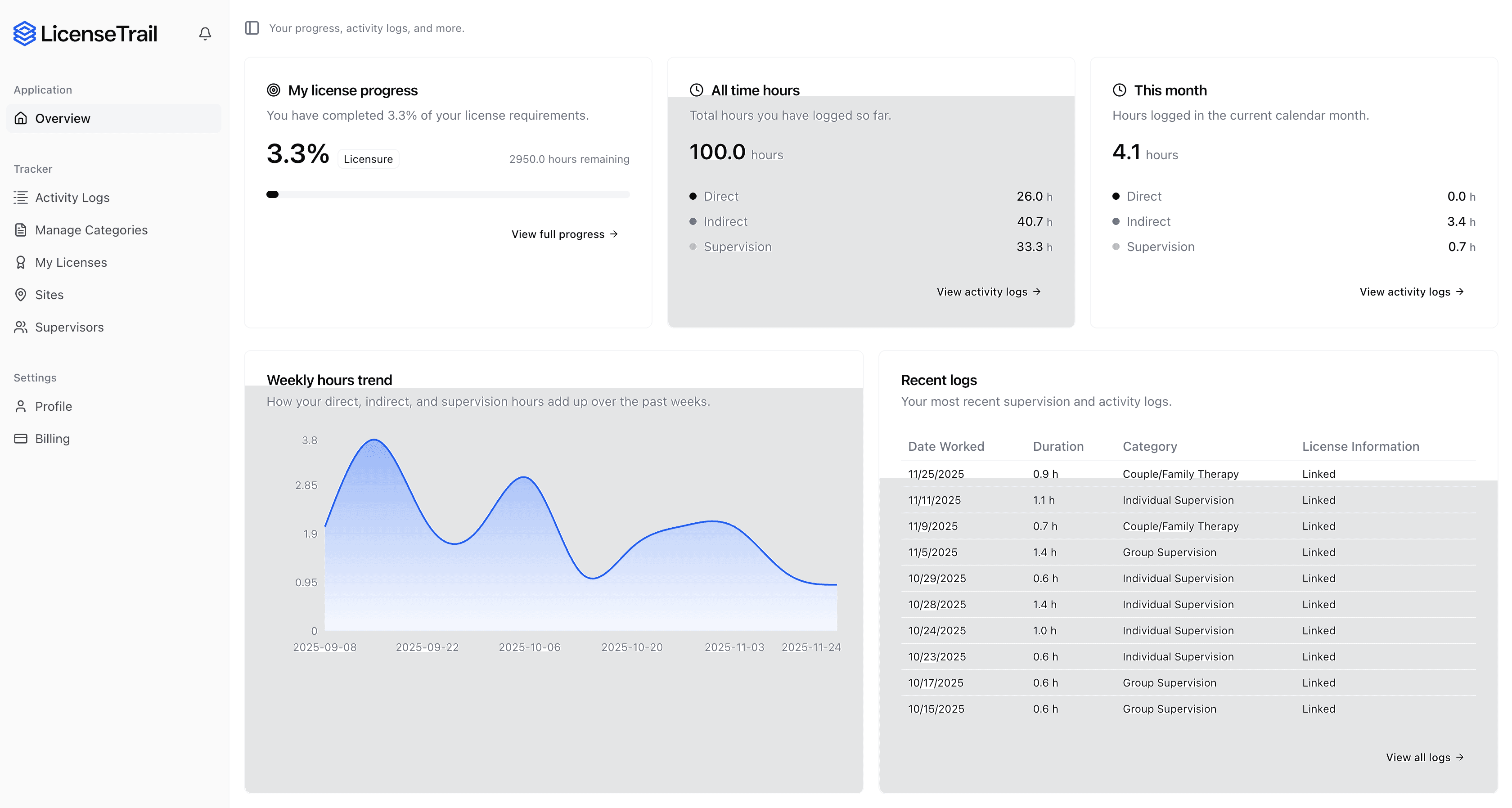 Start Tracking for Free
No credit card required · Free plan available
Related Licenses
Is your spreadsheet hiding California PSB risks?
Stop guessing if your categories match California Board of Psychology requirements. License Trail checks your direct, indirect, and supervision hours continuously and flags mismatches before you submit.
Import or log
Bring your spreadsheet or start fresh
Upload your existing tracking spreadsheet and we'll map every hour into the right California Board of Psychology categories automatically.
Verify against California
Catch mismatches before the board does
License Trail checks your direct, indirect, and supervision hours against California PSB requirements continuously.
Export board-ready
One-click clean reports
Generate professional, board-ready reports for supervision meetings and California Board of Psychology submissions in seconds.
No credit card required · Free plan available