
California RP Requirements: Hours, Exams & Step-by-Step Guide
Stop guessing if your categories match California requirements. License Trail checks your direct, indirect, and supervision hours against RP requirements continuously and flags mismatches before you submit.
No credit card required · Free plan available
Quick Requirements Overview
- Registration (not licensure): CA Board of Psychology registers Research Psychoanalysts (RP) under Psychology Law Article 3.5.
- Prereqs: Doctorate (or equivalent) plus demonstrated achievement/aptitude in teaching, training, or research; must be affiliated with/graduate of a Board-approved or “equivalent” psychoanalytic institute.
- Institute training minimums (equivalent institutes): 560 classroom hours over ≥3 years; 300 hours personal psychoanalysis (with qualified graduate psychoanalyst); 3 supervised psychoanalyses (3 different supervisors; ≥1 case to termination).
- Scope limits: Psychoanalysis only as an adjunct to teaching/training/research; fee-for-service ≤ one-third of total professional time; no full-time clinical practice.
- Title restrictions: Must not represent as a psychologist/psychology-licensed or use restricted “psychological/psychologist/psychology” type titles.
- Application requirements: Board application + fingerprint DOJ/FBI background check + institute dean certification; $150 application fee (plus fingerprint fees).
- Mandated content/training: Substance use dependency + spousal/partner abuse (hours not specified); effective 1/1/2026: 6 hrs suicide risk + 6 contact hrs aging/long-term care.
- Renewal: Every 2 years; renewal fee (≤$75) and 36 hours CPD per 2-year cycle; provide required consumer notice.
License Details
Procedures
Becoming a Registered Research Psychoanalyst (R.P.) in California
California does not license “RP Research Psychoanalysts” in the same way it licenses psychologists; instead, it registers them under Article 3.5 of the Psychology Law, now administered by the California Board of Psychology (BOP).(psychology.ca.gov)
A Research Psychoanalyst may practice psychoanalysis only as an adjunct to teaching, training, or research, and may not hold themselves out as a psychologist or as licensed to practice psychology.(legiscan.com)
Below is a step‑by‑step guide, focusing on what the state law and regulations actually require—especially hour‑based requirements and the Board’s own terminology.
1. Understand the role and limitations of a Research Psychoanalyst
Legal definition and scope
Under the regulations, a “Research Psychoanalyst” is a psychoanalyst who is registered with the state under the research psychoanalyst law.(law.cornell.edu)
State law allows specific groups to practice psychoanalysis under this exemption:
- Graduates of specified California psychoanalytic institutes (and institutes deemed equivalent by the Board) “who have completed clinical training in psychoanalysis” may engage in psychoanalysis as an adjunct to teaching, training, or research and may call themselves “psychoanalysts,” subject to restrictions below.(legiscan.com)
- Students in those institutes may practice psychoanalysis under supervision.(legiscan.com)
However, students and graduates:
- Must not use titles or descriptions that include “psychological,” “psychologist,” “psychology,” “psychometrists,” “psychometrics,” or “psychometry,” and must not state or imply that they are licensed to practice psychology.(legiscan.com)
“Adjunct” status and the one‑third rule
The regulations define “adjunct” this way:
- A Research Psychoanalyst may not engage in a full‑time clinical practice providing psychoanalytic services on a fee‑for‑service basis.
- They may provide fee‑for‑service psychoanalysis for no more than an average of one‑third of their total professional time, counting time spent in practice, teaching, training, and research.(regulations.justia.com)
- Teaching, training, or research must be the primary activity, typically demonstrated by:
- A full‑time faculty appointment at a qualifying institution, or
- Significant responsibility for teaching/training, or
- A significant research record (e.g., publications).(regulations.justia.com)
2. Complete the educational and professional prerequisites
Doctorate requirement and academic profile
To enter a psychoanalytic institute that qualifies for Research Psychoanalyst registration, the state requires that each research psychoanalyst student:
-
Hold a doctorate degree, or an equivalent level of education and experience, from:
- The University of California, a state university or college, or
- An accredited/approved institution (including properly accredited out‑of‑state schools).(law.cornell.edu)
-
Have shown prior achievement in teaching, training, or research with demonstrated aptitude in their primary scholarly or scientific field.(law.cornell.edu)
The Board’s application form reinforces this: in the declaration section, the applicant must affirm that they are the “lawful holder of a doctorate degree” obtained through regular instruction and examination.(psychology.ca.gov)
3. Complete psychoanalytic training that meets Board criteria
To be eligible for registration as a Research Psychoanalyst, you must have “completed clinical training in psychoanalysis” at:
- One of the specifically named California institutes (as updated by SB 775), or
- An institute the Board has deemed “equivalent.”(legiscan.com)
Regulation 16 CCR §1374 sets the minimum training structure for an “equivalent psychoanalytic institute.” This is where most of the explicit hour requirements appear:
Required training hours (state‑mandated minimums for equivalent institutes)
An equivalent psychoanalytic institute must require each research psychoanalyst student to complete at least:(law.cornell.edu)
-
Classroom instruction
- At least 560 hours of classroom training
- Spread over a minimum of three years
- Covering “all phases of psychoanalysis.”
-
Personal psychoanalysis
- A minimum of 300 hours of personal psychoanalysis
- Conducted by a graduate psychoanalyst with at least five years of post‑graduate clinical experience in psychoanalysis.
-
Supervised psychoanalytic cases
- At least three separate psychoanalyses
- Under the supervision of three different graduate psychoanalysts
- At least one case must be taken to termination, unless delay would pose an extreme hardship and the institute provides for continued supervision post‑graduation until a case is completed.
-
Ongoing clinical discussion and evaluation (no fixed hours given)
- Participation in continuous case conferences led by graduate psychoanalysts.
- Successful completion of either a comprehensive examination or an approved thesis.
Note that §1374 does not specify a global number of “direct client hours” or “supervised experience hours” beyond the personal analysis hours and the requirement to conduct the three supervised psychoanalyses.(law.cornell.edu)
Individual psychoanalytic institutes frequently impose additional hour requirements (e.g., large numbers of supervised treatment hours and internships), but those are program policies, not state law. The Board’s concern is that the institute as a whole meets or exceeds the minimum standards above.
4. Register as a Student Research Psychoanalyst (while in training)
If you are currently enrolled in an approved psychoanalytic institute and wish to treat patients as a trainee, you apply for Student Research Psychoanalyst registration with the Board of Psychology.(legiscan.com)
Key requirements for student registration
-
Enrollment in an approved or equivalent psychoanalytic institute
- The Board maintains a list of approved research psychoanalytic institutions and recognizes “equivalent” institutes that meet §1374.(psychology.ca.gov)
-
Dean’s certification
- The Board’s application requires “official certification from the dean verifying the student’s status” for Student Research Psychoanalyst applicants.(psychology.ca.gov)
-
Fingerprint‑based background check
- By statute, all applicants for registration as a research psychoanalyst or student research psychoanalyst must undergo a fingerprint‑based state and federal criminal history check.(california.public.law)
-
Application and fees
- Application fee: currently $150, plus fingerprint fees.(psychology.ca.gov)
-
Scope of practice and title restrictions
- Students may “engage in psychoanalysis under supervision.”(legiscan.com)
- They may not suggest they are licensed psychologists or use restricted psychological titles.(legiscan.com)
5. Register as a Research Psychoanalyst (after completing training)
Once you have completed psychoanalytic training at an approved or equivalent institute (as defined above), you may apply to register as a Research Psychoanalyst (RP) rather than a student.(regulations.justia.com)
What “completion of clinical training” means
Regulation 16 CCR §1370 defines “completed clinical training” as completing psychoanalytic training at one of the specified institutes or an equivalent institute meeting Board criteria.(regulations.justia.com)
Documentation and application elements
The Board’s application package requires:(psychology.ca.gov)
- Completed RP application form
- Application fee (currently $150)
- Fingerprint clearance (DOJ & FBI reports must be received before registration is issued)
- Education verification:
- Official certification from the institute’s dean verifying graduation (for RP), or
- Verification of student status (for SRP).
- A declaration under penalty of perjury that you:
- Are the person named in the application
- Are the lawful holder of a doctorate degree, obtained through standard coursework and examination
- Are submitting truthful information and authorize release of records to the Board.
Ongoing professional profile
On the RP application, you must also identify whether your primary professional activity is:
- Teaching (full‑time faculty),
- Training (significant responsibility for training), or
- Research (significant research with publications).(psychology.ca.gov)
This reflects the regulatory requirement that psychoanalysis remain adjunct to teaching, training, or research, not a full‑time clinical practice.(regulations.justia.com)
6. Mandatory coursework and training hours outside the institute curriculum
Beyond psychoanalytic training itself, state law now requires specific content areas and clock hours for Research Psychoanalyst applicants.
Substance use and partner abuse (no fixed hours specified)
Under newly added Business & Professions Code §2954.1, an applicant for registration as a Research Psychoanalyst must:(legiscan.com)
- Complete coursework or provide evidence of training in:
- Detection and treatment of alcohol and other chemical substance dependency; and
- Spousal or partner abuse assessment, detection, and intervention.
The statute mandates the content, but does not specify exact hour counts for these two topics.
Suicide risk assessment – 6 hours (effective January 1, 2026)
Effective January 1, 2026, §2954.4 adds an explicit hour requirement:(legiscan.com)
- Applicants must show they have completed a minimum of 6 hours of:
- Coursework or applied experience under supervision in suicide risk assessment and intervention.
This may be satisfied either:
- As part of the qualifying graduate degree or institute curriculum (with transcript or written certification), or
- Through separate training, for which the applicant must retain proof and certify compliance under penalty of perjury.
Aging and long‑term care – 6 contact hours (effective January 1, 2026)
Also effective January 1, 2026, §2954.5 requires:(legiscan.com)
- A minimum of 6 contact hours of coursework or applied experience in aging and long‑term care, including:
- Biological, social, and psychological aspects of aging; and
- Instruction on assessing, reporting, and treating elder and dependent adult abuse and neglect.
Again, this must be documented via transcript or program certification.
7. Renewal and continuing professional development (CPD) requirements
Registration term and fees
Under amended Business & Professions Code §2952:(legiscan.com)
- Initial registration fee: $150.
- Registration term: 2 years.
- Renewal fee: no more than $75 biennially (the Board currently lists $75).
Continuing professional development hours
§2954.2 introduces a specific continuing education requirement:(legiscan.com)
- To renew registration, a Research Psychoanalyst must complete 36 hours of approved continuing professional development (CPD) in the preceding two years.
- The registrant must:
- Certify compliance under penalty of perjury when renewing, and
- Retain proof (certificates, transcripts, etc.) for submission to the Board on request.
These 36 hours are in addition to the initial 6‑hour suicide risk and 6‑hour aging/long‑term care training that will be required for new applicants starting in 2026.
8. Consumer notice and background checks
Fingerprint background check
As noted above, §2953.1 mandates a statewide and national fingerprint‑based criminal history check for all Research Psychoanalyst and Student Research Psychoanalyst applicants, with the Board submitting fingerprints to the Department of Justice and receiving both state and federal responses.(california.public.law)
Notice to consumers
Research Psychoanalyst registrants must give each patient a notice to consumers explaining that they are registered and regulated by the board and how to check the registration or file a complaint. The regulation currently prescribes specific wording and requires the notice to be displayed or otherwise provided in a conspicuous format.(law.cornell.edu)
9. Hour‑based requirements: what California law does and does not require
Explicit hour requirements in California law/regulation for RPs
From the statutes and regulations currently in force (and those already enacted but effective January 1, 2026), the only numeric hour requirements specific to Research Psychoanalyst training or registration are:
| Category | Required Hours | Source |
|---|---|---|
| Classroom instruction in psychoanalysis | ≥ 560 hours over at least 3 years | 16 CCR §1374(e)(law.cornell.edu) |
| Personal psychoanalysis | ≥ 300 hours with a qualified graduate psychoanalyst | 16 CCR §1374(g)(law.cornell.edu) |
| Supervised psychoanalyses | Three supervised psychoanalyses with 3 different supervisors; at least one taken to termination (no hour count given) | 16 CCR §1374(h)(law.cornell.edu) |
| Suicide risk assessment & intervention (initial training) | 6 hours (coursework or supervised applied experience), effective 1/1/2026 | BPC §2954.4(legiscan.com) |
| Aging & long‑term care (initial training) | 6 contact hours, effective 1/1/2026 | BPC §2954.5(legiscan.com) |
| Continuing professional development | 36 hours every 2 years for renewal | BPC §2954.2(legiscan.com) |
The law also requires coursework/training in alcohol and other drug dependency and spousal/partner abuse, but without specifying a number of hours.(legiscan.com)
No “1,500 hours direct + 1,500 hours supervised” requirement in California law
The California Board of Psychology’s Research Psychoanalyst framework does not contain a requirement such as “1,500 hours of direct experience and 1,500 hours of supervised experience.”
Numbers of that kind do appear in other jurisdictions and private standards, such as:
- New York’s licensure requirements for psychoanalysts, and
- Private accrediting bodies and professional associations (for example, NAAP membership or New York‑based program standards).(op.nysed.gov)
Those figures do not apply to California’s Research Psychoanalyst registration unless an individual institute independently chooses to adopt similar thresholds as part of its own training curriculum.
In California, patient‑contact and supervision hours beyond the 560 classroom hours and 300 hours of personal analysis are largely determined by your psychoanalytic institute, provided the institute still meets or exceeds the minimal criteria in 16 CCR §1374.
Practical summary
To become registered as a Research Psychoanalyst (R.P.) with the California Board of Psychology, you must:
- Hold a doctorate and have a record of achievement in teaching, training, or research.(law.cornell.edu)
- Complete a full course of psychoanalytic training at a Board‑recognized institute, including:
- ≥560 hours of classroom instruction (≥3 years),
- ≥300 hours of personal psychoanalysis, and
- At least three supervised psychoanalyses, one taken to termination.(law.cornell.edu)
- Register first as a Student Research Psychoanalyst while in training if you wish to treat patients under supervision.(legiscan.com)
- Undergo fingerprint‑based state and federal background checks and submit the Board’s RP/SRP application with dean certification and fees.(california.public.law)
- Complete mandatory coursework/training in:
- Alcohol and other chemical substance dependency;
- Spousal/partner abuse assessment and intervention;
- (From January 1, 2026) 6 hours in suicide risk assessment/intervention and 6 contact hours in aging & long‑term care.(legiscan.com)
- Practice psychoanalysis only as an adjunct to your teaching, training, or research, and keep fee‑for‑service psychoanalysis under one‑third of your total professional time.(regulations.justia.com)
- Renew registration every 2 years with 36 hours of approved CPD each cycle and continuing compliance with all statutory and regulatory requirements.(legiscan.com)
Within that framework, the exact number of direct clinical hours and supervision hours you complete beyond the statutory minima will be governed by your psychoanalytic institute’s training standards, not by a statewide 1,500‑plus‑1,500 hour formula.
Track your RP hours with confidence
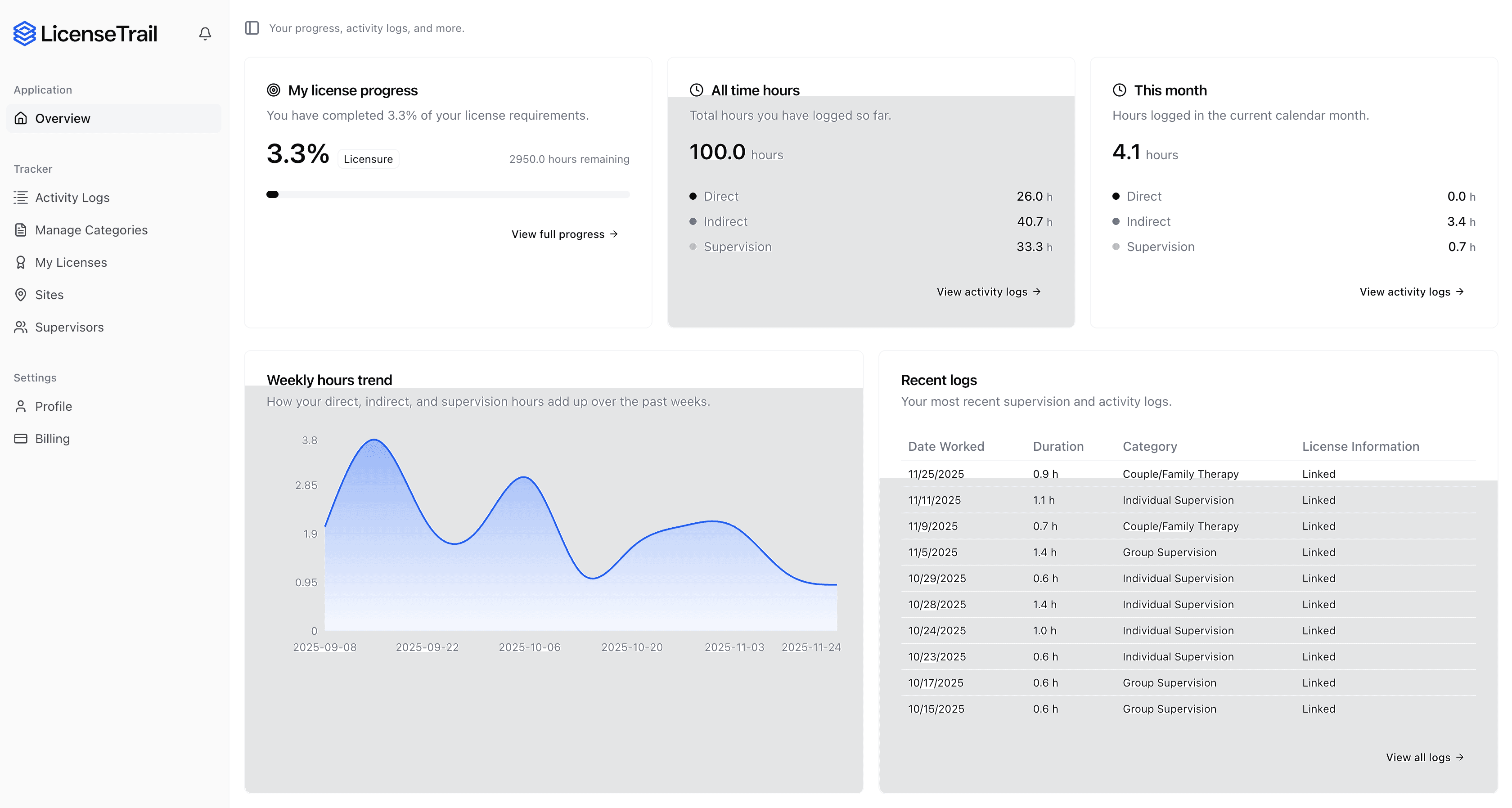
License Trail checks your direct, indirect, and supervision hours against California RP requirements continuously and flags mismatches before you submit.
 Start Tracking for Free
No credit card required · Free plan available
Related Licenses
Is your spreadsheet hiding California RP risks?
Stop guessing if your categories match California Board of Psychology requirements. License Trail checks your direct, indirect, and supervision hours continuously and flags mismatches before you submit.
Import or log
Bring your spreadsheet or start fresh
Upload your existing tracking spreadsheet and we'll map every hour into the right California Board of Psychology categories automatically.
Verify against California
Catch mismatches before the board does
License Trail checks your direct, indirect, and supervision hours against California RP requirements continuously.
Export board-ready
One-click clean reports
Generate professional, board-ready reports for supervision meetings and California Board of Psychology submissions in seconds.
No credit card required · Free plan available