
California SRP Requirements: Hours, Exams & Step-by-Step Guide
Stop guessing if your categories match California requirements. License Trail checks your direct, indirect, and supervision hours against SRP requirements continuously and flags mismatches before you submit.
No credit card required · Free plan available
Quick Requirements Overview
- Regulator/authority: California Board of Psychology (BOP) (program moved from Medical Board effective 01/01/2025; BPC §§2950–2954).
- Credential type: Registration (Student Research Psychoanalyst), not a psychologist/psychotherapist license.
- Eligibility: Must be enrolled in a BOP‑approved Research Psychoanalytical Institution; dean/official certification of current student status required.
- Background check: Fingerprint-based DOJ + FBI criminal history check required (Live Scan in CA; fingerprint cards if out-of-state).
- ID/tax: SSN or ITIN required for registration.
- Fees: $150 nonrefundable application/registration fee (plus any fingerprint processing fees).
- Practice limits: May engage in psychoanalysis only under supervision as part of institute training.
- Title/advertising restrictions: Must not imply psychology licensure or use prohibited “psychology/psychologist/psychological/psychometrics” wording in titles or service descriptions.
License Details
Procedures
Student Research Psychoanalyst (SRP) registration in California sits in an unusual niche: it is a narrow registration for psychoanalytic trainees, now overseen by the California Board of Psychology (BOP) but with most “hours” and training details dictated by the psychoanalytic institutes themselves, not by the state.
The points below focus on what the Board of Psychology and state law actually require, and then on where hour requirements typically come from.
1. Regulatory background and what an SRP is
- As of January 1, 2025, the Research Psychoanalyst and Student Research Psychoanalyst program was transferred from the Medical Board of California to the California Board of Psychology under SB 815 (Roth).(mbc.ca.gov)
- Article 3.5 of the California Business and Professions Code (BPC §§2950–2954) now governs “Research Psychoanalysts,” including student research psychoanalysts.(california.public.law)
- This is a registration, not a psychologist license. You are legally a “student research psychoanalyst”, not a “psychologist” or “psychotherapist.”
Statutory definition of who can register
BPC §2950 provides that:
- Graduates of specified psychoanalytic institutes (or equivalents approved by the Board) who have completed clinical training in psychoanalysis may register as research psychoanalysts.
- Students in those institutes may engage in psychoanalysis under supervision, but only if they register and do not hold themselves out with any title or description including “psychological,” “psychologist,” “psychology,” “psychometrists,” “psychometrics,” or “psychometry,” and do not state or imply that they are licensed to practice psychology.(california.public.law)
2. Core eligibility to become a Student Research Psychoanalyst (SRP)
2.1. Enrollment in an approved psychoanalytic institute
The Board’s application packet specifies as a minimum requirement:
- You must be enrolled in a “Research Psychoanalytical Institution” from the Board’s approved list (page 7 of the application form).(psychology.ca.gov)
For SRP registration:
- You must “submit official certification from the dean verifying the student’s status” in that approved psychoanalytic training program.(psychology.ca.gov)
There is no separate state‑mandated minimum of practicum, therapy, or supervision hours attached to SRP registration itself. The state defers to institute standards for the substance and volume of training.
2.2. Background check
Under BPC §2953.1, applicants for both:
- Research Psychoanalyst, and
- Student Research Psychoanalyst
must undergo a fingerprint-based state and national criminal history background check (California DOJ + FBI).(california.public.law)
The BOP application:
- Requires Live Scan fingerprints for California residents, or three fingerprint cards (or Live Scan in CA) for out‑of‑state applicants.
- States the Board must receive criminal record responses from both DOJ and FBI before issuing a registration.(psychology.ca.gov)
2.3. Identification and tax documentation
The Board’s packet makes disclosure of a U.S. Social Security Number (SSN) or Individual Taxpayer Identification Number (ITIN) mandatory before registration, pursuant to BPC §30 and related tax‑sharing provisions.(psychology.ca.gov)
2.4. Grounds for denial
The Board notes it may deny registration based on:
- Dishonesty or omission on the application,
- Unprofessional conduct,
- Criminal conviction, or
- Discipline on another professional license.(psychology.ca.gov)
3. Application components and process (SRP)
From the Board of Psychology’s “Application Information for Research Psychoanalyst or Student Research Psychoanalyst” form:(psychology.ca.gov)
-
Obtain the SRP/RP application
- Download from the “Research Psychoanalyst/Student Research Psychoanalyst” page of the BOP website.
-
Select application type
- Check “Student Research Psychoanalyst” in the “Type of Application” section.
-
Complete identity and background sections
- Legal name, date of birth, SSN or ITIN, addresses, contact information.
- Answer questions about prior registrations and any disciplinary history; provide the Board’s disciplinary form if applicable.
-
Education / Enrollment documentation
- Under “Education for Student Research Psychoanalyst Registration,” list your psychoanalytic school and have the dean or equivalent send official certification verifying current student status in that institute.
-
Fingerprinting / background check
- California residents: complete a Live Scan using the Board’s “Request for Live Scan Services” form and pay the Live Scan operator; the Board receives results directly.
- Out‑of‑state residents: submit three completed fingerprint cards plus the specified processing fee, or travel to California for Live Scan and then mail supporting forms as directed.
-
Fees
- Pay the application/registration fee of $150 (non‑refundable), as stated in the checklist.(psychology.ca.gov)
- Pay any additional DOJ/FBI processing fees as directed on the fingerprint forms (these may be collected by the Live Scan vendor or by the Board when hard cards are used).
-
Submit the complete packet
- Mail the signed application, fee, any fingerprint cards or Live Scan documentation, and education certification to the Board of Psychology in Sacramento.
4. Scope of practice and supervision rules for SRPs
4.1. “Adjunct” practice limitation (mainly for Research Psychoanalysts)
The Board’s application explains the statutory concept of “adjunct” practice for registered research psychoanalysts:
- Psychoanalysis must be an adjunct to teaching, training, or research.
- The research psychoanalyst may not provide fee‑for‑service psychoanalytic services for more than an average of one‑third of total professional time (including practice, teaching, training, and research).
- Teaching/training/research must be the primary professional activity, demonstrated by:
- A full‑time faculty appointment at a qualifying institution, or
- Significant ongoing responsibility for teaching or training, or
- Significant research output (e.g., professional publications).(psychology.ca.gov)
These adjunct limits technically apply to registered research psychoanalysts (RP). As a student research psychoanalyst, you:
- Practice only under supervision in an approved psychoanalytic institute or as arranged through that training.(california.public.law)
4.2. Title and advertising restrictions
Both the statute and the Board’s materials emphasize:
- Students and graduates are not allowed to state or imply that they are licensed to practice psychology.
- They may not use any title or description of services incorporating the words “psychological,” “psychologist,” “psychology,” “psychometrists,” “psychometrics,” or “psychometry.”(california.public.law)
In practice, your public designation should be something like:
“Student Research Psychoanalyst, registered with the California Board of Psychology; psychoanalytic services provided under supervision.”
(Always check your institute’s exact wording requirements.)
5. Are there hour requirements (clinical, supervision, etc.) for SRPs?
5.1. What the Board of Psychology and state law say
Neither:
- BPC §2950 and related Research Psychoanalyst provisions, nor
- The Board’s 2025 SRP/RP application packet,
set any specific numerical requirements for:
- Minimum direct client‑contact hours,
- Minimum supervision hours,
- Minimum personal analysis hours, or
- A required total (e.g., “1,500 hours of direct experience and 1,500 hours of supervised experience”).
Instead, the only hour-like requirements in statute currently relate to:
- Continuing professional development for registered research psychoanalysts: proposed requirement of 36 hours every two years for renewal (SB 775, adding BPC §2954.2).(legiscan.com)
- Specific topic coursework for research psychoanalysts (not explicitly for SRPs), such as minimum hours in suicide risk assessment and aging/long‑term care, effective January 1, 2026, if and as those provisions are implemented.(legiscan.com)
There is no statute or BOP regulation that says, for SRPs: “You must complete X hours of direct experience and Y hours of supervised experience.”
5.2. Where the hour requirements actually come from: the institutes
In practice, hour requirements are created by the individual psychoanalytic institutes, not by the Board.
For example, one approved California institute (the Psychoanalytic Center of California) requires its Research Psychoanalysis candidates to complete:(p-c-c.org)
- At least 300 hours of personal analysis,
- A field placement internship of at least 10 hours per week for at least 10 months in an approved mental health facility,
- At least 150 hours of supervised psychotherapy experience in that internship before taking analytic control cases, and
- Ongoing supervision on analytic cases until graduation, with specific ratios (e.g., one hour of supervision per four hours of patient contact).
These are institute standards, used to determine progression and graduation; the Board simply requires that the institute itself be on its approved list and that the dean certifies your student status.(psychology.ca.gov)
So if you are looking for a breakdown such as “1,500 hours of direct service, 1,500 hours supervised,” you will not find that in Board or statutory language for SRPs. You will find that kind of specificity only in the curriculum documents of your particular psychoanalytic institute.
6. Special notes about timing and future requirements
- As of November 23, 2025, the Board of Psychology is fully administering SRP/RP registrations under SB 815.(mbc.ca.gov)
- SB 775 (2025) adds several new requirements for research psychoanalysts (not clearly extended to SRPs), including:
- Coursework/training in alcohol and other drug dependency and in spousal/partner abuse assessment and intervention (BPC §2954.1).
- Required continuing professional development hours for renewal (BPC §2954.2).
- Additional 6‑hour coursework minimums in suicide risk and in aging/long‑term care starting January 1, 2026, for research psychoanalyst applicants.(legiscan.com)
SRPs should be aware of these because they will likely apply later if you transition from student research psychoanalyst to research psychoanalyst registration.
7. Practical checklist if you want to become an SRP
Putting this together in a concise sequence:
-
Gain admission to a Board‑approved psychoanalytic institute.
- Confirm the institute is on the BOP’s “Approved Research Psychoanalytical Institutions” list.(psychology.ca.gov)
-
Clarify your institute’s internal training-hour requirements.
- These will govern your actual practicum, personal analysis, supervision, and casework hours.
- They are often extensive (hundreds of analysis hours, intensive supervision, and multi‑year training), but they vary by program.
-
Request official certification from your institute.
- Have the dean or appropriate official send documentation verifying your current student status for SRP registration.(psychology.ca.gov)
-
Complete the Board of Psychology’s SRP application.
- Check “Student Research Psychoanalyst,” answer all questions, and sign under penalty of perjury.
-
Complete fingerprinting and pay required fees.
- Live Scan or fingerprint cards, plus the $150 application fee and any processing charges.(psychology.ca.gov)
-
Await Board review and registration issuance.
- The Board will issue your Student Research Psychoanalyst registration after receiving your background checks and verifying eligibility.
-
Practice only under supervision and within title limitations.
- Provide psychoanalytic services solely within the framework arranged by your institute and supervisor.
- Do not use any title or suggestive wording implying you are licensed to practice psychology or are a psychologist.(california.public.law)
In summary: becoming an SRP in California is primarily about (1) being enrolled in an approved psychoanalytic institute, (2) passing the Board’s registration and background‑check process, and (3) practicing under supervision with strict title restrictions. The Board of Psychology does not set specific clinical or supervision hour minimums for SRP registration; those numerical requirements come from your psychoanalytic institute’s curriculum rather than from state law or the Board itself.
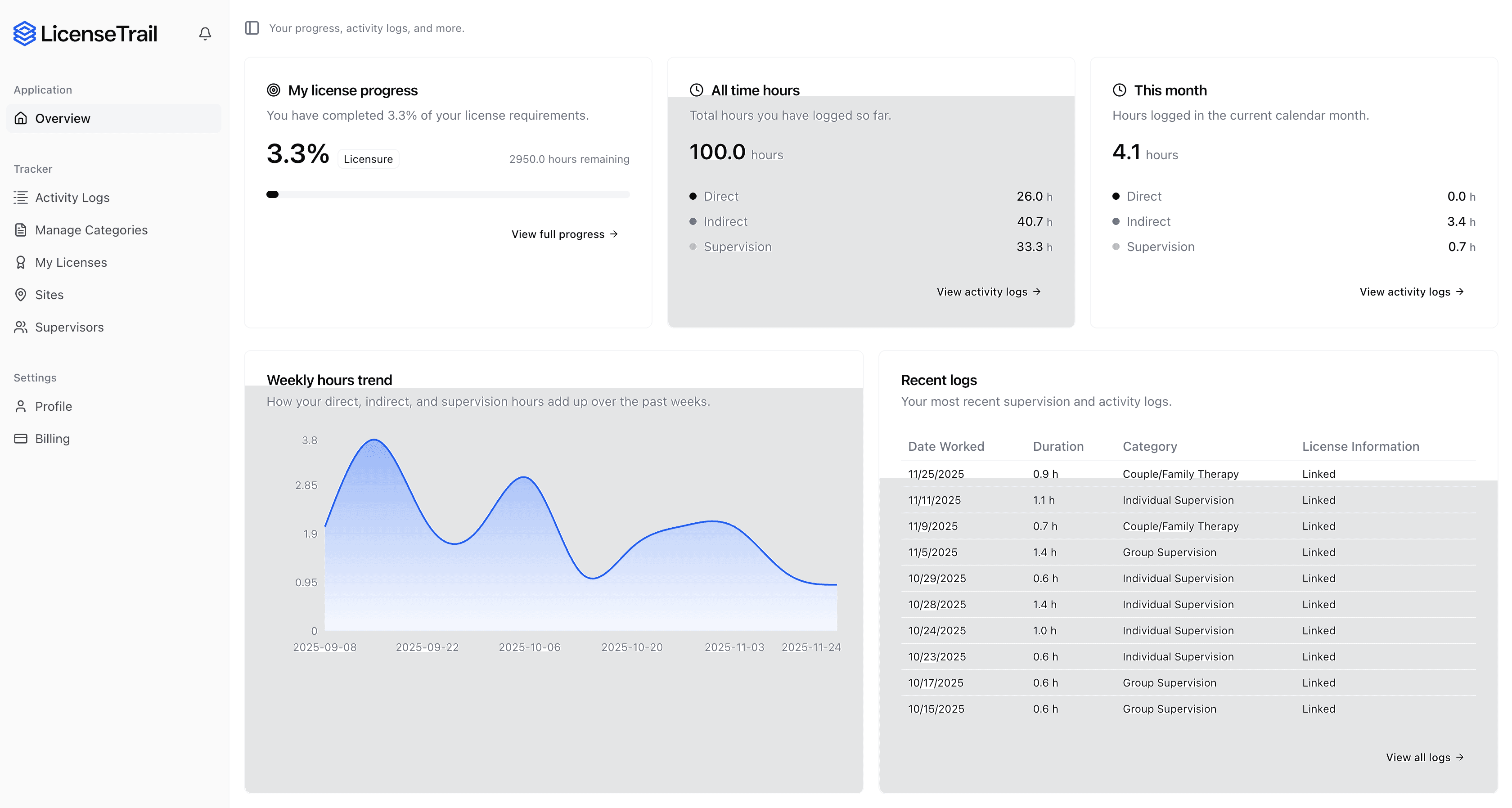
Track your SRP hours with confidence
License Trail checks your direct, indirect, and supervision hours against California SRP requirements continuously and flags mismatches before you submit.
 Start Tracking for Free
No credit card required · Free plan available
Related Licenses
Is your spreadsheet hiding California SRP risks?
Stop guessing if your categories match California Board of Psychology requirements. License Trail checks your direct, indirect, and supervision hours continuously and flags mismatches before you submit.
Import or log
Bring your spreadsheet or start fresh
Upload your existing tracking spreadsheet and we'll map every hour into the right California Board of Psychology categories automatically.
Verify against California
Catch mismatches before the board does
License Trail checks your direct, indirect, and supervision hours against California SRP requirements continuously.
Export board-ready
One-click clean reports
Generate professional, board-ready reports for supervision meetings and California Board of Psychology submissions in seconds.
No credit card required · Free plan available