
Colorado CAS Requirements: Hours, Exams & Step-by-Step Guide
Stop guessing if your categories match Colorado requirements. License Trail checks your direct, indirect, and supervision hours against CAS requirements continuously and flags mismatches before you submit.
No credit card required · Free plan available
Quick Requirements Overview
- Minimum eligibility: 18+ and not in violation of Colorado Mental Health Practice Act/Board rules
- Education: Bachelor’s degree in a behavioral health concentration or human services equivalent (CCE equivalency review if needed)
- Training: Complete the full BHA-approved CAS curriculum via an approved CAC Clinical Training Program (no substitutions unless allowed)
- Experience (CAT foundation): 1,000 supervised clinical experience hours over ≥ 6 months (can count toward CAS)
- Experience (CAS total): 3,000 supervised clinic work hours over ≥ 18 months (may include the CAT 1,000 hours)
- Supervision: Hours must be addiction-counseling practice under qualified clinical supervision with documented verification forms
- Exams: Pass Colorado jurisprudence exam and NAADAC NCAC II (Level II) or equivalent
- Renewal/CPC: 40 PDH every 2 years plus required self-assessment/learning plan (subject to audit)
License Details
Procedures
In Colorado, the Certified Addiction Specialist (CAS) credential is the mid‑level addiction counseling certification issued by the State Board of Addiction Counselor Examiners within the Department of Regulatory Agencies (DORA). It sits above the Certified Addiction Technician (CAT) and below the Licensed Addiction Counselor (LAC).
The requirements for CAS come from three places that work together:
- Colorado statute (C.R.S. § 12‑245‑804)
- Board rules (4 CCR 744‑1, Board of Addiction Counselor Examiners Rules)
- Behavioral Health Administration (BHA) training standards
Below is a step‑by‑step guide focused on what you need to become a CAS, with special attention to the required hours and the exact types of hours the law and rules talk about.
1. Understand what the CAS credential is
Under Colorado law, a person who holds a valid CAS certificate:
- Has the right to practice addiction counseling under supervision or consultation as required by rule, and
- May supervise addiction counseling practice and use the title “certified addiction counselor” and the abbreviation “CAS.” (codes.findlaw.com)
The CAS level is designed for bachelor’s‑level clinicians who provide direct addiction counseling services and can supervise CAT‑level counselors.
2. Meet the basic statutory eligibility
Colorado statute requires that, for certification as an addiction counselor (which includes CAT and CAS), the Board must see that you: (colorado.public.law)
- Are at least 18 years of age.
- Are not in violation of the Mental Health Practice Act or any rules of:
- the State Board of Addiction Counselor Examiners, or
- the State Board of Human Services (which sets education/training rules).
These are baseline conditions for any certification application.
3. Education requirement for CAS
The statute is very specific about your degree level and major area:
A certified addiction specialist must have “a bachelor’s degree in a behavioral health concentration or human services equivalent.” (colorado.public.law)
Key points:
- Minimum degree: Bachelor’s (BA or BS).
- Field: Behavioral health or human services–type degree (e.g., psychology, counseling, human services, social work, behavioral health sciences).
- Equivalency: If your degree isn’t a straightforward match, Colorado now uses the Center for Credentialing & Education (CCE) to perform education equivalency reviews for addiction counselors and other mental‑health professions. (dpo.colorado.gov)
In practice, if your degree is in something adjacent (for example, criminal justice or sociology), you often must go through an education equivalency evaluation to show it meets the “behavioral health concentration or human services equivalent” standard.
4. Required addiction‑specific training (coursework)
Two different sets of rules govern the training:
- State statute (for LAC) says applicants must complete “clock hours of addiction‑specific training” in areas such as evidence‑based treatment, clinical supervision, ethics, and co‑occurring disorders. (colorado.public.law)
- BHA training rules and the “Training Requirements for CAS” document spell out the exact courses and hours (e.g., advanced treatment models, CBT, advanced MI, etc.). These are BHA‑approved curricula; DORA relies on BHA to define the training package. (bha.colorado.gov)
Practically, to be eligible for CAS you must:
- Complete the full, BHA‑approved CAS curriculum at a recognized CAC Clinical Training Program (listed on the BHA site). (bha.colorado.gov)
- Make sure each course appears in the official “Training Requirements for CAS” and is recorded in your training transcript.
Because the exact course‑by‑course hour totals are maintained in BHA PDFs, the Board’s expectation is simply that you complete every required CAS training listed by BHA; they do not let you “mix and match” substitute courses unless specifically allowed under BHA rules.
5. The critical requirement: supervised experience hours for CAS
This is where the law is very specific about hours and the type of hours.
5.1. CAT‑level supervised clinical experience
The statute first defines what supervised experience looks like for the CAT level:
A Certified Addiction Technician must have: (colorado.public.law)
- “A minimum of one thousand hours of supervised clinical experience hours over a minimum of six months, which includes hours accrued prior to the application for certification so long as the supervised clinical experience hours meet any additional criteria as defined by the board.”
In other words, for CAT:
- 1,000 supervised clinical experience hours
- Accrued in no less than 6 months
- Hours can begin before you formally apply, if they meet Board criteria.
Most people who become CAS have already gone through this CAT step, so these 1,000 hours often become the foundation for CAS.
5.2. CAS‑level “supervised clinic work hours”
For the Certified Addiction Specialist level, the same statute requires that a CAS must have: (colorado.public.law)
- “Accrued a minimum of three thousand hours of supervised clinic work hours over a minimum of eighteen months, which may include the one thousand hours required to be accrued for certification as a certified addiction technician.”
This is the central hour requirement for CAS. In plain language:
- Total required for CAS:
- 3,000 hours of supervised clinic work hours
- Completed over at least 18 months (you cannot compress them into a shorter period).
- Overlap with CAT hours:
- Those 3,000 CAS hours may include the 1,000 CAT supervised clinical experience hours you already earned, as long as they meet the Board’s criteria.
So, the typical pattern looks like:
- Step 1 – CAT:
- 1,000 supervised clinical experience hours (≥ 6 months).
- Step 2 – CAS:
- An additional 2,000 supervised clinic work hours (for a total of 3,000), spread over at least 18 months in all.
The statute does not divide the 3,000 CAS hours into separate categories such as “direct” vs. “indirect” time. Instead, all 3,000 must be “supervised clinic work hours” in the addiction field.
5.3. How “supervised” is defined
Board rules for licensure (LAC) give useful definitions the Board also uses for supervised experience at lower levels. In 4 CCR 744‑1.15, “clinical supervision” is defined as personal and responsible direction, in person or virtually, by an approved supervisor, who must: (regulations.justia.com)
- Have sufficient knowledge of all clients,
- Be able to approve cases and treatment plans, and
- Personally observe, evaluate, and correct services provided by the supervisee.
While that particular rule section is written for LAC licensure, the Board uses the same basic concepts when it recognizes “supervised clinic work hours” and “supervised clinical experience hours” for CAT and CAS. The hours must reflect:
- Actual practice of addiction counseling, not purely administrative work; and
- Practice that is under the oversight of a qualified supervisor (CAS, LAC, or another board‑approved behavioral health professional, under the applicable rules). (regulations.justia.com)
5.4. Direct vs. indirect hours (what the law does and doesn’t say)
For CAS specifically, the law does not require a specific split between:
- “Direct” client contact hours, and
- “Indirect” hours (documentation, case consultation, team meetings, etc.).
It simply requires 3,000 supervised clinic work hours.
By contrast, for LAC licensure, statute and rules do specify that an applicant must complete “at least two thousand direct clinical hours of clinically supervised work experience in the addiction field.” (colorado.public.law)
So if you are only targeting the CAS level, you are working toward:
- 3,000 total supervised clinic work hours,
- Not a particular number of “direct” hours within that total (although in practice, programs and supervisors will still want most of your time in direct clinical service).
6. Required examinations
Two examinations are required at the CAS level:
-
Colorado Mental Health Professions Jurisprudence Examination
- Statute requires a jurisprudence exam for licensure and for CAS‑level credentials. (colorado.public.law)
- Administered online by the Division of Professions and Occupations (DPO).
- Covers Colorado law and rules, confidentiality, prohibited conduct, disciplinary process, etc.
-
National examination – NCAC II–level (CAS)
- The law requires that a CAS applicant have passed “the national certification addiction counselor level II examination” (NAADAC) or an equivalent successor exam. (colorado.public.law)
You must pass both exams within the timeframes specified in Board rules (typically within five years of application, or you may have to re‑test). (regulations.justia.com)
7. Putting the requirements together: a step‑by‑step path to CAS
Step 1 – Obtain the right degree
- Complete a bachelor’s degree in a behavioral health concentration or human services equivalent (or complete an education equivalency review if your degree is not clearly in that category). (colorado.public.law)
Step 2 – Complete CAT‑level training and hours (if you have not already)
Most CAS applicants first become CATs:
- Take the BHA‑approved CAT training curriculum. (bha.colorado.gov)
- Complete 1,000 supervised clinical experience hours over at least 6 months under an approved supervisor. (colorado.public.law)
- Pass the NCAC I‑level exam and the jurisprudence exam (for CAT certification).
Although the statute allows you to accrue qualifying hours even before you formally apply, they must meet all Board/BHA criteria.
Step 3 – Complete CAS‑specific coursework
- Enroll in a BHA‑approved CAC Clinical Training Program and complete all courses listed in the official “Training Requirements for CAS” document. (bha.colorado.gov)
- Ensure the program provides you with transcripts or certificates that match the exact course titles required by BHA.
Step 4 – Accrue the full 3,000 “supervised clinic work hours”
Working in an approved clinical setting (often one of the Addiction Counselor Clinical Training Program facilities listed by BHA): (bha.colorado.gov)
- Accumulate a total of 3,000 supervised clinic work hours, over at least 18 months.
- This 3,000‑hour total can include your 1,000 CAT supervised clinical hours, so many clinicians effectively add another 2,000 supervised hours beyond CAT. (colorado.public.law)
Your hours typically include:
- Direct face‑to‑face counseling (individual and group),
- Assessment and treatment planning,
- Documentation directly tied to client care,
- Case consultation and team meetings related to client care.
Hours must be:
- Documented and verified by your supervisor on the Board’s Work Verification Form or equivalent (a downloadable form on the DPO site). (dpo.colorado.gov)
- Under qualified clinical supervision, in line with the definitions and supervisor qualifications in Board rules. (regulations.justia.com)
Step 5 – Pass the required exams at CAS level
- Colorado jurisprudence examination (if not already passed within the allowed timeframe). (colorado.public.law)
- NCAC II‑level exam (National Certification Addiction Counselor Level II) or its successor; your exam provider reports your passing status, and you also attach verification to your application. (colorado.public.law)
Step 6 – Apply to the State Board of Addiction Counselor Examiners for CAS
Applications are handled through DPO Online Services: (dpo.colorado.gov)
You will:
- Create or log into your DPO account.
- Select the application for “Certified Addiction Technician and Specialist – Initial License by Original or Endorsement Method” and choose the CAS level. (dpo.colorado.gov)
- Upload or arrange for:
- Degree transcript/equivalency evaluation,
- Proof of completion of all required BHA CAS trainings,
- Work Verification Form(s) documenting your 3,000 supervised clinic work hours (with supervisor signatures),
- Exam score reports (jurisprudence and NCAC II),
- Any other disclosures (disciplinary history, criminal background information, if applicable).
Board rules specify that:
- Your application remains active for one year; if you don’t finalize certification by then, you may have to re‑apply and meet any updated requirements. (regulations.justia.com)
Once approved, DORA issues your CAS certificate, and you are recognized as a Certified Addiction Specialist under Colorado law.
8. Maintaining your CAS certification (Continuing Professional Competency)
After initial certification, Colorado requires ongoing Continuing Professional Competency (CPC) for CAT, CAS, and LAC: (dpo.colorado.gov)
- CAS holders must complete at least 40 Professional Development Hours (PDH) in each two‑year certification period.
- PDH must relate directly to addiction counseling competence.
- You must:
- Complete a Professional Practice Survey and Self‑Assessment,
- Create a Learning Plan, and
- Log at least 40 PDH across at least two categories of Professional Development Activities.
CPC requirements apply for each renewal cycle and are subject to audit.
Summary of the hour requirements for CAS (as the Board and statute define them)
For Certified Addiction Specialist (CAS) in Colorado, as of November 23, 2025, the controlling statutory and rule language can be summarized this way:
- Degree: Bachelor’s or higher in a “behavioral health concentration or human services equivalent.” (colorado.public.law)
- Experience hours:
- CAT foundation:
- 1,000 “supervised clinical experience hours” over at least 6 months (usually obtained at the CAT level). (colorado.public.law)
- CAS total:
- 3,000 “supervised clinic work hours” over at least 18 months, which may include the 1,000 CAT hours. (colorado.public.law)
- The law does not carve those 3,000 hours into separate numerical requirements for “direct” vs. “indirect” hours; it simply requires they be supervised clinic work hours in the addiction field.
- CAT foundation:
- Training: Completion of all BHA‑approved CAS training courses as listed in the official Training Requirements for CAS and CAC Handbook. (bha.colorado.gov)
- Exams:
- Colorado jurisprudence examination, and
- NAADAC Level II (NCAC II) (or equivalent) national exam. (colorado.public.law)
Those are the hour‑related and key eligibility requirements as defined in Colorado statute and Board rules for becoming a Certified Addiction Specialist under the Colorado State Board of Addiction Counselor Examiners.
Track your CAS hours with confidence
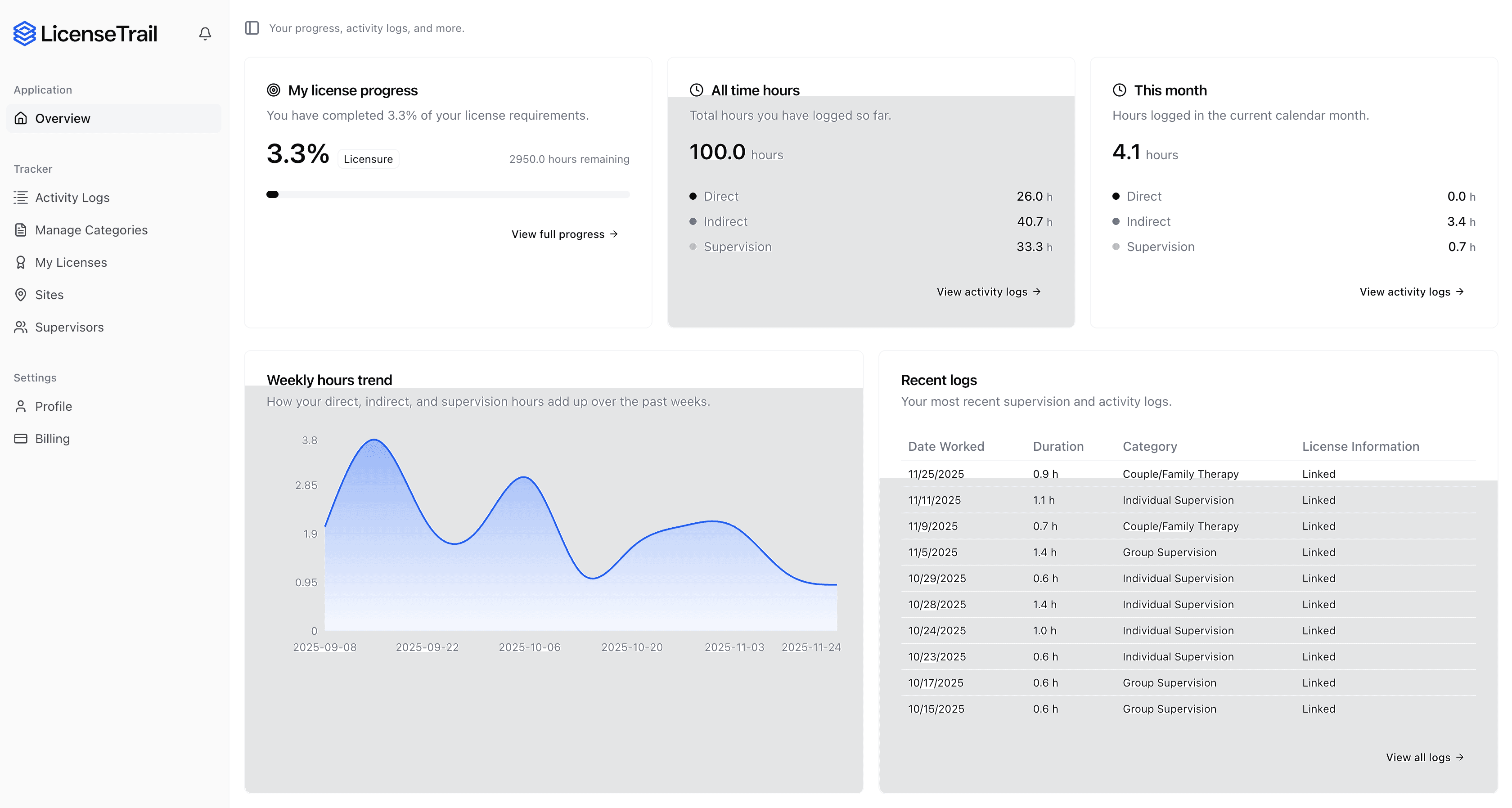
License Trail checks your direct, indirect, and supervision hours against Colorado CAS requirements continuously and flags mismatches before you submit.
 Start Tracking for Free
No credit card required · Free plan available
Related Licenses
Is your spreadsheet hiding Colorado CAS risks?
Stop guessing if your categories match Colorado State Board of Addiction Counselor Examiners requirements. License Trail checks your direct, indirect, and supervision hours continuously and flags mismatches before you submit.
Import or log
Bring your spreadsheet or start fresh
Upload your existing tracking spreadsheet and we'll map every hour into the right Colorado State Board of Addiction Counselor Examiners categories automatically.
Verify against Colorado
Catch mismatches before the board does
License Trail checks your direct, indirect, and supervision hours against Colorado CAS requirements continuously.
Export board-ready
One-click clean reports
Generate professional, board-ready reports for supervision meetings and Colorado State Board of Addiction Counselor Examiners submissions in seconds.
No credit card required · Free plan available