
Colorado CAT Requirements: Hours, Exams & Step-by-Step Guide
Stop guessing if your categories match Colorado requirements. License Trail checks your direct, indirect, and supervision hours against CAT requirements continuously and flags mismatches before you submit.
No credit card required · Free plan available
Quick Requirements Overview
- Regulator(s): DORA State Board of Addiction Counselor Examiners (issues CAT); BHA sets required addiction-training “clock hours” curriculum
- Minimum eligibility: Age 18+; high school diploma (or equivalent); must be in compliance with the Mental Health Practice Act
- Required training: Complete BHA-approved addiction-specific coursework (clock hours per current CAT training chart; commonly ~112 hours)
- Required experience: 1,000 hours of supervised clinical experience over at least 6 months (may include qualifying hours earned before application)
- Exams: Pass CO Mental Health Professions Jurisprudence Exam + NAADAC NCAC Level I (or Board-accepted equivalent)
- Scope/title: Entry-level; may practice addiction counseling under supervision/consultation; may use “CAC” or “CAT” title
- Renewal/CPC: 40 PDH (clock hours) every 2-year cycle; category limits and limited carryover apply per DORA CPC rules
License Details
Procedures
Colorado regulates addiction counseling through two state entities working together:
- The State Board of Addiction Counselor Examiners in the Department of Regulatory Agencies (DORA), which issues the Certified Addiction Technician (CAT) credential and enforces the Mental Health Practice Act. (dpo.colorado.gov)
- The Behavioral Health Administration (BHA) in the Department of Human Services, which sets the education and training standards (courses and “clock hours”) for addiction counselor credentials. (bha.colorado.gov)
A CAT is the entry‑level, state‑regulated addiction counseling credential in Colorado. It allows you to practice “addiction counseling under supervision or consultation” and to use the title “certified addiction counselor” with the abbreviation “CAC” or “CAT.” (codes.findlaw.com)
Below is a structured guide to the current requirements, focusing on the exact hour types and the Board’s statutory language as of late 2025.
1. Snapshot of CAT Requirements (What the law/Board require)
Under C.R.S. 12‑245‑804(3.5)(a), the Board’s rules must require that a Certified Addiction Technician: (colorado.public.law)
-
Education level
- Have “a high school diploma or its equivalent.”
-
Supervised clinical experience hours
- Have “accrued a minimum of one thousand hours of supervised clinical experience hours over a minimum of six months”
– Hours can include those accrued before you apply for CAT, so long as they meet the Board’s criteria. (colorado.public.law)
- Have “accrued a minimum of one thousand hours of supervised clinical experience hours over a minimum of six months”
-
Examinations
- Have “passed a jurisprudence examination as determined by the board” (the Colorado Mental Health Professions Jurisprudence Exam).
- Have “passed the national certification addiction counselor level I examination” administered by NAADAC (the NCAC Level I exam), or an equivalent exam. (colorado.public.law)
-
Addiction‑specific training hours (coursework)
- At the licensure (LAC) level, the law specifies that the applicant must have completed “the number of clock hours of addiction‑specific training” required by Board rule, including training in evidence‑based treatment, clinical supervision, ethics, and co‑occurring disorders. The same training framework under BHA rules underpins CAT and CAS. (colorado.public.law)
- BHA’s Training Requirements for CAT chart (a state PDF) spells out the exact number and type of clock‑hour courses; independent summaries indicate this is currently about 112 clock hours of BHA‑approved coursework for CAT candidates. (counselingschools.com)
-
Age and conduct
- To be certified as an addiction counselor (CAT or CAS), you must be “at least eighteen years of age” and “not in violation” of the Mental Health Practice Act or related rules. (law.justia.com)
Colorado also requires certified and licensed addiction counselors to maintain Continuing Professional Competency (CPC) by completing 40 Professional Development Hours (PDH) every two‑year certification period (PDH = clock hours). (dpo.colorado.gov)
2. Understanding the Hour Types and Official Verbiage
2.1 “Clock hours of addiction‑specific training”
In statute and Board rules, course‑based training requirements are described as “clock hours of addiction‑specific training.” (colorado.public.law)
Key points:
- Clock hour = 60 minutes of instruction. PDH for CPC are also defined this way. (dpo.colorado.gov)
- Training must be BHA‑approved and follow the CAC Clinical Training Program curriculum (e.g., Addiction Counseling Skills, Principles of Addiction, ethics, co‑occurring disorders). (bha.colorado.gov)
- The exact number and mix of courses for CAT are laid out in the “Training Requirements for CAT” chart maintained by BHA; those requirements can change, so the state emphasizes checking the current chart. (bha.colorado.gov)
Independent, up‑to‑date licensing summaries (based on that chart) describe the CAT coursework requirement as:
completion of Colorado Office of Behavioral Health/BHA “required training courses” totaling 112 hours for CAT candidates. (counselingschools.com)
Because the official grid is in a state PDF that requires sign‑in, you should confirm the current course list and hour totals directly via the BHA “Counselor Training Requirements for CAT” link on the CAC Clinical Training Program page.
2.2 “Supervised clinical experience hours”
For Certified Addiction Technicians, the key experience requirement in law is:
“A certified addiction technician [must] have … accrued a minimum of one thousand hours of supervised clinical experience hours over a minimum of six months, which includes hours accrued prior to the application for certification so long as the supervised clinical experience hours meet any additional criteria as defined by the board.” (colorado.public.law)
Important clarifications:
- All 1,000 hours must be supervised; the statute does not break this into “unsupervised” vs “supervised” work experience for CAT.
- “Clinical” here means clinical practice in the addiction field—face‑to‑face client work plus closely related clinical tasks.
- Hours must meet any additional criteria the Board sets by rule (e.g., appropriate setting, supervisor qualifications, documentation).
The Board’s licensure‑by‑examination rule (used for LAC, but also defining supervision generally) further defines related terms: (law.cornell.edu)
- “Clinical supervision” is “personal direction and responsible direction” by a qualified supervisor, who has enough knowledge of all clients to oversee service delivery and your treatment plans.
- “Individual supervision” = supervision of one supervisee at a time.
- “Group supervision” = supervision of up to ten supervisees at a time.
- Supervisors must keep records that show the exact number of hours of acceptable practice of addiction counseling and the exact number of hours of supervision completed, and keep those records for five years.
Supervision for CAT/CAS hours can be provided by a Licensed Addiction Counselor (LAC) or certain other licensed behavioral health professionals who meet LAC‑level education requirements, per Board rule. (law.cornell.edu)
2.3 How “direct clinical hours” fit in (for context)
Your example—“1,500 hours of direct experience and 1,500 hours of supervised experience”—matches the structure used at the licensed level, not the CAT level.
For Licensed Addiction Counselors (LAC), the Board’s rule on licensure by examination requires: (law.cornell.edu)
“Applicants must complete 3000 hours of supervised experience in addiction counseling with a minimum of 2000 direct clinical hours.”
Here:
- 3,000 hours supervised experience = total addiction counseling work under clinical supervision.
- 2,000 direct clinical hours = a subset of those 3,000, consisting of hands‑on clinical work (assessment, counseling, treatment planning, etc.).
For CAT, the law only specifies the 1,000 “supervised clinical experience hours” minimum; it does not divide that into “direct” vs “indirect” buckets. (colorado.public.law)
3. Step‑by‑Step Path to Becoming a Certified Addiction Technician (CAT)
Step 1 – Confirm baseline eligibility
Under the Mental Health Practice Act and Board rules, you must: (colorado.public.law)
- Be at least 18 years old.
- Hold a high school diploma or its equivalent.
- Not be in violation of any provisions of Article 245 or relevant Board/Human Services rules (e.g., no disqualifying discipline or certain criminal issues).
Step 2 – Complete BHA‑approved addiction‑specific training (“clock hours”)
Before or while accruing experience, you complete BHA‑approved coursework:
-
Go to the CAC Clinical Training Program page on the BHA site and locate:
- “Counselor Training Requirements for CAT, CAS, and LAC”
- Specifically, the “Training Requirements for CAT” document (PDF), which lists required courses and clock hours. (bha.colorado.gov)
-
Enroll in a BHA‑approved training provider offering the CAT‑level curriculum.
-
Complete all required clock hours of addiction‑specific training for CAT.
- Independent licensing guides describing those state requirements currently summarize this as approximately 112 clock hours of OBH/BHA‑approved courses for CAT. (counselingschools.com)
- The exact hour totals and course titles (e.g., Addiction Counseling Skills, Principles of Addiction, ethics, trauma‑informed care, motivational interviewing, group counseling skills) must match the current CAT training grid.
Keep your certificates/transcripts showing course titles, providers, and hours; you will need them for your application (either via the state’s CERTS system, official transcripts, or education‑equivalency documentation). (counselingschools.com)
Step 3 – Register as an Addiction Counselor Candidate (ADDC)
To accrue post‑training supervised hours toward a credential, Colorado expects you to be registered appropriately.
Under C.R.S. 12‑245‑804(3.7), the Board registers Addiction Counselor Candidates who meet basic education and conduct criteria (essentially mirroring the initial licensure requirements). (law.justia.com)
On DORA’s site, you apply online as an Addiction Counselor Candidate (ADDC): (dpo.colorado.gov)
- Use the DPO Online Services portal (“Addiction Counselor Candidate – Initial by Original Method”).
- Once registered, you can accrue clinically supervised work experience hours that will count toward CAT and potentially later toward CAS/LAC, as long as they meet supervision and setting requirements. (bha.colorado.gov)
(Some pre‑application hours can count toward CAT if they meet criteria, as the statute allows hours “accrued prior to the application for certification.”) (colorado.public.law)
Step 4 – Accrue the required “supervised clinical experience hours”
To qualify for CAT you must complete: (colorado.public.law)
-
Minimum hours:
- 1,000 hours of supervised clinical experience hours
- Over at least six months (you cannot compress this into a shorter time frame).
-
Nature of the hours (what counts):
While the Board does not publish a detailed CAT‑only breakdown in the statute, BHA and Board materials describe these as “clinically supervised work experience hours in the addiction field.” That typically includes:- Direct client services (assessment, individual and group counseling, psychoeducation).
- Treatment planning, documentation, and case management tied to addiction services.
- Participation in clinical team meetings and case staffing, where directly related to client care.
-
Supervision requirements:
- Supervision must be “clinical supervision” as defined by Board rule—ongoing, personal and responsible oversight of your clinical work by a qualified supervisor (usually a LAC, sometimes CAS or other fully licensed behavioral health professionals who meet the LAC education criteria). (law.cornell.edu)
- Supervision can be individual or group, in‑person or telesupervision, as permitted by current rules. (law.cornell.edu)
- Supervisors should sign off on your hours using the Certified Addiction Technician and Specialist – Work Verification Form provided by DORA. (dpo.colorado.gov)
Unlike the LAC level, there is no requirement at CAT that a specific subset (e.g., 2,000 hours) be “direct clinical hours.” All 1,000 hours are already defined as “supervised clinical experience hours.” (colorado.public.law)
Step 5 – Pass the required examinations
You must pass two separate exams:
-
Colorado Mental Health Professions Jurisprudence Examination
- Referred to in statute as a “jurisprudence examination as determined by the board.” (colorado.public.law)
- This open‑book online exam covers statutes, rules, confidentiality, prohibited activities, discipline, and emergency procedures.
- DORA provides a “Jurisprudence Examination Guide” on the Addiction Counselor Applications and Forms page. (dpo.colorado.gov)
-
National Certification Addiction Counselor Level I Examination
- Statute requires that a CAT “passed the national certification addiction counselor level I examination” administered by NAADAC, or an equivalent successor exam. (colorado.public.law)
- This is often referred to as the NCAC Level I exam.
Both exam results must be submitted (or otherwise verified) to the Board as part of your CAT application.
Step 6 – Apply for CAT certification with the State Board
Once you have:
- Completed the required BHA training (clock hours),
- Accrued 1,000 supervised clinical experience hours over at least six months,
- Passed the jurisprudence exam and NCAC Level I exam,
you apply for CAT through DORA’s DPO Online Services: (dpo.colorado.gov)
- Choose “Certified Addiction Technician and Specialist – Initial License by Original or Endorsement Method.”
- Upload or arrange for:
- Proof of education (high school or equivalent).
- Proof of required BHA training (CERTS ID, transcripts, or CCE education‑equivalency report if applicable). (dpo.colorado.gov)
- Work Verification Form documenting your 1,000 supervised clinical experience hours. (dpo.colorado.gov)
- Exam score reports (jurisprudence and NCAC I).
- Pay the required application fee.
Under C.R.S. 12‑245‑804(2) the Board then issues certification as an addiction counselor (CAT or CAS) if your application is complete, the fee is paid, and you have met all requirements. (law.justia.com)
4. After You’re Certified: Ongoing Hour Requirements (CPC)
Once certified as a CAT (credential code CAT/ACA at DORA), you must comply with Continuing Professional Competency (CPC) requirements. (dpo.colorado.gov)
For each two‑year certification cycle:
- Complete at least 40 Professional Development Hours (PDH).
- PDH are defined as “clock hours” of active learning (1 PDH = 1 clock hour). (dpo.colorado.gov)
- No more than 20 PDH may be in a single activity category (e.g., courses vs self‑directed learning).
- Up to 5 PDH may be carried over to the next cycle if earned in the six months before expiration and above the required 40 hours. (dpo.colorado.gov)
You also maintain a Professional Practice Survey, Self‑Assessment, Learning Plan, and activity log as part of the Board’s CPC program. (dpo.colorado.gov)
5. How CAT Fits with CAS and LAC (hour progression)
For context, the same statute section that defines CAT requirements also defines the next steps: (colorado.public.law)
-
Certified Addiction Specialist (CAS) must:
- Hold a bachelor’s degree in a behavioral health or human services field.
- Have “accrued a minimum of three thousand hours of supervised clinic work hours over a minimum of eighteen months,” which may include the 1,000 hours required for CAT. (colorado.public.law)
-
Licensed Addiction Counselor (LAC) must, in addition to graduate‑level education and advanced training, complete 3,000 hours of supervised experience in addiction counseling, with at least 2,000 of those hours being “direct clinical hours.” (law.cornell.edu)
So, your 1,000 CAT “supervised clinical experience hours” can be the first part of a longer supervised‑experience path that totals 3,000 hours (with 2,000 direct) if you choose to progress to CAS and then LAC.
6. Practical Hour Planning Summary for CAT
Putting the Board and BHA language into a practical planning checklist:
-
Coursework: BHA addiction‑specific training
- Plan for roughly 100–120 clock hours of BHA‑approved core addiction counseling coursework, matching the current Training Requirements for CAT chart (do not rely solely on older CAC grids). (bha.colorado.gov)
-
Clinical experience: supervised clinical experience hours
- Accumulate at least 1,000 hours of “supervised clinical experience hours” in addiction counseling.
- Ensure:
- You are an Addiction Counselor Candidate (ADDC) or otherwise properly registered when earning most of these hours. (law.justia.com)
- Your work occurs in appropriate substance‑use‑disorder treatment or behavioral health settings. (bha.colorado.gov)
- You have a qualified clinical supervisor and keep detailed supervision/hour records (using DORA’s Work Verification Form).
-
Exams
- Complete the Colorado jurisprudence exam.
- Pass the NCAC Level I national exam (or Board‑accepted equivalent).
-
Application and certification
- Apply online through DORA’s Addiction Counselor Applications and Forms portal for Certified Addiction Technician – Initial License by Original Method, including all documentation and fees. (dpo.colorado.gov)
-
Ongoing: Continuing Professional Competency hours
- After certification, complete 40 PDH (40 clock hours) every two years to renew and stay in good standing. (dpo.colorado.gov)
This is the current framework, with the critical numeric requirement for a CAT being the 1,000 supervised clinical experience hours over at least six months, on top of the required BHA‑approved training clock hours and the two examinations.
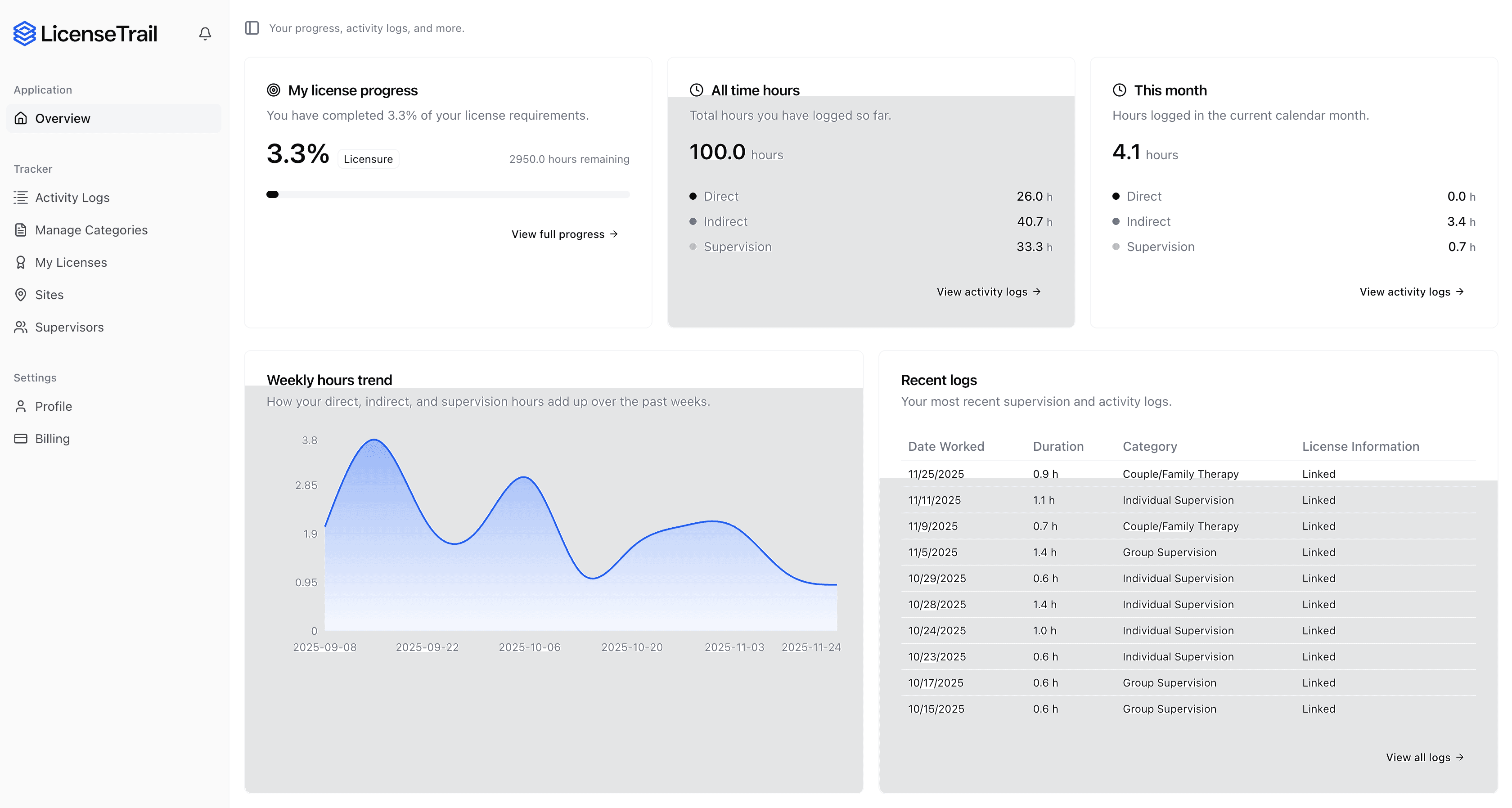
Track your CAT hours with confidence
License Trail checks your direct, indirect, and supervision hours against Colorado CAT requirements continuously and flags mismatches before you submit.
 Start Tracking for Free
No credit card required · Free plan available
Related Licenses
Is your spreadsheet hiding Colorado CAT risks?
Stop guessing if your categories match Colorado State Board of Addiction Counselor Examiners requirements. License Trail checks your direct, indirect, and supervision hours continuously and flags mismatches before you submit.
Import or log
Bring your spreadsheet or start fresh
Upload your existing tracking spreadsheet and we'll map every hour into the right Colorado State Board of Addiction Counselor Examiners categories automatically.
Verify against Colorado
Catch mismatches before the board does
License Trail checks your direct, indirect, and supervision hours against Colorado CAT requirements continuously.
Export board-ready
One-click clean reports
Generate professional, board-ready reports for supervision meetings and Colorado State Board of Addiction Counselor Examiners submissions in seconds.
No credit card required · Free plan available