
Colorado LPCC Requirements: Hours, Exams & Step-by-Step Guide
Stop guessing if your categories match Colorado requirements. License Trail checks your direct, indirect, and supervision hours against LPCC requirements continuously and flags mismatches before you submit.
No credit card required · Free plan available
Quick Requirements Overview
- Apply + fee to CO LPC Board (DORA) for LPCC (candidate) registration; must be 21+, meet conduct standards, and hold a master’s/doctoral in professional counseling (or board-equivalent) incl. practicum/internship
- Colorado jurisprudence exam required for candidate applicants; NBCC national counseling exam is the designated licensure exam (timing per board instructions)
- Hours count only if accrued while registered as LPCC (or in an exempt status)
- Post-degree practice required for LPC: 2,000 hours of practice in counseling minimum 24 months (or 1 year post-doc)
- Within the 2,000 hours: 1,500 hours face-to-face direct client contact under clinical supervision
- Supervision (in addition to practice hours): 50 hrs per 1,000 practice hrs ⇒ 100 hrs total, incl. ≥50 hrs individual; remaining may be triadic/group (group max 1:10); in-person or telesupervision
- Renewal/time limits: candidate registration expires Dec 31 every 3 years, but must complete LPC requirements within 4 years of initial LPCC registration (extension possible; otherwise expires/nonrenewable)
License Details
Procedures
Licensed Professional Counselor Candidate (LPCC) status in Colorado is the state’s formal registration for post‑degree clinicians who are working under supervision toward full Licensed Professional Counselor (LPC) licensure. It is regulated by the Colorado State Board of Licensed Professional Counselor Examiners within DORA’s Division of Professions and Occupations.
This guide walks through:
- What the LPCC credential is (legally called “licensed professional counselor candidate” registration)
- How to qualify and apply
- The exact post‑degree hour requirements you must complete while registered as an LPCC in order to become an LPC, with the board’s terminology and structure.
1. What “Licensed Professional Counselor Candidate” (LPCC) means in Colorado
Under Colorado law, the board does not issue a full license at the candidate stage; it registers you as a “licensed professional counselor candidate.” (colorado.public.law)
As an LPCC you:
- Practice professional counseling under clinical supervision from an approved supervisor
- Accrue required post‑degree practice and supervision hours that will later be used to qualify for full LPC licensure
- Are under the jurisdiction of the LPC Board and may (but are not required to) also register as an unlicensed psychotherapist. (colorado.public.law)
Colorado also makes clear that your post‑degree work experience and supervision only count toward licensure if you are registered as a candidate (LPCC/LPP/other mental health candidate types) or are practicing in a specifically exempt status. (dpo.colorado.gov)
2. Eligibility requirements to become an LPCC
Colorado Revised Statutes § 12‑245‑604(4) sets out the basic requirements for registration as a licensed professional counselor candidate. In plain language, to be registered as an LPCC you must: (colorado.public.law)
-
File an application and pay the required fee to the board.
-
Meet the same foundational requirements as an LPC applicant regarding age, conduct, and education:
- At least 21 years of age.
- Not in violation of Article 245 or any board rule (e.g., no disqualifying discipline or misconduct).
- Completed a master’s or doctoral degree in professional counseling from:
- An accredited school/college, or
- An equivalent program as determined by the board.
- That degree must include a practicum or internship in the principles and practice of professional counseling. (colorado.public.law)
-
Not have been previously registered as a licensed professional counselor candidate in Colorado. (colorado.public.law)
Jurisprudence and national exam at the candidate stage
Board rules require that both licensure and candidate registration applicants pass a Colorado jurisprudence examination developed by the board. (law.cornell.edu)
The same rule designates the national counselor certification examination administered by NBCC (or its successor) as the required professional counseling exam for licensure. (law.cornell.edu)
In practice, many applicants sit for the national exam during or soon after graduate school; check current board instructions to see whether they require it before candidate registration or permit it during your supervised experience period.
3. LPCC license/registration duration and renewal
According to DORA’s Professional Counselor Applications and Forms page:
- All Professional Counselor Candidate licenses expire on December 31 every 3 years. (dpo.colorado.gov)
Statute adds an additional limitation:
- If a candidate does not meet the LPC licensure requirements in § 12‑245‑604(1)(d) and (1)(e) (practice hours, supervision, and exams) within four years after initial registration, the candidate registration expires and is not renewable, unless the board grants an extension. (colorado.public.law)
In practical terms, this means:
- You typically hold an LPCC registration in 3‑year cycles,
- But you are expected to complete the required supervised practice and exams within 4 years of your initial LPCC registration, unless the board approves an extension.
4. Post‑degree practice hour requirements you must complete as an LPCC
While registered as an LPCC, you must complete specific post‑master’s (or post‑doctoral) supervised practice to become fully licensed. The controlling statute and rules are § 12‑245‑604(1)(d) C.R.S. and Board Rule 4 CCR 737‑1.14(C). (colorado.public.law)
4.1 Overall “practice in counseling” requirement
To qualify for LPC licensure, the board requires:
- At least two years of post‑master’s practice in licensed professional counseling
- OR one year of post‑doctoral practice under clinical supervision; and (colorado.public.law)
- At least 2,000 hours of practice in counseling, which cannot be completed in fewer than 24 months, and may involve supervision by more than one approved supervisor. (colorado.public.law)
Board rule clarifies that “practice in professional counseling” means all services covered by the statutory definition of psychotherapy and, in particular, those activities included in the statutory definition of professional counseling (such as evaluation, diagnosis, treatment, intervention, and psychotherapy). (law.justia.com)
4.2 Required “face‑to‑face direct client contact” hours
Of the 2,000 total practice hours, the statute specifies that they must include:
- At least 1,500 hours of face‑to‑face direct client contact in counseling or practice under the professional counseling scope, under clinical supervision that can be in person or via telesupervision. (colorado.public.law)
So, broken down:
- Total post‑degree practice required:
- 2,000 hours of practice in counseling
- Within that total:
- 1,500 hours must be “face‑to‑face direct client contact” (counseling/psychotherapy sessions with clients)
- Up to 500 hours can be other qualifying counseling practice activities (e.g., case planning, documentation, consultation as part of treatment), as defined within the professional counseling scope.
This is the core “direct practice” requirement you must meet while registered as an LPCC.
5. Supervision hour requirements while you accrue LPCC hours
Colorado separates practice hours from supervision hours. Supervision is counted in addition to your 2,000 practice hours.
Board Rule 4 CCR 737‑1.14(C)(4) and the statute require that, for supervised post‑graduate practice in professional counseling, the applicant: (law.cornell.edu)
5.1 Minimum supervision per practice hours
- For each 1,000 hours of supervised practice in professional counseling, you must receive a minimum of 50 hours of supervision.
- A minimum of 25 of those 50 hours must be individual supervision, which may occur in person or via telesupervision.
- The remaining 25 of the 50 hours may be:
- Triadic supervision (one supervisor to two supervisees), or
- Group supervision, with a maximum ratio of one supervisor to ten supervisees.
- No other modes of supervision are accepted for meeting the requirement. (law.cornell.edu)
Because you must accrue 2,000 hours of practice:
- Total minimum supervision required:
- 2,000 practice hours ÷ 1,000 = 2 blocks
- 2 × 50 = 100 hours of supervision minimum
- Within that 100 hours:
- At least 50 hours must be individual supervision
- Up to 50 hours may be triadic or group supervision (subject to the 1:10 supervisor‑to‑supervisee ratio).
5.2 Important definitions from the board rules
Board rules define several supervision terms that govern how LPCC supervision must be structured: (law.cornell.edu)
- “Individual supervision” – supervision provided to one supervisee at a time.
- “Group supervision” – supervision provided to no more than ten supervisees at one time.
- “Supervision” – personal and responsible direction provided by a board‑approved supervisor, either in person or via telesupervision. It requires the supervisor to know the clients, monitor treatment, and collaborate on all decisions that require LPC‑level skill (e.g., treatment planning, methods, fees, case approval).
- “Telesupervision” – clinical supervision conducted through audio/video technology (e.g., videoconferencing, in some cases telephone).
Supervisors may be LPCs or certain other licensed mental health professionals (e.g., LCSWs, LMFTs, psychologists, licensed addiction counselors) whose scope is substantially equivalent to that of an LPC, as long as they were appropriately licensed in the jurisdiction where supervision occurred. (law.cornell.edu)
The supervisor must keep detailed records of your exact number of practice hours and supervision hours, and ultimately must verify your completion of supervised practice on the board’s post‑degree experience and supervision form. (dpo.colorado.gov)
6. Education and practicum/internship expectations
Because your eligibility for LPCC hinges on the graduate program you complete, board rules set out detailed criteria for acceptable programs:
- Degree must be a master’s or doctoral program with a major in professional counseling or its equivalent, either:
- CACREP‑accredited, or
- Demonstrated as educationally equivalent through board‑approved credential evaluation (e.g., through CCE). (law.cornell.edu)
- The graduate program must include:
- A coherent, organized curriculum in professional counseling
- Core coursework in specified content areas (human growth and development, helping relationships, appraisal, research, professional orientation, etc.)
- Supervised field experience of not fewer than 700 hours that is counseling in nature, for those enrolled after certain dates, unless made up in board‑approved post‑degree coursework or experience. (law.cornell.edu)
The statute separately requires that the degree include a practicum or internship in professional counseling, and this must be completed to qualify for LPC or LPCC consideration. (colorado.public.law)
7. Putting it together: What you must do to become (and use) an LPCC in Colorado
In sequence, the pathway looks like this:
-
Complete an approved counseling graduate degree
- Master’s or doctoral degree in professional counseling (or board‑recognized equivalent), including practicum/internship. (colorado.public.law)
-
Apply for LPCC registration
- Submit online application and fee as a Professional Counselor Candidate – Initial. (dpo.colorado.gov)
- Demonstrate you meet:
- Age requirement (21+)
- Conduct requirement (not in violation of the article or rules)
- Education and practicum/internship requirements. (colorado.public.law)
- Complete the Colorado jurisprudence exam (and, depending on current board practice, the national counseling exam). (law.cornell.edu)
-
Begin accruing post‑degree supervised practice only after LPCC registration
- Your post‑degree work experience and supervision hours only count toward licensure if you are registered as an LPCC (or in another recognized candidate/exempt status). (dpo.colorado.gov)
-
During your LPCC period, complete:
- At least 2,000 hours of practice in counseling, not in fewer than 24 months; and
- Of those 2,000 hours, at least 1,500 hours must be face‑to‑face direct client contact; and (colorado.public.law)
- At least 100 hours of clinical supervision, structured as:
- 50+ hours individual supervision
- Up to 50 hours triadic or group supervision, with one supervisor to no more than ten supervisees
- Supervision delivered by board‑approved supervisors, either in person or by telesupervision
- Documented on the board’s supervision forms. (law.cornell.edu)
-
Apply for full LPC licensure
- Once the practice hours, supervision hours, and examination requirements in § 12‑245‑604(1)(d)–(e) are met, you apply for LPC by examination. (colorado.public.law)
-
Observe the time limits
- Your Professional Counselor Candidate license normally runs on a 3‑year renewal cycle (expiring December 31 of the third year). (dpo.colorado.gov)
- You must complete the statutory licensure requirements within 4 years of your initial LPCC registration, absent a board‑approved extension; otherwise, your candidate registration expires and cannot be renewed. (colorado.public.law)
In summary, for Colorado’s LPCC pathway the key quantitative requirements, using the board’s own structure and language, are:
- 2,000 hours of post‑degree practice in counseling,
- including 1,500 hours of face‑to‑face direct client contact;
- 50 hours of supervision per 1,000 hours of supervised practice, totaling 100 hours of supervision for 2,000 hours of practice,
- with at least half of those supervision hours provided as individual supervision, and the remainder as triadic or group (1:10 maximum);
- All completed while you are registered as a licensed professional counselor candidate (LPCC) and within the statutory time limits. (colorado.public.law)
Track your LPCC hours with confidence
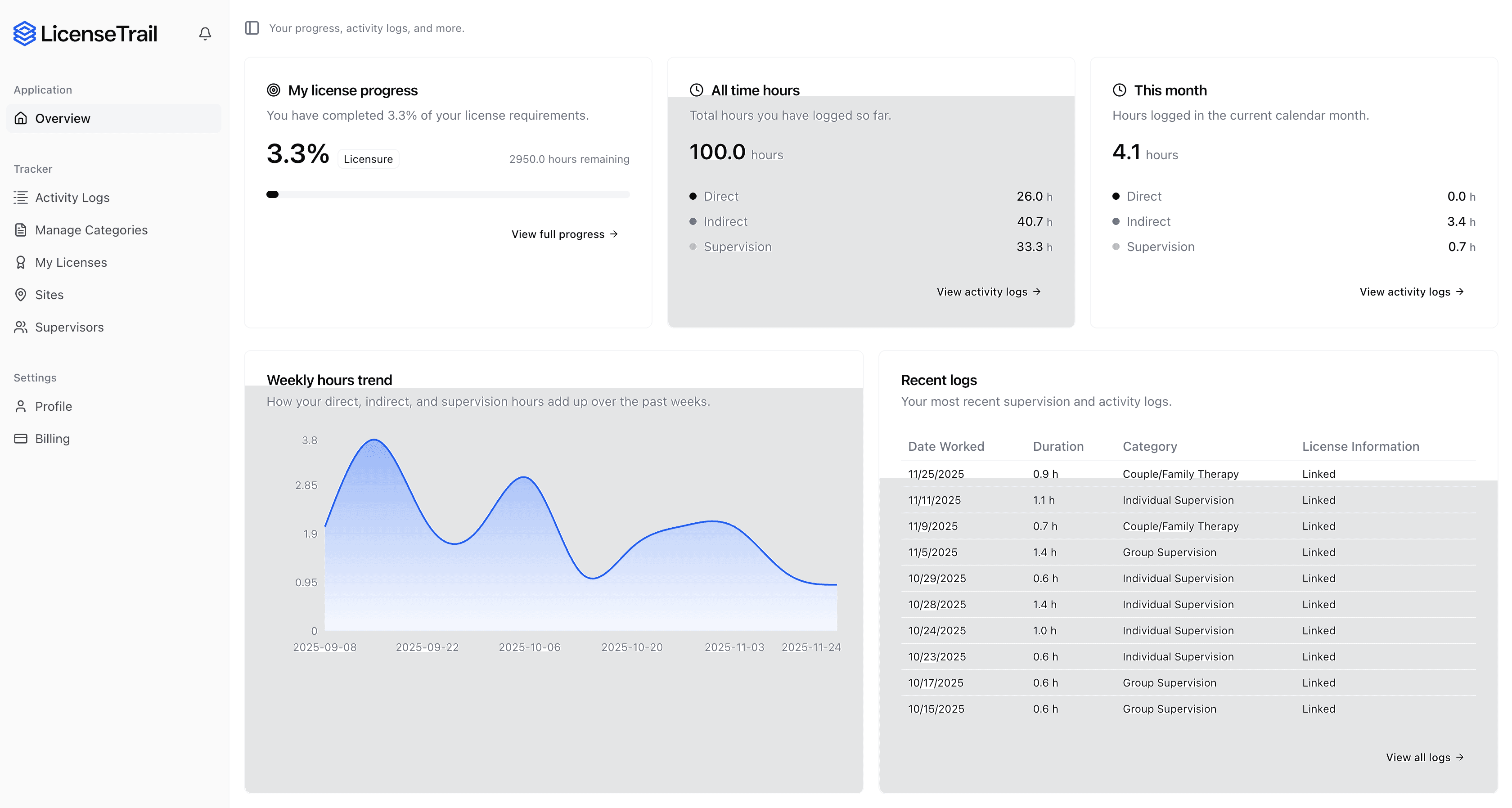
License Trail checks your direct, indirect, and supervision hours against Colorado LPCC requirements continuously and flags mismatches before you submit.
 Start Tracking for Free
No credit card required · Free plan available
Related Licenses
Is your spreadsheet hiding Colorado LPCC risks?
Stop guessing if your categories match Colorado State Board of Licensed Professional Counselor Examiners requirements. License Trail checks your direct, indirect, and supervision hours continuously and flags mismatches before you submit.
Import or log
Bring your spreadsheet or start fresh
Upload your existing tracking spreadsheet and we'll map every hour into the right Colorado State Board of Licensed Professional Counselor Examiners categories automatically.
Verify against Colorado
Catch mismatches before the board does
License Trail checks your direct, indirect, and supervision hours against Colorado LPCC requirements continuously.
Export board-ready
One-click clean reports
Generate professional, board-ready reports for supervision meetings and Colorado State Board of Licensed Professional Counselor Examiners submissions in seconds.
No credit card required · Free plan available