
Colorado MFTC Requirements: Hours, Exams & Step-by-Step Guide
Stop guessing if your categories match Colorado requirements. License Trail checks your direct, indirect, and supervision hours against MFTC requirements continuously and flags mismatches before you submit.
No credit card required · Free plan available
Quick Requirements Overview
- Regulated CO credential: Marriage & Family Therapist Candidate (MFTC) = temporary pre‑licensure registration to practice only under supervision toward LMFT hours
- Eligibility (baseline LMFT standards): age 21+, good standing/fitness, master’s/doctoral MFT (or equivalent) from accredited school including MFT practicum/internship
- Exam required for MFTC: pass Colorado Mental Health Jurisprudence Exam before registration
- Application: submit DPO/Board application + required fee
- Hours count rule: post‑degree experience counts toward LMFT only if registered as MFTC (or other allowed status) while accruing hours
- Post‑degree experience (typical master’s track for LMFT): 2,000 supervised hours over ≥24 months, incl. 1,500 direct face‑to‑face client hours; ~1,000 direct hours with couples/families
- Supervision requirement: 100 clinical supervision hours (min 50 individual) by Board‑approved supervisor (e.g., LMFT/AAMFT-approved)
- Renewal/term: MFTC expires Dec 31 every 3 years; if hours not completed within 3 years, subject to renewal/reinstatement rules; CPD required for second+ renewal
License Details
Procedures
In Colorado, the title Marriage and Family Therapist Candidate (MFTC) is a regulated credential issued by the State Board of Marriage and Family Therapist Examiners and housed in the Division of Professions and Occupations (DPO). It functions as a temporary, pre-licensure registration that allows you to practice marriage and family therapy under supervision while you complete the post‑degree experience required for full licensure as a Licensed Marriage and Family Therapist (LMFT).
Below is a structured guide to what the Board and statute actually require, with the key hour requirements spelled out.
1. What MFTC Status Is (and Is Not)
Legally, the Board “registers” you as a marriage and family therapist candidate under C.R.S. § 12‑245‑504(4). Once registered, you are:
- Under the jurisdiction of the State Board of Marriage and Family Therapist Examiners.(law.justia.com)
- Allowed to use the protected titles “marriage and family therapist candidate,” “MFT candidate,” or “MFTC” when you practice under supervision.(colorado.public.law)
MFTC does not mean you have met the full experience requirements to be an LMFT. Instead, it is the status you must hold while you earn those hours.
2. Statutory Prerequisites Before the Board Can Register You as an MFTC
Colorado law sets out minimum qualifications in C.R.S. § 12‑245‑504.
To be registered as a marriage and family therapist candidate, the Board must see that you already meet the same baseline education and character standards required of an LMFT, minus the post‑degree hours and national exam. Specifically, the Board “shall register as a marriage and family therapist candidate a person who”:(law.justia.com)
-
Files an application and pays the fee
- Statute: You must “[f]ile an application for registration, accompanied by the fee as required by section 12‑245‑205.” (law.justia.com)
- Practically: You apply online through DPO’s system under “Marriage and Family Therapist Candidate – Initial by Original Method.”(dpo.colorado.gov)
-
Meets the base LMFT education and character requirements
You must submit evidence that you meet C.R.S. § 12‑245‑504(1)(a)–(c):(law.justia.com)
- Age: At least 21 years of age.
- Fitness: Not in violation of the mental health practice act (Article 245) or any rule adopted under it.
- Education: Completion of a master’s or doctoral degree in marriage and family therapy or equivalent, from an accredited school or college, and the degree must include a practicum or internship in the principles and practice of marriage and family therapy.(colorado.public.law)
The Board and multiple licensure resources treat this practicum/internship as at least 300 hours of supervised clinical field experience in MFT as part of the degree.(onlinegrad.pepperdine.edu)
(Those are pre‑degree hours; they are separate from the post‑degree hours you will earn as an MFTC.) -
Passes the Colorado Mental Health Jurisprudence Exam
- As of August 7, 2024, statute explicitly requires that a candidate “has passed a jurisprudence examination administered by the division” in order to obtain MFTC registration.(law.justia.com)
- DPO confirms that SB24‑115 now requires passing the Colorado jurisprudence exam to obtain registration as a marriage and family therapist candidate.(dpo.colorado.gov)
-
Has not previously been registered as an MFTC
- Earlier statutory language required that the person “has not been previously registered as a marriage and family therapist candidate by the board.”(colorado.public.law)
- The 2024 amendments shift the focus to renewal rules (see below), but the Board still treats initial registration as distinct from later renewals.
3. How Long MFTC Registration Lasts and Renewal Rules
Colorado recently changed how long candidate registrations can be held and how they renew:
-
Term and expiration
- DPO’s licensing page: “All Marriage and Family Therapist Candidate licenses expire on December 31, every 3 years.”(dpo.colorado.gov)
-
Timeframe to complete the LMFT experience requirement
- Current statute: If an MFTC has not met the post‑degree practice requirement in § 12‑245‑504(1)(d) within three years after initial registration, the candidate’s registration becomes “subject to the renewal, reinstatement, and delinquency fee provisions” of the general licensing law (C.R.S. § 12‑20‑202).(law.justia.com)
-
Continuing professional development (CPD) for repeated renewals
- Before a second or subsequent renewal of an MFTC registration, the candidate “shall complete continuing professional development and educational hours to maintain” that registration.(law.justia.com)
In practical terms: you get an initial 3‑year candidate period; if you still haven’t completed the required post‑degree experience, you may renew, but after the first renewal you must document CPD hours in order to keep your candidate status.
4. What Counts While You Are an MFTC: Post‑Degree Work Experience Rules
The reason to become an MFTC is so your post‑degree clinical hours will count toward LMFT licensure. Colorado’s own licensing guide states that:
“Post‑Degree Work Experience and Supervision Requirements: The required post‑degree work experience and supervision hours will only count towards licensure if the applicant is registered as a candidate (…MFTC…) or is currently registered as an Unlicensed Psychotherapist or practicing in an exempt facility as permitted.”(dpo.colorado.gov)
So you generally must be registered as an MFTC (or other allowed registration) before those hours start to count.
5. Exact Hour Requirements You Must Complete as an MFTC to Qualify for LMFT
The experience requirements that you complete while holding MFTC are written in two layers:
-
Statutory minimum: 1,500 hours of direct client contact under clinical supervision
C.R.S. § 12‑245‑504(1)(d) requires, after your degree, at least:
- Two years of post‑master’s (or one year of postdoctoral) practice in individual and marriage and family therapy,
- Including “at least one thousand five hundred hours of face‑to‑face direct client contact … under clinical supervision” (either in person or via telesupervision).(colorado.public.law)
That is the floor set in statute.
-
Board practice standard: 2,000 total supervised hours with 1,500 direct; 100 supervision hours
The State Board, via its licensing materials and credentials chart, applies a more detailed breakdown that all reputable Colorado‑focused licensure guides now mirror:(mft-license.com)
For master’s‑level candidates (the typical MFTC):
- Total post‑master’s supervised practice:
2,000 hours of post‑degree supervised clinical experience over a minimum of 24 months. - Direct client contact:
At least 1,500 hours must be face‑to‑face direct client contact. - Couples and families emphasis:
Within those direct hours, at least 1,000 hours must involve couples and families (two or more family members in session).(mft-license.com) - Clinical supervision hours:
At least 100 hours of clinical supervision by a Board‑approved supervisor, typically broken down as:- 50 hours minimum of individual supervision (one‑on‑one, which may be in person or telesupervision), and
- Up to 50 hours in either individual or group supervision.(mft-license.com)
- Distribution:
Supervision hours must be spread across the experience period, not “bunched” at the beginning or end, and are intended to correspond to the 2,000 practice hours.(mft-license.com)
For doctoral‑level candidates, Board materials and licensure guides apply a reduced requirement:
- Total post‑doctoral practice: typically 1,500 hours of supervised experience over at least 12 months,
- Still including 1,500 hours of face‑to‑face client contact, at least 1,000 hours with couples and families, and
- 75 hours of clinical supervision (with a specified portion as individual supervision).(mft-license.com)
These numbers bring the statutory minimum (1,500 direct hours) into a more specific Board‑enforced structure (2,000 total / 1,500 direct / 1,000 couples‑family / 100 supervision).
- Total post‑master’s supervised practice:
-
Who can supervise you
- The statute allows supervision by qualified mental health professionals and specifically permits licensed addiction counselors who also meet the LMFT education requirements to provide clinical supervision, as long as they satisfy Board rules.(law.justia.com)
- DPO’s own credentials chart states that MFTCs must be supervised by an AAMFT‑approved supervisor or an LMFT in good standing, and that the Board must approve supervision by non‑MFT licensees for those hours to count.(ru.scribd.com)
-
What activities count toward the hours
Based on Board‑aligned guidance and Colorado‑specific licensure resources:(mft-license.com)
- Counts as direct client contact (toward the 1,500 hours):
- In‑person or telehealth therapy sessions with individuals, couples, or families.
- Sessions involving assessment and intervention where you are in direct contact with the client(s).
- Does not count as direct contact (but may count toward the remaining 500 “non‑direct” hours within the 2,000 total):
- Documentation, treatment planning, consultations, trainings, case staffing, some administrative tasks.
- Some Board‑aligned materials allow up to 300 hours of teaching MFT (with appropriate supervision) to be counted toward the 2,000 practice hours, and a small number of related supervision hours to be credited when the supervision specifically concerns that teaching role.(mft-license.com)
- Counts as direct client contact (toward the 1,500 hours):
6. Protected Titles and How You Must Represent Yourself
Colorado’s title‑use statute, C.R.S. § 12‑245‑218, makes it unlawful for anyone not properly licensed, certified, or registered to hold themselves out to the public using protected titles such as:(colorado.public.law)
- “Marriage and family therapist”
- “LMFT” or “MFT”
- “Marriage and family therapist candidate”
- “MFT candidate” or “MFTC”
While registered as an MFTC, you must:
- Use a title that accurately reflects your status (e.g., Marriage and Family Therapist Candidate or MFTC), and
- Provide the Board‑mandated mandatory disclosure statement to all clients, which includes your credential type and supervision arrangements (addressed in detail in the Board’s Rules and the Model Mandatory Disclosure Statement).(regulations.justia.com)
7. Putting It All Together: The Practical Path to MFTC and LMFT in Colorado
Summarizing the key requirements in sequence:
-
Earn the qualifying degree
- Master’s or doctoral degree in marriage and family therapy or equivalent, from an accredited school.
- Degree includes a practicum/internship in marriage and family therapy (commonly at least 300 supervised hours).(colorado.public.law)
-
Pass the Colorado Mental Health Jurisprudence Exam
- Required before the Board will register you as an MFTC.(law.justia.com)
-
Apply to the State Board for MFTC registration
- Submit online application, fee, proof of age (21+), character/fitness, and qualifying education (including practicum/internship).(law.justia.com)
-
Hold MFTC status while you earn post‑degree hours
- Work under approved clinical supervision; your hours only count toward LMFT if you are properly registered (MFTC, unlicensed psychotherapist, or exempt facility).(dpo.colorado.gov)
-
Complete the Board’s post‑degree experience requirements for LMFT
- 2,000 total supervised practice hours over at least 24 months (master’s track).
- Within that, 1,500 hours must be direct, face‑to‑face client contact; and about 1,000 of those direct hours must be with couples and families.
- 100 hours of clinical supervision, at least 50 hours individual, with a Board‑approved supervisor.(law.justia.com)
-
Apply for LMFT licensure
- Once hours are complete, you must:
- Pass the national MFT exam (AMFTRB).
- Already have passed the Colorado jurisprudence exam (required earlier for MFTC).
- Submit verification of your 2,000 hours of supervised practice and 100 hours of supervision.(regis.edu)
- Once hours are complete, you must:
Key Hour Numbers, Clearly Stated
For a typical master’s‑level MFTC in Colorado, as defined by the State Board and its licensing materials:
- 0–300+ hours – Supervised practicum/internship in your graduate program (pre‑degree, required but separate).(onlinegrad.pepperdine.edu)
- 2,000 hours – Post‑degree supervised clinical experience required for LMFT while you are an MFTC, including:
- 1,500 hours of direct, face‑to‑face client contact, and within that
- About 1,000 hours specifically with couples and families, and
- 100 hours of clinical supervision, at least 50 of which must be individual supervision.(law.justia.com)
Those figures capture the actual hour requirements and terminology as they are applied by the Colorado State Board of Marriage and Family Therapist Examiners for candidates progressing from MFTC to full LMFT licensure.
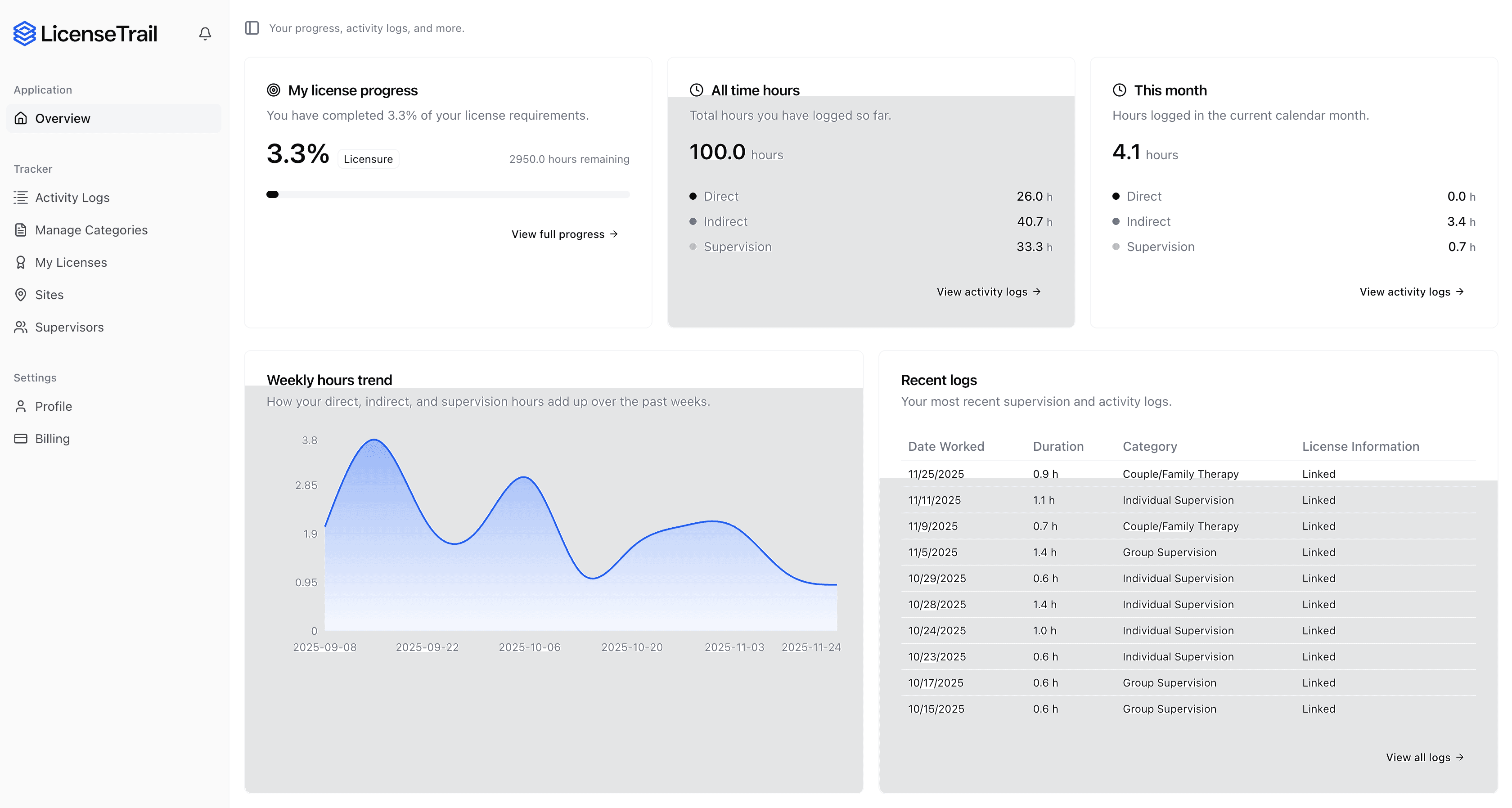
Track your MFTC hours with confidence
License Trail checks your direct, indirect, and supervision hours against Colorado MFTC requirements continuously and flags mismatches before you submit.
 Start Tracking for Free
No credit card required · Free plan available
Related Licenses
Is your spreadsheet hiding Colorado MFTC risks?
Stop guessing if your categories match Colorado State Board of Marriage and Family Therapist Examiners requirements. License Trail checks your direct, indirect, and supervision hours continuously and flags mismatches before you submit.
Import or log
Bring your spreadsheet or start fresh
Upload your existing tracking spreadsheet and we'll map every hour into the right Colorado State Board of Marriage and Family Therapist Examiners categories automatically.
Verify against Colorado
Catch mismatches before the board does
License Trail checks your direct, indirect, and supervision hours against Colorado MFTC requirements continuously.
Export board-ready
One-click clean reports
Generate professional, board-ready reports for supervision meetings and Colorado State Board of Marriage and Family Therapist Examiners submissions in seconds.
No credit card required · Free plan available