
Colorado LPP Requirements: Hours, Exams & Step-by-Step Guide
Stop guessing if your categories match Colorado requirements. License Trail checks your direct, indirect, and supervision hours against LPP requirements continuously and flags mismatches before you submit.
No credit card required · Free plan available
Quick Requirements Overview
- Master’s/Doctorate in professional counseling (CACREP or Board‑equivalent), including practicum/internship
- Must be employed in a Colorado residential child care facility (RTC/RCCF)
- Must practice under supervision of a Colorado‑licensed mental health professional; supervisor info required on application
- Apply via Colorado DPO Online Services for “Provisional Licensed Professional Counselor – Original License” and pay fee
- LPP ends 30 days after employment or supervision ends unless new qualifying proof is submitted; supervisor/employment changes must be reported within 30 days
- Hours toward LPC count only while properly registered (LPP/LPCC, etc.)
- For eventual LPC: 2,000 post‑degree hours (min 24 months), incl. 1,500 direct face‑to‑face client hours; supervision = 50 hrs per 1,000 (min 25 individual; group/triadic limits apply)
- For eventual LPC: pass Board‑approved national counseling exam + Colorado jurisprudence exam
License Details
Procedures
Pathway to Provisional Licensed Professional Counselor (LPP) Licensure in Colorado
Colorado uses several different credentials on the way to becoming a fully Licensed Professional Counselor (LPC). The Provisional Licensed Professional Counselor (LPP) is a specific, limited license for counselors working in residential child care facilities under supervision, and it sits alongside (not instead of) the Licensed Professional Counselor Candidate (LPCC) registration.
This overview focuses on the LPP as regulated by the Colorado State Board of Licensed Professional Counselor Examiners, and then explains the exact hours and supervision you must ultimately accumulate for full LPC licensure while you are an LPP or LPCC.
1. Legal framework and definitions
Key statutory and rule sources that govern LPPs and LPCs:
- Provisional license authority – Colorado Revised Statutes (C.R.S.) § 12‑245‑208: “Provisional license – fees.” This allows each mental health board, including the LPC Board, to issue a provisional license to certain post‑graduate degree holders working in residential child care facilities under supervision. (law.justia.com)
- LPC licensure requirements – C.R.S. § 12‑245‑604 and Board Rule 4 CCR 737‑1.14 (“Licensure by Examination”) set out the degree, practice hours, and supervision standards for full LPC licensure. (law.justia.com)
- Title protection for “Provisional Licensed Professional Counselor” – C.R.S. § 12‑245‑218 makes it unlawful to use the title “provisional licensed professional counselor” unless you actually hold that license. (colorado.public.law)
- Board’s own credential chart – The Division of Professions and Occupations (DPO) Mental Health Credentials Chart summarizes the LPP as a provisional credential for those with a counseling master’s/doctorate, working under supervision in a residential child care facility (RTC). (scribd.com)
2. What the LPP credential is (and is not)
What it is
Under C.R.S. § 12‑245‑208, a provisional license is available to an applicant who:
- Has completed a postgraduate degree that meets the educational requirements for licensure as a professional counselor under C.R.S. § 12‑245‑604, and
- Is working in a residential child care facility, as defined in C.R.S. § 26‑6‑903, under the supervision of a licensee. (law.justia.com)
The Board’s mental health credentials chart describes the LPP specifically as:
- “LPP: Provisional Licensed Professional Counselor” – Master’s or Doctorate degree from a CACREP‑approved program or equivalent; must be working under the supervision of a licensed mental health professional in a residential childcare facility (RTC). (scribd.com)
What it is not
- It is not the standard “candidate” registration; that is the LPCC (Licensed Professional Counselor Candidate), which is the more typical status for accruing hours outside RTC settings. (scribd.com)
- It is not full LPC licensure; you cannot practice independently and must remain under supervision in the qualifying facility.
The LPP is primarily a way to legally practice and to accrue post‑degree experience in an RTC while you work toward full LPC requirements.
3. Baseline eligibility for an LPP
3.1 Education
To qualify for an LPP, you must already meet the educational standard for LPC licensure:
- A master’s or doctoral degree in professional counseling from an accredited school or an equivalent program as determined by the Board. The degree must include a practicum or internship in the principles and practice of professional counseling. (law.justia.com)
The DPO credential chart reflects this as:
- “Master’s or Doctorate degree from CACREP‑approved program or equivalent” for LPP, LPCC, and LPC. (scribd.com)
3.2 Employment setting and supervision
C.R.S. § 12‑245‑208 lays out the core LPP requirements:
- You must be working in a residential child care facility (RCCF/RTC) as defined in C.R.S. § 26‑6‑903.
- You must be “working…under the supervision of a licensee.” (law.justia.com)
The DPO Mental Health Credentials Chart specifies, for LPP:
- Must be working under supervision of a licensed mental health professional in a residential childcare facility (RTC). (scribd.com)
3.3 Registration status for your hours to count
The Board is explicit that post‑degree experience and supervision hours only count toward LPC licensure if you are in the right registration status:
- DPO states: “The required post‑degree work experience and supervision hours will only count towards licensure if the applicant is registered as a candidate ie LPCC/LPP, PSYC, MFTC, SWC/LSW, CAT/CAS or is currently registered as an Unlicensed Psychotherapist or practicing in an exempt facility as permitted.” (dpo.colorado.gov)
So, being registered as LPP or LPCC is one of the Board‑recognized ways to accumulate the hours you’ll need for full LPC.
4. Step‑by‑step: How to obtain the LPP
Step 1 – Complete the qualifying counseling degree
- Finish a master’s or doctoral degree in professional counseling, including practicum/internship, that meets the educational requirements of C.R.S. § 12‑245‑604(1)(c) (or the Board‑approved “equivalent” route via CCE). (law.justia.com)
Step 2 – Secure qualifying employment and a supervisor
- Obtain a position in a residential child care facility (RTC/RCCF). (law.justia.com)
- Identify a Colorado‑licensed mental health professional (such as an LPC, psychologist, LCSW, LMFT, etc.) who will formally supervise your work, consistent with Board rules. (scribd.com)
Step 3 – Apply through DPO Online Services
On the Colorado Professional Counselor Applications and Forms page, under “Provisional Licensed Professional Counselor”, the Board lists:
- Provisional Licensed Professional Counselor – Original License (or “Initial by Examination or Endorsement”) – applied for online. (dpo.colorado.gov)
Your application must:
- Identify the name, contact information, and license number of your supervising licensee, per C.R.S. § 12‑245‑208(2). (law.justia.com)
- Be accompanied by the applicable application fee under § 12‑20‑105 (fee amounts are set administratively and can change, so you must confirm them on the DPO site at the time you apply). (law.justia.com)
Step 4 – Maintain supervision and notify the Board of changes
Under C.R.S. § 12‑245‑208:
- Your provisional license terminates 30 days after your employment at the qualifying residential child care facility ends, unless you submit proof of employment with another qualifying facility.
- It also terminates 30 days after your supervision ends, unless you submit proof of supervision by another licensee.
- You must notify the Board of any change in supervision within 30 days of the change. (law.justia.com)
In practice, this means you must keep your LPP file current any time you change employer or supervisor.
Step 5 – Use the correct title and scope of practice
- Under the title‑use statute, you may only use the title “Provisional Licensed Professional Counselor” (or “LPP”) if you hold that license. (colorado.public.law)
- Your role is always under supervision; you may not present yourself as an independent practitioner.
5. The hours and supervision you must ultimately complete (for full LPC)
While the LPP credential itself does not specify a certain number of hours just to obtain or renew the provisional license, it is specifically designed so that your work there can count toward full LPC licensure. Those LPC requirements are where the precise hour counts appear.
5.1 Total counseling practice hours
For LPC licensure, the statute and Board rules require:
- At least 2,000 hours of post‑degree practice in counseling.
- Within those 2,000 hours, at least 1,500 hours must be face‑to‑face direct client contact (counseling or psychotherapy with clients), under clinical supervision that is either in person or via telesupervision. (law.justia.com)
The Board’s rule 4 CCR 737‑1.14 further clarifies:
- The 2,000 hours “cannot be completed in fewer than twenty‑four months” and may involve more than one approved supervisor. (law.cornell.edu)
Put into simple numbers:
- 2,000 total post‑degree counseling hours,
- Of which 1,500 must be direct, face‑to‑face client contact,
- Accrued over a minimum of 24 months.
5.2 Supervision hours and format
Supervision requirements for those 2,000 hours are also spelled out in statute and rule:
- For each 1,000 hours of supervised practice, you must receive at least 50 hours of supervision.
- At least 25 of those 50 hours must be individual supervision (one‑on‑one with your supervisor), which may be in person or via telesupervision.
- The remaining up to 25 hours may be triadic or group supervision, with a maximum ratio of one supervisor to ten supervisees.
- The rule explicitly states that no other modes of supervision will be accepted. (codes.findlaw.com)
Practically, that means:
- Minimum 100 hours of supervision across your 2,000 hours,
- With at least 50 of those 100 hours as individual supervision,
- Shared/group formats are capped and must follow the Board’s ratio limits.
The Mental Health Credentials Chart summarizes this as:
- “Post degree experience: 2,000 hours of experience over minimum of 24 months.”
- “Post degree supervision: 100 hours (70 face‑to‑face & individual) over minimum 24 months.” (scribd.com)
The chart is labeled as a general summary only, so if there is any tension between it and the rule text, the statute and rules control. (scribd.com)
5.3 Where the LPP fits into those hours
The DPO makes clear that your 2,000 hours of practice and associated supervision can be accumulated while registered as an LPP, as long as you meet all supervision and practice requirements:
- Post‑degree experience and supervision “will only count towards licensure” if you are registered as LPCC/LPP (or equivalent statuses) while you accrue them. (dpo.colorado.gov)
So, from an hours standpoint:
- The LPP stage is when you can start logging hours toward the LPC 2,000/1,500/100 thresholds, provided you maintain your provisional license, work in the qualifying RTC setting, and receive supervision that meets Board rules.
6. Practical checklist for aspiring LPPs in Colorado
-
Confirm your degree
- Master’s or doctorate in professional counseling (or Board‑recognized equivalent) with required practicum/internship. (law.justia.com)
-
Get an RTC position and a licensed supervisor
- Offer of employment from a residential child care facility (RTC/RCCF).
- Identify a supervising Colorado licensee willing to oversee your counseling work. (law.justia.com)
-
Apply for the LPP online
- Use DPO Online Services under “Provisional Licensed Professional Counselor – Original License.”
- Provide supervisor’s name, contact details, and license number as required by C.R.S. § 12‑245‑208(2); pay the application fee. (dpo.colorado.gov)
-
Start tracking your hours and supervision immediately
- Aim toward 2,000 total hours of counseling practice, with 1,500 face‑to‑face direct client contact.
- Ensure you receive 50 supervision hours per 1,000 hours of practice, with at least 25 individual per 1,000, consistent with 4 CCR 737‑1.14. (law.cornell.edu)
-
Maintain your LPP status
- Notify the Board within 30 days of any change in employment or supervisor.
- Understand that your LPP terminates 30 days after employment or supervision ends unless you document a new qualifying arrangement. (law.justia.com)
-
Plan your transition to LPC
- Once your hours and supervision are complete, you will apply for full LPC licensure, which also requires passing a Board‑approved national counseling exam and the Colorado jurisprudence examination under C.R.S. § 12‑245‑604(1)(e). (law.justia.com)
In summary, there is no standalone “1,500 hours for LPP” requirement. Instead, the LPP is a legally recognized, supervised license for working in residential child care facilities while you accumulate the 2,000 total hours of practice (with 1,500 hours of direct client contact) and at least 100 hours of structured supervision that are required for full LPC licensure.
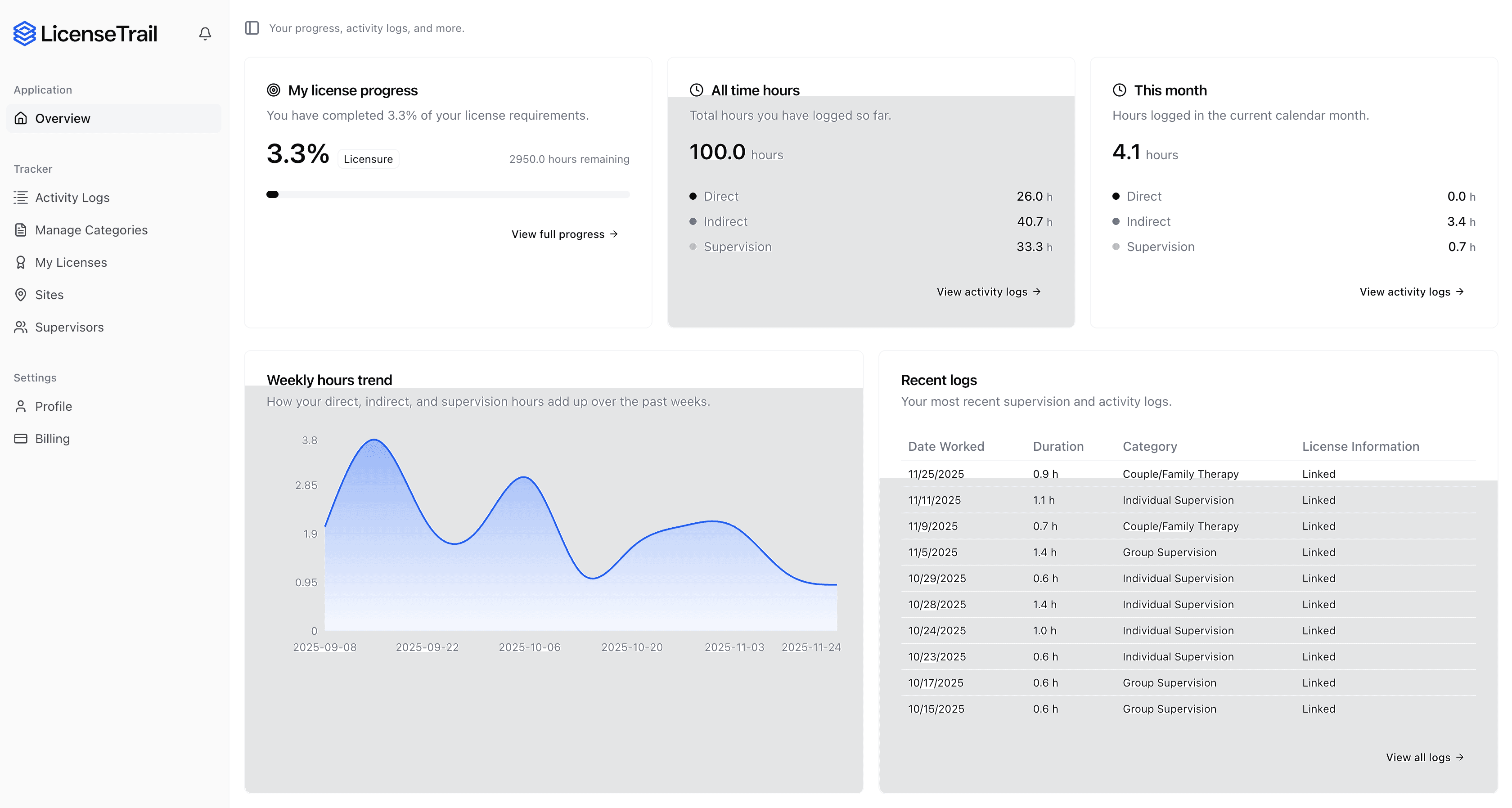
Track your LPP hours with confidence
License Trail checks your direct, indirect, and supervision hours against Colorado LPP requirements continuously and flags mismatches before you submit.
 Start Tracking for Free
No credit card required · Free plan available
Related Licenses
Is your spreadsheet hiding Colorado LPP risks?
Stop guessing if your categories match Colorado State Board of Licensed Professional Counselor Examiners requirements. License Trail checks your direct, indirect, and supervision hours continuously and flags mismatches before you submit.
Import or log
Bring your spreadsheet or start fresh
Upload your existing tracking spreadsheet and we'll map every hour into the right Colorado State Board of Licensed Professional Counselor Examiners categories automatically.
Verify against Colorado
Catch mismatches before the board does
License Trail checks your direct, indirect, and supervision hours against Colorado LPP requirements continuously.
Export board-ready
One-click clean reports
Generate professional, board-ready reports for supervision meetings and Colorado State Board of Licensed Professional Counselor Examiners submissions in seconds.
No credit card required · Free plan available