
Colorado PMFT Requirements: Hours, Exams & Step-by-Step Guide
Stop guessing if your categories match Colorado requirements. License Trail checks your direct, indirect, and supervision hours against PMFT requirements continuously and flags mismatches before you submit.
No credit card required · Free plan available
Quick Requirements Overview
- Regulator: CO State Board of Marriage & Family Therapist Examiners (CRS Article 245)
- PMFT credential: “Provisional Marriage & Family Therapist” (MFP) is a narrow license for residential child care facility (RCCF/RTC) settings
- Education: Completed master’s or doctorate meeting CO MFT education requirements (e.g., COAMFTE or equivalent)
- Setting requirement: Must be employed in an eligible RCCF/RTC; Verification of Employment form required
- Supervision: Must practice under supervision of a Colorado-licensed mental health professional
- Hours for PMFT: No board-specified clinical/supervision hour minimum to obtain/hold the provisional license
- Termination/changes: Provisional license ends 30 days after employment or supervision ends; supervision changes must be reported within 30 days
- Pathway note: Post-degree hours toward LMFT generally count only if registered as MFTC (or other allowed status); LMFT requires defined post-degree hours (e.g., 2,000 hrs/100 supervision for master’s)
License Details
Procedures
Colorado regulates marriage and family therapists through the State Board of Marriage and Family Therapist Examiners under Article 245 of the Colorado Revised Statutes. Within this system there are three key titles:
- Provisional Marriage and Family Therapist – license type code MFP (often called “PMFT” in schools/program materials)
- Marriage and Family Therapist Candidate – MFTC
- Licensed Marriage and Family Therapist – MFT/LMFT
The Provisional Marriage and Family Therapist license is a special, narrow license for people working in certain residential child‑care settings. It is not the license under which you complete your post‑degree 2,000 clinical hours; that is done as a Marriage and Family Therapist Candidate. The provisional license mainly requires the right degree, the right work setting, and supervision—not a specific tally of clinical hours.
Below is a step‑by‑step guide with the exact types of requirements and how the hour requirements fit into the overall pathway.
1. Understand what “Provisional Marriage and Family Therapist” means in Colorado
State law defines a “provisional license” this way:
“Provisional license” means a license or certification issued pursuant to section 12‑245‑208. (colorado.public.law)
Section 12‑245‑208 then states that a board (including the MFT Board) may issue a provisional license to an applicant who:
- “has completed a postgraduate degree that meets the educational requirements for licensure” for the relevant profession, and
- “is working in a residential child care facility … under the supervision of a licensee.” (colorado.public.law)
The Colorado Mental Health Credentials Chart published by DORA/DPO (the same chart linked directly from the Board’s site) labels this credential as:
- MFP: Provisional Marriage and Family Therapist
- Education: “Master’s or Doctorate degree from COAMFTE approved program or equivalent”
- Work setting: “in a residential childcare facility (RTC)”
- Supervision: “Must be working under supervision of a licensed mental health professional” (ru.scribd.com)
Key point: The statutes and Board materials do not assign a specific number of clinical or supervision hours in order to be issued the Provisional Marriage and Family Therapist (MFP) license itself. Instead, the focus is on education, work setting, and supervision.
2. Educational requirement for PMFT (MFP)
To qualify for an MFP license, you must already have completed the same sort of graduate education that will ultimately qualify you for full MFT licensure:
- A master’s or doctoral degree in marriage and family therapy (or a closely related field)
- From a program that is COAMFTE‑accredited or equivalent, as summarized in the DORA Mental Health Credentials Chart and licensure overviews. (ru.scribd.com)
COAMFTE‑approved programs typically include:
- A minimum of 500 clinical contact hours over at least 12 months of practicum/internship during the degree. (allpsychologyschools.com)
Those 500 practicum hours are a training requirement of the degree, not a Board‑counted post‑degree requirement; but in practice, you cannot get the provisional license without having completed that clinical training as part of your graduate program.
3. Employment and supervision requirement for PMFT
Colorado law is explicit that a provisional license is only for people in specific jobs and under supervision:
-
Residential Child Care Facility Requirement
- You must be “working in a residential child care facility, as defined in section 26‑6‑903.” (colorado.public.law)
- The Mental Health Credentials Chart restates this: MFPs must work “in a residential childcare facility (RTC).” (ru.scribd.com)
-
Supervision Requirement
- Statute: you must be working “under the supervision of a licensee” (i.e., a Colorado‑licensed mental health professional such as an LMFT, LPC, psychologist, etc.). (colorado.public.law)
- Credentials Chart: for MFP, “Must be working under supervision of a licensed mental health professional.” (ru.scribd.com)
-
Verification of Employment
- The Board’s application page lists a “Provisional Marriage and Family Therapist – Verification of Employment” form as a required document. (dpo.colorado.gov)
- This form is used to prove you actually work in an eligible residential child care facility and are under appropriate supervision.
-
No specific hour quota for the provisional license
- Neither the controlling statute (§12‑245‑208) nor the Board’s public summaries impose a minimum number of client‑contact or supervision hours to obtain the provisional license.
- Third‑party licensure overviews confirm that, for MFTs, only the full MFT license has a defined post‑degree experience requirement; the provisional and candidate statuses themselves do not. (allpsychologyschools.com)
So for the PMFT (MFP) specifically:
- There is no requirement like “1,500 hours direct experience and 1,500 hours supervised experience” to be granted the provisional license.
- The requirements are structural (degree + setting + supervision), not quantitative (no fixed number of hours at this stage).
4. How the PMFT fits into the full Colorado MFT pathway
Although the PMFT/MFP license doesn’t itself carry an hour quota, it exists within the larger pathway to full LMFT licensure. That pathway is where the specific hour counts show up.
4.1. Marriage and Family Therapist Candidate (MFTC)
After completing your degree, to earn hours that count toward full LMFT licensure in most settings you must be registered as a Marriage and Family Therapist Candidate (MFTC) (or be practicing in an exempt facility such as certain RCCFs, or registered as an unlicensed psychotherapist):
- The Board states: “The required post‑degree work experience and supervision hours will only count towards licensure if the applicant is registered as a candidate (… MFTC …) or is currently registered as an Unlicensed Psychotherapist or practicing in an exempt facility as permitted.” (dpo.colorado.gov)
The MFTC credential itself does not have its own hour quota; it is the status under which you accrue the hours described below.
4.2. Full Licensed Marriage and Family Therapist (MFT/LMFT) – hour requirements
Colorado’s Board rules and licensing guide (as summarized by multiple university and licensure resources that track Colorado requirements) set out the post‑degree supervised experience needed to become a fully licensed MFT after your degree:
For master’s‑level candidates:
- 2,000 hours of post‑master’s supervised clinical experience over at least 24 months
- Including 1,500 hours of face‑to‑face client contact
- Of those, 1,000 hours must be with couples and families
- 100 hours of clinical supervision, generally with at least half (50 hours) being individual, face‑to‑face supervision (allpsychologyschools.com)
For doctoral‑level candidates:
- 1,500 hours of post‑doctoral supervised clinical experience over at least 12 months
- All 1,500 hours must be face‑to‑face client contact
- 1,000 hours must be with couples and families
- 75 hours of clinical supervision, with at least half being individual, face‑to‑face supervision (allpsychologyschools.com)
Some sources summarize the master’s track requirements this way:
- Total post‑degree experience: 2,000 hours
- Direct client contact: minimum 1,500 hours
- Couples/families: minimum 1,000 of those direct hours
- Supervision: 100 hours (≥50 individual, face‑to‑face) (careersinpsychology.org)
Those are the specific hour‑type requirements (“face‑to‑face client contact,” “hours with couples and families,” “hours of clinical supervision”) that the Colorado Board uses for full MFT licensure, not for the provisional license itself.
5. Putting it together: a practical step‑by‑step for becoming an MFP in Colorado
-
Complete an appropriate graduate degree
- Earn a master’s or doctorate in marriage and family therapy (or closely related field) that meets Colorado’s educational requirements (COAMFTE program or equivalent). (ru.scribd.com)
-
Obtain employment in a qualifying setting
- Secure a position providing mental health services in a Residential Child Care Facility (RCCF) as defined in Colorado law. (colorado.public.law)
-
Arrange proper supervision
- Ensure you will work “under the supervision of a licensee” (for an MFP, generally a Colorado‑licensed mental health professional—often an LMFT, LPC, psychologist, etc.). (colorado.public.law)
- Get your supervisor’s name, license number, and contact information for the application.
-
Apply online for the Provisional Marriage and Family Therapist (MFP) license
- Use the DPO Online Services portal and select “Provisional Marriage and Family Therapist – Initial by Examination or Endorsement Method.” (dpo.colorado.gov)
- Submit:
- Application and fee
- Evidence of your qualifying degree
- The Provisional MFT – Verification of Employment form, completed by your RCCF employer
- Any other items listed in the online instructions (e.g., identification, background checks if required).
-
Maintain required employment and supervision
- By statute, the provisional license automatically terminates 30 days after:
- Your employment with the residential child care facility ends (unless you move to another qualifying facility and submit proof), or
- Supervision by your licensee‑supervisor ends (unless you secure a new supervisor and notify the Board). (colorado.public.law)
- You must notify the Board of “any change in supervision within thirty days after the change.” (colorado.public.law)
- By statute, the provisional license automatically terminates 30 days after:
-
Plan your path to MFTC and eventually LMFT
- While you are working under an MFP license, you may also need to be registered as an MFTC (or as an unlicensed psychotherapist or be in an exempt facility status) for your hours to count toward LMFT. (dpo.colorado.gov)
- Once set up correctly, begin tracking:
- Total post‑degree hours
- Face‑to‑face client contact
- Couples/family hours
- Supervision hours and format
These hours are what will eventually be submitted on the Board’s Post‑Degree Experience and Supervision Form when you apply for full MFT licensure. (dpo.colorado.gov)
Summary of hour‑related points
-
For the PMFT / MFP license itself:
- No Board‑specified minimum number of clinical or supervision hours is required to obtain or hold the provisional license.
- Requirements are: qualifying postgraduate degree + employment in an RCCF + supervision by a licensee + completed application and verification of employment.
-
For eventual full MFT licensure (LMFT):
- Master’s graduates: 2,000 hours post‑degree supervised experience, including 1,500 hours face‑to‑face client contact and 1,000 hours with couples/families, plus 100 hours of clinical supervision (≥50 individual, face‑to‑face) over at least 24 months. (allpsychologyschools.com)
- Doctoral graduates: 1,500 hours face‑to‑face client contact, including 1,000 hours with couples/families, plus 75 hours of supervision over at least 12 months. (allpsychologyschools.com)
Those quantitative hour requirements belong to the full LMFT license stage, not to the Provisional Marriage and Family Therapist license.
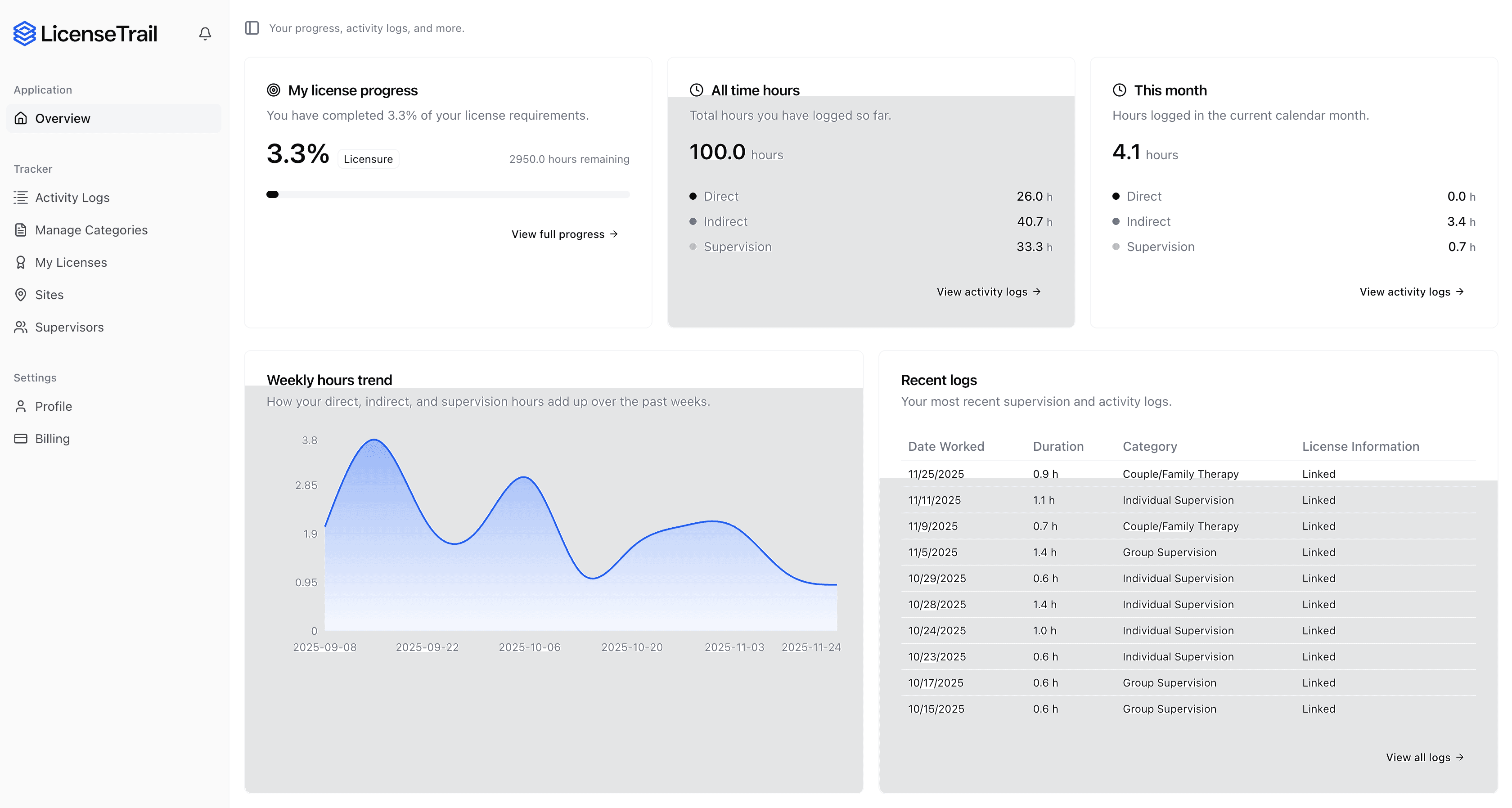
Track your PMFT hours with confidence
License Trail checks your direct, indirect, and supervision hours against Colorado PMFT requirements continuously and flags mismatches before you submit.
 Start Tracking for Free
No credit card required · Free plan available
Related Licenses
Is your spreadsheet hiding Colorado PMFT risks?
Stop guessing if your categories match Colorado State Board of Marriage and Family Therapist Examiners requirements. License Trail checks your direct, indirect, and supervision hours continuously and flags mismatches before you submit.
Import or log
Bring your spreadsheet or start fresh
Upload your existing tracking spreadsheet and we'll map every hour into the right Colorado State Board of Marriage and Family Therapist Examiners categories automatically.
Verify against Colorado
Catch mismatches before the board does
License Trail checks your direct, indirect, and supervision hours against Colorado PMFT requirements continuously.
Export board-ready
One-click clean reports
Generate professional, board-ready reports for supervision meetings and Colorado State Board of Marriage and Family Therapist Examiners submissions in seconds.
No credit card required · Free plan available