
Connecticut LMFTA Requirements: Hours, Exams & Step-by-Step Guide
Stop guessing if your categories match Connecticut requirements. License Trail checks your direct, indirect, and supervision hours against LMFTA requirements continuously and flags mismatches before you submit.
No credit card required · Free plan available
Quick Requirements Overview
- Regulator/authority: Connecticut Department of Public Health (DPH), Chapter 383a / §20-195c (title protected)
- Scope: LMFTA is associate-level and may practice only under clinical supervision of a CT LMFT (no independent practice)
- Education: Graduate degree specializing in MFT from a COAMFTE-accredited program or a program meeting Regs §20-195a-2 (regionally accredited institution)
- Degree practicum/internship: ≥500 direct clinical hours with ≥100 supervision hours (MFT emphasis)
- Application items: online application + photo, official transcript sent to DPH, supervising LMFT verification, $125 fee
- Exam: May request approval to sit for AMFTRB MFT exam at LMFTA stage; passing required for LMFT (not required to issue LMFTA)
- License term/renewal: Expires 2 years from issuance; renewable every 2 years with $125 renewal fee (no stated renewal limit); CE tied to LMFT requirements
- Postgraduate hours (for later LMFT, typically while LMFTA): ≥24 months (DPH) including 1,000 direct client contact hours + 100 supervision hours by LMFT (≥50 individual, remainder group allowed)
License Details
Procedures
Connecticut regulates marriage and family therapists through the Department of Public Health (DPH) under Chapter 383a of the General Statutes. Within this system, there are two licenses:
- Licensed Marital and Family Therapist Associate (LMFTA) – an entry‑level license that allows you to practice only under the clinical supervision of a licensed marital and family therapist (LMFT). (portal.ct.gov)
- Licensed Marital and Family Therapist (LMFT) – the independent practice license.
The associate license itself does not require thousands of post‑graduate hours before issuance. Those hours are required later, for full LMFT licensure, and you typically earn them while holding the LMFTA.
Below is a step‑by‑step guide with the specific Connecticut wording and hour requirements.
1. Legal framework and role of the LMFTA
Key statutory pieces:
- Definition of LMFTA. A “licensed marital and family therapy associate” is defined as someone licensed by DPH whose license permits practice of marital and family therapy only under the clinical supervision of a licensed marital and family therapist. (portal.ct.gov)
- Title protection. No one may use the title “licensed marital and family therapist” or “licensed marital and family therapist associate” unless licensed under §20‑195c. (portal.ct.gov)
The LMFTA is designed as the transitional license while you complete the supervised post‑graduate experience required for the LMFT.
2. Educational requirement (for LMFTA and LMFT pathway)
To qualify for LMFTA, you must already have completed a graduate program in marital and family therapy:
- A graduate degree specializing in marital and family therapy from either:
- a COAMFTE‑accredited program, or
- a program that meets the requirements of Regulations §20‑195a‑2 at a regionally accredited institution. (portal.ct.gov)
The same type of degree is the foundation for eventual LMFT licensure. (portal.ct.gov)
3. Practicum / internship hours during the degree
The practicum or internship is part of the degree, not something you complete after graduation. Connecticut law and DPH’s posted practice act specify:
- You must complete a supervised practicum or internship with an emphasis in marital and family therapy,
- supervised by your degree program or an approved COAMFTE‑accredited post‑graduate training program,
- in which you obtain at least 500 direct clinical hours, and within those hours, 100 hours of clinical supervision. (portal.ct.gov)
These practicum hours are a prerequisite for LMFT licensure and are normally completed before or by the time you apply for the LMFTA license (since you must already hold the qualifying degree).
4. Requirements to obtain the LMFTA in Connecticut
4.1 Core eligibility
Under Conn. Gen. Stat. §20‑195c(b) and DPH’s LMFTA page, an applicant for licensure as a marital and family therapist associate must provide: (portal.ct.gov)
- Proof of the required graduate degree in marital and family therapy (as outlined above), from a regionally accredited institution or COAMFTE‑accredited post‑graduate training program.
- Verification from a supervising LMFT (per the statute and practice‑act posting) that you are working toward the post‑graduate experience requirements for full LMFT licensure. (portal.ct.gov)
- Official transcript sent directly from your program to DPH. (portal.ct.gov)
- A completed online application with a photo and the $125 initial application fee. (portal.ct.gov)
4.2 Examination option at LMFTA stage
On the LMFTA application, DPH asks whether you wish to be approved to sit for the Examination in Marital and Family Therapy of the Association of Marital and Family Therapy Regulatory Boards (AMFTRB). If you answer yes and DPH has all required documentation, they will provide information on exam registration. (portal.ct.gov)
You do not have to pass the exam to receive the LMFTA, but you must pass it for eventual LMFT licensure.
4.3 LMFTA license term and renewal
Connecticut sets the term and renewal rules for LMFTA as follows:
- The LMFTA license expires two years from the date it is issued.
- It may be renewed online every two years thereafter; DPH’s current page explicitly notes there is no limit to the number of renewals, and the renewal fee is $125. (portal.ct.gov)
- Statute also ties LMFTA renewal to the same continuing education requirements that apply to LMFTs. (portal.ct.gov)
5. Hours and supervision required later for full LMFT licensure
The large hour requirements often associated with the profession are not for the LMFTA itself but for the eventual LMFT license. DPH’s LMFT licensure requirements page sets these out in detail: (portal.ct.gov)
5.1 Required supervised post‑graduate experience
After the degree (and typically while licensed as an LMFTA), you must complete:
- Twenty‑four (24) months of supervised post‑graduate work experience (per DPH’s LMFT licensure page). (portal.ct.gov)
- Within those 24 months, the experience must include at least:
- 1,000 hours of direct client contact providing marital and family therapy services, and
- 100 hours of post‑graduate clinical supervision by a licensed marital and family therapist.
DPH further specifies that:
- Of the 100 supervision hours, at least 50 must be individual supervision;
- The remaining supervision hours may be group supervision, as defined in the state regulations. (portal.ct.gov)
In DPH’s documentation section, they repeat that they will require:
- Verification of at least 1,000 hours of direct client contact in not less than 24 months of post‑graduate work, and
- Verification of 100 hours of post‑graduate supervision by an LMFT, with separate forms if you had multiple employers or supervisors. (portal.ct.gov)
Important nuance:
The current online posting of Conn. Gen. Stat. §20‑195c in some sources reflects a minimum of twelve months of post‑graduate experience, while DPH’s own LMFT licensure webpage and its posted “Practice Act” still describe twenty‑four months and specify the 1,000/100 hour breakdown. (law.justia.com)For practical purposes, DPH’s published licensure requirements are what applicants must satisfy unless and until the agency updates them, so candidates should plan for the full 1,000 direct hours plus 100 supervised hours, over at least 12–24 months, and confirm timing with DPH directly.
5.2 Examination requirement for LMFT
For LMFT licensure, you must also demonstrate:
- Successful completion of the AMFTRB Examination in Marital and Family Therapy. (portal.ct.gov)
DPH requires verification of a passing score as part of the LMFT application package.
6. How the pieces fit together (LMFTA pathway in plain sequence)
Putting this into an easy‑to‑follow pathway, focused on the LMFTA:
-
Complete a qualifying graduate program in marital and family therapy
- COAMFTE‑accredited or meeting Regs §20‑195a‑2, at a regionally accredited institution.
- Includes practicum/internship with at least 500 direct clinical hours and 100 hours of clinical supervision. (portal.ct.gov)
-
Apply for LMFTA licensure
- Arrange for your official transcript to be sent directly to DPH. (portal.ct.gov)
- Arrange any required course‑of‑study verification if your program was not COAMFTE‑accredited. (portal.ct.gov)
- Obtain verification from a supervising LMFT that you are working toward the post‑graduate experience required for LMFT licensure (as reflected in §20‑195c(b) and the DPH practice‑act posting). (portal.ct.gov)
- Complete the online LMFTA application, attach a photo, and pay the $125 fee. (portal.ct.gov)
- Indicate on the application if you want approval to take the AMFTRB exam at this stage. (portal.ct.gov)
-
Practice as an LMFTA under supervision
- Work only under clinical supervision of an LMFT; the license does not allow independent practice. (portal.ct.gov)
- During this period, accumulate the post‑graduate hours that will eventually be used for LMFT licensure:
- 1,000 hours of direct client contact in marital and family therapy;
- 100 hours of clinical supervision (at least 50 individual, the rest group). (portal.ct.gov)
-
Maintain your LMFTA license
- Renew every two years, paying the $125 renewal fee and meeting continuing education obligations. (portal.ct.gov)
-
Apply for LMFT once you meet experience and exam requirements
- Submit verification forms documenting:
- at least 1,000 direct client hours, and
- 100 hours of supervision, in not less than the required period (currently described by DPH as 24 months). (portal.ct.gov)
- Arrange for DPH to receive exam score verification and any additional documentation required for the LMFT license. (portal.ct.gov)
- Submit verification forms documenting:
Direct answer to the “hours” question
For Connecticut’s LMFTA/LMFT pathway as administered by the Department of Public Health:
-
During the degree (practicum/internship):
- 500 direct clinical hours,
- with 100 hours of clinical supervision included. (portal.ct.gov)
-
After the degree, for LMFT licensure (usually while you are an LMFTA):
- 1,000 hours of direct client contact providing marital and family therapy;
- 100 hours of post‑graduate clinical supervision by an LMFT, at least 50 of which are individual supervision, the rest allowed as group supervision. (portal.ct.gov)
Connecticut does not require “1,500 hours of direct experience and 1,500 hours of supervised experience” for this license; the specific figures are 500 pre‑degree direct hours + 100 pre‑degree supervision hours, then 1,000 post‑degree direct client hours + 100 post‑degree supervision hours, accumulated over at least the minimum post‑graduate period specified by law and DPH policy.
Track your LMFTA hours with confidence
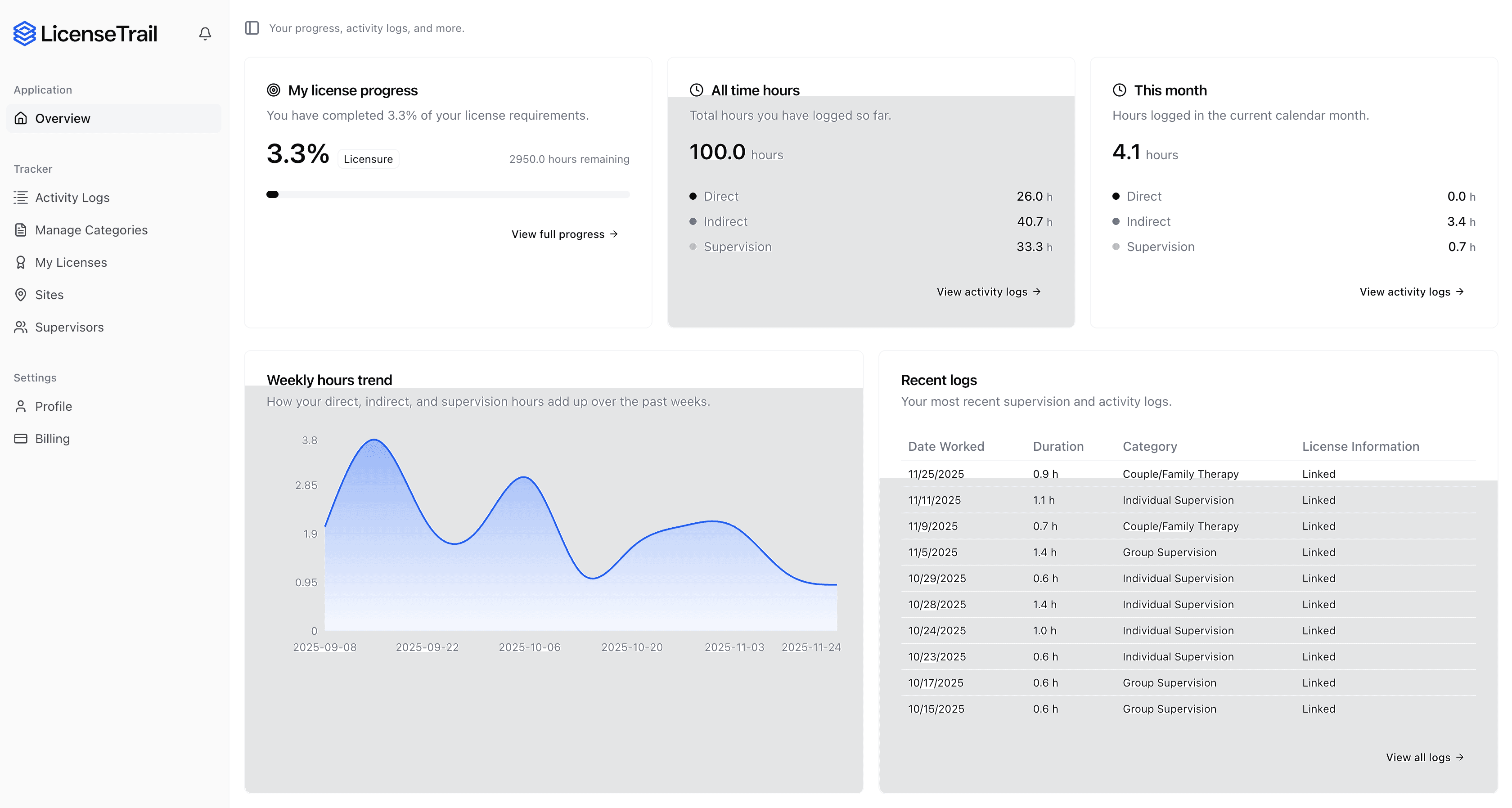
License Trail checks your direct, indirect, and supervision hours against Connecticut LMFTA requirements continuously and flags mismatches before you submit.
 Start Tracking for Free
No credit card required · Free plan available
Related Licenses
Is your spreadsheet hiding Connecticut LMFTA risks?
Stop guessing if your categories match Connecticut Department of Public Health (Marital and Family Therapist Licensure) requirements. License Trail checks your direct, indirect, and supervision hours continuously and flags mismatches before you submit.
Import or log
Bring your spreadsheet or start fresh
Upload your existing tracking spreadsheet and we'll map every hour into the right Connecticut Department of Public Health (Marital and Family Therapist Licensure) categories automatically.
Verify against Connecticut
Catch mismatches before the board does
License Trail checks your direct, indirect, and supervision hours against Connecticut LMFTA requirements continuously.
Export board-ready
One-click clean reports
Generate professional, board-ready reports for supervision meetings and Connecticut Department of Public Health (Marital and Family Therapist Licensure) submissions in seconds.
No credit card required · Free plan available