
Connecticut LMSW Requirements: Hours, Exams & Step-by-Step Guide
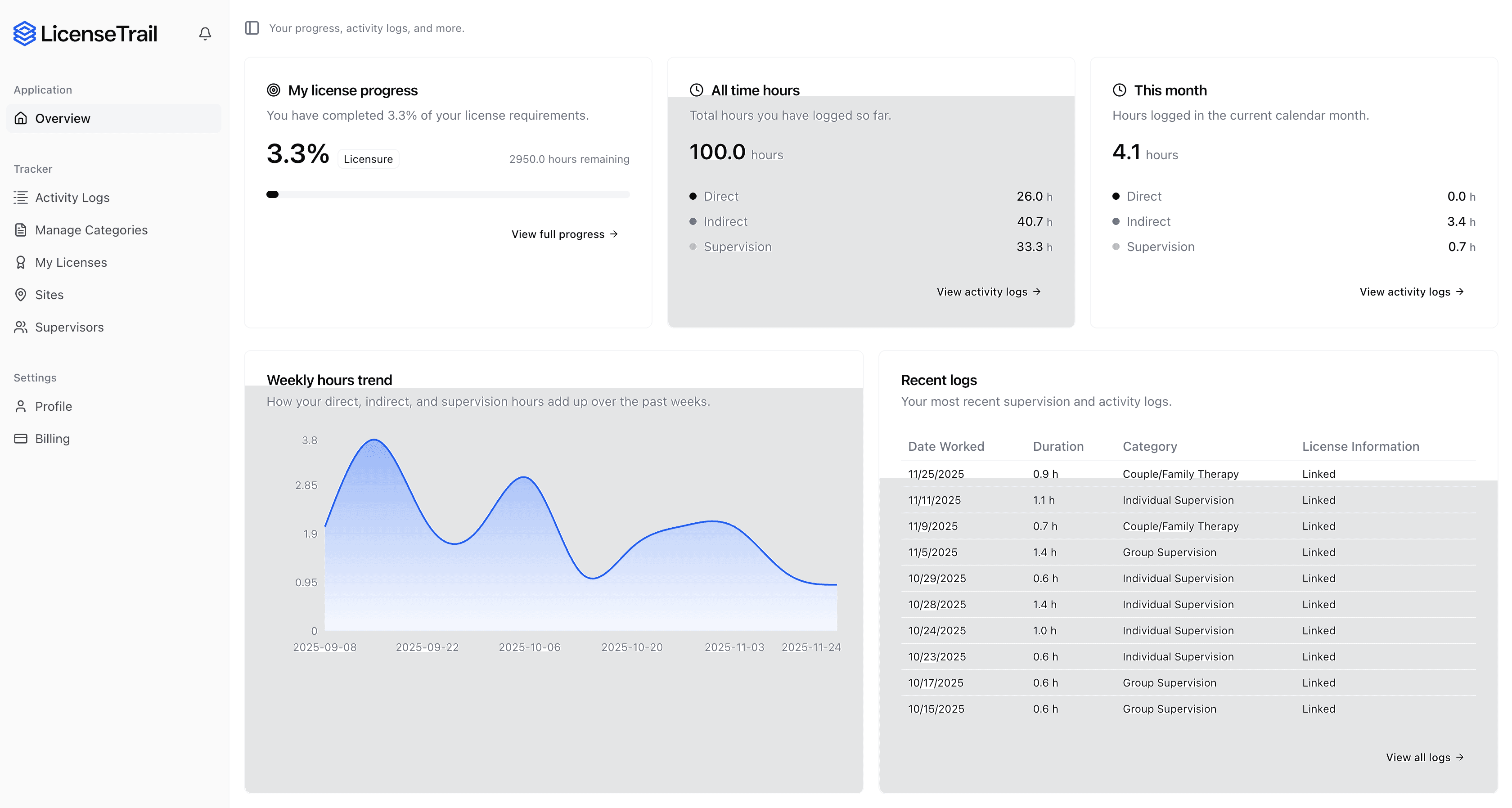
Stop guessing if your categories match Connecticut requirements. License Trail checks your direct, indirect, and supervision hours against LMSW requirements continuously and flags mismatches before you submit.
No credit card required · Free plan available
Quick Requirements Overview
- Regulator: Connecticut Department of Public Health (DPH) — “Master Level Social Worker” (LMSW)
- Education: MSW from CSWE-accredited program; CT CSWE-candidate programs accepted (Spring 2024–Spring 2028); foreign MSW must be CSWE-equivalent
- Exam: ASWB Master’s exam required by statute but suspended until Jan 1, 2026 (DPH currently issues LMSW without it)
- Experience hours: None required for initial LMSW licensure
- Application: Online via DPH eLicense; upload photo; school sends official MSW transcript directly to DPH; provide license verifications if applicable
- Fees: $125 initial; $125 annual renewal; $125 reinstatement (per DPH schedule)
- Practice limits: No independent clinical practice; must practice under professional supervision; diagnosis only in consultation with qualified licensed professionals
- Supervision standard (practice): At least monthly face-to-face supervision with written evaluation (per statute/legislative summaries)
License Details
Procedures
Connecticut’s Licensed Master Social Worker (LMSW) credential is regulated by the Department of Public Health (DPH) under the “Master Level Social Worker” category and by statute in Chapter 383b, Clinical Social Workers and Master Social Workers. This license is designed as Connecticut’s entry‑level clinical social work license: it allows you to practice clinical social work only under professional supervision, and it is the status you must hold while accruing hours toward the Licensed Clinical Social Worker (LCSW).
The sections below walk through what is required to become licensed as an LMSW in Connecticut as of late 2025, and how “hours” and supervision fit into the overall pathway.
1. Licensure framework and titles in Connecticut
Under Connecticut General Statutes § 20‑195n(b), an “applicant for licensure as a master social worker” must meet specified education and examination requirements.(cga.ct.gov) DPH administers this license through its “Master Level Social Worker Licensing” program and posts the operative requirements on its “Licensing Requirements” page for master’s‑level social workers.(portal.ct.gov)
Key points about the LMSW in Connecticut:
- It is the master’s‑level license.
- It is required for most clinical social work practice after graduation in Connecticut.(naswct.socialworkers.org)
- LMSWs may not practice independently; they must work under professional supervision.(cga.ct.gov)
- All post‑master’s hours used later for LCSW licensure in Connecticut must be completed while you are licensed as an LMSW in this state (for hours accrued in Connecticut on or after October 1, 2011).(cga.ct.gov)
2. Do you need experience hours to become an LMSW?
For the LMSW license itself, Connecticut does not require any specific number of post‑degree experience hours.
- The DPH master‑level licensing requirements list only:
- the degree requirement, and
- the (currently suspended) examination requirement and documentation steps.
There is no mention of practice hours or supervised experience as a condition of initial LMSW licensure.(portal.ct.gov)
- An Office of Legislative Research comparison table for social work licensure likewise lists “Experience: 0” for the Connecticut Licensed Master Social Worker license.(cga.ct.gov)
So if you are asking whether Connecticut requires something like “1,500 hours of direct experience and 1,500 hours of supervised experience” before it will issue an LMSW: it does not. Hours come into play when you move on to the LCSW, not for getting the LMSW in the first place.
3. Core eligibility requirements for the LMSW
3.1 Education
DPH’s master‑level social worker licensing page specifies that, to qualify for LMSW licensure, an applicant must:(portal.ct.gov)
- Hold a master’s degree in social work from:
- a program accredited by the Council on Social Work Education (CSWE), or
- a program offered by a Connecticut institution that is in candidate status with CSWE between the spring semester of 2024 and the spring semester of 2028,
- Or, if educated outside the United States or its territories, have completed a social work education program that CSWE deems equivalent.
In practice:
- A standard CSWE‑accredited MSW from any U.S. school satisfies this.
- If your MSW is from a non‑U.S. school, you must obtain CSWE equivalency review as DPH requires.
3.2 Examination – and the 2026 suspension
By statute, an LMSW applicant must “pass the masters level examination of the Association of Social Work Boards (ASWB) or any other examination prescribed by the commissioner.”(cga.ct.gov)
However, DPH has suspended this requirement:
- The DPH licensing requirements state that “the ASWB master’s level examination requirement is suspended until January 1, 2026.”(portal.ct.gov)
- DPH will currently issue the LMSW license without requiring you to pass the ASWB Master’s exam, although you can ask to be approved to sit for the exam anyway if you want to take it.(portal.ct.gov)
What this means now (through December 31, 2025):
- You must meet the degree requirement.
- You do not have to pass the ASWB Master’s exam to obtain the LMSW license during the suspension period, unless and until the law or policy changes.
- If you check the box on your application requesting exam approval, DPH will both issue your license (without exam) and send you information on how to register for the exam if you still wish to take it.(portal.ct.gov)
4. Application materials and process with DPH
DPH processes LMSW (master‑level) applications only through its online eLicense system. The current DPH page lays out the documentation required.(portal.ct.gov)
4.1 Documents DPH requires
For a first‑time LMSW license, you must arrange for:
-
Official MSW transcript
- Sent directly from your school to DPH.
- Must verify the award of a master’s degree in social work that meets the CSWE criteria described above.(portal.ct.gov)
-
License verifications (if applicable)
- If you have ever held any other professional license (in any jurisdiction) that DPH asks about, you must have each licensing authority send verification directly to DPH.(portal.ct.gov)
-
Online application and photo
- You complete the application in the eLicense system and attach a photograph.
- Applications are only accepted online; paper applications are not used.(portal.ct.gov)
4.2 Fees
On the master‑level social worker licensing page, DPH lists the current LMSW fee schedule as:(portal.ct.gov)
- Initial application fee: $125
- Annual renewal fee: $125
- Reinstatement of a lapsed license: $125
(Fees can be changed by regulation; the DPH website is the controlling source.)
4.3 Where documents go
All supporting documents must be sent directly from the issuing source to:(portal.ct.gov)
Connecticut Department of Public Health
MSW Licensing
410 Capitol Ave., MS #12APP
P.O. Box 340308
Hartford, CT 06134
DPH also lists telephone, fax, and an email address for the “counselors team” that manages social work licensure.
5. What supervision and “professional supervision” mean for an LMSW
Even though no hours are required to obtain the LMSW license, supervision is central to what you’re allowed to do after you are licensed.
5.1 Scope of practice for an LMSW
Under Connecticut’s master social worker law and explanatory summaries:(cga.ct.gov)
- A licensed master social worker may:
- Practice clinical social work under professional supervision; and
- Offer a mental health diagnosis, but only in consultation with certain licensed mental health professionals (such as an LCSW, psychologist, psychiatrist, APRN, or marital and family therapist).
- An LMSW may not engage in independent practice (that is, practice clinical social work without supervision).
5.2 Definition of “under professional supervision”
The statute and legislative summaries define “under professional supervision” and “professional supervision” roughly as follows (paraphrased):(cga.ct.gov)
- It is the practice of (clinical) social work under the supervision of a licensed mental health, health care, social services, or education professional.
- “Professional supervision” must include face‑to‑face consultation, at least monthly, where the supervisor reviews and assesses the LMSW’s clinical social work practice, and provides written evaluation.
NASW‑CT’s current guidance (which reflects the statute but is not itself law) further clarifies that supervision of an LMSW must be provided by a:(naswct.socialworkers.org)
- Licensed Clinical Social Worker (LCSW)
- Licensed Psychologist
- Licensed Marital and Family Therapist
- Licensed Professional Counselor
- Licensed Advanced Practice Registered Nurse (APRN)
- Licensed Physician
and that supervision must be at least monthly, face‑to‑face in person or via interactive virtual technology.
6. How hours are used later: the path from LMSW to LCSW
Although not part of the LMSW licensure requirements, Connecticut ties the LMSW very closely to the LCSW requirements. This is where experience hours come in, and where board verbiage about hours matters.
6.1 Statutory hour requirement
Under § 20‑195n(c) and DPH’s LCSW licensing page, an applicant for LCSW must:(portal.ct.gov)
- Hold a master’s or doctorate in social work from a CSWE‑accredited (or CSWE‑equivalent) program;
- Have 3,000 hours of post‑master’s social work experience, which:
- Must be completed after the MSW is awarded; and
- Must include at least 100 hours of work under professional supervision by a licensed clinical or certified independent social worker; and
- Pass the ASWB Clinical examination.
Additional statutory language specifies that:
- On and after October 1, 2011, those 3,000 hours completed in Connecticut must be earned while licensed as an LMSW.(cga.ct.gov)
6.2 How Connecticut describes the hours
Putting the board and statutory language together:
- The law does not break the 3,000 hours down into “direct client” vs “indirect” hours the way some states do. Instead, it speaks in aggregate of “three thousand hours post‑master’s social work experience.”
- The only numeric subdivision is:
- Total required experience: 3,000 post‑master’s social work hours;
- Minimum supervised by LCSW or certified independent social worker: 100 hours (“work under professional supervision” by one of these supervisors).(portal.ct.gov)
Independent explanatory materials (such as MSWGuide and NASW‑CT) treat those 3,000 hours as supervised clinical social work hours:
- The LMSW must work under professional supervision for the duration of this time.
- At least 100 of those supervision hours must be provided directly by an LCSW or Certified Independent Social Worker; the rest of the supervision can be provided by other qualified licensed mental‑health professionals within the statutory definition of “professional supervision.”(mswguide.org)
But again, those 3,000 / 100 hours are LCSW requirements, not LMSW licensing requirements. You begin accruing them after you have your MSW and LMSW.
7. Step‑by‑step summary: becoming an LMSW in Connecticut
-
Earn a qualifying MSW
- From a CSWE‑accredited program, or a Connecticut program in CSWE candidate status (within the 2024–2028 window), or a foreign program deemed equivalent by CSWE.(portal.ct.gov)
-
Confirm current exam policy
- By statute, the ASWB Master’s exam is required; however, DPH has suspended this requirement until January 1, 2026, and currently licenses without the exam.(portal.ct.gov)
-
Apply online through DPH’s eLicense system
- Complete the master‑level (LMSW) application and upload a photograph.
- Pay the $125 initial application fee (subject to change).(portal.ct.gov)
-
Arrange for your school to send your transcript
- Official MSW transcript sent directly to DPH verifying degree conferral.(portal.ct.gov)
-
Provide any required license verifications
- If you hold or have held any other licenses that DPH requires disclosure of, have each licensing authority send a verification directly to DPH.(portal.ct.gov)
-
Receive your LMSW license
- DPH reviews your file; if you meet the requirements, it issues the LMSW (master‑level) license, currently without requiring the ASWB Master’s exam during the suspension period.
-
Begin practice under professional supervision
- As an LMSW, practice clinical social work only under professional supervision and in consultation for diagnosis, as defined by statute and DPH policy.(cga.ct.gov)
- If you intend to become an LCSW, structure your employment so that:
- Your work qualifies as post‑master’s clinical social work, and
- You are on track to accumulate 3,000 total hours, including at least 100 supervision hours with an LCSW or certified independent social worker, all while holding your LMSW.(portal.ct.gov)
In summary: Connecticut’s DPH does not require any experience hours to issue the LMSW license. The only formal entry requirements are a qualifying MSW and, once the current suspension ends, the ASWB Master’s exam. The well‑known 3,000 hours of post‑master’s experience with at least 100 hours under an LCSW or certified independent social worker are LCSW requirements that you complete after becoming an LMSW, under the framework of “professional supervision” described in Connecticut law.
Track your LMSW hours with confidence
License Trail checks your direct, indirect, and supervision hours against Connecticut LMSW requirements continuously and flags mismatches before you submit.
 Start Tracking for Free
No credit card required · Free plan available
Related Licenses
Is your spreadsheet hiding Connecticut LMSW risks?
Stop guessing if your categories match Connecticut Department of Public Health (Social Work Licensure) requirements. License Trail checks your direct, indirect, and supervision hours continuously and flags mismatches before you submit.
Import or log
Bring your spreadsheet or start fresh
Upload your existing tracking spreadsheet and we'll map every hour into the right Connecticut Department of Public Health (Social Work Licensure) categories automatically.
Verify against Connecticut
Catch mismatches before the board does
License Trail checks your direct, indirect, and supervision hours against Connecticut LMSW requirements continuously.
Export board-ready
One-click clean reports
Generate professional, board-ready reports for supervision meetings and Connecticut Department of Public Health (Social Work Licensure) submissions in seconds.
No credit card required · Free plan available