
Connecticut LPCA Requirements: Hours, Exams & Step-by-Step Guide
Stop guessing if your categories match Connecticut requirements. License Trail checks your direct, indirect, and supervision hours against LPCA requirements continuously and flags mismatches before you submit.
No credit card required · Free plan available
Quick Requirements Overview
- Issued/regulated by CT Department of Public Health (DPH); pre‑licensure credential to practice under supervision toward LPC
- Education required from a regionally accredited institution via either: CACREP clinical mental health counseling degree or non‑CACREP + ≥60 graduate semester hours in counseling/related mental health field
- Non‑CACREP route must document required content areas (e.g., human development, multicultural, theories/techniques, group, career, appraisal, research/eval, professional orientation/ethics, addictions, trauma/crisis, diagnosis/treatment)
- Graduate program must include 100‑hour counseling practicum
- Graduate program must include 600‑hour clinical mental health counseling internship
- Practicum/internship must be taught/supervised by faculty who are licensed/certified professional counselors (or equivalent out‑of‑state)
- No exam required for LPCA (exam applies later to LPC)
- Apply via DPH eLicensing; $125 fee; submit official transcripts + course of study form sent directly from institution(s)
License Details
Procedures
In Connecticut, the Licensed Professional Counselor Associate (LPCA) credential is issued by the Department of Public Health (DPH) and functions as a pre‑licensure status on the way to full Licensed Professional Counselor (LPC). The LPCA requirements are almost entirely educational; the large “hour” requirement (3,000 hours of supervised practice) applies later, when you upgrade to LPC.
Below is a step‑by‑step guide focused on the LPCA, with clear detail on the types of hours and the state’s own terminology.
1. Governing authority and role of the LPCA
- The LPCA is regulated by the Connecticut Department of Public Health – Professional Counselor Licensure unit.(portal.ct.gov)
- It authorizes you to practice professional counseling under supervision while you accumulate the supervised post‑graduate hours needed for full LPC licensure (those 3,000 hours are described in Section 4 below).
The LPCA requirements themselves are centered on:
- The type of graduate degree you hold.
- Specific coursework content.
- A 100‑hour counseling practicum and 600‑hour clinical mental health counseling internship completed in your graduate program.(portal.ct.gov)
There is no separate “1,500 direct / 1,500 supervised hours”–type requirement for obtaining the LPCA in Connecticut.
2. Educational pathway options for LPCA
Connecticut gives you two main educational routes that both lead to LPCA eligibility. In both cases, education must be completed at a regionally accredited institution.(portal.ct.gov)
Option A – CACREP‑accredited clinical mental health counseling degree
You qualify if you have:
- A graduate degree in clinical mental health counseling from a program accredited by CACREP (Council for Accreditation of Counseling and Related Educational Programs) (or its successor).(portal.ct.gov)
This option assumes the program already includes the required coursework plus the 100‑hour practicum and 600‑hour internship described below (CACREP requires this structure).
Option B – Non‑CACREP program with 60 graduate semester hours
You may also qualify if you have:
- At least 60 graduate semester hours in counseling or a related mental health field, from a regionally accredited institution.(portal.ct.gov)
- Course work that collectively covers at least the following content areas (paraphrasing the DPH list):
- Human growth and development across the lifespan
- Social and cultural / multicultural foundations
- Counseling theories
- Counseling techniques or helping skills
- Group counseling or group work
- Career counseling / vocational development
- Appraisal, testing, and measurement with individuals and groups
- Research methods and program evaluation
- Professional orientation to mental health counseling (ethics, roles, standards)
- Addiction and substance use counseling
- Trauma and crisis counseling
- Diagnosis and treatment of mental and emotional disorders(portal.ct.gov)
- A graduate degree in counseling or a related mental health field (e.g., counseling, social work, marriage and family therapy, psychology) from a regionally accredited institution.(portal.ct.gov)
3. Practicum and internship hour requirements for LPCA
For LPCA licensure, Connecticut DPH is very specific about the practicum and internship hours that must be part of your graduate training:
3.1 Required practicum hours
You must have completed:
- A 100‑hour practicum in counseling.(portal.ct.gov)
The statute/DPH language also requires that:
- The practicum is taught and supervised by a faculty member who is licensed or certified as a professional counselor, or holds an equivalent counselor credential in another state.(portal.ct.gov)
Connecticut’s rules do not break this 100 hours down into specific “direct client” vs “indirect” hour categories for LPCA eligibility; instead, they rely on the practicum structure set by the program and accreditation standards (for CACREP programs, that typically includes a minimum number of direct client contact hours inside the 100 total).
3.2 Required internship hours
You must also have completed:
- A 600‑hour clinical mental health counseling internship.(portal.ct.gov)
Again, Connecticut specifies that:
- The internship must be taught/supervised by a faculty member who is licensed or certified as a professional counselor, or its equivalent in another state.(portal.ct.gov)
As with the practicum, the state does not impose its own separate ratio of “direct client contact” vs “other duties” within the 600 hours; that mix is governed by program and accreditation standards.
What this means in practice
For LPCA licensure:
-
Total clinical training hours required by the state during your graduate program:
- 100 hours of counseling practicum, plus
- 600 hours of clinical mental health counseling internship
= 700 hours of structured, supervised field experience embedded in the degree.(portal.ct.gov)
-
There is no additional pre‑licensure fieldwork requirement beyond those 700 hours in order to obtain the LPCA. The larger hour requirement you may have heard about (3,000 hours) applies later when moving from LPCA to full LPC.
4. Post‑degree supervised hours (for full LPC after LPCA)
You asked specifically for how the state talks about “types of hours” such as direct vs supervised experience. Those distinctions appear not in the LPCA rules, but in the full Professional Counselor (LPC) requirements.
Once you are an LPCA, to become a fully licensed Professional Counselor you must (among other things):
- Complete 3,000 hours of postgraduate experience “in the practice of professional counseling,” obtained after your qualifying graduate degree.
- These 3,000 hours must be “under professional supervision” and must include at least 100 hours of “direct professional supervision.”
- The hours must be accumulated over at least two years (i.e., you cannot compress 3,000 hours into less than a two‑year span).(portal.ct.gov)
Key terms as defined and used by the Connecticut DPH and statutes (paraphrased from their language):(portal.ct.gov)
-
“Under professional supervision” means you are practicing professional counseling while being supervised by one of the following Connecticut‑licensed professionals:
- Licensed Professional Counselor
- Physician licensed in CT and board‑certified in psychiatry
- Advanced Practice Registered Nurse (APRN) licensed in CT and certified in psychiatric–mental health (clinical nurse specialist or nurse practitioner)
- Licensed Psychologist
- Licensed Marital and Family Therapist
- Licensed Clinical Social Worker
-
“Direct professional supervision” means face‑to‑face consultation between one qualified supervisor (from the above list) and one supervisee, including:
- At least monthly review of your counseling practice, and
- A written evaluation and assessment of your counseling work by the supervisor.
Connecticut does not split the 3,000 hours into separate numeric categories like “X hours of direct client contact” and “Y hours of other activities.” Instead, it simply requires:
- 3,000 total hours of post‑degree professional counseling practice under professional supervision,
- within that, 100 or more hours must be the special, face‑to‑face direct professional supervision described above.(portal.ct.gov)
These 3,000 post‑degree hours cannot include your graduate practicum or internship hours; they are separate and in addition to the 700 practicum/internship hours required before LPCA.(research.com)
5. Application steps and fees for LPCA
To actually be granted the LPCA license after meeting the education/practicum/internship requirements, you must submit the following directly to the Connecticut DPH:(portal.ct.gov)
-
Online application for Professional Counselor Associate
- Submitted via the state’s eLicensing portal.
- Application fee: $125 (non‑refundable).
-
Official graduate transcripts and “course of study” form
- Sent directly from each institution where you completed graduate‑level counseling or related mental health coursework.
- Must verify:
- All graduate coursework
- The graduate degree conferred
- The fact that you completed the required practicum and internship (via the course of study form).
-
Delivery details
-
Transcripts and course of study forms go directly from the institution to:
Connecticut Department of Public Health
Professional Counselor Licensure
410 Capitol Ave., MS #12 APP
P.O. Box 340308
Hartford, CT 06134 -
The DPH also lists an email ([email protected]) and fax number for document submission where appropriate.(portal.ct.gov)
-
At the LPCA stage, no national exam is required; the exam requirement (NCE or NCMHCE) attaches to the full LPC license application, not LPCA.(portal.ct.gov)
6. Summary of hour and terminology requirements
For Connecticut’s LPCA (pre‑licensure):
- Graduate field experience hours required:
- 100 hours – counseling practicum
- 600 hours – clinical mental health counseling internship
- Both must be supervised/taught by a faculty member licensed or certified as a professional counselor (or equivalent in another state).(portal.ct.gov)
- There is no separate numeric requirement of “direct client” vs “indirect” hours specified by the state for LPCA; those details are embedded in program and accreditation rules.
For eventual upgrade to LPC (after LPCA), the state’s key hour‑related language is:
- 3,000 hours of post‑graduate experience “under professional supervision” in professional counseling.
- Within that total, at least 100 hours of “direct professional supervision” (regular, face‑to‑face supervisory meetings with written evaluations).
- Accrued over no fewer than two years.(portal.ct.gov)
So, unlike states that specify a split such as “1,500 hours direct client work plus 1,500 supervised hours,” Connecticut defines:
- 700 structured field hours (100 + 600) during the degree for LPCA eligibility, and
- 3,000 supervised post‑degree practice hours, including 100 hours of direct professional supervision, for full LPC licensure.
Track your LPCA hours with confidence
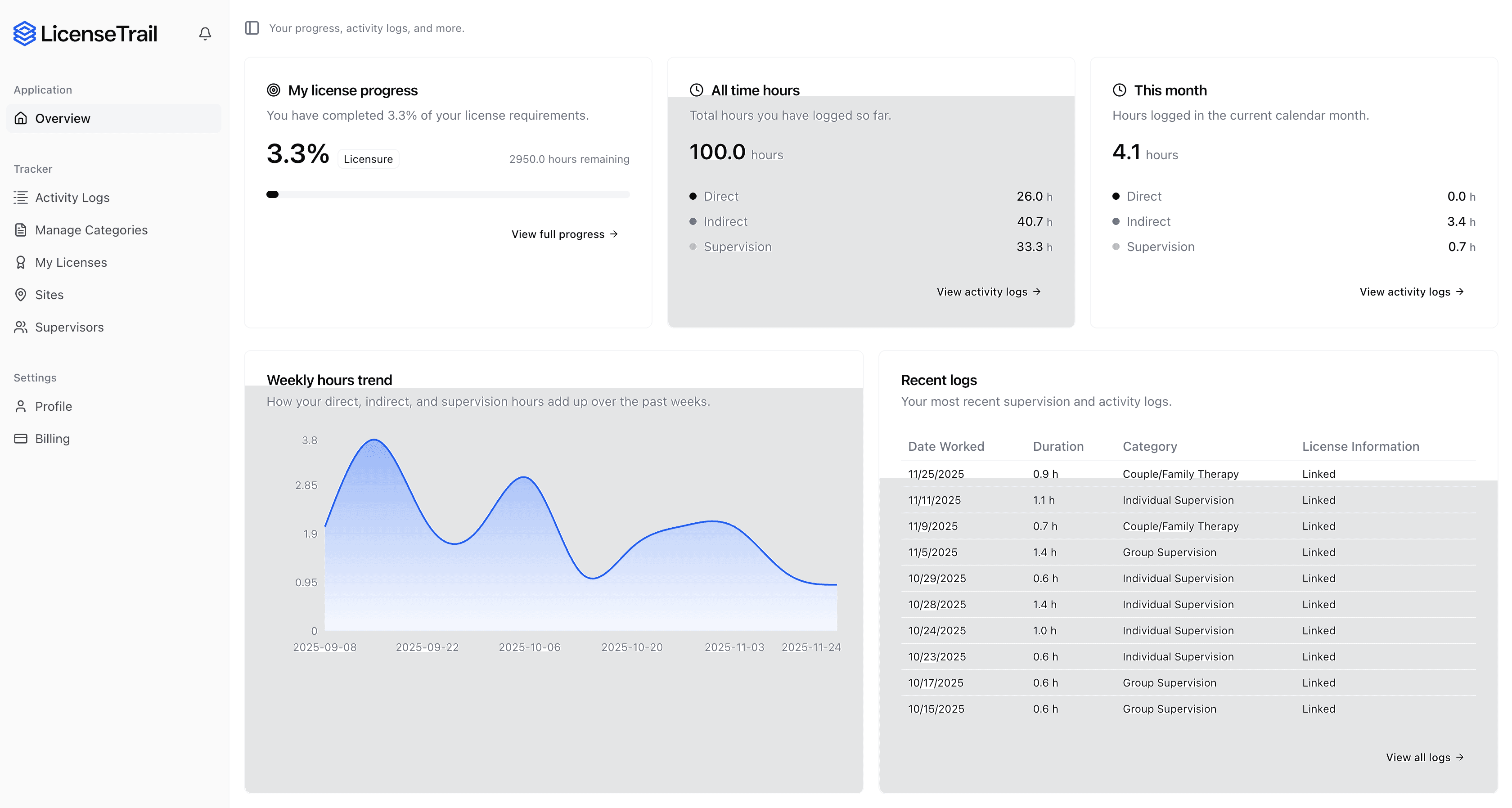
License Trail checks your direct, indirect, and supervision hours against Connecticut LPCA requirements continuously and flags mismatches before you submit.
 Start Tracking for Free
No credit card required · Free plan available
Related Licenses
Is your spreadsheet hiding Connecticut LPCA risks?
Stop guessing if your categories match Connecticut Department of Public Health (Professional Counselor Licensure) requirements. License Trail checks your direct, indirect, and supervision hours continuously and flags mismatches before you submit.
Import or log
Bring your spreadsheet or start fresh
Upload your existing tracking spreadsheet and we'll map every hour into the right Connecticut Department of Public Health (Professional Counselor Licensure) categories automatically.
Verify against Connecticut
Catch mismatches before the board does
License Trail checks your direct, indirect, and supervision hours against Connecticut LPCA requirements continuously.
Export board-ready
One-click clean reports
Generate professional, board-ready reports for supervision meetings and Connecticut Department of Public Health (Professional Counselor Licensure) submissions in seconds.
No credit card required · Free plan available