
Connecticut POSTDOC TRAINING PERMIT Requirements: Hours, Exams & Step-by-Step Guide
Stop guessing if your categories match Connecticut requirements. License Trail checks your direct, indirect, and supervision hours against POSTDOC TRAINING PERMIT requirements continuously and flags mismatches before you submit.
No credit card required · Free plan available
Quick Requirements Overview
- Authority: CT DPH / Board of Examiners of Psychologists issues a temporary Post Doctoral Training Permit for supervised postdoc practice.
- Eligibility: Doctoral degree in psychology (or equivalent); have not completed required supervised postdoctoral experience and have not taken the EPPP.
- Scope: May practice only under supervision of a licensed psychologist; no independent practice as a psychologist.
- Validity: Expires no later than 1 year after the doctoral degree conferral date; non‑renewable (late application shortens usable time).
- Exam failure: Permit becomes void and cannot be reissued if you fail the EPPP.
- Application: Apply via CT eLicense; upload photo + diploma or transcript showing degree awarded; $100 fee.
- Supervised experience (for full licensure): 1 year via 35 hrs/week × 46 weeks within 12 months or 1,800 hrs within 24 months; max 40 hrs/week count; doctoral internship does not count.
- Supervision rules (for those hours): 3 hrs supervision per 40 hrs work (≥ 1 hr individual, face‑to‑face); supervisor must be doctoral‑level licensed psychologist; max 3 supervisees at a time.
License Details
Procedures
Connecticut Postdoctoral Training Permit for Psychologists: What the State Actually Requires
Connecticut regulates postdoctoral practice in psychology through the Department of Public Health (DPH) and the Board of Examiners of Psychologists. The “Post Doctoral Training Permit” is a temporary permit that lets a new doctoral graduate practice as a supervised, doctoral-level psychology provider while completing postdoctoral experience and preparing for full licensure. (portal.ct.gov)
This article walks through:
- What the Post Doctoral Training Permit is (and is not)
- Exact eligibility criteria
- What the permit allows and how long it lasts
- The supervised work experience / hours structure Connecticut requires for eventual psychologist licensure
- How the permit fits with the broader supervised-experience and “psychology resident” rules
1. What the Connecticut Post Doctoral Training Permit Is
The DPH describes this credential as a temporary permit issued to “an applicant for licensure as a doctoral-level psychology provider” who:
- Already holds a doctoral degree in psychology or its equivalent, and
- Has not yet completed the supervised postdoctoral work experience or taken the licensure EPPP examination. (portal.ct.gov)
Key points:
- It is not a full psychologist license.
- It is designed for postdoctoral residents/fellows and other doctoral-level providers who are in supervised training on the path to licensure.
- The state explicitly notes that a “doctoral-level psychology provider” includes a postdoctoral resident or fellow who provides psychological services. (portal.ct.gov)
2. What the Permit Authorizes and How Long It Lasts
Under Connecticut’s description, the temporary Post Doctoral Training Permit:
-
Authorizes supervised practice
- It allows you to practice as a doctoral-level psychology provider under the supervision of a licensed psychologist. (portal.ct.gov)
- You must be supervised; independent practice as a psychologist is not allowed under this permit.
-
Duration and expiration
- The permit “shall be valid for a period not to exceed one year after the date of attaining such doctoral degree” and is not renewable. (portal.ct.gov)
- Important implication:
- If your degree was awarded on, for example, June 1, 2025, the permit expires no later than June 1, 2026, even if it was issued later.
- Applying late effectively shortens how long you can use the permit.
-
What happens if you fail the licensing exam
- The permit becomes void and cannot be reissued if you fail the licensure examination (EPPP). (portal.ct.gov)
-
Fee
- The state fee for the temporary permit is $100. (portal.ct.gov)
3. Eligibility Requirements for the Post Doctoral Training Permit
To qualify for this specific permit, Connecticut DPH requires: (portal.ct.gov)
-
Doctoral degree in psychology (or equivalent)
- You must hold a doctoral degree in psychology or the equivalent from a qualifying education program.
- During the online application you must upload either:
- A copy of your diploma, or
- A transcript showing that the doctoral degree in psychology was awarded.
-
Status on postdoctoral experience and EPPP
- You must not yet have:
- Completed the supervised postdoctoral work experience required for full licensure, or
- Taken the EPPP licensure examination.
- You must not yet have:
-
Completed online application and fee
- You must:
- Complete the online application through the state’s eLicense system (choose “Psychologist – Post Doctoral Training Permit”), and
- Pay the $100 fee. (portal.ct.gov)
- You must:
-
Photo requirement
- As part of the online process, DPH requires you to upload a photograph of yourself. (portal.ct.gov)
There is no separate requirement for having already accumulated a specific number of supervised hours before the permit can be issued; the permit exists so you can work under supervision while accumulating those hours.
4. The Work Experience / Hours Structure Behind Connecticut Licensure
Although the Post Doctoral Training Permit page itself does not spell out specific hour counts (e.g., “1,500 direct / 1,500 supervised”), the psychologist licensure regulations and DPH licensure page define the supervised work experience you must complete for full licensure.
These standards apply to at least one year of supervised work experience at the pre- or postdoctoral level and are what you will typically be working toward while holding a Post Doctoral Training Permit. (law.cornell.edu)
4.1 Overall supervised work requirement (time and hours)
Connecticut requires at least one year of supervised work experience that meets one of two schedules:
-
Full-time style option
- At least 35 hours per week
- For at least 46 weeks
- All within 12 consecutive months
-
Hour-based option
- At least 1,800 hours of supervised work experience
- Completed within 24 consecutive months
In either case:
- You cannot count more than 40 hours per week toward the required experience.
- The required internship that was part of your doctoral program does not count toward this supervised work experience. (law.cornell.edu)
Connecticut does not divide these hours into categories such as “1,500 hours direct client contact” and “1,500 hours of supervision or support activities.” Instead, the state sets:
- Total hours / time frame, and
- A minimum supervision ratio and format (see below).
4.2 Supervision requirements linked to those hours
The regulations and DPH licensure page set very specific supervision rules: (law.cornell.edu)
-
Who can supervise
- Supervision must be provided by a doctoral-level psychologist licensed in the state where the experience occurs.
-
Minimum supervision intensity
- For each 40 hours of work experience, you must receive at least 3 hours of supervision or consultation.
- Of those 3 hours, at least 1 hour must be individual, direct, face‑to‑face supervision.
-
Supervisor caseload
- A supervising psychologist may not supervise more than three individuals who are completing the work experience at the same time.
-
Content and setting of the experience
- The work experience must:
- Be in an area for which you are qualified by your doctoral education, and
- Be appropriate to your intended area of practice (e.g., clinical, counseling, school).
- You generally cannot count experience from an independent practice setting where you receive direct client fees or variable compensation based on fees you generate. (law.cornell.edu)
- The work experience must:
These rules define the quality and structure of the hours, but they do not state that a specific subset must be “direct experience” versus “indirect.” Your supervisor and setting must ensure your work includes appropriate patient/client services and other professional activities consistent with doctoral-level practice.
5. License Exemption and Use of Title While Completing Hours
Connecticut has a separate “license exemption” rule tied to supervised work experience plans. This interacts with—but is distinct from—the Post Doctoral Training Permit. (portal.ct.gov)
5.1 Pre-approval of supervised work experience (optional but relevant)
For supervised experience completed in Connecticut, you may (but are not required to) submit a “pre-approval of work experience” plan to DPH:
- The prospective supervisor usually completes and submits this plan.
- DPH reviews whether the planned setting, supervision structure, and duties will meet regulatory requirements. (portal.ct.gov)
5.2 Exemption from licensure during supervised work
For candidates completing their supervised work experience in Connecticut:
- DPH states that individuals completing this required experience are exempt from the psychologist licensure requirement while completing the work experience necessary to obtain licensure. (portal.ct.gov)
- This exemption is time‑limited; it ends no later than two years after you complete the work experience if you have not passed the EPPP. (portal.ct.gov)
During an approved postdoctoral work experience plan in Connecticut, you may use the descriptive title “psychology resident” in that employment context. Outside that approved employment, you must not use titles that include “psychologist,” “psychology,” or “psychological” in a way that suggests independent practice for a fee. (portal.ct.gov)
This “psychology resident” exemption pathway and the Post Doctoral Training Permit are both ways the state allows supervised postdoctoral practice; the permit is specifically framed as a temporary permit to an applicant for licensure as a doctoral‑level psychology provider who has finished the doctoral degree but not the postdoctoral experience or EPPP.
6. Step‑by‑Step: How to Obtain the Post Doctoral Training Permit
Summarizing the state’s process: (portal.ct.gov)
-
Confirm your eligibility
- You hold a doctoral degree in psychology or equivalent.
- You have not yet completed the supervised postdoctoral work experience and/or not yet taken the EPPP.
-
Prepare your documentation
- A photo of yourself (for upload).
- A copy of your doctoral diploma or
- A transcript clearly showing the doctoral degree in psychology was awarded (and the date of conferral).
-
Apply online
- Go to Connecticut’s eLicense system.
- Create or log into your account.
- Under Initial Application → Public Health Practitioners, select “Psychologist – Post Doctoral Training Permit.”
- Complete all required fields and upload your photo and diploma/transcript.
-
Pay the fee
- Submit the $100 application fee online.
-
Track issuance and note your expiration date
- Once issued, verify that the permit’s expiration reflects one year after the date your doctoral degree was awarded, not simply one year from issuance.
- Plan your supervised postdoctoral employment and EPPP timeline to fit within:
- The permit’s one‑year validity, and
- The longer statutory timelines on when your licensure exemption ends if you have not yet passed the EPPP.
7. Clarifying the “Type of Hours” Question
Using your example: Connecticut does not state the requirement as “1,500 hours of direct experience and 1,500 hours of supervised experience.”
Instead, for licensure as a psychologist, the state board and DPH define: (law.cornell.edu)
- A minimum of one year of supervised work experience,
- Either:
- 35 hours/week for at least 46 weeks in 12 consecutive months, or
- 1,800 total hours in 24 consecutive months,
- With:
- A maximum of 40 hours/week counted,
- 3 hours of supervision per 40 hours of experience, including
- At least 1 hour of individual, direct, face‑to‑face supervision per 40 hours, and
- A cap on how many supervisees each psychologist can supervise at once (three).
The Post Doctoral Training Permit itself is the authorization mechanism that lets you work as a supervised doctoral‑level psychology provider while accumulating that required supervised experience and preparing for the EPPP; it does not independently establish a different or additional hour breakdown beyond those licensure standards.
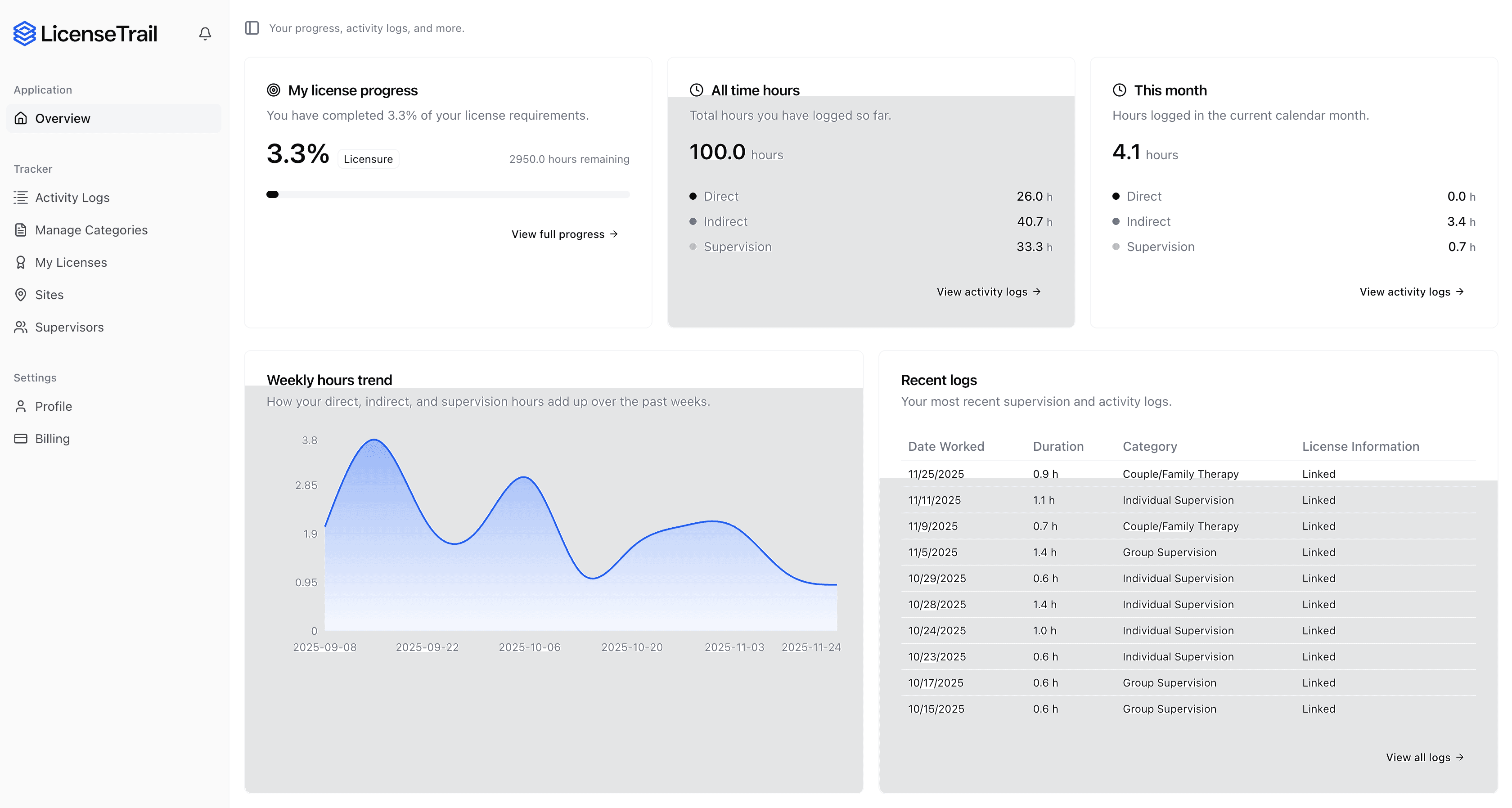
Track your POSTDOC TRAINING PERMIT hours with confidence
License Trail checks your direct, indirect, and supervision hours against Connecticut POSTDOC TRAINING PERMIT requirements continuously and flags mismatches before you submit.
 Start Tracking for Free
No credit card required · Free plan available
Related Licenses
Is your spreadsheet hiding Connecticut POSTDOC TRAINING PERMIT risks?
Stop guessing if your categories match Connecticut Board of Examiners of Psychologists requirements. License Trail checks your direct, indirect, and supervision hours continuously and flags mismatches before you submit.
Import or log
Bring your spreadsheet or start fresh
Upload your existing tracking spreadsheet and we'll map every hour into the right Connecticut Board of Examiners of Psychologists categories automatically.
Verify against Connecticut
Catch mismatches before the board does
License Trail checks your direct, indirect, and supervision hours against Connecticut POSTDOC TRAINING PERMIT requirements continuously.
Export board-ready
One-click clean reports
Generate professional, board-ready reports for supervision meetings and Connecticut Board of Examiners of Psychologists submissions in seconds.
No credit card required · Free plan available