
Delaware LBSW Requirements: Hours, Exams & Step-by-Step Guide
Stop guessing if your categories match Delaware requirements. License Trail checks your direct, indirect, and supervision hours against LBSW requirements continuously and flags mismatches before you submit.
No credit card required · Free plan available
Quick Requirements Overview
- Regulator: Delaware Board of Social Work Examiners (Title 24, Ch. 39)
- Education: BSW from a CSWE-accredited program (official transcript required)
- Exam: Pass Board-designated exam (ASWB Bachelors); max 6 attempts + possible 1 final by petition
- Hours (pre-licensure): No post-degree practice or supervision hours required (fieldwork is within BSW)
- Background/fitness: DE + FBI fingerprint checks; abuse registry checks; no disqualifying criminal/disciplinary history; fitness to practice required
- Apply via DELPROS; fee: $205 (nonrefundable)
- Renewal/CE: Biennial; 20 CE hours per cycle incl. 6 ethics + 1 mandatory reporting; expires Jan 31 of odd-numbered years
License Details
Procedures
Licensure at the bachelor’s level in Delaware is regulated by the Board of Social Work Examiners (historically referred to as the Board of Clinical Social Work Examiners). This license is called a Licensed Bachelor Social Worker (LBSW) in practice and a “baccalaureate social worker” in the Delaware statutes.
The key point for Delaware:
There is no post‑degree practice‑hour or supervision‑hour requirement to obtain an LBSW.
The only hour-based requirements that touch an LBSW license are (1) the field work built into your CSWE‑accredited BSW program, and (2) continuing education hours after you are licensed.
Below is a step‑by‑step guide built directly from Delaware’s statutes, regulations, and Board materials.
1. Official terminology and scope at the bachelor level
Delaware’s Title 24, Chapter 39 sets out the official definitions that govern LBSW practice.
“Baccalaureate social work”
The law defines baccalaureate social work as:
- The entry level of social work, and
- The application of social work theory, knowledge, methods, ethics, and professional use of self to restore or enhance social, psychosocial, or biopsychosocial functioning of individuals, couples, families, groups, organizations, and communities, and
- Explicitly states that **“baccalaureate social work” is generalist practice. (delcode.delaware.gov)
In other words, the LBSW is a generalist, non‑clinical license focused on assessment, case management, resource coordination, advocacy, and similar functions—not on independent clinical diagnosis or psychotherapy (those are reserved for LCSWs under the same chapter). (delcode.delaware.gov)
“Baccalaureate social worker”
A baccalaureate social worker is simply defined as an individual licensed to practice baccalaureate social work. (delcode.delaware.gov)
In practice, this is your LBSW license.
2. Core legal eligibility (applies to all social work licenses)
Before you can be licensed at any tier (baccalaureate, master’s, clinical), you must meet the general character and background requirements in 24 Del. C. § 3907(a). In summary, an LBSW applicant must: (delcode.delaware.gov)
-
Avoid disqualifying conduct or discipline
- You must not have engaged in acts that would be grounds for discipline under Delaware’s social work law.
- If you have ever been licensed elsewhere, each jurisdiction must send a statement about your disciplinary history.
-
Have acceptable criminal history
- You must not have been convicted of a felony sexual offense (no time limit).
- You must not have been convicted of a crime “substantially related” to social work unless granted a specific waiver by the Board under detailed criteria in state law. (delcode.delaware.gov)
-
Complete state and federal background checks
- Submit fingerprints and other information for:
- A Delaware criminal history report, and
- An FBI criminal history report, with the State Bureau of Identification as intermediary and the Board as the screening point. (delcode.delaware.gov)
- Submit fingerprints and other information for:
-
Meet fitness-to-practice requirements
- You must not have an impairment related to drugs, alcohol, or a finding of mental incompetence that would limit safe practice. (delcode.delaware.gov)
-
Abuse registry checks
- You must submit reports from child and adult abuse registries in Delaware and every other state where you have lived, worked, or been licensed as an adult. (delcode.delaware.gov)
-
Provide complete and truthful information
- All required information must be provided, and false or fraudulent applications may be referred to the Attorney General. (delcode.delaware.gov)
3. Education requirement for LBSW
Degree requirement
To become a baccalaureate social worker / LBSW, you must:
- “[Have] graduated and received a baccalaureate degree in social work from a program accredited by the Council on Social Work Education (CSWE) or its successor.” (delcode.delaware.gov)
This is written in 24 Del. C. § 3907(d)(2) and reiterated in the Board’s Bachelors/Masters Social Worker application instructions, which require an official transcript showing a BSW from a CSWE‑accredited program. (dpr.delaware.gov)
Embedded field hours
Delaware law does not restate a specific field-hour number, but because the degree must be CSWE‑accredited, you must complete the field education requirements of that accreditation. CSWE requires a minimum of 400 hours of supervised field education for BSW programs nationwide, and Delaware’s only in‑state BSW program notes a multi‑credit field practicum consistent with that standard. (publichealthonline.org)
Those hours are part of your degree, not a separate Board‑mandated post‑degree requirement.
4. Examination requirement
Delaware’s statute states that every licensure tier must pass an examination “designated” by the Board under § 3906(a)(3). For baccalaureate social workers, that designated exam is the ASWB Bachelors exam. (delcode.delaware.gov)
What the statute requires
For an LBSW, the law requires that you:
- “[Have] successfully passed an examination that the Board designated under § 3906(a)(3)” for the baccalaureate level. (delcode.delaware.gov)
The Board’s Bachelors/Masters page and external summaries confirm that this is the ASWB Bachelors exam, taken after the Board approves you to test. (dpr.delaware.gov)
Exam attempt limits (from regulations)
The Board’s regulations (24 DE Admin. Code 3900) state that: (archive.regulations.delaware.gov)
- You must obtain a passing score on the national exam approved by ASWB, and
- You have no more than six attempts. After six failures, you may petition the Board in writing for permission to take the exam one final time, which may be granted for good cause.
These limits apply generally and are part of the “licensure requirements for all applicants.”
5. Application process and fees
Step 1 – Create a DELPROS account
Delaware uses DELPROS (Delaware Professional Regulation Online Services) for all applications. On the Board’s site, you: (dpr.delaware.gov)
- Go to DELPROS.
- Register as a new user or link to an existing account.
- Choose the application for “Bachelors or Masters Social Worker” and designate that you are seeking baccalaureate licensure (LBSW).
Step 2 – Submit required documentation
For an LBSW, you must submit (or arrange submission of) through DELPROS: (dpr.delaware.gov)
- Application and fee
- The application fee for “Social Worker – BSW” is $205 and is non‑refundable. (dpr.delaware.gov)
- Official transcript
- An official transcript sent directly from your BSW program showing a CSWE‑accredited baccalaureate degree in social work. (dpr.delaware.gov)
- Criminal background check
- State of Delaware and FBI background checks done via IdentoGO using the Service Code listed on the Board’s Criminal Background Check Process page (checks done for other purposes do not count). (dpr.delaware.gov)
- Child Protection Registry Consent Form
- The Board’s Child Protection Registry Consent Form, completed and signed according to the instructions. (dpr.delaware.gov)
- License verifications (if applicable)
- If you have ever been licensed in another jurisdiction as a social worker, each jurisdiction must send official license verification directly to the Board. (dpr.delaware.gov)
- ASWB exam score
- For “examination” applicants, the Board will approve you to sit for the ASWB Bachelors exam and later receive your score directly from ASWB.
- For reciprocity applicants, ASWB must send an official score verification.
DELPROS distinguishes between documents you upload and “third‑party” documents (like transcripts and verifications) that must be sent directly to the Board and are “acknowledged” in the portal rather than uploaded. (dpr.delaware.gov)
6. Hour-based requirements specific to the LBSW
A. Practice/experience hours before LBSW licensure
There is no post‑degree practice‑hour or supervision‑hour requirement in Delaware law for the LBSW.
- The baccalaureate social worker subsection, § 3907(d), requires:
- Meeting the general criteria in § 3907(a);
- A CSWE‑accredited baccalaureate degree in social work;
- Passing the Board‑designated exam. (delcode.delaware.gov)
- Unlike the clinical social worker subsection, there is no language requiring a specified number of supervised practice hours, years of experience, or supervisory reference forms for LBSWs. (delcode.delaware.gov)
The only “experience” component is what is inherently part of a CSWE‑accredited BSW program (field education), which is embedded in your degree and not separately tracked by the Board.
B. Continuing education hours after you are licensed
While there are no pre‑licensure practice hours, ongoing continuing education (CE) hours are mandatory for LBSWs.
In the Board’s regulations (24 DE Admin. Code 3900, § 7.0) and NASW‑DE’s licensing FAQ: (archive.regulations.delaware.gov)
-
LBSW CE requirement:
- 20 hours of CE per biennial renewal period.
- Of those 20 hours:
- At least 6 hours must be in professional ethics.
- At least 1 hour must be in mandatory reporting.
-
Renewal timing:
- Licenses renew every two years, expiring January 31 of odd‑numbered years (e.g., January 31, 2025). (archive.regulations.delaware.gov)
The CE hours are prorated for your first renewal if you have been licensed for less than the full two‑year cycle at that point. (archive.regulations.delaware.gov)
7. How LBSW requirements compare to hour‑heavy licenses in Delaware
The example you gave (e.g., “1,500 hours of direct experience and 1,500 hours of supervised experience”) resembles the clinical model seen in some jurisdictions. Delaware handles this at the LCSW, not LBSW, level.
For contrast only:
- A Delaware Licensed Clinical Social Worker (LCSW) must:
- Hold an MSW or doctoral degree in social work. (delcode.delaware.gov)
- Complete 2 years of supervised experience acceptable to the Board after the degree, under a licensed clinical social worker (or if truly unavailable, a licensed psychologist or psychiatrist). (delcode.delaware.gov)
- Regulations flesh this out as not less than 3,200 hours of post‑degree supervised clinical social work experience over 2–5 years, with all hours under “professional supervision acceptable to the Board.” (archive.regulations.delaware.gov)
Delaware has no comparable numeric practice‑hour requirement for the LBSW. For LBSWs, once you meet the degree, background, and exam requirements, you can be licensed without logging a specified number of clinical or direct‑service hours under supervision beyond your BSW program’s fieldwork.
8. Summary checklist for Delaware LBSW (baccalaureate social worker)
Framed strictly in terms of what the Delaware Board of Social Work Examiners and Title 24, Chapter 39 require:
Before licensure
-
Degree
- BSW from a CSWE‑accredited program (baccalaureate in social work). (delcode.delaware.gov)
-
Background and fitness
- No disqualifying criminal or disciplinary history.
- State and FBI criminal background checks completed via the Board’s process.
- Child and adult abuse registry checks. (delcode.delaware.gov)
-
Application
- Submit LBSW application in DELPROS under “Bachelors or Masters Social Worker.”
- Pay $205 non‑refundable application fee for “Social Worker – BSW.” (dpr.delaware.gov)
-
Exam
- Obtain Board approval and pass the ASWB Bachelors examination, within the Board’s attempt limits. (dpr.delaware.gov)
-
Experience hours
- No Board‑mandated post‑degree practice or supervision hours are required for the LBSW license.
After licensure
-
Continuing education hours
- Every 2‑year renewal cycle (license expires January 31 of odd‑numbered years), complete:
- 20 total CE hours, including
- 6 hours ethics, and
- 1 hour mandatory reporting. (archive.regulations.delaware.gov)
- Every 2‑year renewal cycle (license expires January 31 of odd‑numbered years), complete:
-
Maintain good standing
- Continue to meet fitness, criminal history, and ethical practice requirements under Delaware law and Board regulations.
This is the full, state‑law‑based picture of what Delaware actually requires to become — and remain — a Licensed Bachelor Social Worker (LBSW).
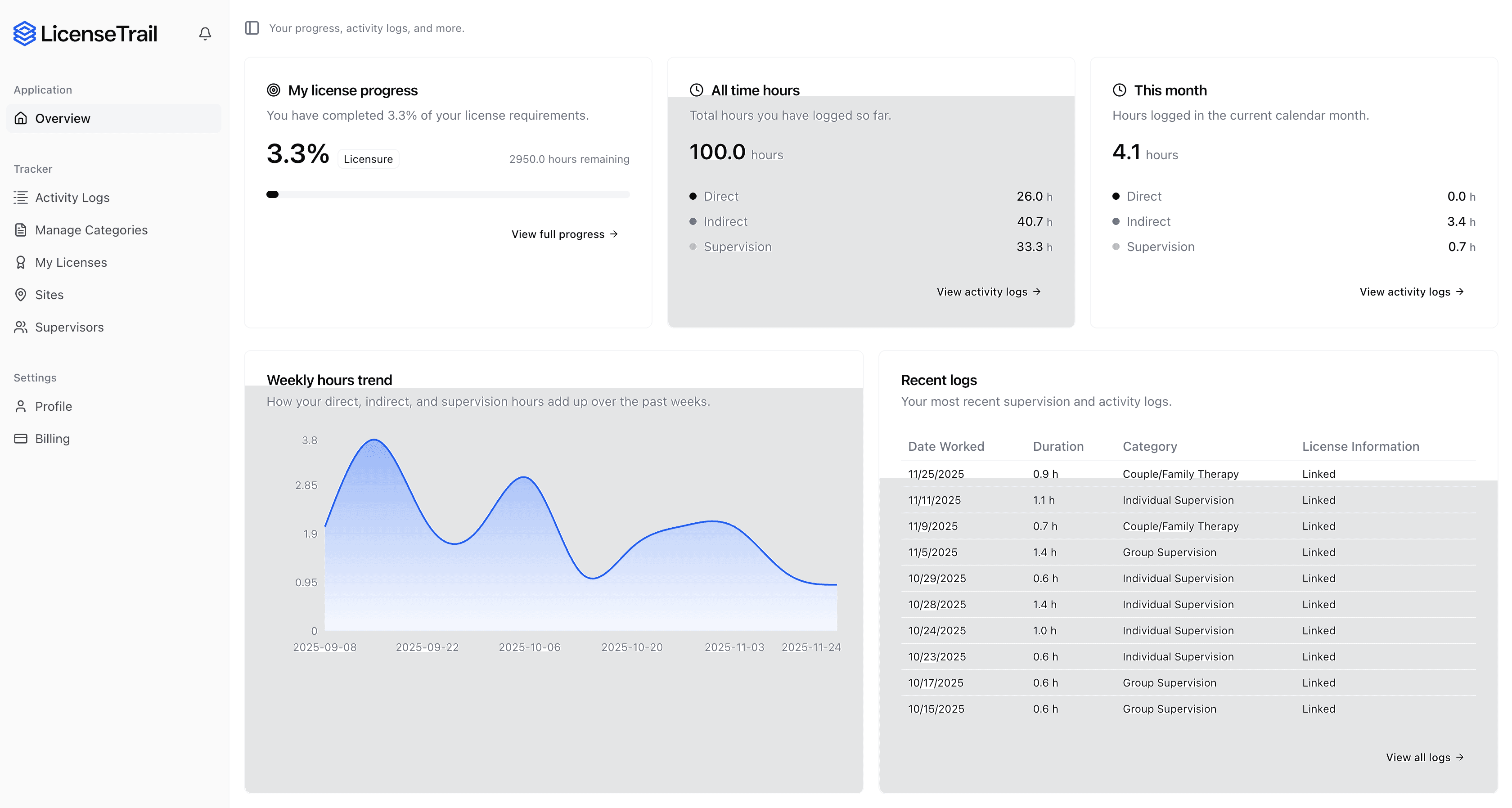
Track your LBSW hours with confidence
License Trail checks your direct, indirect, and supervision hours against Delaware LBSW requirements continuously and flags mismatches before you submit.
 Start Tracking for Free
No credit card required · Free plan available
Related Licenses
Is your spreadsheet hiding Delaware LBSW risks?
Stop guessing if your categories match Delaware Board of Clinical Social Work Examiners requirements. License Trail checks your direct, indirect, and supervision hours continuously and flags mismatches before you submit.
Import or log
Bring your spreadsheet or start fresh
Upload your existing tracking spreadsheet and we'll map every hour into the right Delaware Board of Clinical Social Work Examiners categories automatically.
Verify against Delaware
Catch mismatches before the board does
License Trail checks your direct, indirect, and supervision hours against Delaware LBSW requirements continuously.
Export board-ready
One-click clean reports
Generate professional, board-ready reports for supervision meetings and Delaware Board of Clinical Social Work Examiners submissions in seconds.
No credit card required · Free plan available