
District-of-columbia LMFT Requirements: Hours, Exams & Step-by-Step Guide
Stop guessing if your categories match District-of-columbia requirements. License Trail checks your direct, indirect, and supervision hours against LMFT requirements continuously and flags mismatches before you submit.
No credit card required · Free plan available
Quick Requirements Overview
- Qualifying degree: Master’s/Doctorate in MFT (or allied field deemed equivalent) with ≥60 semester hrs/90 quarter credits incl. ≥39 semester credits in specified content areas; practicum completed before postgrad hours
- Postgrad experience: ≥2 years full-time supervised clinical experience; must generally be completed within 5 years of graduation (good-cause exceptions)
- Total experience hours: ≥2,000 hours of supervised practice in marriage & family therapy
- Direct client contact: ≥1,000 hours face-to-face with couples/families for assessment & intervention (counts within the 2,000)
- Supervision hours: ≥200 hours MFT supervision, with ≥100 hours individual
- Supervision process: AAMFT-approved or Board-approved supervisor; monthly face-to-face supervisor meetings; 1 hr supervision per 20 hrs direct client contact
- Supervisor/setting rules: supervised work is unlicensed practice under supervisor responsibility (client informed/consent; supervisor co-signs); no direct client compensation (salary via employer allowed)
- Exam: must pass the Board-required MFT examination process before licensure issuance
License Details

Procedures
In the District of Columbia, becoming a Licensed Marriage and Family Therapist (LMFT) is governed by both the D.C. Code (statute) and the D.C. Municipal Regulations (DCMR), Title 17, Chapter 77 (Marriage and Family Therapy). Together, they set very specific education, experience, and supervision hour requirements. (code.dccouncil.gov)
Below is a structured, step‑by‑step outline focused on the types and amounts of hours you must accumulate, using the terminology defined by the District.
1. License type and governing authorities
- License: Licensed Marriage and Family Therapist (LMFT) – the sole MFT license type in D.C. (aamft.org)
- Regulatory framework:
- D.C. Code § 3‑1208.31 – “Qualifications for licensure” (statutory requirements). (code.dccouncil.gov)
- 17 DCMR Chapter 77 – Marriage and Family Therapy, especially § 7703 “Experiential Requirements”. (dcrules.elaws.us)
- Definitions section 17 DCMR § 7799 (e.g., “supervised clinical experience”). (dcrules.elaws.us)
As of mid‑2024, § 3‑1208.31 has been amended, and Chapter 77 is still the “latest version” on the DCMR site (last updated 2017), so these represent current law as of 2025. (code.dccouncil.gov)
2. Educational foundation (briefly)
The statute requires:
- A Master’s or Doctoral degree in marriage and family therapy from a recognized educational institution; or
- A graduate degree in an allied field with graduate‑level coursework “equivalent to a Master’s degree in marriage and family therapy,” as determined by the Board. (code.dccouncil.gov)
The “qualifying degree” must include at least 60 semester hours / 90 quarter credits, with a minimum of 39 semester credits distributed across specific content areas:
- Marriage and family studies (≥ 9 credits)
- Marriage and family therapy (≥ 9 credits)
- Human development (≥ 9 credits)
- Psychological and mental health competency (≥ 6 credits)
- Professional ethics and identity (≥ 3 credits)
- Research (≥ 3 credits) (code.dccouncil.gov)
This coursework and its practicum must be completed before you start counting the required post‑graduate supervised hours.
3. What “supervised clinical experience” means in D.C.
The D.C. Municipal Regulations define supervised clinical experience as:
Practice of marriage and family therapy by a graduate or first‑time applicant for a license, performed without a license and under supervision of an AAMFT‑approved supervisor or Board‑approved supervisor, to meet the experiential requirements of § 7703. (dcrules.elaws.us)
Key implications:
- You are an unlicensed marriage and family therapist for these hours (after you’ve completed the qualifying degree and practicum). (dcrules.elaws.us)
- You may not independently hold yourself out as an LMFT; you practice under supervision explicitly for the purpose of meeting licensure experience requirements.
- The work must be in the practice of marriage and family therapy (not just general counseling), consistent with your training.
4. Required duration and total supervised practice hours
4.1 Duration
Both statute and regulation require two (2) years of post‑graduate supervised clinical work:
- The Code: you must have “2 calendar years of work experience in marriage and family therapy under qualified supervision” following receipt of the qualifying degree. (code.dccouncil.gov)
- The regulations: you must complete “a minimum of two (2) years of full‑time post‑graduate supervised clinical experience … within five (5) years of graduation.” (dcrules.elaws.us)
So, in practice:
- Minimum duration: 2 years of supervised work after your qualifying degree and practicum.
- Time window: the 2 years / hours must normally be completed within 5 years of the degree and practicum, unless “good cause” is shown. (dcrules.elaws.us)
4.2 Total supervised practice hours
D.C. regulations are explicit on total hour counts. The 2‑year supervised experience:
- Must include at least 2,000 hours of “supervised practice in marriage and family therapy.” (dcrules.elaws.us)
In the D.C. board’s language, this is your “supervised practice in marriage and family therapy” and is the umbrella category of experience hours. Within these 2,000 hours, specific sub‑requirements apply (see next sections).
5. Direct client contact hours (face‑to‑face work)
Within the 2,000 hours of supervised practice, D.C. requires:
-
At least 1,000 hours of face‑to‑face direct client contact:
- The regulations require “a minimum of one thousand (1,000) hours of face‑to‑face direct client contact hours” as part of the supervised experience. (dcrules.elaws.us)
- The statute specifies that you must complete “at least 1000 hours of face‑to‑face contact with couples and families for the purpose of assessment and intervention.” (code.dccouncil.gov)
Practically, these two provisions together mean:
- You need 1,000 hours of direct client contact, and those hours must be face‑to‑face work with couples and families, focused on assessment and intervention in a marriage and family therapy framework.
- These hours are a subset of (and counted within) your 2,000 hours of supervised practice.
-
The regulations distinguish between direct client contact and other time:
- Only face‑to‑face clinical work with clients (couples/families and related systems work) counts toward the 1,000 “direct client contact” hours.
- The other ~1,000 hours (to reach the 2,000 total) can be other supervised marriage and family therapy activities (documentation, case conferences, indirect services, etc.), provided they are part of “supervised practice in marriage and family therapy” under the board’s standards. (dcrules.elaws.us)
6. Supervision hour requirements (content and structure)
D.C. separates supervised practice hours (Section 4–5 above) from supervision hours (time face‑to‑face with your supervisor about cases and your work).
6.1 Minimum supervision hours (from statute)
The Code requires:
- “200 hours of supervision of marriage and family therapy, at least 100 of which are individual supervision.” (code.dccouncil.gov)
This means:
- You need at least 200 hours of supervision that is specifically focused on your marriage and family therapy practice.
- At least 100 of those 200 hours must be “individual supervision” (one‑to‑one supervisor–supervisee), as opposed to group supervision.
6.2 Supervision structure (from regulations)
17 DCMR § 7703 adds process and ratio requirements:
- The experience must be under an AAMFT‑approved supervisor or a supervisor approved by the Board. (dcrules.elaws.us)
- Minimum frequency:
- The supervisor and supervisee must have at least monthly face‑to‑face discussions of the practice and related matters. (dcrules.elaws.us)
- Supervision ratio:
- “One (1) hour of direct supervisory contact shall be provided for every twenty (20) hours of direct client contact.” (dcrules.elaws.us)
How the ratio interacts with the statutory minimum:
- Because you must complete 1,000 hours of direct client contact, and the ratio is 1 supervision hour per 20 direct hours, the ratio itself implies at least 50 hours of direct supervisory contact tied specifically to those client hours.
- The Code’s 200‑hour supervision minimum sits above this; in practice supervisors often structure additional supervision activities (e.g., non‑case‑specific supervision, professional development, ethics review) so that your total supervision reaches or exceeds 200 hours, with at least half individual.
Thus, to satisfy both statute and regulations, your file should show:
- ≥ 200 hours total supervision,
- ≥ 100 hours individual supervision, and
- Supervision sessions scheduled often enough to meet both the monthly minimum and the 1:20 ratio for your 1,000 direct contact hours.
7. Supervisor qualifications and responsibilities
The regulations and definitions specify who may supervise and what that supervision entails:
-
Supervisors must be:
- AAMFT‑approved supervisors, or
- Supervisors approved by the Board who have:
- A valid license in marriage and family therapy, professional counseling, counseling psychology, psychiatry, or independent clinical social work in the jurisdiction of the supervised experience;
- At least 5 years of clinical experience working with couples and families;
- Adequate training/experience in supervision. (dcrules.elaws.us)
-
Supervisors must:
- Accept full responsibility for the supervisee’s practice and co‑sign notes, documents, and correspondence.
- Ensure that clients are informed that services are being provided under supervision and that they consent to this arrangement.
- Agree on the scope of supervision and experience with the supervisee before hours begin. (dcrules.elaws.us)
-
Compensation limitations during supervised experience:
- The supervisee “shall not receive compensation of any nature as a marriage and family therapist, either directly or indirectly, from a client,” except for salary from an employer based on hours worked under supervision. (dcrules.elaws.us)
This is intended to ensure you are clearly in a training / supervised clinical experience role, not functioning as an independent LMFT.
8. Summary of required hours in D.C. (LMFT)
Putting the numbers and terminology together:
-
Post‑graduate supervised practice (experiential requirement)
- At least 2 years of full‑time, post‑graduate supervised clinical experience in marriage and family therapy. (dcrules.elaws.us)
- Must normally be completed within 5 years of graduation/practicum. (dcrules.elaws.us)
- Total hours of supervised practice:
- ≥ 2,000 hours of supervised practice in marriage and family therapy. (dcrules.elaws.us)
-
Direct client contact requirement (within the 2,000 hours)
- ≥ 1,000 hours of face‑to‑face direct client contact,
- Specifically face‑to‑face contact with couples and families for assessment and intervention. (dcrules.elaws.us)
-
Supervision hours (distinct from practice hours)
- ≥ 200 hours of supervision of marriage and family therapy,
- Of which ≥ 100 hours must be individual supervision. (code.dccouncil.gov)
- Supervision must also satisfy:
- At least monthly face‑to‑face supervisor–supervisee meetings, and
- Ratio of 1 hour of direct supervisory contact for every 20 hours of direct client contact. (dcrules.elaws.us)
-
Supervisor and setting requirements
- Supervised work must qualify as “supervised clinical experience”: post‑degree, unlicensed practice of marriage and family therapy under an AAMFT‑approved or Board‑approved supervisor, in settings consistent with the practice of MFT. (dcrules.elaws.us)
9. Remaining steps: examination and application (high level)
Once education and all experiential/supervision requirements are met:
- You must “satisfactorily complete the examination process” required by the Board, which includes the national MFT exam approved for D.C. (code.dccouncil.gov)
- You then apply to the District (through DC Health, under the relevant Board) with documentation of:
- Qualifying degree and coursework,
- Supervised experience hours (2,000 practice / 1,000 direct client contact),
- Supervision hours (200 total / 100 individual), and
- Passing exam scores and any other items required by rule (e.g., background checks, fees).
In short, D.C. does not simply split hours into a generic “direct experience vs. supervised experience” bucket. Instead, it requires:
- 2,000 hours of supervised practice in marriage and family therapy,
- including 1,000 hours of face‑to‑face direct client contact with couples and families,
- plus 200 hours of supervision (at least 100 individual),
- all completed over at least two post‑graduate years and within approximately five years of graduation, under AAMFT‑approved or Board‑approved supervision. (dcrules.elaws.us)
Track your LMFT hours with confidence
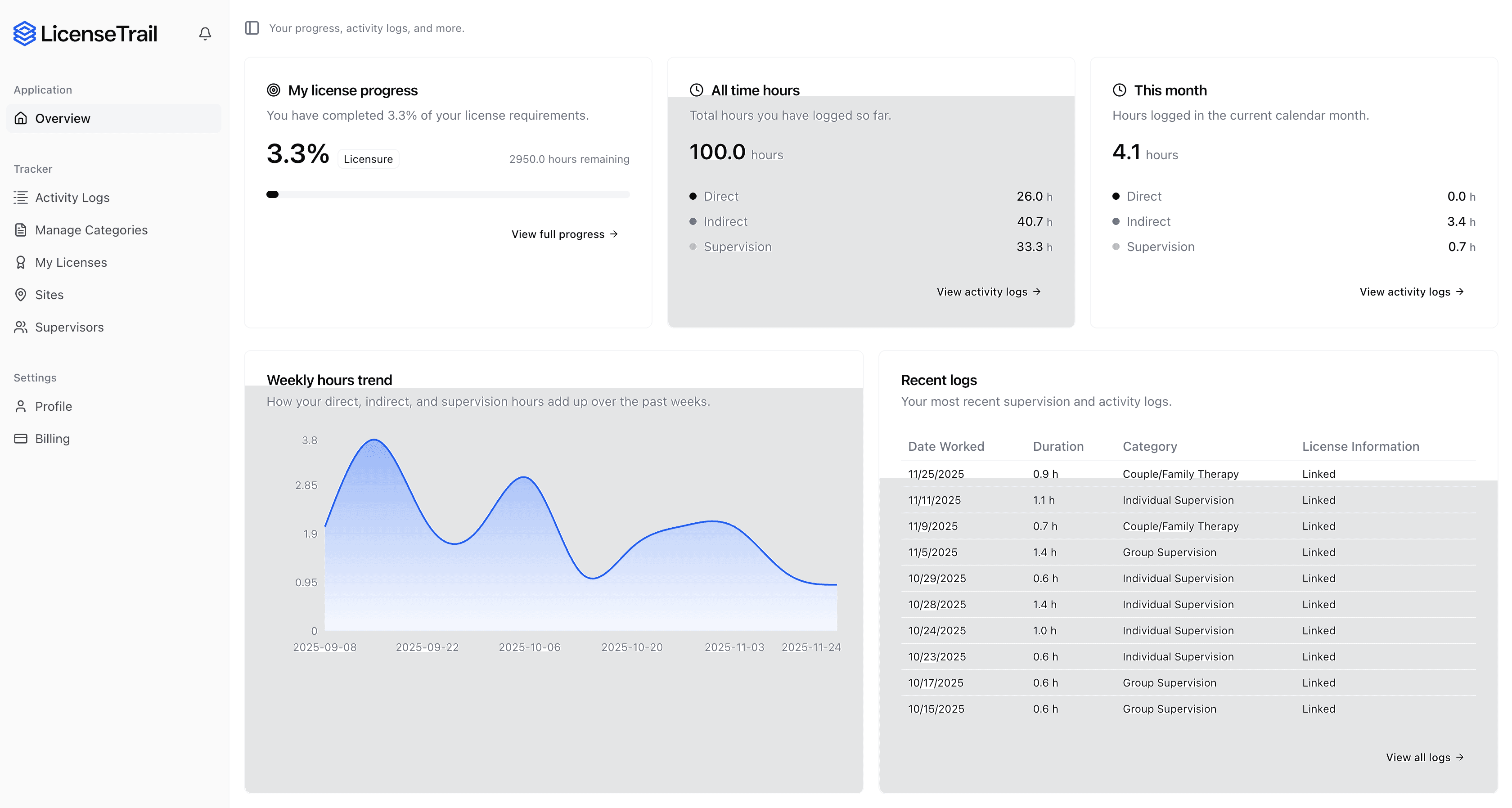
License Trail checks your direct, indirect, and supervision hours against District-of-columbia LMFT requirements continuously and flags mismatches before you submit.
 Start Tracking for Free
No credit card required · Free plan available
Is your spreadsheet hiding District-of-columbia LMFT risks?
Stop guessing if your categories match District of Columbia Board of Marriage and Family Therapy requirements. License Trail checks your direct, indirect, and supervision hours continuously and flags mismatches before you submit.
Import or log
Bring your spreadsheet or start fresh
Upload your existing tracking spreadsheet and we'll map every hour into the right District of Columbia Board of Marriage and Family Therapy categories automatically.
Verify against District-of-columbia
Catch mismatches before the board does
License Trail checks your direct, indirect, and supervision hours against District-of-columbia LMFT requirements continuously.
Export board-ready
One-click clean reports
Generate professional, board-ready reports for supervision meetings and District of Columbia Board of Marriage and Family Therapy submissions in seconds.
No credit card required · Free plan available